
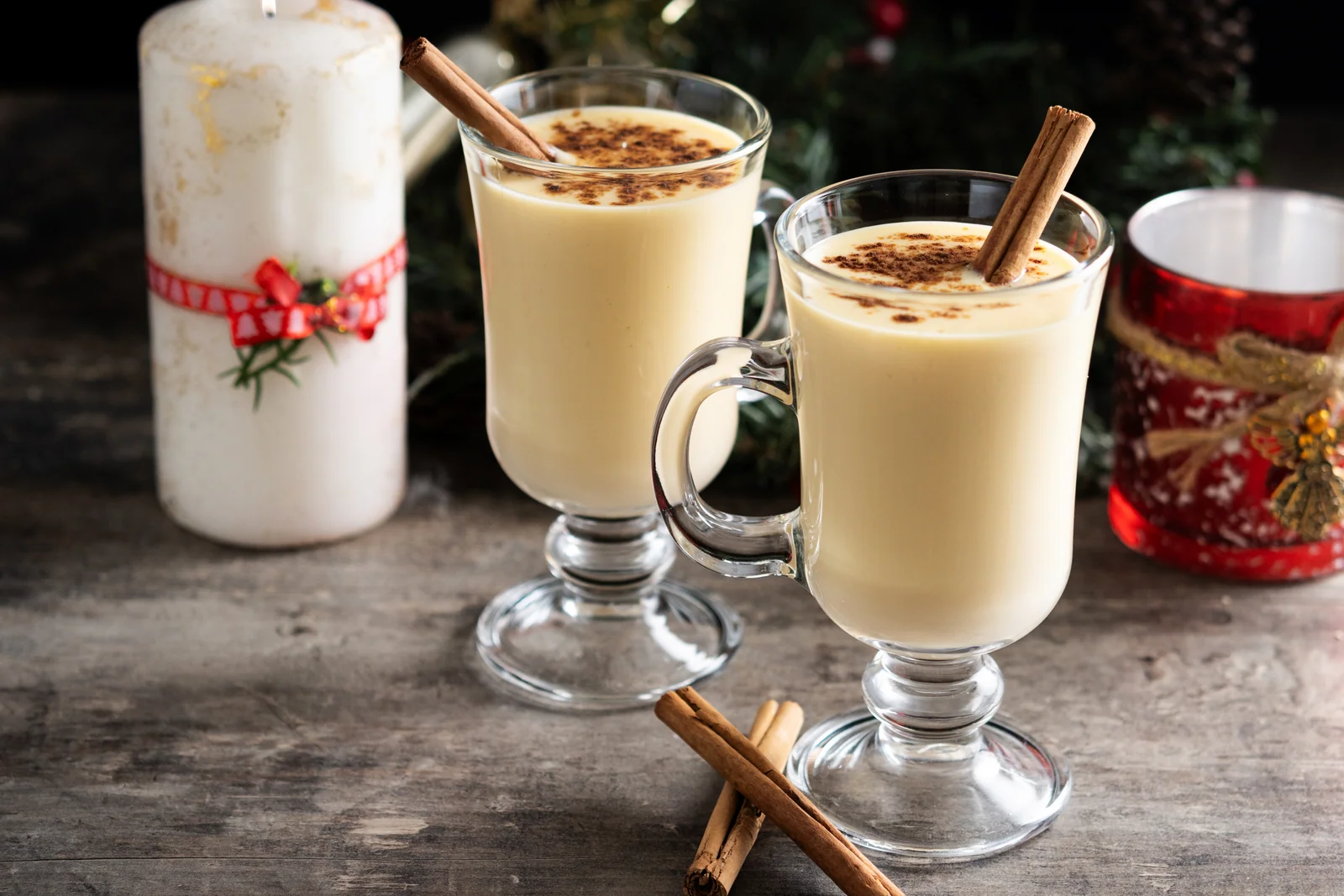

Rompope (rohm-POH-peh) is Mexico’s Christmas eggnog, and the difference from the carton in an American fridge starts in the pot: no cream and no whole eggs, just milk simmered down with sugar and a cinnamon stick, thickened with egg yolks and finished with rum or brandy. It’s poured cold into small glasses in December, and it goes lumpy for one reason, too much heat at the wrong moment. Below is the whole method with the two thermometer readings that keep it smooth, how much alcohol to add, a version for kids, and how long a bottle keeps.
Rompope vs eggnog, and what to expect
How do you make rompope? Simmer 1 liter (4¼ cups) of whole milk with 1 cup (200 g) of sugar, a cinnamon stick and ¼ tsp of baking soda until it’s down to about 3½ cups (850 ml). Let it cool to 140°F (60°C), temper 8 egg yolks with a cup of it, then cook everything, stirring, to 160°F (71°C). Strain, chill over ice, and stir in vanilla and ¾ cup (180 ml) of rum. 70 minutes for 15 servings.
If you know American eggnog, here’s how the two line up:
| Rompope (this recipe) | Typical American eggnog | |
|---|---|---|
| Eggs | Yolks only | Usually whole eggs, sometimes with whipped whites |
| Dairy | Whole milk, simmered and reduced | Milk plus heavy cream |
| Spice | Cinnamon and vanilla | Nutmeg, often vanilla |
| Spirit | Rum or brandy, in some homes cane spirit | Bourbon, rum or brandy |
| Texture | Pours like a thin custard sauce | Ranges from thin to very rich |
So if your idea of eggnog is thick and creamy, rompope will taste lighter and more of cooked milk and cinnamon. The baking soda is the odd one out for most English-speaking cooks: it keeps the milk from curdling as it reduces (more on that below). The drink is traditionally credited to the convents of Puebla in colonial times.
One batch makes about 4¾ cups (1.15 liters), fifteen 2½ fl oz (75 ml) glasses, at around 6% ABV, about the strength of a strong beer. 70 minutes to the bottle, about 10 of them stirring without walking away, then at least 4 hours in the fridge. Medium difficulty, and you do need an instant-read thermometer.
Two other Latin Christmas drinks on this site are close relatives. Venezuelan ponche crema is built on canned sweetened condensed and evaporated milk with lime zest and nutmeg, so it skips the reducing. Colombian sabajón uses fresh milk like rompope but is thickened with cornstarch and has to boil for a minute, and is usually spiked with anise-flavored aguardiente.
Ingredients and US and UK swaps
| Ingredient | Metric | US | Notes and swaps |
|---|---|---|---|
| Whole milk | 1 liter | 4¼ cups | Low-fat milk makes a thinner, less creamy drink |
| Granulated sugar | 200 g | 1 cup | |
| Egg yolks | 8 large, 136 g | 8 large, 4¾ oz | Save the whites for meringues |
| Cinnamon stick | 1 | 1 | Mexican (Ceylon) or the regular kind |
| Baking soda | 1 g | ¼ tsp | UK: bicarbonate of soda. Not baking powder |
| Vanilla extract | 5 ml | 1 tsp | |
| Rum or brandy, 40% ABV | 180 ml | ¾ cup | Or cold milk for the alcohol-free version |
Why baking soda. As milk reduces it gets more acidic, and acid is what makes milk proteins clump during a long simmer. A quarter teaspoon per liter neutralizes it and turns the milk a shade more golden. More than that and you can taste it, a soapy edge. Mexican cajeta, goat’s milk caramel, uses the same dose per liter for the same reason.
Yolks only. Whites set at a lower temperature than yolks and leave white strings; even a streak of white gives an eggy taste. Crack each egg over a small cup before adding the yolk to the bowl.
Want it spicier? Add 2 whole cloves with the cinnamon and fish them out with it.
Which alcohol, and how strong it comes out
Rum or brandy at 80 proof (40% ABV) is what most home cooks use. The convent tradition is tied to cane spirit, and some Mexican homes use aguardiente de caña. Whatever you pick, it goes in at the end, into cool rompope. For one batch:
| Spirit | Amount | Rompope ABV, approx. |
|---|---|---|
| None (cold milk instead) | ¾ cup (180 ml) | 0% |
| Rum or brandy, 80 proof, mild | ½ cup (120 ml) | 4% |
| Rum or brandy, 80 proof, as written | ¾ cup (180 ml) | 6% |
| Rum or brandy, 80 proof, strong | 1 cup + 1 tbsp (250 ml) | 8% |
| Cane aguardiente, 29% ABV | ¾ cup (180 ml) | 4.5% |
| 190-proof (96%) drinkable grain or cane spirit | 70 ml (scant ⅓ cup) | 6% |
The math: milliliters of spirit times its ABV, divided by the final volume. With 190-proof spirit, measure carefully, because 70 ml gives almost the same strength as ¾ cup of rum. More rum also makes a thinner rompope.
Equipment. A heavy 3 to 4 quart (3 to 4 liter) pot, a silicone spatula, an instant-read thermometer, a fine sieve, a measuring jug, a bowl of ice water, a funnel and glass bottles with lids. No fine sieve? A double layer of cheesecloth. Thin pot? Set it on a heat diffuser.
How to make rompope, step by step
Reduce the milk without a boil-over. Milk with sugar and baking soda foams up suddenly when it comes to the boil, which is why you want a big pot and medium, not high, heat. Once it foams, turn it down to a gentle simmer for about 20 minutes, stirring every couple of minutes so it doesn’t catch. The time depends on how wide your pot is, so go by volume: it’s ready at about 3½ cups (850 ml) in the jug. It turns ivory, a little darker than milk.
Let it cool to 140°F (60°C). This is where lumps come from. Milk straight off the boil cooks the yolks the moment they touch. With the pot in a sink of cold water it takes about 5 minutes.
Temper the yolks. Whisk them, then pour in 1 cup (240 ml) of the milk in a thin stream, whisking nonstop, and tip the lot back into the pot. The yolks warm up gradually instead of all at once.
Cook to 160°F (71°C). Medium-low heat, spatula always moving, sweeping the bottom and corners, where it sets first. It takes 5 to 8 minutes. Signs that go with that number:
- It steams hard but doesn’t bubble. Bubbles mean it’s gone too far.
- It coats the back of a spoon thinly, and a finger drawn through leaves a clean line.
- The foam on top disappears and the surface turns glossy.
The spoon test tells you it has thickened, not that it reached 160°F (71°C). That temperature is what makes it safe, and neither the rum nor the cold replaces it. With no thermometer, use pasteurized eggs and still cook until it coats the spoon. The pot keeps heating off the burner, so have the sieve ready before you get there.
Chill, then add the spirit. Strain straight away and stir over ice for 10 minutes. Add the rum once it’s at room temperature or colder; added hot, some of the alcohol and aroma cook off. Bottle and chill at least 4 hours. Cold, it should pour in a thick, steady ribbon, like a pouring custard. Separation in the bottle is normal; shake it.
Why rompope curdles, and other fixes
- Lumps when the yolks went in. The milk was too hot or poured in too fast. Strain, then blend 30 seconds; it comes out smooth.
- Curdled at the end. It went past 160°F (71°C), or the bottom heated without stirring. Same fix. Next time, lower heat and the sieve ready.
- Thin after chilling. The milk didn’t reduce enough or the custard didn’t reach 160°F (71°C). If you didn’t measure the temperature, don’t serve it. Once the rum is in, don’t reheat it; reduce to 3½ cups (850 ml) next time.
- Too thick. Loosen with cold whole milk 2 tbsp at a time.
- Tastes eggy. Some white got in with the yolks. Separate carefully and don’t skip the vanilla.
- Can’t taste the rum. It went in warm. Always cold.
- Soapy aftertaste. Too much baking soda. Level the ¼ tsp.
Non-alcoholic rompope, and who shouldn’t drink the spiked one
Rompope with rum is not for children or for anyone pregnant. The alcohol-free version is the same recipe with ¾ cup (180 ml) cold whole milk instead of the rum, added at the end the same way. To make both from one pot, split the cooled rompope in two before adding anything, stir 90 ml (6 tbsp) of rum into one half and 90 ml of milk into the other, and label the bottles, because they look identical.
For pregnant women, older people or anyone with a weakened immune system, make the alcohol-free version with pasteurized eggs, still cooked to 160°F (71°C).
Allergens. Contains eggs and milk. Gluten-free and nut-free, except the almond version.
Variations and bigger batches
- Almond rompope. Blend ½ cup (about 50 g / 1¾ oz) ground or blanched almonds with the cold milk before heating, and strain it out after reducing, when you remove the cinnamon. Thicker, with an almond flavor. Pecans or pine nuts work the same way.
- Stronger or milder. Use the ABV table and change nothing else.
- For 20 to 30 people. Double everything: 2 liters (8½ cups) milk, 400 g (2 cups) sugar, 16 yolks, ½ tsp baking soda and 360 ml (1½ cups) rum, in a 6 quart (6 liter) pot. Reduce to about 1.7 liters (7 cups), which takes longer; in a narrow pot, make two batches. You get about 2.3 liters (9¾ cups), 30 small glasses.
Make ahead, gifting and storage
Plan for Christmas Eve. A batch gives 15 small glasses, one or two each for 6 to 10 adults; double it for 12 to 20. Make it the afternoon of December 23, so it has chilled more than 12 hours by the 24th; leftovers last until the 26th or 27th. For New Year’s Eve, make a fresh batch on the 29th or 30th. A day or two before, check your thermometer in boiling water: it should read about 212°F (100°C) at sea level.
Gifting. Use 8 or 12 fl oz (250 or 375 ml) glass bottles boiled for 10 minutes, and label each with the date, “keep refrigerated, drink within 3 to 4 days” and “contains egg and alcohol”. It should reach the next fridge within 2 hours, so make it the day before you hand it over and don’t ship it. Store-bought rompope keeps for months because it’s made with a different, industrial process; homemade doesn’t.
Fridge. 3 to 4 days at 40°F (4°C) or below, like any cooked egg dish. I treat the spiked bottle the same: at 6% ABV, the alcohol doesn’t reliably stretch that.
Out of the fridge. 2 hours at most. At a long dinner, pour and put the bottle back.
Freezer. I don’t freeze it: the milk fat separates on thawing and it turns grainy.
Serving. Well chilled in 2 to 2½ fl oz (60 to 75 ml) glasses with a pinch of ground cinnamon. It belongs with the sweet side of a Mexican December: Mexican buñuelos with piloncillo syrup, Mexican polvorones, or poured cold over a slice of Mexican pan de elote. Before dinner, a lighter cold option for the same table is a pitcher of clericot, Mexico’s red wine and fruit punch. For a hot drink everyone can share, there’s Mexican Christmas punch, made with fruit and no eggs.
Frequently asked questions
Can I use regular (Cassia) cinnamon? Yes. Mexican cinnamon is softer and more floral, but one regular stick per 1 liter (4¼ cups) of milk works fine.
Can I skip the baking soda? It may still work, but the milk is more likely to curdle during the 20-minute simmer. It’s ¼ tsp; keep it.
Can I make it with whole eggs to use them up? Not with this method. The whites set before the yolks and leave strands, and the color goes pale.
Can I use oat or almond milk? I haven’t tested it, and plant milks behave differently when reduced, so I can’t promise the same thickness.
Nutrition
Per 2½ fl oz (75 ml) glass (1/15 of the batch), worked out ingredient by ingredient from the quantities above:
- Calories: 150 kcal
- Protein: 4 g
- Carbohydrates: 17 g, of which 17 g sugars
- Fat: 5 g, of which 2 g saturated
- Fiber: 0 g
- Sodium: 56 mg
About 26 kcal of each glass comes from the rum. The alcohol-free version is about 131 kcal a glass.
The Christmas bottle in my house has always been ponche crema; rompope came later, when I wanted an egg liqueur that didn’t depend on cans. What I like is that with fresh milk I set the thickness myself, reducing a little more or a little less. Dylan gets his own bottle without rum, with his name on the label. Josnaisis.