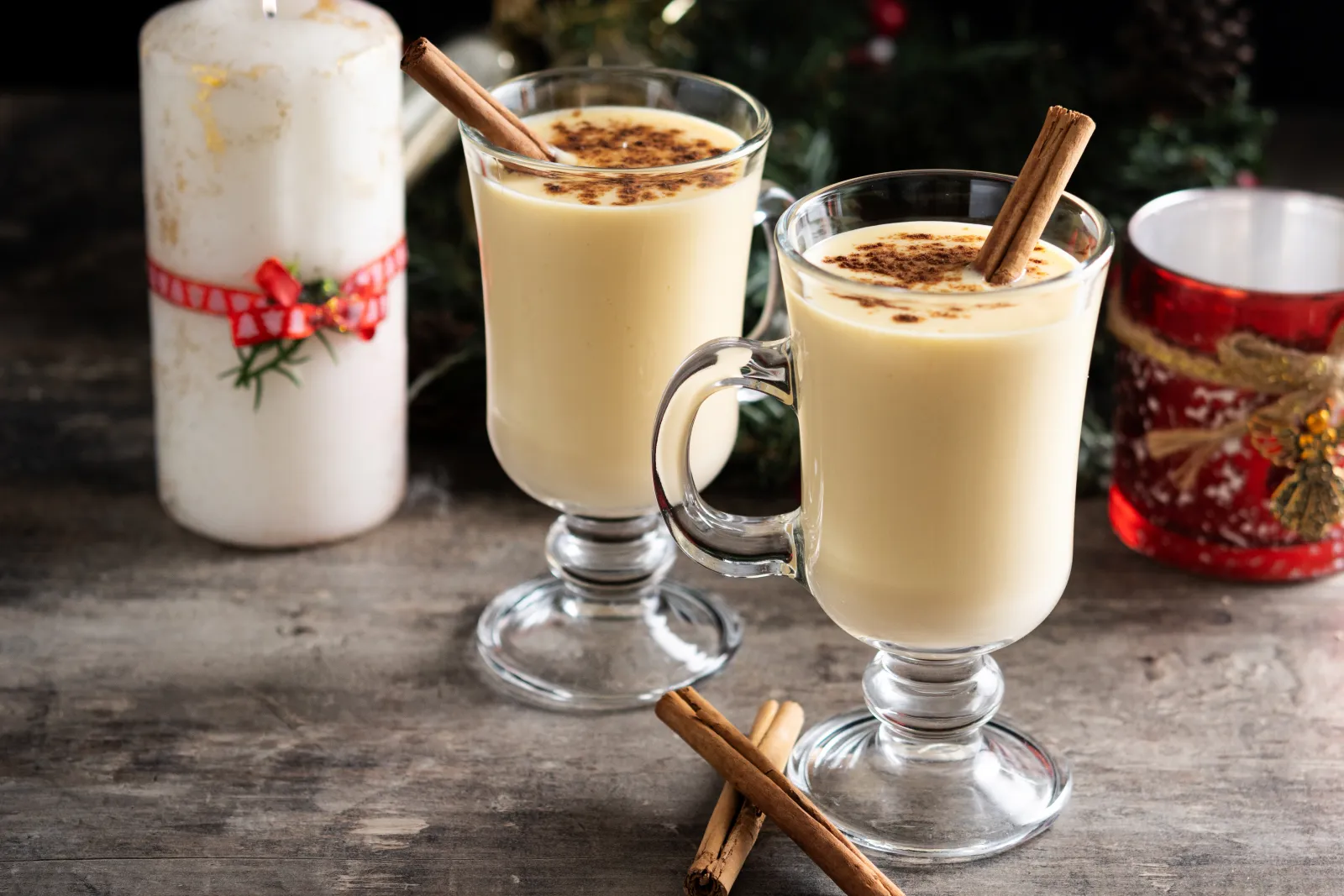

Sabajón (sah-bah-HONE) is the cold, thick holiday drink Colombians pour in small glasses through December, next to fritters and custard: whole milk, sugar, egg yolks and cinnamon, cooked into a pourable custard and spiked with aguardiente, the country’s anise-flavored cane spirit. Think eggnog with a hint of licorice and a body closer to melted pudding. The catch is the cornstarch that gives it that body. Pull the pot off the stove too early and the bottle you put in the fridge thick comes out thin, and the fix is one extra minute of boiling.
What is sabajón, and how is it different from eggnog?
How do you make Colombian sabajón? Heat 3 cups (750 ml) of whole milk with 1 cup (200 g) of sugar and a cinnamon stick. Temper 6 yolks whisked with 1 cup (250 ml) of cold milk and 2 tbsp (16 g) of cornstarch, return them to the pan and stir until it boils, then 1 minute more. Strain, chill in an ice bath and add 1¼ cups (300 ml) of aguardiente. 50 minutes for 20 servings.
It’s a cooked custard drink, bottled a day ahead and served cold, never warm. Compared with the eggnog you may know, three things stand out.
It’s thickened with cornstarch. That’s what lets a sabajón with only 6 yolks per liter pour like a thin custard, and it’s why the base has to boil (more on that below). It uses yolks only, no whole eggs and no cream. And the spirit tastes of anise: Colombian aguardiente is sweet and licorice-scented, which sets it apart from bourbon or rum.
If you know Venezuelan ponche crema, sabajón is its neighbor across the border. Both use only yolks; ponche crema leans on canned condensed and evaporated milk, needs no starch and comes off the heat at 160°F (71°C), and it takes rum. Sabajón starts from fresh milk and cornstarch, boils, and takes aguardiente.
Is sabajón worth making, and who is it for?
Yes, if you want a gentle, creamy holiday drink and can spare 50 minutes the day before. One batch gives about 1.5 liters (6⅓ cups), two 750 ml bottles, or 20 small glasses. With aguardiente it lands around 6% ABV, lighter than a glass of wine, and the same pot can make a milk-only bottle for the kids.
Skip the spiked version for pregnant guests, older adults and anyone with a weakened immune system. Give them the milk version, cooked the same way; the FDA also advises pasteurized eggs for higher-risk people drinking homemade eggnog.
It’s the wrong project if you want a bottle that keeps for weeks. Homemade sabajón lasts 3 to 4 days in the fridge.
Time and difficulty. 50 minutes to the bottle, about 25 of them hands-on, then at least 4 hours cold. I rate it medium: tempering the yolks and holding the boil without scorching are the two moments that need your eyes.
Ingredients, with US and UK swaps
Exact amounts are in the recipe card. Milk, sugar, eggs, cornstarch, cinnamon and vanilla are on any supermarket shelf; the spirit is the only thing to hunt for.
| Ingredient | What it does | If you can’t find it | What changes |
|---|---|---|---|
| Aguardiente, 58 proof (29% ABV) | sweet anise flavor, about 5.8% ABV in the finished drink | 80-proof rum, 1¼ cups (300 ml) | about 8% ABV, more vanilla, no anise |
| Aguardiente | same | brandy; EU brandy is at least 36% ABV | about 7.2% ABV at 36%, fruity |
| Cornstarch (US) | thickens to pourable custard | cornflour (UK name, same product) | nothing |
| Cornstarch | same | potato starch, same weight | slightly stretchier body |
| Whole milk | the base | lactose-free whole milk | in my kitchen it thickens the same |
| Granulated sugar | sweetness | caster sugar (UK) | nothing |
Where to buy aguardiente. In the US, Aguardiente Antioqueño, the best-known brand, is stocked by large liquor stores and Latin markets; its traditional bottle is about 29% ABV, according to the Colombian business outlet Valora Analitik. In the UK, look at specialist online spirits shops. If you can’t find any, I’d rather use rum than leave the drink plain, and simmering one star anise pod in the milk with the cinnamon brings back some of the licorice note.
Equipment. A heavy 3 quart (3 liter) saucepan, a silicone spatula, a whisk, a fine-mesh sieve, a big bowl of ice water, a funnel and two 750 ml (25 fl oz) bottles with caps. A thermometer is nice to have, but here the cue is visible: fat bubbles that keep breaking on the surface for a full minute.
Why the base goes past 160°F to a boil
The safety number for eggs is 160°F (71°C): it’s what the FDA’s homemade eggnog recipe asks for, the same point it sets for custards, and the agency warns you can’t count on alcohol to kill all the bacteria. Sabajón needs more than that, for texture. Egg yolks carry amylase, an enzyme that digests starch and isn’t switched off until roughly 176°F (80°C). Harold McGee explains it in On Food and Cooking for pastry cream, which is why that cream is brought to a boil. Pull the base early and it looks thick in the pan, then thins in the fridge overnight.
Altitude moves the boiling point. In Denver, about 5,000 feet up, water boils near 203°F (95°C), still well past the enzyme’s limit. That’s why the cue to trust anywhere is the bubbles, not a number. The starch also protects the yolks, so a cornstarch custard can boil without curdling where a plain egg custard would split.
Make-ahead plan for Christmas Eve and New Year’s
- December 22. Buy milk, eggs and the spirit; wash the bottles.
- December 23, afternoon. Make the batch and refrigerate. By the 24th it has had 12+ hours to chill and thicken.
- December 24. Shake and pour. Leftovers are good until the 26th or 27th.
- New Year’s Eve. Make a fresh batch on the 29th or 30th.
Scaling. For 6 adults, one batch is about 3 small glasses each. For 12 to 20 guests, double it in a 4 quart (4 liter) pot: 2 liters (8½ cups) milk, 400 g (2 cups) sugar, 12 yolks, 32 g (4 tbsp) cornstarch and 600 ml (2½ cups) aguardiente, for four bottles. It takes about 5 extra minutes to reach the boil. If kids are coming, make one batch with milk instead of spirit.
Signs it’s going right.
| Stage | What you should see |
|---|---|
| Yolks, starch and cold milk | smooth and yellow, no white specks of starch at the bottom |
| Milk with sugar, first boil | foam climbing the sides; smells of cinnamon after 5 minutes |
| Tempering | yolk mix turns paler and warm, no strands |
| 6 to 8 minutes after tempering | coats the spatula; the bottom feels heavier as you stir |
| The finish | slow, fat bubbles breaking on top; count 1 minute from here |
| After 4 hours cold | pours in a steady ribbon and leaves a film on the glass |
How strong is it, and the version for kids
With 1¼ cups (300 ml) of 29% aguardiente in about 1.5 liters, sabajón comes out near 5.8% ABV. The math: milliliters of spirit × its strength ÷ total volume. With 80-proof rum it’s about 8%; with a 36% brandy, about 7.2%; with Antioqueño’s sugar-free line, which its maker sells at 24% according to Medellín’s public broadcaster Telemedellín, about 4.8%. Want it stronger? 450 ml (scant 2 cups) of aguardiente brings it to about 7.9%, and a little thinner.
For kids, replace the spirit with 1¼ cups (300 ml) of cold whole milk: zero alcohol, same cinnamon and vanilla. Label that bottle, because the two look identical.
Allergens. Egg and milk. Pure cornstarch is gluten-free, but check the label for anyone with celiac disease, and check the spirit if it’s flavored. Spice level, 0 out of 5.
Mistakes that ruin sabajón, and the fixes
- Thick in the pan, thin the next day → it never boiled, and the yolk amylase ate the starch. Back into the pan, boil 1 minute while stirring, cool, and add a splash more spirit.
- Lumps or strands → the yolks went into hot milk too fast, or the bottom caught. Strain, then blend for 30 seconds.
- Tastes floury → the starch didn’t cook through. Same fix: another minute at a boil.
- Eggy smell → white or the chalaza stayed with the yolks. Separate one at a time and always strain.
- Can’t taste the aguardiente → it went into a hot base and some evaporated. Always cool first.
- Separates in the bottle → normal after a day. Shake before serving.
What to do with the 6 leftover egg whites
Each batch leaves 6 whites, about 198 g (7 oz). The USDA FSIS egg storage chart gives raw whites 2 to 4 days in the fridge and 12 months in the freezer; freeze them in a labeled jar. I whisk two of them in place of one whole egg into a pot of Colombian egg soup, where the egg goes in as fine ribbons, or fold them into the eggs for a breakfast scramble on the 25th.
Variations
- With condensed milk → many Colombian homes add a 14 oz (397 g) can and cut the sugar to 50 g (¼ cup). Denser, with a cooked-milk flavor that edges toward ponche crema.
- With rum → 1¼ cups (300 ml) of 80-proof rum, about 8% ABV. Less anise, more vanilla.
- Lactose-free → lactose-free whole milk, same amount.
- For gifting → the standard batch in four 375 ml (12.7 fl oz) bottles.
What it costs to make
The BLS tracks three of these ingredients. At the US city average for August 2026, 1 liter of whole milk costs $1.12 ($4.229 a gallon), 6 large Grade A eggs $1.14 ($2.272 a dozen) and 200 g of sugar $0.45 ($1.024 a pound).
That’s $2.71 for the grocery part, about 14 cents a glass before the spirit; the milk for the kids’ batch adds $0.34. The batch uses 300 ml of a 750 ml bottle, 40% of it, and the spirit is where the price swings from brand to brand. I found no comparable official price series for the UK, so I’m not giving a pound figure.
Yield. About 1.5 liters (6⅓ cups), two 750 ml bottles, 20 glasses of 2.5 fl oz (75 ml), or 10 if you pour 5 fl oz (150 ml).
How to serve it, and how long it keeps
Flavor and texture. Sweet, cinnamon and vanilla first, anise at the finish. Cold, it has the body of a loose custard, lighter than ponche crema because it starts from fresh milk rather than cans.
Serving. Very cold, in 2 to 2.5 fl oz (60 to 75 ml) glasses, with a pinch of ground cinnamon. In December it sits next to Colombian buñuelos and a slab of Colombian natilla, and after a Colombian lechona it works as dessert. Kids who skip it will happily take a mug of Colombian hot chocolate the next morning.
Fridge life. 3 to 4 days at 40°F (4°C) or below, the FDA’s window for leftover cooked egg dishes. There’s no official figure for homemade eggnog with spirit, and the alcohol isn’t a reliable preservative, so I hold the spiked bottle to the same 3 to 4 days.
Out of the fridge. 2 hours at most, or 1 hour above 90°F (32°C), per the USDA FSIS rule for perishables. Pour a round and put the bottle back.
Freezing. There’s no official guidance for this mix and I don’t freeze it: the starch weeps water on thawing and it turns grainy.
Gifting. A sterilized, chilled bottle with a label that says the date you made it, “keep refrigerated”, “drink within 3 to 4 days” and “contains egg, milk and alcohol”. It should reach another fridge within 2 hours, in a cooler with ice for longer trips. To give it on the 24th, make it on the 22nd or 23rd.
Sabajón FAQ
How long does homemade sabajón last? 3 to 4 days in the fridge at 40°F (4°C) or below, the FDA’s window for cooked egg dishes. The alcohol doesn’t reliably extend it.
Why did my sabajón get thin overnight? The base didn’t boil. Yolk amylase digests the cornstarch unless the base gets past about 176°F (80°C). Boil it again for 1 minute and re-chill.
What does aguardiente taste like, and what can I use instead? Sweet and anise-flavored, around 29% ABV for the traditional Antioqueño. Rum or brandy work; a star anise pod in the milk brings back some of the licorice note.
Is sabajón the same as eggnog? Same family, different build: yolks only, no cream, thickened with cornstarch and spiked with an anise spirit.
Can I make it without alcohol? Yes. Swap the 1¼ cups (300 ml) of spirit for the same amount of cold whole milk.
Can I skip cooking the eggs? I wouldn’t. The FDA asks for 160°F (71°C) in egg mixtures and says alcohol won’t kill all the bacteria, and uncooked cornstarch won’t thicken anyway.
Nutrition per glass
Per 2.5 fl oz (75 ml) glass, 1/20 of the batch, calculated ingredient by ingredient from USDA FoodData Central (SR Legacy) with the amounts in this recipe:
- Calories: 113 kcal
- Protein: 2 g
- Carbohydrates: 13 g, of which 13 g sugars
- Fat: 3 g, of which 1 g saturated
- Fiber: 0 g
- Sodium: 25 mg
About 24 kcal per glass come from the aguardiente’s alcohol; the spirit’s own sugar isn’t declared on the label and isn’t counted. The milk-only version comes to about 99 kcal a glass, and the rum version about 123.
The licorice in a cold glass of milk caught me off guard the first December I spent in Colombia; at home in Venezuela the holiday bottle was rum and condensed milk. These days I make both drinks the same weekend and set them side by side, and nobody at my table has ever had to choose just one. Josnaisis.