
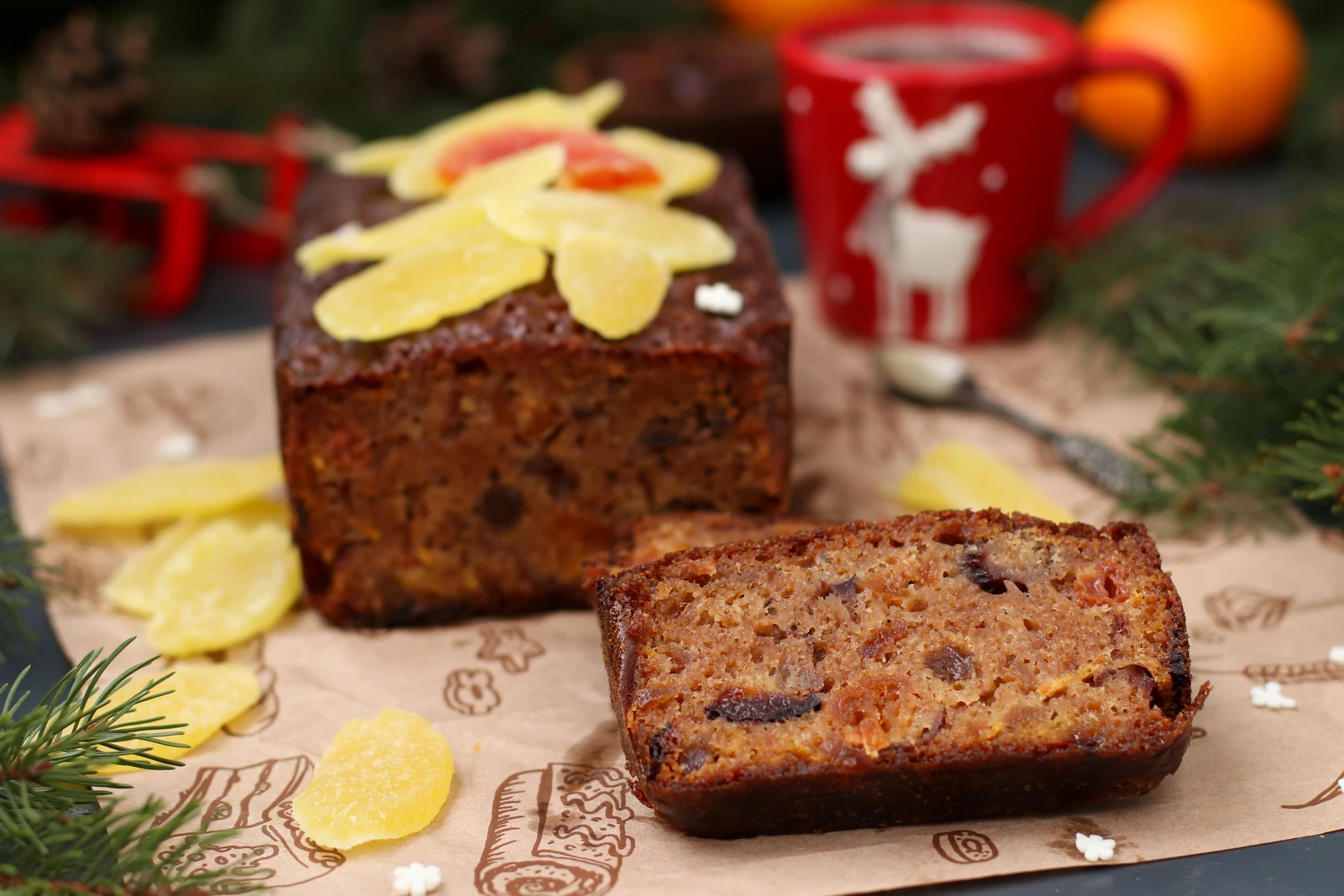

Torta negra (TOR-tah NEH-grah) is Colombia’s black cake: a dense, nearly black fruit cake that shows up at Christmas, weddings and birthdays, and that many Colombians also call torta de vino, wine cake. What sets it apart is the liquor. Raisins and prunes soak in ¾ cup (180 ml) of sweet red wine with a splash of rum, the batter gets chopped figs in syrup, and the hot cake is soaked in another ½ cup (120 ml) of wine. The black color comes from a burnt sugar syrup made with panela, Colombian unrefined cane sugar. Below: the full recipe for one 9-inch cake, how long to soak, how to burn the sugar without making the cake bitter, and how to keep it for weeks.
What Colombian black cake tastes like, and how long it takes
How do you make Colombian black cake? Soak 300 g (2 cups) of raisins and prunes in ¾ cup (180 ml) sweet red wine and ¼ cup (60 ml) rum for at least 3 days. Burn 100 g (3½ oz) panela to dark mahogany, loosen it with 6 tbsp boiling water, and beat it into a butter cake batter with 5 eggs, spices, the fruit, figs and nuts. Bake at 300°F (150°C) for 100 to 120 minutes and soak with ½ cup (120 ml) wine. 150 minutes for 20 servings.
Expect something closer to a firm pudding than a sponge: moist, tight-crumbed, sweet with wine and prunes, with a faint bitter edge from the burnt sugar. You cut it in thin slices, about 3 oz (85 g) each.
Time. 150 minutes on baking day, about 40 of them hands-on. Before that, 3 days to 2 weeks of soaking; after it, at least 3 days wrapped before you cut it. Medium difficulty: the burnt sugar and the oven are the two places it goes wrong.
Colombian black cake vs Caribbean black cake vs fruitcake
All three are dark holiday cakes with dried fruit and alcohol, and they get mixed up.
| Colombian torta negra | Caribbean black cake | British Christmas cake / US fruitcake | |
|---|---|---|---|
| Main liquor | Sweet red wine, a little rum | Rum with port or cherry brandy | Brandy, sherry or bourbon |
| Fruit | Raisins, prunes and figs in syrup, in pieces | Ground to a paste, soaked weeks to months | Mixed dried and candied fruit, in pieces |
| Color | Burnt panela syrup | Browning (burnt sugar) | Light to medium brown |
| After baking | Soaked with wine, fed weekly | Soaked with rum | Fed with spirits; UK often marzipan and icing |
Caribbean black cake also bakes lower, around 275°F (135°C), because the fruit paste makes it denser still. So if you love Caribbean black cake, this one is less boozy and fruitier in texture, because the fruit stays in chunks. If you grew up with fruitcake, it has more batter, no candied peel bitterness and a darker, caramel flavor. The Venezuelan black cake is its closest cousin: it leans on rum instead of wine and gets its color from a white sugar caramel.
Ingredients, and what to buy in a US or UK supermarket
The amounts are in the recipe card. Two of them need explaining outside Colombia.
Panela is cane juice boiled down to a solid block, sold as piloncillo in the Latin aisle in the US and as panela or jaggery in the UK. Grate it with a box grater. Dark brown sugar (UK dark muscovado) makes almost the same burnt sugar syrup. Molasses or UK black treacle, 3 tbsp stirred into the batter, is the no-cook shortcut: it darkens the cake but tastes more of licorice than of toasted cane sugar.
Brevas caladas are green figs simmered in cane sugar syrup until soft and dark, the same fruit as in Colombian figs in syrup. Outside Latin stores, dried figs are the best stand-in: firmer and less sweet. Soak them with the raisins.
| Colombian ingredient | US swap | UK swap | What changes |
|---|---|---|---|
| Sweet red wine (Sansón, moscatel) | Ruby port | Ruby port or Pedro Ximénez | PX is sweeter and darker |
| Panela | Piloncillo or dark brown sugar | Dark muscovado or jaggery | Almost nothing |
| Brevas caladas | Canned figs in syrup or dried figs | Dried figs | Dried figs are chewier |
| Dark rum | Dark rum or brandy | Dark rum or brandy | Brandy is a little drier |
A dry red wine is not a good swap. The cake comes out sour and thin-tasting; if it’s all you have, dissolve 2 tbsp grated panela or brown sugar in the wine for the bath.
Equipment. A 9 in (22 cm) round pan at least 3 in (7.5 cm) deep, a stand or hand mixer, a heavy saucepan, parchment and, ideally, an instant-read thermometer. An 8 in (20 cm) deep pan works too, but takes longer, so go by the skewer or the center temperature.
How long to soak the fruit
- Best, 1 to 2 weeks. The fruit swells, shines and tastes of wine right through. Beyond a month I can’t taste a difference.
- Minimum I’d recommend, 3 days, in a closed jar somewhere cool, shaken every couple of days.
- In a hurry, 24 hours in the fridge. The cake is good, just fruitier and less winey. The wine bath after baking and 3 days of rest make up a lot of it.
The burnt sugar syrup, without the bitterness
This is the step that turns a brown cake black. Melt the grated panela over medium-low heat and don’t stir, just swirl. It bubbles pale, then goes amber, then mahogany, and after 8 to 10 minutes you reach the point: very dark mahogany, a toasted caramel smell and the first thin wisp of smoke. On a thermometer that’s around 350 to 355°F (175 to 180°C).
Black is only seconds away and the hot pan keeps cooking it, so the boiling water goes in at once, slowly, arm stretched out. Two more minutes over the heat dissolves any lumps and leaves a little under ⅔ cup (150 ml) of syrup the color of strong coffee. Let it cool before it meets the butter.
If the smoke turns thick and it smells burnt, throw it out and start again. That bitterness goes straight into the cake and nothing fixes it.
Baking, testing and the wine bath
300°F (150°C) is the whole trick. At 350°F (175°C) the crust burns before the dense center sets. Around the 60-minute mark the top is dry and may crack; if it’s getting very dark, lay foil over it.
It’s ready at 100 to 120 minutes, when a skewer in the center comes out with moist crumbs but no wet batter, or the center reads 205 to 210°F (96 to 99°C), and the edges are pulling away from the paper. If your oven runs hot, start checking at 90 minutes.
Twenty minutes out of the oven, still warm in its pan, poke it all over and spoon the wine over slowly, letting each spoonful sink in. That’s what makes it a torta envinada, wine-soaked from the middle out rather than just damp on top.
Make-ahead plan for Christmas
- 3 to 4 weeks before: start the fruit soaking.
- 2 to 3 weeks before: bake and give it the wine bath.
- Once a week until 2 days before: unwrap, brush on 1 tbsp (15 ml) wine, rewrap.
- On the day: unwrap and slice ⅝ in (1.5 cm) thick with a serrated knife.
Running late? Soak the fruit for 24 hours and bake at least 3 days ahead. For a party of 40, bake two cakes rather than one double cake in a big pan; the center takes so long the edges dry out.
Mistakes that ruin it
- Bitter. The burnt sugar went black. No fix once baked; pull it at the first wisp next time.
- Burnt crust, raw middle. Oven too hot or pan not lined. 300°F (150°C), double parchment, foil if needed.
- Fruit sank. It wasn’t tossed in flour, or soaking liquid went into the batter. Drain it well.
- Pale, milky-coffee color. Not enough burnt sugar, or it was pulled while still amber.
- Crumbles when sliced. Cut before 3 days, or unmolded hot.
- Dry. Overbaked or not soaked. Brush on 1 tbsp wine, wrap, wait 2 days.
- Mold. Stored somewhere warm or damp. Throw the whole cake away.
Is there alcohol in it? Kids and an alcohol-free version
Yes. Baking drives off only part of the alcohol in the soaked fruit, and the wine bath and weekly brushing aren’t cooked at all. With an 18% sweet wine and three brushings, I work it out at about 2 ml of pure alcohol per slice, against 18 ml in a 1½ oz (45 ml) shot of rum. Not much, but not zero, so for children, pregnancy or anyone avoiding alcohol I make it this way:
Alcohol-free. Soak the fruit in dark grape juice or orange juice, in the fridge, for no more than 3 days, and use the same juice for the bath. Without alcohol to protect it, keep the cake in the fridge and eat it within a week. It tastes fruitier and less like wine cake.
Allergens. Wheat, egg, dairy (butter) and tree nuts. Leave the nuts out and it’s just as good.
How to store it for weeks
Wrap it first in parchment and then in foil, so the foil never touches the cake, and put it in a bag or tin. Somewhere cool and dark it keeps 3 weeks with a weekly brushing of wine. If your kitchen runs above 77°F (25°C), keep it in the fridge, well wrapped so it doesn’t dry, and take it out an hour before serving. More than 1 tbsp of wine a week makes the top pasty.
It also freezes well, whole or sliced, in plastic wrap and foil; I don’t keep it longer than 3 months. Thaw it wrapped in the fridge.
One cake gives 20 slices of about 3 oz (85 g). The wine and rum are the biggest expense, then the nuts, which you can drop to save money.
Frequently asked questions
Can I ice it? For Christmas I serve it plain or dusted with powdered sugar (UK icing sugar). If you want to cover it with icing or fondant for a wedding or birthday, do it after the last brushing, once the surface is dry, or the icing turns damp.
Is torta negra the same as Caribbean black cake? No. Caribbean black cake grinds the fruit to a paste and soaks it in rum and port or cherry brandy, often for months. Colombian torta negra keeps the fruit in pieces, uses mostly wine, 1¼ cups (300 ml) per cake against ¼ cup (60 ml) of rum, and has more batter.
What should I serve it with? Coffee, a mug of spiced Peruvian hot chocolate, or a glass of Colombian sabajón. On a Colombian Christmas table it sits next to natilla and cheese buñuelos.
Nutrition
Per slice of about 3 oz (85 g), 1/20 of the cake, calculated from the recipe amounts:
- Calories: 323 kcal
- Protein: 4 g
- Carbohydrates: 41 g
- Fat: 15 g, of which 7 g saturated
- Fiber: 2 g
- Sugars: 27 g
- Sodium: 78 mg
At home in Venezuela our black cake was a rum cake, so the first slice of the Colombian one surprised me: it tasted of wine before anything else. These days I bake both every December, the wine one first because it’s the one everyone asks for, and I brush it on Sunday mornings until Christmas. Josnaisis.