
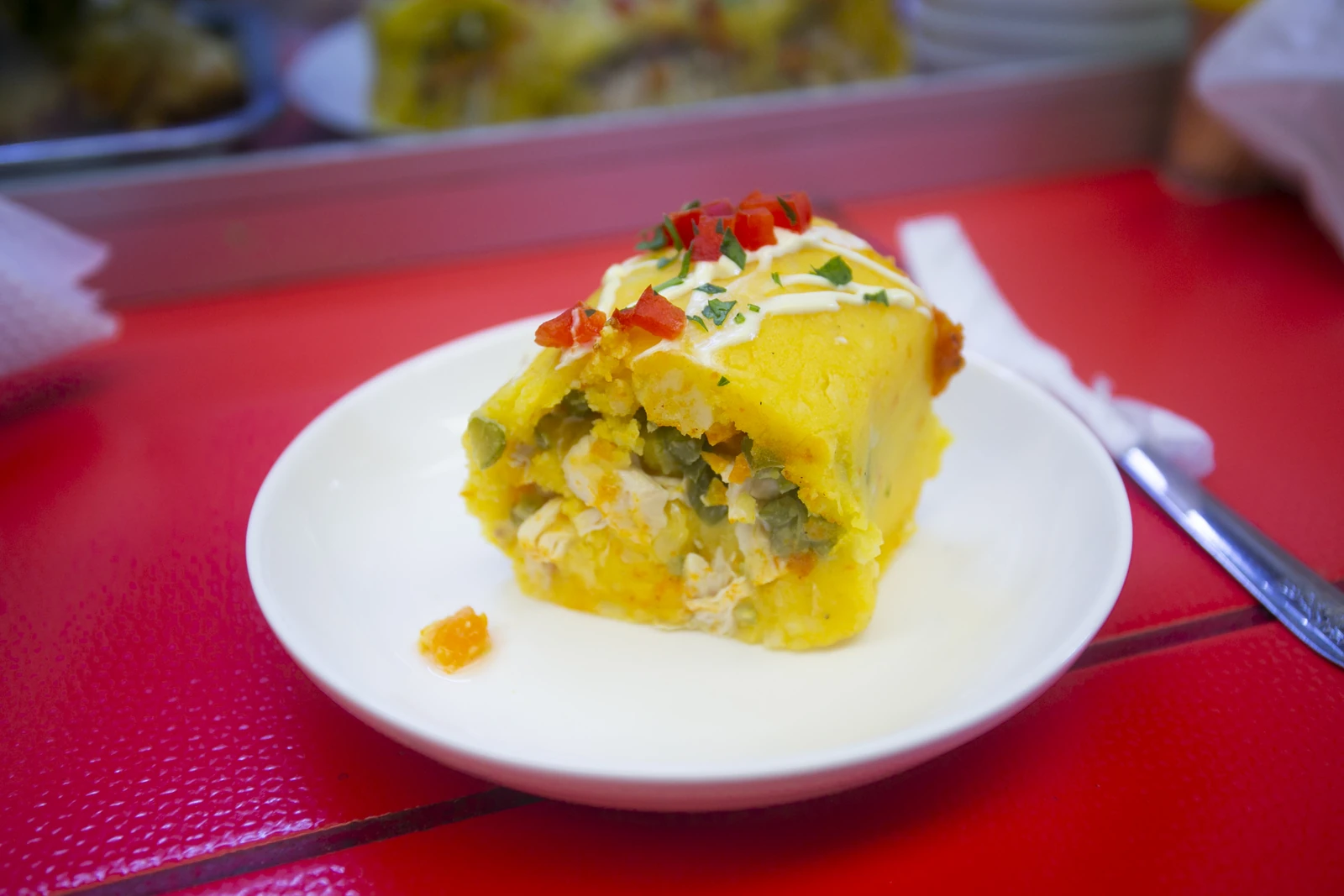

Causa limeña (KOW-sah lee-MEH-nyah) is Peru’s chilled potato terrine: golden potatoes, riced while hot and seasoned with aji amarillo chile paste, lime juice, oil and salt, then layered around a creamy filling, usually chicken salad and avocado. It’s served cold in neat slices or as individual rounds, topped with egg and black olives, and it tastes bright and tangy rather than rich. The dish is easy, but the potato dough decides everything: overwork it and it turns gluey, season it too hot and it goes wet. This recipe serves 6 and covers both problems, what to buy in a US or UK supermarket, other fillings, and how far ahead you can make it.
What causa limeña is, and what to expect
How do you make causa limeña? Boil 2¼ lb (1 kg) of yellow potatoes in their skins for 20 to 25 minutes, peel and rice them while hot, and let them cool until warm. Mix in 3 tbsp aji amarillo paste, 4 tbsp oil, ¼ cup (60 ml) lime juice and salt. Layer half the potato in a lined pan, then avocado, then chicken mixed with mayonnaise, top with the rest and chill at least 1 hour. 120 minutes for 6 servings.
Think of it as a cold, sliceable potato salad with the dressing worked into the potato itself. The texture is soft and smooth, close to a firm mash, and the lime keeps it fresh. With 3 tbsp of a typical paste the heat is gentle, and many kids eat it. In Peru it’s a starter or a light lunch, often next to Peruvian ceviche, raw fish cured in lime, and it shares a table with hot dishes like aji de gallina, the creamy Peruvian chicken stew or lomo saltado, the soy-and-vinegar beef stir fry, both of which use the same jar of aji amarillo paste. For a slow-cooked main you can also make the day before, Peruvian seco de res, beef braised in cilantro, takes the same paste.
If you know papa a la huancaina, potatoes under a cheese and chile sauce, the two use the same potato and chile but work differently. Huancaina keeps the potato in slices and pours a blended sauce over it. In causa, the potato itself becomes the dough. And unlike Latin-style mashed potatoes, there’s no butter or milk, and it’s eaten cold.
Time. 2 hours start to finish, but only about 35 minutes of hands-on work. The potatoes and chicken cook side by side in 25 minutes, and the assembled causa needs at least an hour in the fridge to firm up. Most of the work can be done the day before.
Ingredients, and what to buy in the US and UK
| Ingredient | Amount | US | UK |
|---|---|---|---|
| Yellow potatoes | 1 kg (2¼ lb) | Yukon Gold, or frozen Peruvian yellow potatoes in Latin stores | A floury potato such as Maris Piper |
| Aji amarillo paste | 3 to 4 tbsp | Jarred, in the Hispanic aisle or online | Online or in Latin American shops |
| Limes | 60 ml (¼ cup) juice | Regular limes | Limes, not lemons |
| Chicken breast | 500 g (1 lb 2 oz) | Or 12 oz (350 g) shredded rotisserie chicken | Same |
| Mayonnaise | 110 g (½ cup) | Any full-fat mayo | Any full-fat mayo |
Potatoes
Peruvian yellow potatoes are floury, deep yellow, and press into a smooth dough with lots of color. Yukon Gold is the closest common match. It holds a bit more moisture, so letting the riced potato steam off before seasoning matters more. A white floury potato like russet or Maris Piper works, but the dough is paler and relies on the chile paste for color. Skip waxy, red or new potatoes: they turn sticky before they get smooth. Colombian papa criolla, the small golden potato, is yellow and floury too, but tiny and softer: check it from 10 minutes.
Aji amarillo
Aji amarillo is a fruity yellow Peruvian chile, and it gives causa its color and its flavor. Outside Peru, the jarred paste is the practical choice. Brands vary in heat and salt, so start with 3 tbsp, taste the seasoned potato, and go to 4 only if you want it stronger.
If you find frozen whole aji amarillo, you can make your own paste. Stem, seed and scrape out the white ribs, simmer the chiles 12 to 15 minutes, peel off the skins and blend with 1 or 2 tbsp water until smooth. Six chiles make more than enough.
With no aji amarillo at all, a pinch of turmeric gives the color and a dash of hot sauce in the filling gives some heat. You’ll get a good layered potato salad, but it won’t taste like causa.
Equipment
- Potato ricer or food mill. It makes the dough smooth without working the starch. Without one, mash the potatoes with a fork while hot and accept a few lumps.
- A mold. An 8 in (20 cm) springform ring, a 9 × 5 in (23 × 13 cm) loaf pan lined with plastic wrap, or six 3 in (8 cm) ring molds. A clean can with both ends removed works as a ring.
How to make the potato dough so it isn’t gummy or wet
Boil the potatoes whole, in their skins
Whole, unpeeled potatoes started in cold water take up less water than peeled chunks. A medium Yukon Gold needs 20 to 25 minutes from the boil; start testing at 18. They’re done when a knife slides to the center without pushing. Peruvian yellow potatoes crack open when cooked and fall apart soon after, so pull them promptly.
Rice them hot, never blend them
Drain, let them sit 5 minutes, then peel them hot, using a towel. Rice them right away: hot potato passes through smoothly, cold potato goes lumpy. Never use a blender, stick blender or food processor. They rupture the potato’s starch cells and turn the dough elastic and gluey, and there’s no fixing it.
Season when warm
Spread the riced potato in the bowl and wait 10 to 15 minutes, until it’s warm and no longer steaming. Seasoned straight from the ricer, it keeps releasing steam and the dough comes out damp. Then fold in the paste, oil, half the lime juice and the salt by hand, just until the color is even.
How to tell the dough is right
Roll a walnut-sized ball in your palm. If it holds its shape, looks smooth and barely sticks, you’re there.
- Dry or cracking. Add 1 more tbsp oil.
- Soft and sticky. Add more riced potato, or chill the dough 30 minutes before assembling.
- Flat-tasting. More salt and lime, a little at a time. Cold dulls flavor, so the warm dough should taste slightly bold.
Layering causa in a pan or ring molds
- Line the pan with plastic wrap, leaving an overhang. Rings don’t need lining.
- Bottom layer. Half the potato, pressed in an even ⅝ in (1.5 cm) layer with no gaps.
- Avocado. Slices about ¼ in (5 mm) thick covering the layer, with a pinch of salt.
- Filling. The chicken salad, spread right to the edges.
- Top layer. The rest of the potato, pressed down and smoothed with a wet spoon.
- Chill covered for at least 1 hour, so it sets and slices cleanly.
Unmold just before serving and add the egg, olives and herbs. Some cooks pipe thin lines of mayonnaise on top or add more avocado; put any avocado on top at the last minute, as it browns. Wipe the knife between slices.
For the filling, the chicken breast poaches in salted water for 20 to 25 minutes, to 165°F (74°C) in the thickest part. It shreds most easily while still warm.
Other causa fillings
- Tuna causa. Swap the chicken for 12 oz (350 g) drained canned tuna, about three 5 oz US cans, with the same mayo and onion. Drain it well and break it up with a fork so the layer isn’t wet.
- Shrimp causa. 12 oz (350 g) cooked, peeled shrimp, chopped, with the mayo and a few drops of lime. If yours are raw, boil them 2 to 3 minutes until pink and opaque, then chill in ice water.
- Vegetarian. Avocado, seeded diced tomato, cooked corn and crumbled queso fresco, with little or no mayo. Leave out the cheese to make it vegan.
- Vegan chickpea. One 15 oz (400 g) can of chickpeas, drained and roughly mashed, with vegan mayo, red onion and celery.
- Party bites. Roll the dough into 1½ in (4 cm) balls, press a well in each with your finger and fill with 1 to 2 tbsp of filling.
- For 12 or 20 people. Double the recipe for 12 (2 kg / 4½ lb potatoes) in a 13 × 9 in (33 × 23 cm) dish or two 8 in (20 cm) pans. For 20, make three batches of dough and season each kilo separately so you can taste as you go.
Common causa problems and fixes
- Wet dough. Potatoes peeled before boiling, overcooked, or seasoned while steaming. Boil whole, pull them on time, season warm.
- Gummy or stretchy dough. Blended, beaten too long, or a waxy potato. Rice and fold by hand.
- Lumpy dough. Riced cold. Rice right after peeling.
- Falls apart when unmolded. Not chilled long enough, or a wet filling. Drain the tuna or chicken well and give it the full hour.
- Bland. Not enough salt or lime, or a mild paste. Taste before layering.
- Too spicy. Some pastes are strong. Start at 3 tbsp; if you overshoot, rice one more potato and work it in.
Allergens. Contains egg (mayonnaise and garnish). It’s free of gluten and dairy if your mayo and chile paste are; check the labels.
Making it ahead and storing it
- The night before. Assemble the whole causa, cover it and refrigerate. It slices even better the next day. Add the garnish and any top avocado when you serve.
- In parts. The seasoned dough keeps a day in a sealed container, with the filling stored separately.
- Fridge. Well covered, 3 to 4 days. It’s best in the first 2: after that the avocado in the middle darkens and the potato firms up. Take it out 15 minutes before serving.
- Freezer. Don’t. The mayonnaise separates and the potato turns watery and grainy when thawed.
- On the table. No more than 2 hours out of the fridge, or 1 hour above 90°F (32°C), because of the chicken, mayo and egg. On a buffet, set the platter over ice.
Avocados and the jar of chile paste are what push the cost up outside Peru; potatoes and chicken are cheap, and a tuna causa is cheaper still. One jar of paste covers several batches.
Causa limeña FAQ
Does the potato dough have mayonnaise in it? Not in the classic version: just potato, chile, lime, oil and salt. The mayo goes in the filling. Some cooks add it to the dough for creaminess, but it gets softer and harder to unmold.
Can I use russet potatoes? Yes, or any white floury potato. The dough comes out paler, so use the fourth tablespoon of paste for color.
Why did my causa go hard in the fridge? Potato starch firms up when cold. Give it 15 minutes at room temperature before serving and it softens again.
Where does the name come from? Nobody knows for sure. One explanation links it to the Quechua word kawsay, sustenance; another to the dish being sold in Lima’s streets to raise money for a wartime cause.
Nutrition per serving
Per serving (one sixth of the recipe, with chicken, avocado, egg and olives), worked out ingredient by ingredient:
- Calories: 550 kcal
- Protein: 25 g
- Carbohydrates: 37 g
- Fat: 34 g, of which 6 g saturated
- Fiber: 6 g
- Sugars: 3 g
- Sodium: 895 mg
The potatoes account for about 130 kcal per serving, the mayonnaise about 125, the oil in the dough about 80 and the avocado about 75. Chile pastes carry their own salt, so taste the dough before adding all of it.
Causa is the dish I reach for when I want lunch ready before the day starts: I layer it at night, and the next day all that’s left is to unmold it and slice. With any new jar of paste I add three spoonfuls, taste the warm potato, and only then decide on the fourth. Josnaisis.