
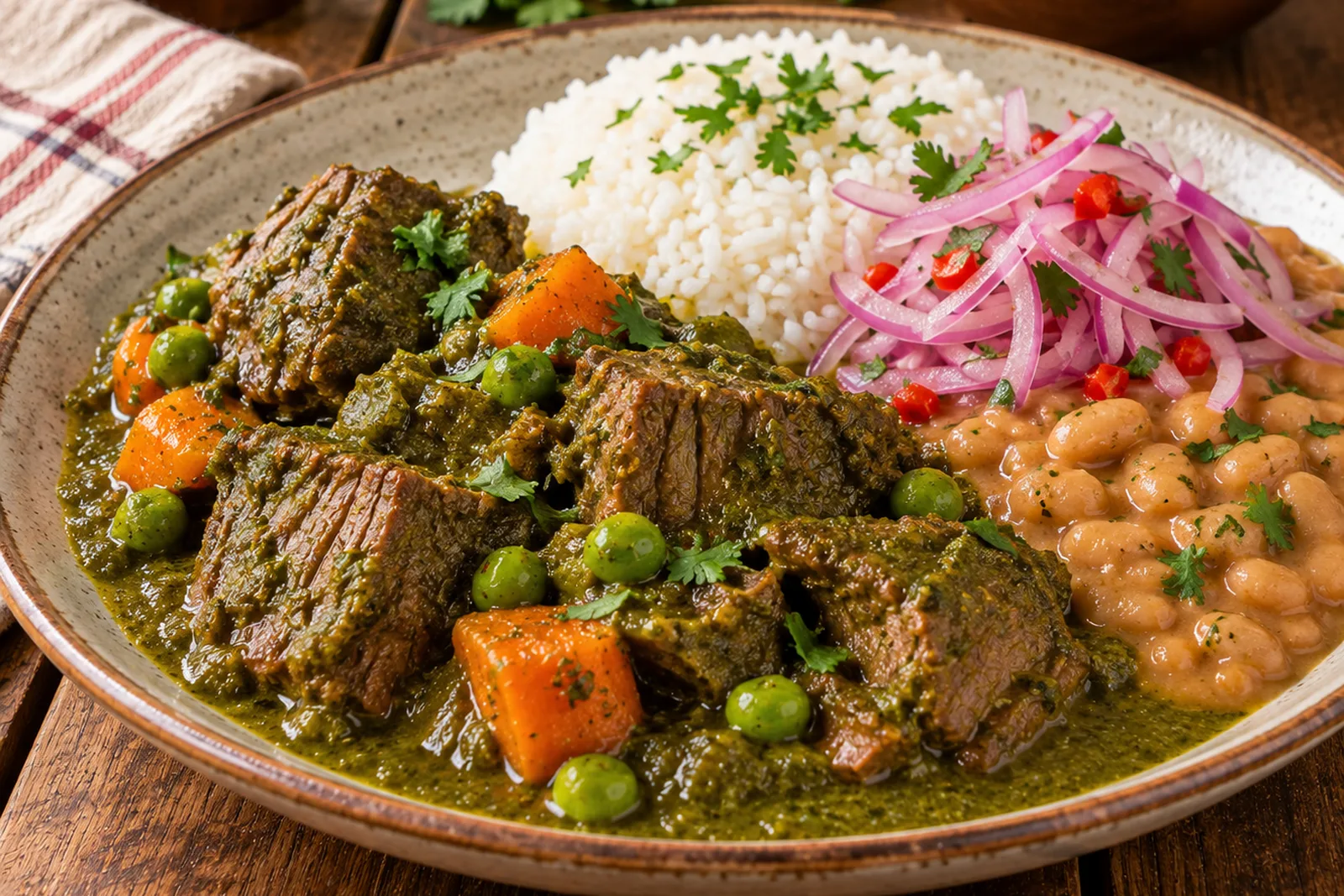

Seco de res (SEH-koh deh REHS) is a Peruvian beef stew where a whole bunch of cilantro, blended with beer or chicha de jora, a sour Peruvian corn drink, becomes the sauce. Chuck or short ribs simmer in it with aji amarillo, Peru’s fruity yellow chile, until the meat falls apart, then potatoes, carrots and peas go in at the end. In Peru it’s a lunch plate with white rice, creamy yellow beans and a sharp red onion relish. Below: which cut to buy in a US or UK shop, the stovetop and Instant Pot timings, how to keep the sauce green, and the beans.
What seco de res is, and how long it takes
How do you make Peruvian seco de res? Brown 2¼ lb (1 kg) of beef chunks and set aside. Soften red onion, garlic and 3 tbsp aji amarillo paste in the same pot, add a bunch of cilantro blended with 1 cup (240 ml) of beer or chicha de jora, return the beef with 2 cups (500 ml) of water and simmer covered on low for 1½ to 2 hours. Add potatoes and carrots for 20 to 25 minutes and peas for 5. 175 minutes for 6 servings.
Despite the name, which means “dry” in Spanish, it’s a saucy stew. The sauce is thick and dark green, herby rather than hot, with a mild chile warmth and a slight sourness from the beer or chicha.
Time. 25 minutes of prep and about 2½ hours on the stove, and only the first 25 or so need you standing there. In an Instant Pot or stovetop pressure cooker, the beef needs 30 to 35 minutes under pressure. Medium difficulty: nothing tricky, but you need to judge when the beef is tender.
If you want a fast Peruvian beef dinner instead, lomo saltado, a soy-sauce beef stir-fry with fries, is cooked in minutes over high heat. Seco is its opposite: a cheap cut and time.
Ingredients, and which beef to buy
The recipe works out to about 5½ oz (165 g) of raw boneless beef per person, which is plenty with rice and beans alongside.
The cut
You want collagen and some fat, which melt during the long simmer and give the sauce body. Lean cuts stay dry and stringy however long you cook them.
| Shop | Ask for | Avoid |
|---|---|---|
| US | Chuck roast, brisket point, bone-in short ribs, oxtail | Round, sirloin, “stew meat” of unknown cut |
| UK | Beef shin, chuck/braising steak, ox cheek, oxtail | Topside, silverside |
With bone-in short ribs or oxtail, use 3¼ lb (1.5 kg) instead of 2¼ lb. They give a more gelatinous sauce and may need an extra 30 minutes. Cut boneless meat into chunks of about 2 in (5 cm); small stew cubes shred before they turn tender.
Cilantro, and lots of it
One large bunch, about 3½ oz (100 g) of leaves and tender stems, blended with the beer gives just over a cup of green purée. Only cut off the thick, woody stems at the bottom, which turn the sauce bitter. In Peru, ordinary cilantro is what people call culantro, so buy regular cilantro; the long, saw-toothed culantro used in Caribbean cooking is a different plant and doesn’t work the same here.
Aji amarillo paste, and swaps
Aji amarillo is an orange Peruvian chile, fruity and medium-hot. In the US the jarred paste is in the Hispanic aisle of many large supermarkets and at Latin grocers; in the UK, at Latin American grocers and online. Brands vary a lot in heat, so taste ½ tsp on its own before adding all 3 tbsp. The rest of the jar makes Peruvian aji de gallina, creamy chicken with pecans, or the sauce for papa a la huancaína, potatoes in a cheese and chile sauce.
- Frozen whole aji amarillo, from Peruvian and Latin grocers. Stem, seed and devein, simmer in water 12 to 15 minutes, peel and blend with a splash of water, then measure 3 tbsp.
- Yellow bell pepper plus half a jalapeño or serrano, blended. Similar color and some heat, but none of the fruity flavor. Good stew, less Peruvian.
Some versions add aji panca or mirasol, dried red chiles. They deepen the flavor but push the sauce toward brown, so leave them out if you want it green.
Chicha de jora or beer
Chicha de jora is a fermented corn drink, slightly sour; Peruvian shops abroad sometimes carry it bottled. Otherwise:
- A light lager, same amount. The most common swap, and it works well.
- Lager plus 1 tbsp white vinegar, closer to the sourness of chicha.
- Alcohol-free. Beef stock with 1 tbsp vinegar. A less rounded sauce, but the option for kids.
Potatoes, vegetables and equipment
- Potatoes. White boiling potatoes or Yukon Gold hold together in the pot. Floury Peruvian yellow potatoes, sold frozen at Latin grocers, fall apart in a 25-minute simmer, so boil them separately and add them to the plate. In the UK, a waxy salad potato or Charlotte holds its shape; a floury Maris Piper breaks up.
- Peas. Frozen go straight in; fresh need 10 minutes instead of 5.
- Pot. A heavy 5-quart (5-liter) Dutch oven with a lid. Thin pots scorch over 2 hours. You also need a blender.
How to make seco de res, step by step
Brown the beef in two batches
Dry the beef and don’t crowd the pot: chunks that touch release juice and turn gray instead of browning. Two batches, 5 to 6 minutes each, until crusted. The brown layer on the bottom is flavor, and the onion lifts it in the next step.
Take your time with the base
The onion needs 8 minutes over medium heat to turn soft and translucent; rushed, it stays crunchy in the sauce. Then 1 minute for the garlic and 3 minutes for the chile paste, until it looks glossy and oil shows at the edges.
Add the cilantro twice
Blend the cilantro with the beer and set ¼ cup (60 ml) aside in the fridge. The rest goes in with the beef and gives the stew its flavor, but after 2 hours on the heat it fades from bright green to dark olive. The raw purée you kept back goes in for the last 5 minutes and brings back color and fresh aroma.
For an even greener sauce, blend 1 cup of baby spinach with the cilantro. It also tames the slight bitterness of the cilantro.
How to tell the beef is done
Covered, on low, with gentle bubbles rather than a rolling boil, 2-inch chunks take 1½ to 2 hours. It’s ready when you can split a piece with the side of a spoon. If it’s still firm at 2 hours, don’t raise the heat, which tightens the outside; give it another 20 to 30 minutes. Check the liquid every half hour, and if it drops below halfway up the meat, add a splash of hot water.
Potatoes and a thick sauce
Potatoes and carrots cook uncovered for 20 to 25 minutes, and their starch thickens the sauce. When it’s right, the sauce coats the beef and sits on a spoon rather than running off like soup.
- Too thin. A few more minutes uncovered, or crush two pieces of potato against the side of the pot and stir.
- Too thick or catching. Add hot water ¼ cup at a time and lower the heat.
Seco de res in an Instant Pot or pressure cooker
Follow the steps through returning the beef to the pot (use the Sauté setting in an Instant Pot), but add only 1 cup (250 ml) of water instead of 2: nothing evaporates under a sealed lid. Lock it and cook at high pressure for 30 to 35 minutes, a starting point rather than a fixed time, since the cut and the size of the chunks change it; then let the pressure release naturally for 10 to 15 minutes.
Test with a spoon. If the beef still resists, seal it again for 10 more minutes. Potatoes, carrots and peas go in afterward, lid off, on Sauté or over the burner: under pressure they collapse. The whole stew takes just over 1½ hours.
Why seco turns out tough, brown or watery
- Beef still tough after 2 hours. Too lean a cut, or boiled hard instead of simmered. A lean cut won’t recover; for a hard boil, lower the heat and give it longer.
- Dull, brownish sauce. All the cilantro went in at the start, or it’s been reheated more than once. Keep some back for the end, and for leftovers, blend a handful of fresh cilantro and stir it in as you reheat.
- Bitter. Too many thick stems in the purée. Use leaves and tender stems only.
- Watery sauce. The lid stayed on after the potatoes went in. Uncover and reduce.
- Potatoes fell apart. They were floury. Boil them separately next time.
- Too hot. A strong brand of paste. Start with 2 tbsp next time; for this pot, serve with more rice and beans.
Heat, kids and allergens. With 3 tbsp of paste it ranges from mild to medium, depending on the brand, and most kids eat it with rice. Made with beer it contains gluten (barley); chicha de jora is made from corn, but check the label. The long simmer reduces the alcohol without removing all of it, so use the alcohol-free version for children or anyone who needs to avoid alcohol.
Peruvian canary beans, rice and salsa criolla
The full plate is white rice, beans and salsa criolla, a quick red onion relish. Make the beans while the beef simmers.
Canary beans for 6
These pale yellow beans turn creamy when cooked. In the US they’re sold dried and canned as mayocoba or peruano beans in the Hispanic aisle. In the UK, look in Latin grocers or online; cannellini beans are the easiest stand-in, though they’re a different bean.
- Soak 1 lb 2 oz (500 g) dried beans in cold water for 8 to 12 hours.
- Drain, cover with water by about 2 in (5 cm) and simmer over medium heat for 1 to 1½ hours, until they crush easily between your fingers. Older beans take longer. In an Instant Pot, soaked beans need 20 to 25 minutes at high pressure with a natural release.
- In a skillet, soften ½ chopped red onion and 1 tsp garlic in 2 tbsp oil for 5 minutes. Add the drained beans with a ladle of their liquid, mash some of them with the spoon and cook 10 minutes, until creamy. Salt at the end.
With canned beans, use four 15-oz (425 g) cans, drained, and start at step 3.
Rice and salsa criolla
Allow 1 cup of cooked rice per person; a fluffy pot of white rice is the everyday choice. For salsa criolla, slice 1 red onion very thinly, soak 10 minutes in cold salted water, drain and toss with the juice of 2 limes, a little sliced aji amarillo or chile, chopped cilantro and salt.
Tacu tacu from the leftovers
Leftover rice and beans become tacu tacu the next day. Soften a little onion, garlic and 1 tbsp aji amarillo paste, mix in equal parts rice and beans (some of the beans mashed) with a couple of spoonfuls of the seco sauce, and fry it in an oiled skillet over medium-low heat, pressed into a thick cake, until crusted on both sides. Serve it under reheated seco or with a fried egg. If it’s only rice you have left, Peru’s other answer is arroz chaufa, Chinese-Peruvian fried rice.
Lamb, goat and other versions
- Northern Peruvian seco de cabrito. In the north of Peru, especially Lambayeque, young goat is marinated in chicha de jora with garlic and chile, sometimes overnight, and in Lambayeque it’s finished with grated loche, a local squash. It’s served with beans, boiled cassava, rice and salsa criolla. Seco de cordero, with lamb, follows the same method; lamb shoulder in chunks takes 1½ to 2 hours on low.
- Chicken. Bone-in thighs cook far faster: simmer until they reach 165°F (74°C) near the bone, adding the potatoes from the start so they finish together.
- With cassava. Boil cassava (yuca) separately and serve it in place of the potatoes.
- For 12. Double everything in two pots or one 10-quart (10-liter) pot, brown the beef in four batches and keep the same simmering time. Double the beans too: 2¼ lb (1 kg) dried.
Making it ahead, storing and reheating
Make ahead. Seco tastes better the next day, once the beef has soaked up the sauce. Cook it through the potatoes, leaving out the peas and reserved cilantro, then divide it into shallow containers and refrigerate within 2 hours; it can cool uncovered in the fridge and be covered once cold. Reheat the next day and add the peas and freshly blended cilantro for the last 5 minutes.
Fridge. Refrigerate in a covered container within 2 hours of cooking; it keeps 3 to 4 days, and so do the beans.
Freezer. 2 to 3 months. Freeze it without the potatoes, which turn watery and grainy when thawed, and simmer fresh ones in the sauce when you reheat. The beans freeze well in their liquid. Thaw overnight in the fridge.
Reheating. In a covered pot over medium-low heat with ¼ cup of water, stirring now and then, until it bubbles gently and the beef is hot through, 165°F (74°C). In the microwave, use medium power in 2-minute bursts, stirring between them.
The beef is what makes this dish cost what it does. Chuck is cheaper than short ribs, and with rice and beans 2¼ lb feeds 6 generously.
Seco de res FAQ
Why is it called seco if it has sauce? The name doesn’t describe the texture; it’s a saucy stew. What sets it apart from other beef stews is the blended cilantro and the beer or chicha.
Can I make it in a slow cooker? Yes. Brown the beef and cook the onion base in a skillet, move everything to the slow cooker with half the water and cook on low for 7 to 8 hours, until the beef splits with a spoon. Add the potatoes for the last 2 hours and the peas and reserved cilantro 10 minutes before serving. The color will be less bright.
Can I use dried cilantro? No. Dried leaves give neither color nor flavor. A jar of Peruvian cilantro paste, from Latin grocers, can boost the green but doesn’t replace the fresh bunch.
Nutrition for seco de res
Per serving (one-sixth of the pot, with potatoes and vegetables, without rice or beans), worked out ingredient by ingredient from the quantities in the recipe:
- Calories: 640 kcal
- Protein: 38 g
- Carbohydrates: 37 g
- Fat: 37 g, of which 13 g saturated
- Fiber: 6 g
- Sugars: 7 g
- Sodium: 760 mg
The beef accounts for about 405 kcal per serving and the potatoes about 95. Jarred chile paste and boxed stock carry their own salt, so taste before adjusting at the end. A cup of cooked white rice adds about 200 kcal.
I almost always cook seco a day ahead, because it’s better on day two, and I keep a little cilantro aside to blend fresh when I reheat it. With jarred aji amarillo I always taste half a teaspoon first: the heat changes a lot from one brand to the next. Josnaisis.