
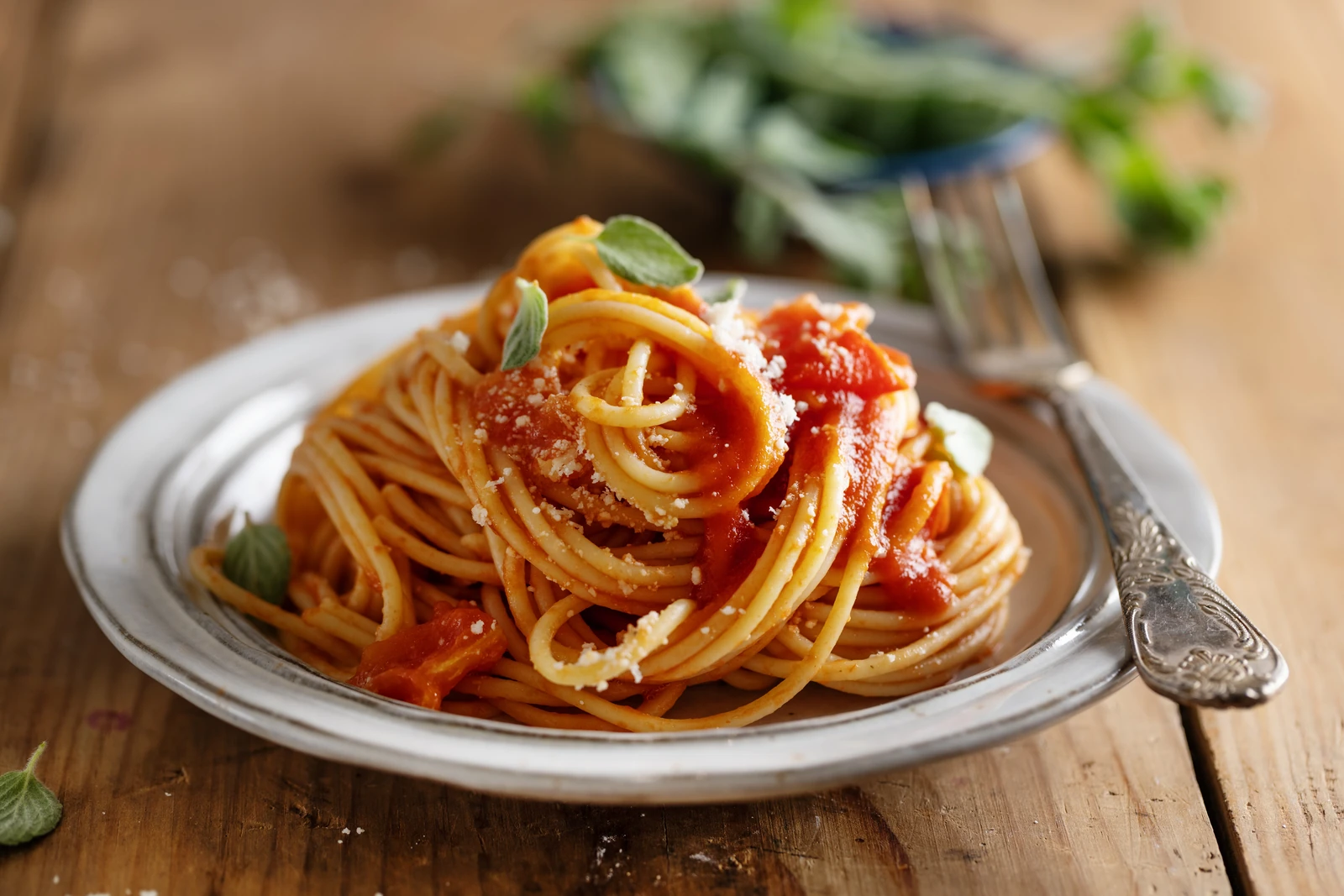

Espagueti rojo (es-pah-GHEH-tee ROH-ho) means red spaghetti, and in Mexico it’s the tomato counterpart to the cream-only white spaghetti: spaghetti in a sauce of tomatoes that are boiled, blended with onion and garlic, then fried in a little oil and butter until they darken, and finished with Mexican crema and cream cheese. It’s mild, slightly tangy and orange-red, with crumbled queso fresco on top. Many Mexican families make it on weeknights as a pasta course and set it out next to the ham or turkey at Christmas. With a couple of chipotles blended in, it turns smoky and hot.
What espagueti rojo is, and how long it takes
How do you make creamy Mexican red spaghetti? Boil 2.2 lb (1 kg) of Roma tomatoes with onion and garlic for 8 to 10 minutes and blend them with chicken bouillon and oregano. Fry the sauce in oil and butter for 10 to 12 minutes, then lower the heat and stir in 1 cup (240 ml) of crema mashed with 3⅓ oz (95 g) of cream cheese, without letting it boil. Toss with 14 oz (400 g) of al dente spaghetti and top with queso fresco. 45 minutes for 6 servings.
Total time 45 minutes: 10 to prep, 35 at the stove, with the pasta boiling while the sauce cooks down. Easy. The one thing to watch is the heat once the cream goes in.
It isn’t an Italian tomato pasta. The sauce is blended smooth with cooked onion and garlic and seasoned with chicken bouillon and oregano rather than basil, and the crema and fresh cheese make it softer and saltier. Its sibling, Mexican white spaghetti with crema and cream cheese, has no tomato and no heat, and some families serve both at Christmas.
Ingredients and supermarket swaps
The recipe makes 6 generous side servings, about 2⅓ oz (67 g) of dry pasta each. As a main dish, it feeds 4.
| Ingredient | Metric | US | Swaps and what changes |
|---|---|---|---|
| Spaghetti | 400 g | 14 oz | Penne or elbows work and clump less while waiting |
| Roma tomatoes | 1 kg | 2.2 lb | Canned or tomato puree, see below |
| Mexican crema | 240 ml | 1 cup | Heavy cream; UK double cream. Sour cream curdles more easily |
| Cream cheese | 95 g | 3⅓ oz | A little under half an 8 oz block |
| Chicken bouillon powder | 4 g | 2 tsp | 1 stock cube, crumbled |
| Queso fresco | 60 g | 2 oz | Feta, saltier; cotija, saltier still |
| Butter and oil | 30 g + 14 g | 2 tbsp + 1 tbsp |
Where to find crema and queso fresco. In the US, both sit in the Latin dairy case of most supermarkets, near the tortillas. In the UK, double cream is the closest swap for crema, and feta is the easiest stand-in for queso fresco: it crumbles the same way and doesn’t melt, but it’s saltier, so salt the sauce less.
Fresh tomatoes, canned or tomato puree
- Fresh Roma tomatoes, as written. They’re meatier and less watery than round tomatoes. They need to be red all the way to the stem: pale ones give a pinkish, sour sauce.
- Canned tomatoes. Two 14.5 oz cans (US) or two 400 g tins (UK), whole or crushed, about 800 g, instead of the fresh tomatoes. Skip the boiling: blend them with the raw onion, garlic, bouillon and oregano and fry the sauce for the same 10 to 12 minutes, which the raw onion needs.
- Tomato puree or passata. About 420 g (15 oz) by weight; cans and jars come in different sizes, so go by the weight on the label. Blend it with the raw onion, garlic, seasonings and ½ cup (120 ml) of water, then fry it the same way. It’s the quickest option for a crowd. The sauce comes out thicker and tastes more cooked than with fresh tomatoes. Many purees are salted, so start with half the bouillon and taste.
How much cream and cheese
For 14 oz (400 g) of pasta and 2.2 lb (1 kg) of tomatoes, 1 cup (240 ml) of crema and 3⅓ oz (95 g) of cream cheese keeps the sauce orange-red and still tasting of tomato. With half the cream it’s a tomato pasta with a creamy edge; with double, it turns pink and tastes more of dairy than tomato.
- Cream cheese thickens the sauce and gives it body, but it won’t stop it splitting if it boils: only low heat does that. It’s optional: without it, use 1¼ cups (300 ml) of crema and expect a looser sauce.
- Queso fresco goes on top and doesn’t melt. It’s there for salt and a crumbly contrast to the smooth sauce.
Equipment. Two pots (one at least 5 quarts for the pasta), a blender, a wide 11 in (28 cm) sauté pan or shallow pot that will hold all the spaghetti, and tongs. A fine strainer if you want the sauce silky.
How to make Mexican red spaghetti
Boil and blend. The tomatoes are ready after 8 to 10 minutes at a boil, when the skins split and they give under a spoon. Blend them with their own cooking water rather than fresh water, since it carries the flavor they released. Straining is optional; unstrained, you’ll see tiny flecks of skin, which is how plenty of home cooks serve it.
Fry the sauce until it changes color. This is the step that decides the flavor. The sauce hits the hot fat, spatters and bubbles; turn it down to medium-low and give it 10 to 12 minutes, stirring every couple of minutes so it doesn’t catch. It’s ready when:
- it has gone from light, almost pink, to deep red;
- it no longer smells of raw tomato;
- it coats the back of a spoon and a finger drawn through it leaves a clean line.
Cut this short at 5 minutes and the sauce stays sour, and the cream turns it a pale pink.
Cream on the lowest heat. Mashing or blending the crema with the cream cheese prevents white specks. Before it goes in, stir a ladle of hot sauce into the cream so it isn’t hit by heat and acid all at once. Then 2 to 3 minutes on the lowest heat, until the color is even and small bubbles show only at the edge. From here on, the sauce doesn’t boil again.
Pasta and the final toss. Use 4 quarts (4 liters) of water per 14 oz (400 g) and a tablespoon of salt. Pull the pasta 1 minute early, tender but still firm in the center when you bite it (some brands show a thin white thread), because it finishes in the sauce. Don’t rinse it, since the surface starch helps the sauce cling. Toss over low heat for 1 to 2 minutes. It’s right when every strand is coated, a little sauce pools at the bottom of the pan and the pasta slides when you serve it. It keeps soaking up sauce on the platter, so if it’s just right in the pan, it’ll be dry at the table.
Chipotle version, and how hot it gets
Chipotles in adobo, smoked dried jalapeños canned in a tangy red sauce, go into the blender with the tomatoes. For the 2.2 lb (1 kg) of tomatoes and 1 cup (240 ml) of crema in the recipe:
| Heat | Chipotles in adobo | Adobo sauce |
|---|---|---|
| Mild, barely there | 1, seeds scraped out | none |
| Medium, as written | 2 | 1 tsp |
| Hot | 3 or 4 | 1 tbsp |
With 2 chipotles, you taste smoke from the first bite and the heat arrives at the end, rounded off by the cream. Cans vary, so start low, taste the fried sauce, and if it needs more, blend another chipotle with a ladle of sauce and stir it in. The only way to take heat out is more cream, which turns the sauce pink.
Feeding kids too? Fry the sauce without chipotle, move half to a second pan and add 1 chipotle blended with a ladle of sauce there. Give each pan half the crema and cream cheese, and serve two platters. If you like chipotle and cream together as a main, creamy chipotle chicken pairs the two without tomato, with seared chicken.
Why it curdles, tastes sour or dries out
- The cream split into specks or an oily film. The sauce boiled after the cream went in, the cream was fridge-cold, or sour cream or light cream met too much heat. Take the pan off the heat, add 2 tbsp of warm milk and whisk hard; if it doesn’t come back, blend the sauce for 30 seconds without the pasta.
- Sour, or tastes of raw tomato. It wasn’t fried long enough, or the tomatoes weren’t ripe. Give it 3 to 5 more minutes before the cream; if it’s still sharp, ½ tsp of sugar balances it.
- Pale pink. Pale tomatoes or too much cream. One or two tablespoons of tomato paste fried with the sauce bring the red back.
- White lumps. Cold cream cheese, or it wasn’t mashed in. Blend the sauce for a few seconds, without the pasta.
- Dry and stuck together on the platter. Tossed too far ahead, or there wasn’t enough sauce. Add hot milk or pasta water ¼ cup at a time and toss with tongs.
- Too salty. Bouillon, salted puree, salted butter and feta or cotija all add up. Taste before adding the ¼ tsp of salt, and use less cheese if it’s feta or cotija.
- Soft pasta. Boiled for the full package time and then 2 more minutes in the sauce. Always 1 minute less.
Who it suits. Without chipotle there’s no heat, and most kids like it. It contains gluten (the pasta) and dairy (crema, cream cheese, butter, cheese). Bouillon powder can contain soy or wheat depending on the brand, so check the label.
Making it for 20, and making it ahead
| Ingredient | 6 people | 12 people | 20 people |
|---|---|---|---|
| Spaghetti | 400 g (14 oz) | 800 g (1¾ lb) | 1.4 kg (3 lb) |
| Roma tomatoes | 1 kg (2.2 lb) | 2 kg (4.4 lb) | 3.5 kg (7.7 lb) |
| or tomato puree | 420 g (15 oz) | 840 g (30 oz) | 1.5 kg (3.3 lb) |
| White onion | ½ | 1 | 1¾ |
| Garlic | 2 cloves | 4 cloves | 7 cloves |
| Bouillon powder | 2 tsp | 4 tsp | 7 tsp |
| Dried oregano | ½ tsp | 1 tsp | 1¾ tsp |
| Butter and oil | 2 tbsp + 1 tbsp | 4 tbsp + 2 tbsp | 7 tbsp + 3½ tbsp |
| Crema | 1 cup (240 ml) | 2 cups (480 ml) | 3½ cups (840 ml) |
| Cream cheese | 95 g (3⅓ oz) | 190 g (6¾ oz) | 330 g (11½ oz) |
| Queso fresco | 60 g (2 oz) | 120 g (4 oz) | 210 g (7½ oz) |
The 20-person column works out to about 2½ oz (70 g) of dry pasta each, the same as the recipe. If there are two or three other sides on the table, 2½ lb (1.2 kg) of spaghetti is enough.
- Sauce in batches. Boil the tomatoes in a 10 quart (10 liter) pot or in two rounds, and never fill the blender more than halfway with hot liquid. With tomato puree you skip all of this.
- A big batch takes longer to cook down. In a 12½ in (32 cm) pan, or split between two, allow 15 to 20 minutes and go by color and thickness, not the clock.
- Pasta in two pots at once, or two rounds in the same water. Drain, return it to the big pot and toss it with the sauce there.
What to do the day before. Make the fried tomato base without the cream; it keeps up to 2 days in a covered container in the fridge. On the day, warm it over medium-low heat for 5 to 8 minutes until it bubbles, drop to the lowest heat, add the tempered cream as in step 4, and boil the pasta in the meantime. The cream only gets heated once, so it doesn’t split. If you need the pasta cooked a day ahead too, use the same method as for the white spaghetti: boil it 2 minutes short, cool it in cold water and toss it with 1 tbsp of oil per 14 oz (400 g).
On the buffet. Tossed spaghetti keeps a good texture for up to an hour if you leave it noticeably loose, with an extra ½ cup (120 ml) of pasta water per 14 oz, and keep ½ cup of hot sauce aside to stir in at serving time. To hold it hot, cover it and keep it in a low oven or a chafing dish, checking with a thermometer that the center stays above 140°F (60°C). If you can’t keep it hot, serve it straight away and don’t leave it out more than 2 hours.
What to serve with it
It’s a side for roasted or baked meat, on the same plate.
- Christmas and New Year’s. With a Latin Christmas turkey with picadillo stuffing or a whole Latin roast chicken, meats with no red sauce of their own, the spaghetti brings the color and the sauce. Next to pierna adobada, Mexican adobo pork leg, which already has a chile sauce, the white spaghetti makes more of a contrast; if you serve both, make the red one without chipotle.
- Something cold and sweet alongside. Mexican apple salad is the usual partner on a December table.
- On a weeknight. As a pasta course before the main dish, or on the same plate as a crispy Mexican beef milanesa or tortitas de papa, Mexican potato patties.
A side portion is a little under 1 cup served.
Storing and reheating
Fridge. Covered and refrigerated within 2 hours, it keeps 3 to 4 days. If you made it for 20, split the leftovers (and the make-ahead tomato base) into shallow containers so they cool quickly; a full pot takes hours to cool in the middle. The next day it will look firm, with little sauce showing, because the pasta absorbed it.
Reheating. In a skillet over low heat with 2 tbsp of milk or stock per cup of spaghetti, covered for the first few minutes and then tossed with tongs, 4 to 6 minutes, until it’s creamy again and reaches 165°F (74°C) in the center. In the microwave, covered, with the same milk, at medium power in 1-minute bursts, stirring in between: on full power the sauce boils at the edges and splits.
Freezer. I don’t freeze it once it’s tossed, because the cream separates and the pasta goes soft. The tomato base without cream freezes well for up to 3 months in portions; thaw it overnight in the fridge.
Mexican red spaghetti FAQs
Can I make it without cream? Yes, and plenty of families do: fried tomato sauce, pasta and crumbled cheese on top, with a spoonful of crema on each plate. It’s lighter, tangier and a deeper red.
Can I add ham or sausage? Yes. Brown 5 oz (150 g) of diced ham or hot dogs in the butter for 2 or 3 minutes before pouring in the sauce, and leave them in. With hot dogs, go easy on the salt.
Is it the same as spaghetti with marinara? No. Marinara is simmered with olive oil, garlic and herbs and served chunky or smooth without dairy. Espagueti rojo is blended with cooked onion, seasoned with chicken bouillon and finished with cream, so it’s milder, creamier and saltier.
Nutrition per serving
Per serving (⅙ of the recipe, without chipotle or ham), calculated ingredient by ingredient from the recipe amounts:
- Calories: 546 kcal
- Protein: 14 g
- Carbohydrates: 61 g
- Fat: 28 g, of which 15 g saturated
- Fiber: 5 g
- Sugars: 9 g
- Sodium: 440 mg
The pasta accounts for about 247 kcal per serving, the crema 116, the cream cheese 55 and the butter 36, while the 2.2 lb of tomatoes add only 30. Sodium doesn’t include the salt the pasta absorbs from its cooking water.
In December I fry the tomato base the night before and keep it in the fridge without the cream, so on the day all that’s left is warming it, tempering the crema and boiling the pasta while the meat rests. Every time I’ve made the whole sauce ahead with the cream already in, it has come back grainier when reheated. Josnaisis.