

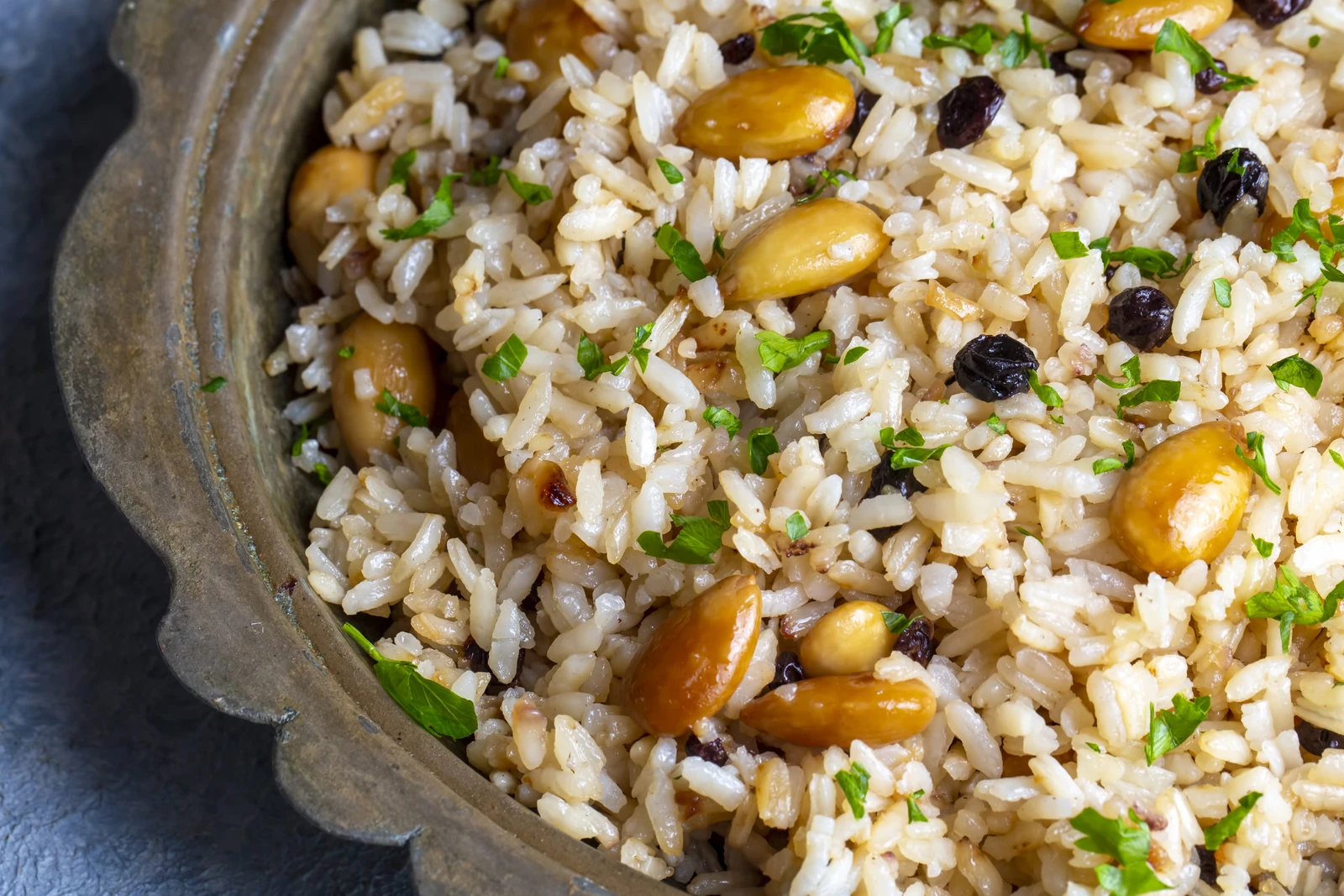

Mexican Christmas rice is a buttery, savoury side dish: white rice cooked in chicken stock with raisins that plump up in the pot and toasted pecans folded in at the end, served next to the turkey or roast pork at a Mexican Christmas Eve dinner. In Spanish it’s arroz navideño. This recipe makes 8 side servings, and further down you’ll find amounts for up to 20, a creamy variation and a plan for cooking it the day before.
What Mexican Christmas rice is like
How do you make Mexican Christmas rice? Fry rinsed long-grain rice in butter with onion and garlic, add twice its volume of hot stock and the raisins, cook covered on the lowest heat for 18 minutes, rest 10, then fold in pecans toasted separately. 55 minutes for 8 servings.
Expect fluffy, ivory-colored grains with a buttery, savory flavor, a little sweetness from the raisins and crunch from the nuts. It isn’t spicy, and it isn’t a dessert rice. Think of it as the Mexican cousin of a holiday pilaf: a side dish that goes on the plate with the meat, not a meal on its own.
There’s no single recipe in Mexico. It’s also made creamy, with corn and cream (see below), and some versions add diced carrot and peas to the raisins and pecans, all in the same pot.
If you’re after the tomato-based rice served with tacos and enchiladas, that’s Mexican red rice; the poblano and cilantro one is Mexican green rice.
Time and difficulty. 55 minutes, about 20 of them hands-on. Easy: the only things that need care are measuring the stock and leaving the lid alone.
Christmas rice in other countries
Several Latin American and Caribbean countries serve a rice with the same name, and it isn’t the same dish. Compared with this Mexican base:
- Dominican Republic. Toasted flaked almonds instead of pecans, often with dark and golden raisins mixed. The almonds are toasted first and go back in at the end too.
- Ecuador. Raisins and almonds, and often diced ham, served with the turkey.
- Brazil, arroz natalino. Two colors of raisins with walnuts or other nuts, and frequently bacon or ham and dried apricots.
Ingredients and what changes with each swap
The recipe makes 8 side servings of about ¾ cup cooked rice each, which is the right amount when the table also has meat, salad and bread.
Rice and stock, the 2-to-1 ratio
Use long-grain white rice (regular American long-grain or basmati both work) and 2 cups of stock for every cup of rice, measured with the same cup. Rinsed and fried in butter, that ratio gives separate, tender grains; more liquid doesn’t make it moister, it makes it mushy. Avoid short-grain and pudding rice, which release more starch and clump. Arborio and other risotto rices soak up far more liquid and need longer, so at this ratio they stay chalky. Parboiled or “converted” rice needs whatever liquid its package says, and instant rice won’t work with this method.
The stock carries most of the flavor. With water the rice tastes flat: add 1 teaspoon of salt per 4 cups and a little extra butter when you fluff it. Store-bought stock or broth is already salted, which is why the recipe only adds salt to homemade or unsalted stock. In the UK, one good-quality stock cube dissolved per 2 cups (480 ml) of water does the job; taste before adding any salt.
Nuts, raisins and their swaps
- Pecans. In many Mexican recipes, nuez means pecan, which is sweet and buttery. Walnuts work the same way and taste a little more bitter. Flaked almonds are crunchier and milder, and are the easiest to find in UK supermarkets; they’re also what the Dominican version uses. Whichever you pick, toast them separately and add them at the table: cooked with the rice, they turn soft and grey.
- What makes it pricey is the pecans. If they’re expensive where you live, walnuts or flaked almonds usually cost less, or use half the amount and scatter it only on top.
- Raisins. Dark raisins are sweeter and darker; sultanas or golden raisins are milder. Dried cranberries look more festive but are noticeably tarter.
- Butter. With oil, the rice still comes out fluffy but loses the flavor that sets it apart. To cut fat, fry in 2 tablespoons of oil and stir 1 tablespoon of butter in at the end.
Equipment. A heavy 9½-inch (24 cm) pot with a tight-fitting lid for the 8-serving batch. If your lid lets steam escape, lay a clean tea towel or a sheet of foil between pot and lid. You’ll also need a sieve for rinsing and a frying pan for the nuts.
Making it, step by step
Rinse, drain, fry
Rinsing removes the loose surface starch that glues grains together. Drain well: wet rice spits in the butter and steams instead of frying. Fry for 4 to 5 minutes, until it goes from translucent to opaque white with a few pale golden grains. Don’t take it to deep gold; this rice should stay light.
Hot, tasted stock
The stock should be just below boiling. Cold stock takes too long to come back to the boil, and the rice sits soaking and breaks. Taste the liquid before you cover the pot: it’s your last chance to fix the salt, and it should be slightly saltier than you want the rice. The raisins go in now because they need the steam to plump up.
Covered, untouched
Once it’s boiling across the whole surface, not just around the edge, cover and drop to the lowest heat for 18 minutes. Don’t peek: the steam is part of the cooking liquid, and if it escapes the top layer stays hard. Then 10 minutes’ rest, heat off, lid on.
How to tell it’s done
When you lift the lid there’s no liquid at the bottom, the surface is dotted with small steam holes, and a grain is tender but intact when you bite it. Fluff from the bottom with a fork without pressing down.
- Hard on top, fine underneath. The lid was lifted or doesn’t seal. Sprinkle 3 to 4 tablespoons of hot stock over, cover and give it 5 more minutes on the lowest heat.
- Sticky or mushy. Too much stock, unrinsed rice, or stirring while it cooked. There’s no rescue for tonight; next time measure the stock with the same cup as the rice.
- Scorched at the bottom. Heat higher than the minimum, or a thin pot. Serve from the top without scraping, so the burnt taste doesn’t spread.
Amounts for 4 to 20 people
The stock ratio stays the same however much you make. The pot and the timing are what change.
| People | Rice | Stock | Butter | Raisins | Pecans | How to cook it |
|---|---|---|---|---|---|---|
| 4 | 1 cup (185 g) | 2 cups (480 ml) | 2 tbsp (30 g) | ¼ cup (40 g) | ¼ cup (30 g) | 8-inch (20 cm) pot, 18 min covered |
| 8 | 2 cups (370 g) | 4 cups (960 ml) | 4 tbsp (60 g) | ½ cup (75 g) | ½ cup (55 g) | 9½-inch (24 cm) pot, 18 min |
| 12 | 3 cups (555 g) | 6 cups (1.44 l) | 6 tbsp (90 g) | ¾ cup (110 g) | ¾ cup (80 g) | Wide 11-inch (28 cm) pot, 18-20 min |
| 16 | 4 cups (740 g) | 8 cups (1.92 l) | 8 tbsp (120 g) | 1 cup (150 g) | 1 cup (110 g) | Two 9½-inch pots, 8-serving batch in each |
| 20 | 5 cups (925 g) | 10 cups (2.4 l) | 10 tbsp (150 g) | 1¼ cups (185 g) | 1¼ cups (140 g) | Two pots, one with 3 cups and one with 2 |
Why two pots above 12. Four or five cups of raw rice make roughly 3 to 3.7 quarts (2.8 to 3.5 liters) of cooked rice. Even in an 11-inch (28 cm) pot that’s a layer 2 inches (5 to 6 cm) deep, and the bottom turns mushy before the top is cooked. Two medium pots beat one huge one, and you can cook one the day before and the other on the day.
Onion and garlic scale with the rice: ½ onion and 2 cloves for every 2 cups.
A plan for Christmas Eve or New Year’s Eve
Two approaches, and both work.
Cooked on the day, for the best texture. The morning before (or the day before), toast the nuts (they keep in a sealed jar at room temperature) and chop the onion and garlic and refrigerate them. Start the rice 1 hour before dinner: it’s ready in 55 minutes, and off the heat with the lid on it stays hot and fluffy for another 20 to 30 minutes while the meat is carved.
Cooked the day before, to free up the stove. Don’t make it more than one day ahead.
- Cook the rice all the way through, with the raisins but without the nuts.
- As soon as it has rested, spread it in trays or shallow containers, no more than about 2 inches (5 cm) deep, so it cools fast.
- Cover it and get it into the fridge within the first hour after turning off the heat.
- On the day, tip it into a baking dish, sprinkle 1 to 2 tablespoons of stock per cup of cooked rice and dot with a little butter. Seal tightly with foil and bake at 350°F (180°C). This fits neatly into the 30 minutes a roast turkey rests out of the oven. It should come out steaming in the center (165°F / 74°C if you have a thermometer). Fluff, fold in the nuts and serve.
The tight foil is what stops it drying out: the stock turns to steam and rehydrates the grains. Uncovered, the top layer goes hard.
Why the rush to cool it. Cooked rice left warm for hours, in the pot or on the table, can cause food poisoning, and reheating it later doesn’t make it safe again. So cool it fast, refrigerate it promptly and don’t leave it sitting in the pot all afternoon.
The creamy variation with corn and cream
Working from the same 8-serving recipe, leave out the raisins and nuts and add 1 cup (150 g / 5 oz) corn kernels, frozen or drained canned, with the stock. After resting, over the lowest heat, stir in 1 cup (240 ml) Mexican crema at room temperature and 3½ oz (100 g) grated Monterey Jack or mild cheddar, folding gently until the cheese melts. Don’t let it boil hard or the cream can split.
It comes out softer, milkier and bound together rather than fluffy. The richness comes from the cream at the end, never from extra stock. If you like, spread it in a dish, top with a little more cheese and brown it in the oven, or stir in 2 roasted poblano peppers in strips with the cream for a mild heat. Mexican crema is sold in the Latin aisle of many US supermarkets; otherwise use crème fraîche, which handles heat well, or sour cream thinned with a splash of milk and added off the heat, since it splits more easily and tastes tangier. This variation doesn’t freeze well: the cream turns grainy.
Common mistakes and allergens
- More stock “to make it moister.” It only makes it mushy. For a richer result, add butter or cream at the end.
- Nuts in the pot. They arrive soft at the table; add them as you serve.
- Raisins dividing the table. If someone won’t eat them, soak them separately for 10 minutes in a little hot stock and fold them into half the pot when you fluff.
Allergens. Contains tree nuts (pecans or almonds) and milk (butter). For anyone with a nut allergy, serve their portion before the nuts go in, and check that your boxed stock is gluten-free if that matters.
What to serve it with, storing and reheating
Serve it with the Christmas roast: Latin Christmas turkey with picadillo stuffing, Mexican adobo pork leg or pork loin in prune sauce, whose sweet sauce suits it well. Add Mexican apple salad on the side. If you’re also serving Mexican white spaghetti, make it instead of the creamy rice rather than alongside, or the meal gets very heavy.
On the table. For a long evening, put out a small dish and refill it, keeping the rest covered in a switched-off oven. Whatever is left in the pot gets cooled and refrigerated as soon as you’ve served.
Fridge. Cooled fast and refrigerated within the first hour, in shallow covered containers, eat it within 24 hours. Keep the nuts separate in a jar.
Freezer. If you won’t eat it in that time, freeze it the same day in flat freezer bags, without the nuts, which go soft once thawed. It keeps 3 to 4 months; thaw it in the fridge.
Reheating. Only once, and until it’s steaming hot in the center. In the microwave, add 1 to 2 tablespoons of water or stock per cup, cover, heat 1 minute, stir, then another minute; or use a covered frying pan over low heat. If you’ve already reheated it once (for example, the batch you cooked the day before and warmed up for dinner), don’t keep the leftovers.
Frequently asked questions
What’s in Mexican Christmas rice? Long-grain white rice, chicken stock, butter, onion, garlic, raisins and pecans. Some versions add carrot and peas, and the creamy one swaps the raisins and nuts for corn, cream and cheese.
How much water or stock does it need? 2 cups of stock for every cup of rice, measured with the same cup: 4 cups (960 ml) for 2 cups (370 g) of rice. With water instead of stock, use the same amount plus 1 teaspoon of salt per 4 cups.
Can I make it with leftover cooked rice? Yes, as a shortcut. Warm 4 tablespoons (60 g) of butter with the onion and garlic, add about 6 cups of cold cooked rice and the raisins soaked for 10 minutes in ½ cup (120 ml) of hot stock (drain them first), and stir over medium-low heat until piping hot. Nuts go in at the end. The grains taste less of stock than when cooked in it, and if the rice was from the day before, this counts as its one reheat.
Does it have cinnamon, almonds or walnuts? This recipe has no cinnamon; some cooks add a pinch, but it pushes the flavor toward dessert, and this is a savoury side. It uses pecans, and flaked almonds are the most common swap: they’re what Dominican Christmas rice uses. Walnuts work too.
Can I make it in a rice cooker? Yes. Fry the onion, garlic and rice in the butter in a frying pan, move it to the rice cooker with the stock and raisins at the same ratio, and use the white rice setting. Nuts go in at the end.
In my kitchen I toast double the nuts: half go into the rice and the rest sit in a little bowl on the table, because they’re the first thing to disappear and this way everyone takes as many as they like. Josnaisis.