

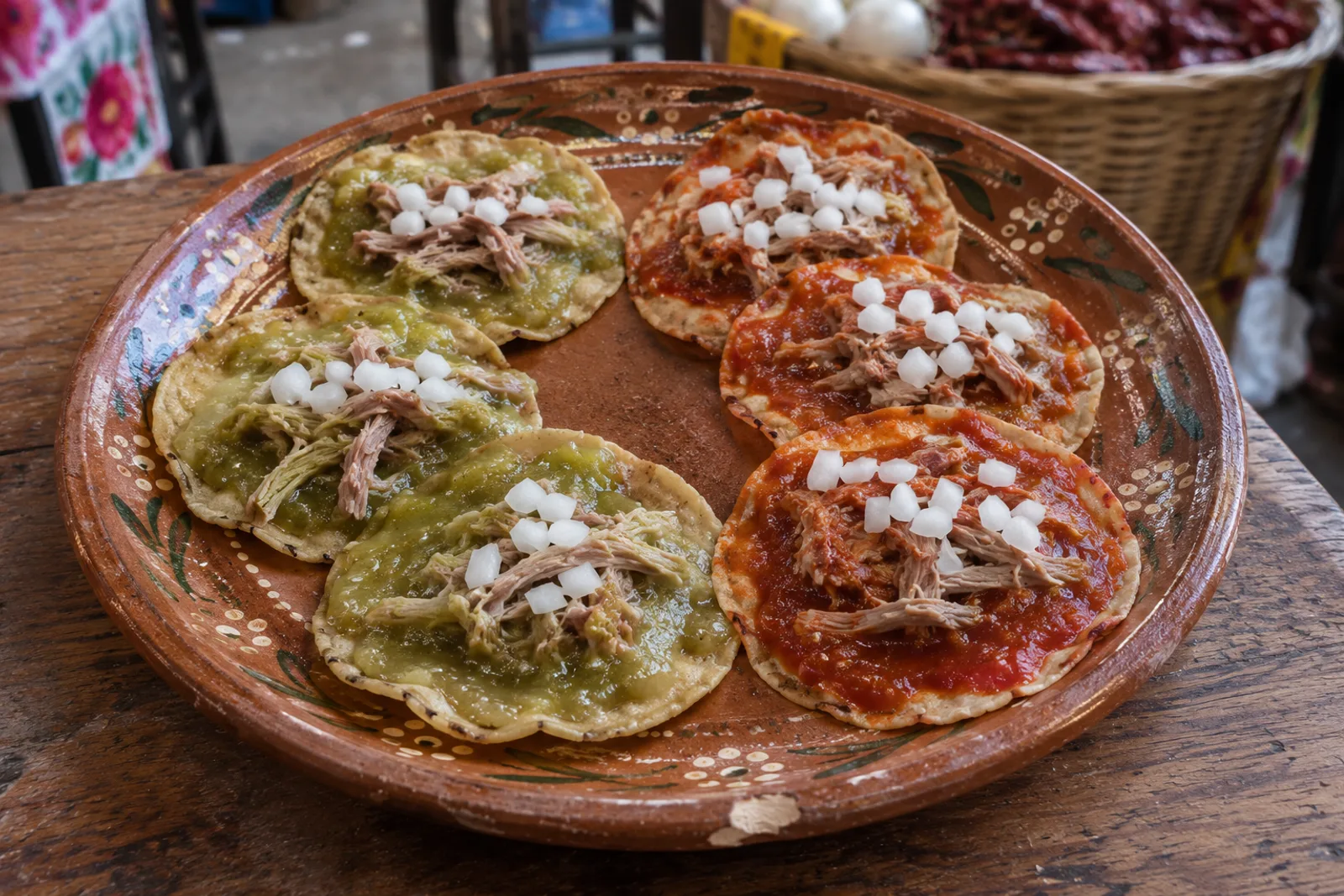

Four inches of corn tortilla, less than two minutes in hot lard, and everything happens in the pan: the tortilla softens for 20 to 30 seconds on one side, gets flipped, takes its salsa, shredded pork and minced onion right there, and comes out 30 to 40 seconds later, when the salsa bubbles at the edge. Chalupas poblanas are the street snack of Puebla, the city two hours southeast of Mexico City, and they are served by the plateful, half green, half red. This recipe makes 24, with the tortilla size to buy, what changes if you use oil, how to run two skillets for a party, and how they differ from the chalupa most Americans know.
What a chalupa poblana is, and what it isn’t
How do you make chalupas poblanas? Simmer 500 g (1.1 lb) pork shoulder with onion, garlic and salt until it shreds, then shred it fine. Fry 4-inch corn tortillas in hot lard, 4 or 5 at a time, 20 to 30 seconds on the first side; flip, leave them in the pan, top with salsa verde or red salsa, meat and onion, baste with lard and lift them out after 30 to 40 seconds, when the salsa bubbles. 95 minutes for 4 servings of 6 chalupas.
It is a small, thin corn tortilla fried in lard and topped with salsa, finely shredded meat and raw white onion that wilts slightly from the heat. In Puebla they are tied to the Paseo de San Francisco, where vendors fried them in lard over charcoal braziers from the late 1800s. The Puebla version has no cheese and no cream. You eat them with your hands, hot.
Not the Taco Bell chalupa. That one is a thick fried flatbread folded like a taco shell and filled with beef, lettuce and cheese. It shares the name and nothing else.
The closest relatives in Mexican cooking are other masa snacks. A Mexican sope is a thick masa base with a pinched rim, a gordita is split open and stuffed, a huarache is a long oval with beans sealed inside, and a tostada, like these Mexican tuna tostadas, is fried until it shatters. The chalupa is the thinnest and the only one topped while it’s still frying.
Time and effort. 95 minutes in all, but 50 to 60 of those are the pork simmering on its own. With the meat and salsas ready, frying and topping 24 chalupas takes about 15 minutes. It’s easy; the only thing that needs your attention is the seconds in the pan.
Shopping list and smart swaps
This is dinner for four, six chalupas apiece. On a party table next to other food, the same batch feeds six to eight.
Tortillas, small and thin
You want 4-inch (10 cm) corn tortillas, the size sold as street-taco tortillas. A thin one softens in seconds and lets the salsa lead; a thick 6-inch tortilla browns before it softens and eats heavy.
- US. Street-taco corn tortillas are in the Latin aisle or the tortilla section of most supermarkets.
- UK. Corn tortillas are usually 6 in (15 cm). Cut 4-inch rounds with a cookie cutter or the rim of a glass, and fry the scraps as chips.
- From scratch. Use the dough from these homemade corn tortillas, roll balls of about 16 g (just over ½ oz) and press them to 4 in.
Let them come to room temperature. Straight from the fridge they crack when you flip them.
Lard or oil
Lard is the fat of a chalupa poblana. It gives the tortilla a toasty, porky flavor and browns it more evenly than oil. Vegetable oil gets the texture right but tastes flatter, especially on the green ones. Half lard, half oil keeps most of the flavor if you want less pork fat.
- US. Shelf-stable lard in a block is often hydrogenated and tastes of very little. Fresh rendered lard (manteca) from a Mexican butcher or carnicería is the one worth hunting down.
- UK. Block lard is sold in most supermarkets near the butter and baking fats.
The two salsas
You need a cup of each. Make the Mexican salsa verde from tomatillos and use it as is. For the red, use this taqueria red salsa with only a third of the árbol chiles so it doesn’t bury the pork, or a tomato salsa with chipotle or morita chile, closer to what Puebla uses. Both must be hot and pourable: cold salsa chills the tortilla and makes it soggy, and thick salsa sits on top like paste.
Heat level. Set by the salsas. With 2 serranos in the green and 4 árbol chiles in the red, they’re medium. For kids, keep back some salsa verde made with a single chile.
Pork or chicken
- Pork shoulder (Boston butt, or pork shoulder in UK butchers) has the most fat and shreds best. Leaner leg or loin works but needs a splash of broth.
- Chicken breast or thighs cook in 20 to 25 minutes. With breast, a serving drops to about 500 calories; thighs stay juicier.
500 g (1.1 lb) raw meat gives about 350 g (12 oz) shredded, a heaped spoonful per chalupa.
Equipment. An 11 to 12 in (28 to 30 cm) skillet or a griddle with a lip that holds 4 or 5 tortillas flat in one layer without touching, a wide spatula and two spoons. Measure the flat base, not the rim: five 4-inch tortillas need about 10½ in (27 cm) of flat bottom, so many 11-inch skillets fit 4. Cast iron or a heavy nonstick pan both work.
How to make chalupas poblanas
Game plan
The pork sets the schedule. The salsas fit inside its simmer, and the last 20 minutes are all skillet.
Simmer and shred the meat
A gentle simmer with the lid ajar keeps the outside of the pork from tightening before the inside goes tender. It’s ready when a piece pulls into shreds when you press it with a fork, at 50 to 60 minutes; in a pressure cooker, 20 minutes at pressure. Pork shoulder cooked this long is far past the 145°F (63°C) safe point.
Shred it fine. On a 4-inch tortilla, one long strand drags all the meat off in the first bite. Moisten with 4 tbsp of the broth so it doesn’t dry out while you fry.
Fry and top in the pan
- Hot lard. Medium-high heat, 4 tbsp lard in the skillet, until it shimmers without smoking and a scrap of tortilla bubbles the instant it touches the fat. Don’t test with water: it spits in hot fat.
- First side, no more than half a minute. The tortilla softens, puffs slightly and bubbles at the edge. Flip it.
- Top it where it is. A tablespoon of salsa spread nearly to the edge, green on some and red on the rest, then meat and onion.
- Baste. Spoon ½ tsp hot lard from the pan over each one. It heats the meat and takes the raw bite off the onion.
- Out after another half minute or so. When the salsa bubbles at the edge and the rim underneath is golden.
Each panful takes about two minutes, plus loading and unloading. Top up the fat with a tablespoon or two before each batch.
How a good chalupa looks
- The center bends when you lift it on the spatula, without cracking.
- Only the rim is golden and slightly crisp.
- The salsa is bubbling at the edge and the onion has lost its raw shine.
- The underside is glossy with lard but doesn’t drip when you lift it.
Why chalupas turn hard, greasy or soggy
- Hard, like a tostada. The first side went past 30 seconds before the salsa went on, or the heat was too high. Pull them while only the rim is golden.
- Greasy. The lard wasn’t hot enough, or you crowded the pan and cooled it down. Wait for the sputter and stick to 4 or 5 per batch, in one layer.
- They tear. Cold, dry or thick tortillas. Bring them to room temperature and flip with a wide spatula, not tongs.
- Soggy base. Cold salsa, or too much of it. One tablespoon, hot, always added in the pan.
- Burnt taste. Drips of salsa scorch in the fat. Wipe the pan every 2 or 3 batches and add fresh lard.
Allergens. The Puebla version has no dairy, egg or wheat. Corn tortillas are gluten-free, but check the label on blended corn-and-wheat tortillas. It contains pork unless you make it with chicken and oil.
Chalupas for a crowd
Plan on six apiece when chalupas are the meal, three or four when they share the table with other food. Meat and salsa scale with the tortillas.
| Serves | Chalupas | Raw pork | Each salsa | Lard | Onion |
|---|---|---|---|---|---|
| 4, dinner | 24 | 500 g (1.1 lb) | 1 cup (240 ml) | 150 g (¾ cup) | 1 medium |
| 12, dinner | 72 | 1.5 kg (3.3 lb) | 3 cups (720 ml) | 450 g (2¼ cups) | 3 |
| 20, party spread | 80 | 1.7 kg (3.75 lb) | 3½ cups (840 ml) | 500 g (2½ cups) | 3½ |
| 20, dinner | 120 | 2.5 kg (5.5 lb) | 5 cups (1.2 l) | 750 g (3¾ cups) | 5 |
Running the stove. One 11-inch skillet turns out 4 or 5 chalupas every 2 to 3 minutes. Eighty is 16 to 20 batches, 40 to 50 minutes of nonstop frying, so use two skillets or a large griddle and have one person frying while another carries plates. Send them out in plates of 5 or 6, half green and half red, rather than piling up a tray that goes cold.
Shortcuts and variations
- Weeknight shortcut. Shred a rotisserie chicken and use ready-made salsas: about 30 minutes start to finish. Moisten the chicken with 3 or 4 tbsp hot stock or water, since it’s drier than poached.
- Pork-free. Chicken and vegetable oil. Lighter and milder.
- With cheese and cream. The Mexico City way: a teaspoon of Mexican crema (or sour cream) and crumbled queso fresco (or feta) on top as they come out. No longer Puebla style, but kids love it.
- With tinga. Swap the meat and red salsa for chicken tinga, which brings its own tomato and chipotle. Put it over the salsa verde.
- Meatless. Salsa, onion and queso fresco. A good snack.
What it costs. The meat is the expensive part; tortillas, onion and salsa cost little. Chicken, or pork leg instead of shoulder, brings it down.
Make ahead, storing and reheating
Make ahead. Shred the pork and make both salsas the day before; keep each in a sealed container in the fridge. On serving day, warm them, the pork with a splash of its broth until steaming, mince the onion and you’re frying in 20 minutes. Mince the onion on the day itself: after a few hours it turns sharp and watery. Don’t assemble chalupas ahead: the tortilla soaks up the salsa and falls apart.
Fridge. Refrigerate meat and salsas within 2 hours of cooking, at 40°F (4°C) or below: 3 to 4 days.
Freezer. Shredded pork with a little broth, 2 to 3 months; salsas, 3 to 4 months. Thaw overnight in the fridge.
Leftover chalupas. Reheat in a covered skillet with a few drops of lard over medium heat until the meat is piping hot, 165°F (74°C) if you have a thermometer; the lid heats them from the top too. They come out firmer than fresh.
Frequently asked questions
Can I use flour tortillas? Not for this. A flour tortilla puffs up like fry bread in hot lard and lacks the corn flavor that balances the salsa.
Can I make chalupas in an air fryer? The tortilla dries out and crisps, closer to a tostada than a chalupa. If you’d rather not shallow-fry, use a nonstick skillet with 1 tsp oil per batch: not the same flavor, but the center stays soft.
Do chalupas poblanas have beans? Not in Puebla. Refried beans under the salsa weigh the thin tortilla down and push it toward a sope.
Can I reuse the lard? Yes, if it didn’t burn. Strain it while warm through a fine sieve or paper towel, keep it covered in the fridge and use it for the next batch or for frying beans.
Nutrition per serving
Per serving (six pork chalupas), worked out ingredient by ingredient from the recipe amounts:
- Calories: 656 kcal
- Protein: 27 g
- Carbohydrates: 45 g
- Fat: 42 g, including 14 g saturated
- Fiber: 6 g
- Sugars: 6 g
- Sodium: 743 mg
Each chalupa is about 110 calories. The figure is an estimate that counts 60 g (about 5 tbsp) of lard absorbed out of the 150 g in the recipe, since the rest stays in the pan; it varies with draining and basting, and heavy basting raises it. Made with chicken breast, a serving drops to about 500 calories.
I grew up in Venezuela on arepas and live in Colombia among patacones, so the chalupa won me over for the same reason those two did: corn, hot fat and something good on top. I always pull the first batch the moment the rim turns golden and eat one before frying the rest. That first chalupa tells me whether the lard is ready or needs another minute on the heat. Josnaisis.