

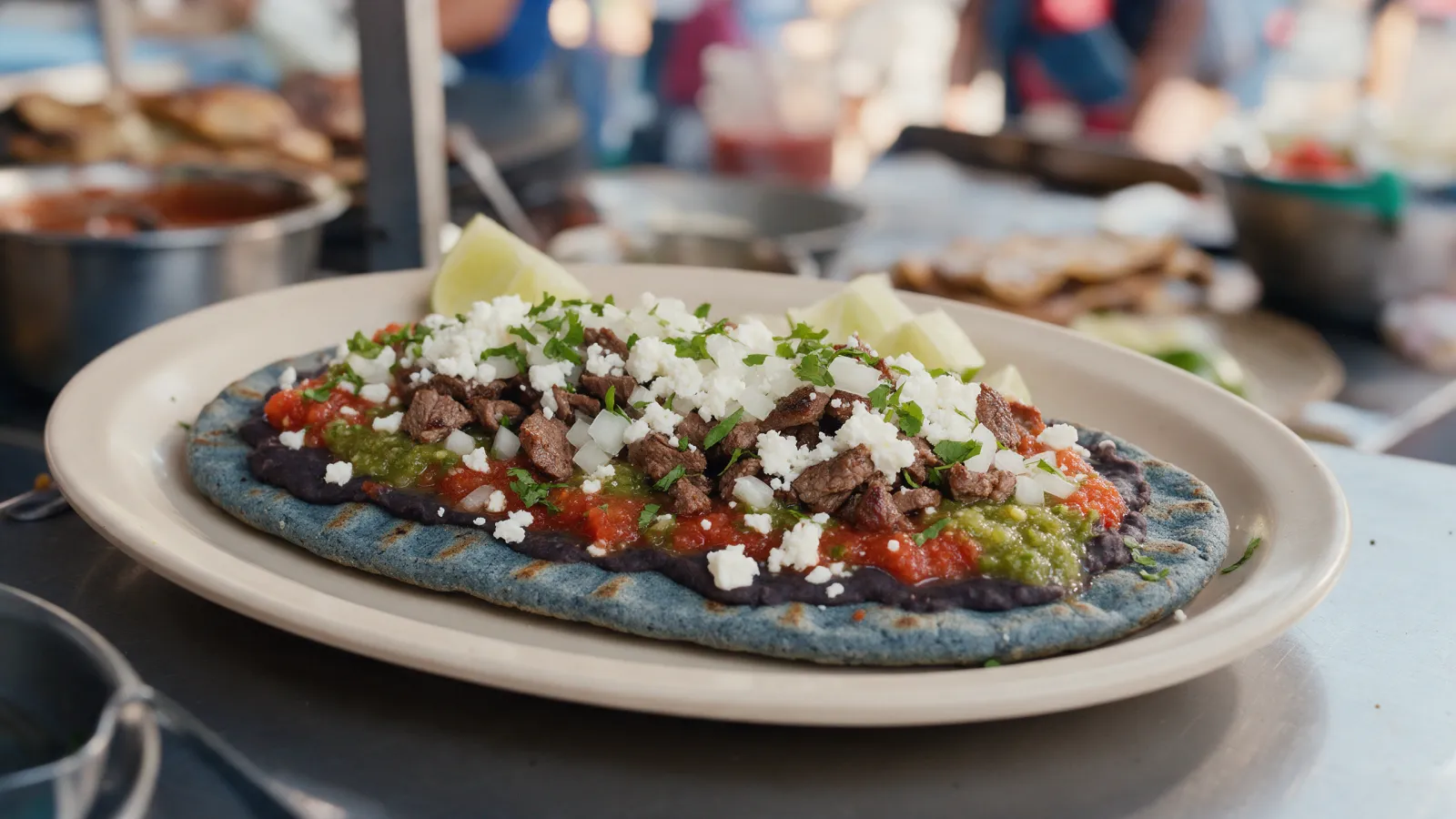

Picture the sole of a sandal made of corn dough, about 8 inches (20 cm) long, with a seam of refried beans sealed inside. That is a huarache (wah-RAH-cheh), named after the Mexican leather sandal it resembles and sold on the streets and in the markets of Mexico City. It goes over the fire twice, first on a dry griddle to set the dough and then in a film of oil that crisps the underside, and only then gets its toppings: salsa, seared steak, raw onion, crumbled cheese and crema. This guide covers the part home cooks find hard, sealing the beans in without the dough splitting, and then the timings, the topping amounts, what to buy in a US or UK store, how to get most of it done the day before, and how to scale it for a crowd.
What is a huarache, and is it worth making at home?
How do you make huaraches? Knead 340 g (3 cups) of masa harina with 475 ml (2 cups) of warm water, divide into 8 portions, seal 2 tablespoons of refried beans inside each, roll into a log and press into an oval about 8 x 4 inches (20 x 10 cm) and ¼ inch thick. Cook 4 minutes on a dry griddle, crisp with ½ tablespoon of oil, then top with salsa, steak, onion, queso fresco and crema. 65 minutes for 8 servings.
It’s worth it if you enjoy working with your hands and feeding a group. A batch of masa costs under a dollar, the beans inside mean every bite has filling even after the toppings run out, and the bases can be made a day ahead. If you’ve made sopes or gorditas, it’s the same dough in a different shape: long and flat with no rim, beans inside, meat on top.
Good for. A weekend lunch, a casual get-together where everyone picks a topping, or a way to use up leftover steak, chorizo or shredded chicken. Two per person is a full meal.
Skip it when. You want dinner in 20 minutes from scratch: it’s 65 minutes, nearly all of them hands-on. Also if you’re after something light, since two steak huaraches come to about 880 calories.
Real time. 65 minutes, about 55 of them active. The only hands-off stretch is the 10-minute rest for the dough. Shape and griddle the bases the night before and serving day takes about 20 minutes.
Honest difficulty, medium. The dough is easy. The skill is in closing the beans inside and pressing without a blowout; expect the first two to come out lopsided.
Where it comes from. The story told in Mexico City credits Carmen Gómez Medina, who sold tlacoyos by the La Viga canal in the 1930s and stretched them out to hold a steak on top. It’s a market story rather than a documented one.
Huarache vs sope vs tlacoyo
All three use the same masa. A sope is round, about 3½ inches (9 cm), with a pinched rim and everything on top. A tlacoyo is a smaller, thicker oval stuffed with beans, requesón or fava beans, eaten with little more than salsa. The huarache is the longest and flattest, with beans inside and a full load of toppings. Many US recipes skip the filling and spread the beans on top; that’s easier, but it’s no longer the Mexico City version.
What you need, with US and UK swaps
The recipe card has the exact amounts: 340 g (12 oz) masa harina, 475 ml (2 cups) water, 240 g (1 cup) refried beans and 500 g (1.1 lb) thin steak for 8 huaraches, plus salsa, onion, cilantro, queso fresco and crema.
Masa harina and how much water
Masa harina is corn that has been cooked in an alkaline solution (nixtamalized), dried and ground. It’s the only ingredient with no workable substitute: cornmeal, polenta and Venezuelan arepa flour aren’t nixtamalized and crack when you fold the dough around the beans.
The usual range is 1.3 to 1.8 ml of water per gram of masa harina: 1¾ cups masa harina to 1 cup plus 2 tablespoons of water at the dry end, 2 cups to 1½ cups in the middle, 2 cups to 1¾ cups of broth at the wet end. I land in the lower middle, 2 cups of water to 3 cups of masa harina (1.4 ml per gram), slightly wetter than tortilla dough because it has to bend around the filling. Humidity and brand change things, so hold back the last 2 tablespoons and use the palm test from the recipe card.
Conversion note. One US cup of masa harina weighs 114 g, so 3 cups is 342 g. If you scoop straight from the bag instead of spooning into the cup, you’ll pack in more; weighing avoids that.
The beans inside
2 tablespoons (30 g) per huarache, and thick. Homemade refried beans cooked down until they hold on a spoon are ideal; canned refried beans work if you cook them in a skillet for 3-5 minutes first. Thin beans are the number one reason a huarache splits in the press. Check the can if you’re cooking for vegetarians: some brands use lard.
Steak and toppings, per huarache
About 60 g (2 oz) of seared steak, 1½ tablespoons of salsa, a tablespoon of chopped onion, a pinch of cilantro, 12 g (1½ tablespoons) of queso fresco and a tablespoon of crema. A tangy salsa verde is the freshest against beans and cream; a red taco salsa with chile de árbol brings the heat. For a saucier topping, drain a batch of bistec a la mexicana and spoon it on instead of plain seared steak.
Other toppings you’ll see in Mexico City: Mexican chorizo (8 oz / 225 g for 8, browned for 4 minutes), shredded chicken, short rib, a fried egg, or grilled nopales for a meat-free version.
Where to shop, and what each swap changes
| Ingredient | US | UK | What changes |
|---|---|---|---|
| Masa harina | Maseca, 4 lb (1.8 kg) bags in most supermarkets | Online, or Latin and Mexican grocers | Nothing, as long as the bag says nixtamalized or masa harina |
| Refried beans | Any canned brand | Canned pinto or black beans, drained and mashed in a pan | Canned is looser; cook it down |
| Thin steak | Round or sirloin, sliced ¼ in | Topside, or minute steak | Sirloin is more tender and costs 48 % more per pound |
| Queso fresco | Latin brands in the dairy case | Mild feta | Feta is saltier; use a little less |
| Mexican crema | Dairy case, Latin section | Soured cream or crème fraîche | Thicker and tangier; thin with 1 tbsp milk per 3 tbsp |
Equipment, and what to use instead
A comal, flat griddle or 11-12 inch (28-30 cm) cast-iron skillet that fits two huaraches, a skillet for the steak, a zip-top bag cut into two sheets and a clean kitchen towel. A standard 7½-8 inch (19-20 cm) tortilla press works if you set the log across the handle. No press? Flatten with the bottom of a heavy skillet, then stretch the oval with a rolling pin over the plastic.
How to plan it, and how to tell each stage is right
Signs you’re on track.
- Dough → soft and smooth, no cracks at the edge of a pressed ball, not sticky.
- Shaped → no beans showing anywhere, about the length of an adult’s open hand.
- Dry griddle → it releases by itself after 1½-2 minutes; if it sticks, give it 30 seconds more. Golden spots, not black.
- Oil → the underside sounds hollow and crisp when you tap it with a spatula.
- Steak → 145°F (63°C) in the center, the safe minimum for whole cuts of beef, plus a 3-minute rest.
Sealing the beans in without blowouts
This is how I do it:
- Canoe. Shape 100 g (3½ oz) of dough into an egg and press your thumb along it, leaving walls about 1 cm (⅜ in) thick.
- Beans in a line. Lay the 30 g of beans lengthwise, not in a mound, so they spread evenly when pressed.
- Close. Pinch the edges together over the beans and smooth the seam with a damp finger.
- Log. Roll it on the counter to about 5 inches (13 cm). This evens out the filling before it meets the press.
- Press crosswise. Seam side down, log set across the handle. Press halfway, rotate 180° and press again, then stretch to 8 inches (20 cm) with your fingers through the plastic.
To move it to the griddle without tearing: peel off the top plastic, flip the huarache onto the fingers of one hand, peel off the second sheet and roll it onto the hot surface in one motion.
Why it cooks twice
The dry griddle sets the dough so you can handle it; the oil gives it a crust. The usual timing is 1 to 3 minutes per side on the griddle and 1½-2 minutes per side in the oil. I don’t fry them raw, because uncooked masa is soft and the huarache folds when you flip it.
Which version should you make?
- Short on time → griddled bases from the day before or the freezer, canned beans cooked down, and chorizo, which cooks in 4 minutes.
- First time → make them smaller, 70 g (2½ oz) of dough and 1½ tablespoons of beans; you’ll get 11, and they’re easier to flip.
- Lighter → skip the oil and serve them straight off the griddle, about 60 calories less each, and halve the crema.
- Vegetarian or vegan → grilled nopales or mushrooms with onion; for vegan, beans cooked in oil and no cheese or crema.
- Beans on top → the common US shortcut: a plain masa oval with the beans spread over it. Easier, different dish.
- If you like big masa dishes → Oaxacan tlayudas are the other large corn base in Mexican street food, though a tlayuda is a thin, crisp tortilla rather than stuffed dough.
Before you cook, mistakes, spice, kids and allergens
Mistakes and fixes.
- Splits in the press → beans too wet, too much filling, or walls too thin. Thicken the beans, stick to 30 g, keep 1 cm walls.
- Cracked edges → dough too dry. Knead in a tablespoon of water.
- Sticks to the plastic → dough too wet or plastic too thin. Dust with a spoonful of masa harina, or use a freezer bag.
- Comes out round → the log went along the handle. Turn it crosswise.
- Raw in the middle → thicker than 10 mm (⅜ in) or the heat too high, browning the outside before the center cooks. Medium-high, not high.
- Soggy base → topped too early, or salsa spread on uncrisped dough.
Heat level. The huarache itself isn’t spicy; the salsa decides. Salsa verde is mild to medium, chile de árbol salsa is hot. Put extra salsa on the table and let people choose.
Kids. Usually a hit, especially if they assemble their own. Make small ones and go light on the salsa.
Allergens. Corn masa is naturally gluten-free; check the bag for cross-contact if you’re cooking for someone with celiac disease. Dairy comes from the cheese and crema. Some canned refried beans contain lard.
Make ahead, freeze and reheat
- Raw, shaped huaraches → Shaped masa ovals keep refrigerated, stacked between waxed paper and wrapped airtight, for up to 2 hours. Longer than that, griddle them first.
- Griddled bases → cool on a rack, stack with parchment, bag them. 3-4 days in the fridge at 40°F (4°C) or below, the usual window for leftovers; frozen, they keep up to 3 months.
- From frozen → straight into the skillet with their ½ tablespoon of oil, medium heat, 3-4 minutes per side, covered for the first minute so the beans inside heat through. From the fridge, 2 minutes per side.
- Meat and leftovers → reheat to 165°F (74°C). Seared steak toughens when reheated; chorizo and shredded chicken hold up better. The microwave turns the base rubbery.
- The 2-hour rule → don’t leave cooked huaraches or toppings out longer than 2 hours.
Scaling up for 12 to 20
The recipe card feeds four people, two huaraches each. Multiply everything; the per-huarache times stay the same.
| People | Huaraches | Masa harina | Water | Refried beans | Steak |
|---|---|---|---|---|---|
| 6 | 12 | 510 g (4½ cups) | 715 ml (3 cups) | 360 g (1½ cups) | 750 g (1⅔ lb) |
| 12 | 24 | 1 kg (2.2 lb) | 1.4 liters (6 cups) | 720 g (3 cups) | 1.5 kg (3.3 lb) |
| 20 | 40 | 1.7 kg (3.75 lb) | 2.4 liters (10 cups) | 1.2 kg (5 cups) | 2.5 kg (5.5 lb) |
A single 4 lb (1.8 kg) bag of Maseca covers 20 people. The bottleneck is the crisping: two skillets, two at a time, is about 35 minutes for 40 huaraches, so make the bases the day before.
What huaraches cost in the US
At US city averages for August 2026 and the Walmart price for Maseca, the priced ingredients come to $11.74 a batch, about $1.47 a huarache, before cheese, crema and salsa.
- Boneless round steak, 500 g (1.1 lb) → $10.68 at $9.692/lb.
- Masa harina, 340 g (12 oz) → $0.75 from a 4 lb bag at $3.98.
- Dried pinto beans for 1 cup of homemade refried beans, about 85 g (3 oz) → $0.31 at $1.630/lb.
- Queso fresco, crema and salsa aren’t priced here; add your store’s prices.
What drives the price. The steak, at more than 90 % of the priced total. Swap in sirloin and the batch rises to $16.89; bean-and-cheese huaraches cost little more than the masa. I couldn’t find a comparable public price index for the UK, so I haven’t given a pound total.
What to expect, and serving 1 or 2 per person
Flavor and texture. Toasted corn, a crisp underside, a soft center with a ribbon of creamy beans in every cut. On top, salsa that has soaked just into the crust, juicy steak, sharp raw onion, salty cheese and cool crema.
Serving. On a long plate, one or two each, straight from the pan, with lime wedges and more salsa on the table. A cold agua de jamaica cuts through the richness. Eat them with a knife and fork.
Frequently asked questions
What is a huarache in Mexican food? An oval of corn masa, usually with beans sealed inside, cooked on a griddle, crisped in a little oil and topped with salsa, meat, onion, cheese and crema. It’s named for its sandal shape.
What’s the difference between a huarache and a sope? Shape and filling. A sope is small, round and rimmed with toppings only on top; a huarache is long and flat, with beans inside and toppings on top.
Do huaraches have beans inside? In Mexico City, yes. Many US recipes put the beans on top instead, which is easier but changes the dish.
Are huaraches fried? Usually both. They’re par-cooked on a dry griddle first, then shallow-fried in about 1½ teaspoons of oil until the base is crisp. Griddle-only huaraches are softer and about 60 calories lighter.
Can I make huaraches without a tortilla press? Yes. Flatten the log between plastic with a heavy skillet, then stretch it to 8 inches (20 cm) with a rolling pin.
How many huaraches does a 4 lb bag of Maseca make? About 42 at 100 g (3½ oz) of dough each, enough for 20 people at two apiece.
Can I freeze huaraches? Freeze the griddled bases, untopped and unfried, separated with parchment, for up to 3 months, and crisp them from frozen.
How many calories are in a steak huarache? One steak huarache from this recipe has about 441 calories if you count all the oil as absorbed, and roughly 380 if you skip the oil.
Nutrition
Per huarache (about 230 g / 8 oz topped, 1 of 8), calculated ingredient by ingredient from this recipe’s amounts and counting every drop of oil as absorbed, which is the upper bound:
- Calories: 441
- Protein: 22 g
- Carbohydrates: 40 g
- Fat: 22 g, of which 7 g saturated
- Fiber: 5 g
- Sugars: 3 g
- Sodium: 745 mg
The oil accounts for about 77 calories and 8.5 g of fat per huarache. Jarred salsa and the salt in the dough and steak make up two thirds of the sodium; with homemade unsalted salsa it falls to about 540 mg. A meatless bean-and-cheese huarache is around 320 calories.
I grew up in Venezuela closing empanadas made from pre-cooked corn flour, so I assumed sealing beans into masa would be second nature. It wasn’t: nixtamalized dough is more delicate, and my first batch had beans escaping out of one end. Now I cook the beans down before I start shaping, roll every piece into a log, and press it sideways. Thick beans, a log, and the press turned crosswise. Josnaisis.