

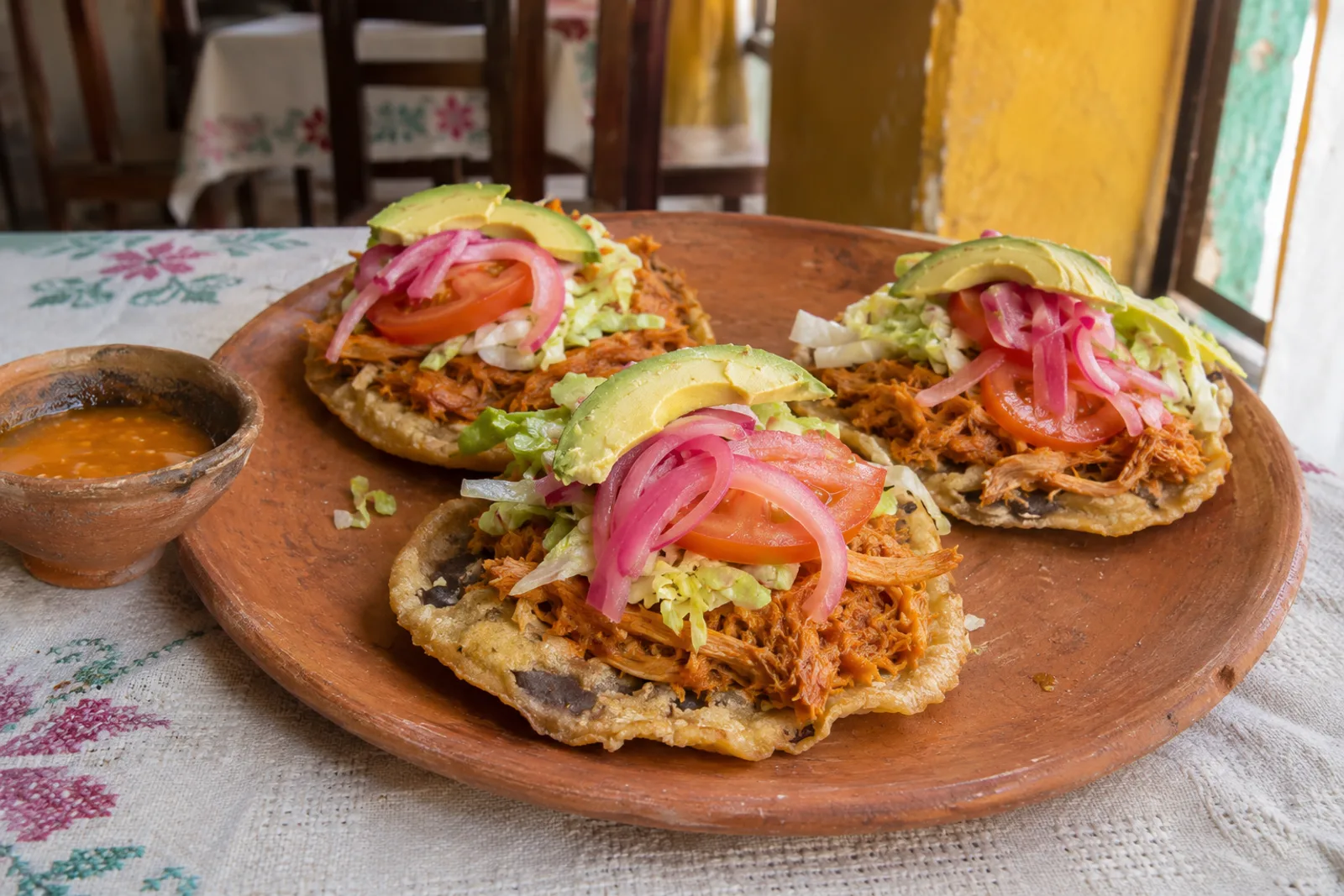

Panuchos (pah-NOO-chohs) are a Yucatán street food made from a small corn tortilla that puffs up on the griddle like pita bread, gets slit open, filled with a thin layer of refried black beans and fried until the edge is crisp. They’re then piled with shredded chicken, lettuce, tomato, avocado and red onion pickled in sour orange juice. The whole thing hinges on the puff: without it there’s no pocket for the beans. This recipe shows how to get 4 in (10 cm) tortillas to puff, how to open them without tearing, how much bean fits before they burst in the oil, and what to do with store-bought tortillas.
What panuchos are, and how long they take
How do you make Yucatán panuchos? Cook 12 small corn tortillas, 4 in (10 to 11 cm) across, on a hot griddle until they puff, slit the thin top layer while hot and spread 1 tbsp of refried black beans inside. Fry them in ⅜ in (1 cm) of oil at 350-355°F (175-180°C) for about 2 minutes per side, then top with lettuce, shredded chicken, pickled red onion, tomato and avocado. 80 minutes for 4 servings.
Think of a panucho as a crisp-edged tostada with the beans tucked inside rather than spread on top. They’re eaten by hand in two or three bites, usually for dinner, and in the Yucatán the topping is often shredded turkey or cochinita pibil, the region’s achiote-marinated pork.
Total time 80 minutes for 12 panuchos, and most of it is hands-on, since one cook runs the griddle, the filling and the oil in a chain. Medium difficulty: the dough is easy, but the first couple of tortillas often refuse to puff until the griddle is properly hot.
Ingredients for 12 panuchos, and where to shop
The recipe allows 3 panuchos per person as a main. As a snack alongside other dishes, figure on 2.
Masa harina or fresh masa
The dough is masa harina, flour made from corn treated with lime (nixtamalized), the same flour used for homemade corn tortillas. Cornmeal, polenta and arepa flour won’t work: they don’t hold together or puff. In the UK, cornflour is cornstarch, which is something else again.
- US. Masa harina is in the Hispanic aisle of most supermarkets. If there’s a tortilleria near you, 2.2 lb (1 kg) of fresh masa makes about 21 balls and skips the mixing.
- UK. Sold online and in Latin American and Mexican food shops; some large supermarkets stock it in the world foods aisle.
Black beans
Panuchos use black beans refried until very smooth. In the Yucatán they’re strained through a sieve; blending gets you almost the same result. A drained can works, and so do the Mexican refried beans made from scratch, which taste of their own broth.
Texture matters more than seasoning. You want a thick spread that doesn’t run: watery beans soak the dough from the inside and the panucho tears in the oil.
Chicken, turkey or cochinita
The recipe starts with 1 lb 2 oz (500 g) of raw chicken, poached and shredded, because it’s the easiest to find. Shredded turkey is the traditional topping in the Yucatán and is cooked the same way. Leftover cochinita works too: about 1 lb 2 oz (500 g), shredded, covers all 12, and so does pollo pibil, the achiote chicken from the same kitchen.
Pickled red onion and sour orange swaps
Thinly sliced red onion sits in sour orange juice with salt and oregano, and in 30 minutes it turns from purple to pink. It’s the acid that cuts through the fried tortilla.
- Sour orange is the bitter orange you know as the Seville orange, the marmalade orange. In the UK it’s in shops in January and February, and the juice freezes well.
- Out of season, use half sweet orange juice and half lime juice: 3 tbsp of each. Slightly sweeter and less fragrant, but close.
- Bottled sour orange from the Latin aisle in the US works, though some brands add salt or preservatives: read the label and taste before salting.
- Sweet orange juice alone won’t do. It isn’t acidic enough to pickle the onion.
Equipment. A cast-iron skillet or comal (Mexican griddle) at least 10 in (25 cm) across, a tortilla press or a heavy pan for pressing, two squares cut from a thick plastic bag, a small pointed knife, a deep 10 to 11 in (26 to 28 cm) skillet for frying and, ideally, a thermometer. Without one, a scrap of tortilla tells you when the oil is ready.
Game plan, 80 minutes and what to make ahead
Order matters because the chicken and the resting dough look after themselves while you do something else. Start with the onion, which needs its 30 minutes, and leave the griddle and the frying for the end, back to back.
Make ahead. The pickled onion, the refried beans and the shredded chicken all keep overnight in the fridge in separate containers. On the night that leaves the dough and its rest (about 20 minutes, while the griddle heats), the tortillas (about 20), the frying (about 17) and topping: about 65 minutes. Filled, unfried tortillas also keep, covered, in the fridge until the next day; take them out 15 minutes before frying, and you’re down to frying and topping, about 25 minutes.
How to make panuchos, step by step
Getting the tortilla to puff
A tortilla puffs when the water in the dough turns to steam and pushes the two faces apart. Three things make that happen:
- A very hot griddle. Medium heat for 8 to 10 minutes before the first tortilla. If the first one doesn’t puff, that’s almost always why: turn it up to medium-high. If black spots appear within 30 seconds, turn it down.
- Dough with enough water. A flattened ball shouldn’t crack at the edge. Dry dough makes tortillas that won’t puff and split when you open them.
- Even thickness. A little thicker than a taco tortilla so the bottom layer can hold the beans, but nowhere near as thick as a sope, which never puffs. If the center is thinner than the edge, the steam escapes there.
The rhythm is three turns: 20 to 30 seconds on the first side, just until it releases; 40 to 50 seconds on the second, until it’s spotted with gold; then flip back and press around the edge with a folded towel to push the steam toward the center. Within 15 to 20 seconds it balloons. These times are a guide that shifts with your griddle and the thickness: leave the first side much longer and it dries out, and that tortilla struggles to puff.
Opening and filling without tearing
Open each tortilla straight off the griddle. A puffed tortilla has a thin layer, the one that rose, and a thicker one. Hot, they separate easily; cool, they glue back together and tear.
- Lay the tortilla thin side up and cut a 1½ to 2 in (4 to 5 cm) slit in the edge, through that layer only.
- Slide the knife tip or your fingers in and loosen the layer toward the center, stopping short of the far edge.
- Add 1 tbsp of beans, about 20 g, and spread them with the back of the spoon over most of the inside.
- Press flat with your palm so the thin layer settles back onto the beans.
More beans than that and the panucho bursts in the oil and spits. If the thin layer tears as you open it, don’t throw it out: fill it anyway and start frying it torn side up.
Using store-bought tortillas
Packaged supermarket tortillas are thin and days old, and they almost never puff. Fresh tortilleria tortillas sometimes will, if you heat them on a very hot griddle and press the edge.
If none of them puff, fry the tortillas flat and spread the beans on top before adding the toppings. That’s closer to a tostada than a panucho, but with the same toppings it eats much the same.
Frying at 350-355°F (175-180°C)
The oil should be at 350-355°F (175-180°C). Without a thermometer, drop in a scrap of tortilla: it should bubble all around its edge the moment it goes in. If it only fizzes lazily, wait.
Fry 3 at a time in a 10 to 11 in (26 to 28 cm) skillet so they don’t touch, about 2 minutes per side. They’re done when the edge is golden and sounds crisp when tapped with a spatula; the middle, where the beans are, stays a little softer, and that’s how it should be. Let the oil come back up to temperature between batches, since the panuchos cool it down.
Drain them standing on edge or on a rack. Paper towels work too, but the underside softens if they sit there long.
Topping the panuchos
Top them at the last minute, because lettuce and tomato soften the tortilla: lettuce, shredded chicken, well-drained pickled onion, tomato and a slice of avocado. The only heat is the habanero in the onion; leave it out and most kids will happily eat them.
6 common mistakes and how to avoid them
- The tortilla won’t puff. The griddle is too cool, the first side cooked too long, or the dough is dry. Fix the heat first.
- It tears when you open it. It had cooled, or the dough was dry. Open it straight off the griddle.
- It bursts in the oil. Too many beans, or runny beans. One tablespoon of thick spread.
- Greasy and limp. Oil below 340°F (170°C), or too many in the pan. Fry 3 at a time and wait between batches.
- Burnt edge, cold beans. Oil above 375°F (190°C). Lower the heat and let it settle.
- Soggy before it reaches the table. Topped too early. Assemble on the plate, just before serving.
Allergens and heat. Gluten-free if your masa harina is pure corn, and free of dairy and egg unless you add a hard-boiled egg on top. The heat lives only in the habanero onion.
Panuchos vs salbutes, sopes and tostadas, 4 different snacks
All four are corn dough with something on top, which is why they get mixed up. The difference is how the dough is cooked and where the beans go.
The salbut (plural salbutes) is the closest cousin: also from the Yucatán and topped the same way, but the raw tortilla goes straight into very hot oil, puffs there and stays soft and spongy, with no beans inside. A sope is a thicker dough base with a pinched rim and beans on top. A tostada is a thin tortilla fried crisp all the way through, like the base of Mexican tuna tostadas.
Variations, and quantities for 8 or 20
- Cochinita pibil. Swap the chicken for 1 lb 2 oz (500 g) of warm shredded cochinita with a little of its juice. Same pickled onion.
- Turkey. Poach turkey breast or thigh exactly like the chicken, to 165°F (74°C) in the center.
- Vegetarian. Skip the meat, double the avocado and add slices of hard-boiled egg, which is also a Yucatán topping. Use oil, not lard, for the beans and the frying, and if the beans are canned, check the label for lard.
- Hotter. Serve a habanero salsa on the side so everyone takes as much as they want.
- For 8. Double everything: 24 panuchos. With two cooks, one on the griddle and one at the oil, it takes barely longer.
- For 20. 60 panuchos: 2.6 lb (1.2 kg) masa harina and 6¾ cups (1.6 liters) water, or about 6¼ lb (2.8 kg) fresh masa, 2¾ lb (1.25 kg) cooked black beans, 5½ lb (2.5 kg) raw chicken and 5 red onions. Fill every tortilla before you start frying and hold the fried panuchos in a 200°F (95°C) oven while you finish. With one skillet that’s 20 batches, close to an hour and a half of frying; two skillets halve it. Keep the chicken covered in the fridge until the end and reheat it to 165°F (74°C) just before topping.
For another Yucatán dish built on black beans and a fried tortilla, try huevos motuleños for breakfast.
Serving, storing and reheating
Serving. Straight from the oil, 2 or 3 per person, with extra pickled onion and habanero salsa on the table. As a dinner they need nothing else; for a full Yucatán meal, start with a bowl of sopa de lima.
Fridge. Store each component separately within 2 hours: chicken and beans keep 3 to 4 days, pickled onion 1 to 2 weeks in a sealed jar.
Freezer. Shredded chicken and beans, 2 to 3 months. Don’t freeze the onion: it goes limp.
Reheating. Fried, untopped panuchos go on a rack in a 350°F (180°C) oven for about 5 minutes, until the edge crisps again. The microwave makes them soft. Reheat chicken and beans in a pan with a splash of broth until steaming, the chicken to 165°F (74°C).
Panuchos FAQ
Can I make panuchos without frying? You can eat them straight off the griddle, filled with beans and topped the same way. They’ll be soft, like a stuffed tortilla, without the crisp edge that defines a fried panucho.
What if the tortilla only puffs halfway? Open it on the puffed side. A pocket covering half the tortilla is enough to slip in the tablespoon of beans and ease them gently toward the rest.
Can I fry them in lard? Yes, it’s the traditional fat and adds flavor. Fry at the same 350-355°F (175-180°C).
Panuchos nutrition facts
Per serving, 3 panuchos with their chicken, beans and vegetables, worked out ingredient by ingredient from the recipe quantities and allowing about 5 g of oil absorbed per panucho:
- Calories: 720 kcal
- Protein: 41 g
- Carbohydrates: 75 g
- Fat: 30 g, of which 4 g saturated
- Fiber: 14 g
- Sugars: 7 g
- Sodium: 940 mg
The dough accounts for about 220 kcal per serving, the chicken about 150 and the frying oil about 130. Salted canned beans plus the recipe’s salt will push the sodium higher.
I always make one or two test tortillas before starting for real, because the griddle takes a while to settle and those first ones tell me whether to turn up the heat or add water to the dough. The onion I pickle the night before, and I keep the beans thick: I’d rather leave some on the spoon than have a panucho split open in the oil. Josnaisis.