

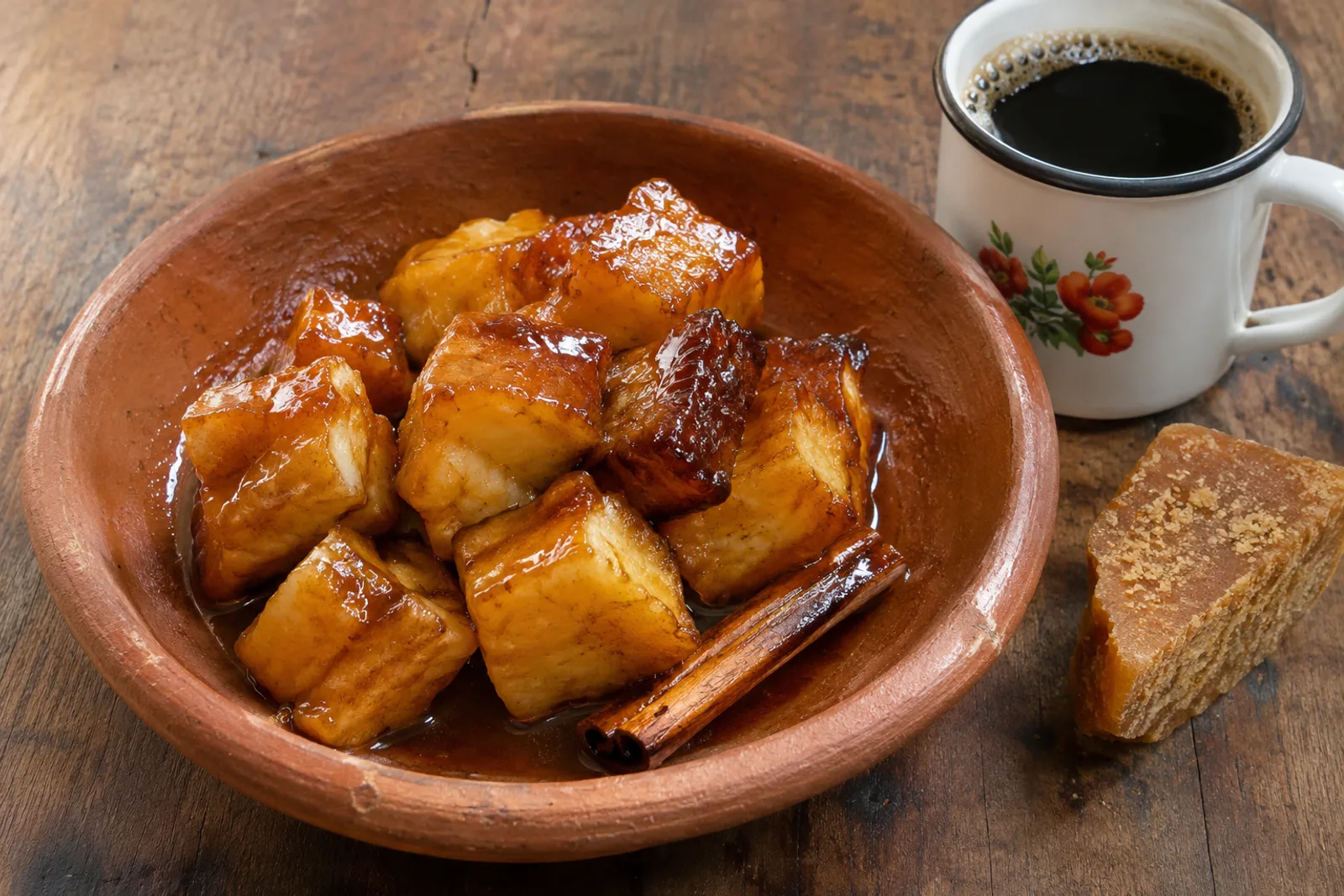

Chicharrón de cuajada (chee-chah-RRON deh kwah-HAH-dah) sounds like pork crackling, but it’s 1 lb (500 g) of fresh cheese curd, with no pork and no frying, cut into cubes and simmered for about 40 minutes in panela syrup until the outside turns the deep golden brown of a chicharrón, which is where the name comes from. The sweet belongs to Somondoco, a small town in the Tenza Valley of Boyacá, in the Colombian Andes, where it’s sold in boxes in bakeries and corner shops. At home it needs three ingredients and a skillet, and the only real question outside Colombia is which cheese to buy.
What chicharrón de cuajada is, and how long it takes
How do you make chicharrón de cuajada? Cut 1 lb (500 g) of firm fresh cheese into 1 in (2.5 cm) cubes and drain them for 10 minutes. Dissolve 7 oz (200 g) of panela in ½ cup (120 ml) of water with a cinnamon stick, add the cubes and cook over medium-low heat for about 40 minutes, turning them gently, until they’re caramel brown and the syrup has thickened. Cool for 15 minutes on a tray. 80 minutes for 8 servings.
Think of it as a cross between fudge and a warm cheese curd: a thin, sticky shell of cane sugar that firms up as it cools, around a soft center that has soaked up the syrup. It isn’t crunchy like pork rinds, despite the name. In Colombia it’s eaten with black coffee or a mug of hot aguapanela, the panela drink, in the late afternoon.
Two related dishes on this site use the same ingredients differently. Cuajada with melao serves the curd uncooked and cold, with the syrup poured over at the table. And the savory Colombian chicharrón is the real pork belly with crackling skin.
Total time 80 minutes, of which only about 20 are hands-on: 15 to cut and drain, 10 for the syrup, 40 simmering while you turn the cubes now and then, and 15 to cool. Easy. The one thing to watch is the end, when the syrup is thick and can scorch.
Ingredients, and the cheese question
| Ingredient | Metric | US | Notes |
|---|---|---|---|
| Fresh cheese, firm | 500 g | about 1 lb | Cuajada, paneer or firm queso fresco |
| Panela or piloncillo | 200 g | 7 oz | Dark muscovado sugar at a pinch |
| Water | 120 ml | ½ cup | |
| Cinnamon stick | 1 | 1 |
That makes about 30 cubes, 8 servings of 3 or 4 each.
Which cheese works, and which melts
Colombian cuajada is a fresh, unsalted curd set with rennet and sold in bags. It softens in hot syrup but doesn’t melt, and that’s the property you’re shopping for. A cheese that stretches when hot turns into a puddle on the bottom of the pan; a very wet whey cheese crumbles.
- Paneer. The closest match in the pan. It’s unsalted, it never melts and it keeps a clean cube. Many US supermarkets carry it in the cheese case, as do Indian grocers in the UK and US.
- Queso fresco or queso blanco (US Latin aisle). Works, but some brands crumble. Pick the firmest block and turn the cubes as little as possible.
- Halloumi (UK and US supermarkets). Holds up fine but is very salty and squeaky. Soak the cubes in cold water for 30 minutes to draw out some salt; it will still taste different.
- Avoid mozzarella, Oaxaca cheese and Monterey Jack, which melt, and ricotta or cottage cheese, which fall apart.
Whatever you use, it should be firm. Press it with a finger: if whey runs out, set it in a colander with a plate on top for 30 minutes before cutting. A wet cheese floods the syrup with whey, takes longer to reduce and breaks when you turn it.
Panela, and how sweet to make it
Panela is unrefined whole cane sugar, sold in hard blocks or cones. Mexican piloncillo is the same thing and is easy to find in the Hispanic aisle in the US; in the UK, look in Latin American shops or online. Dark muscovado gives a similar color and molasses flavor. Regular brown sugar works, but the result is paler and tastes flatter.
More panela doesn’t speed things up. There’s more syrup to reduce, so 250 g (9 oz) can take longer. Go by the look, not the clock: it’s done when the syrup coats the cubes and almost no liquid is left.
Equipment. A wide 10 in (26 cm) skillet, ideally nonstick, so the cubes fit in one layer and brown on every side. A wooden spoon or silicone spatula, and a parchment-lined sheet pan for cooling.
Making it, minute by minute
Cut and drain. Cubes of ¾ to 1 in (2 to 2.5 cm), all the same size so they finish together. Smaller ones break when you turn them; bigger ones stay white in the middle. Start the syrup while they drain if you want to save 10 minutes.
The syrup. Panela, water and cinnamon over medium heat, stirring, take 6 to 8 minutes to dissolve; then let it bubble gently for 2 to 3 minutes more.
The first 20 minutes. Add the cubes in one layer and lower the heat to medium-low. It will look as if something has gone wrong: the cheese releases whey and the syrup turns thinner and paler. That’s normal. Turn the cubes every 3 to 4 minutes, pushing them over from the side. Turning more often breaks them; leaving them longer makes them stick.
How to tell when it’s done
Treat the times as a guide, since they depend on how wet the cheese is, the pan and the heat; the look is what counts. At around 20 minutes the cubes are sweet but pale and soft, sitting in loose syrup. Some recipes stop there, and they’re good with a spoon. The browned version that gives the sweet its name takes about 40 minutes, once the syrup has nearly cooked away.
Look for three signs: caramel brown on every side, a glossy coating with almost no liquid left in the pan, and a spoon drawn across the bottom that leaves a clear trail for a second before the syrup closes over it. From the moment it starts to thicken, turn the heat to its lowest, because in those final minutes panela burns fast. A bitter smell or a wisp of smoke means take it off now.
Cooling. Spread the cubes on the lined tray, not touching. In 15 minutes the coating firms and stops sticking to your fingers. Piled on a plate, they weld into a single block.
What goes wrong, and how to fix it
- The cheese melted. It was a stretchy cheese. Use cuajada, paneer, queso fresco or another non-melting fresh cheese.
- The cubes fell apart. The cheese was too wet, or it was turned too often. Press it for 30 minutes before cutting, and turn every 3 to 4 minutes from the side.
- The syrup burned. High heat at the end with almost no liquid left. If only the pan bottom has darkened, lift the cubes straight onto the tray without scraping.
- Pale and watery. Not enough time, or the cubes were crowded in a small pan. One layer and 40 minutes.
- Hard and tacky. It went too far and the panela is close to hard caramel. Off the heat, stir in 2 tbsp of hot water to loosen it.
- Stuck together. They cooled touching. Separate them while hot.
Allergens. Contains milk. No gluten, egg or nuts. Each serving has about 26 g of sugar, nearly all from the panela, so it’s a proper sweet. Children usually love it.
Variations
- Soft and spoonable. Stop at 20 to 25 minutes, while the syrup still covers the pan, and serve in small cups with their syrup.
- Less sweet. Drop to 150 g (5¼ oz) of panela and keep the cinnamon.
- Sweet and salty. Colombian queso campesino, a lightly salted farmer’s cheese, or soaked halloumi, gives a firmer cube with a salty edge.
- For 16. Double everything and split it between two 10 in (26 cm) skillets, or cook two batches. A 12 in (30 cm) skillet has only about a third more surface, so the cubes no longer fit in one layer. Judge each pan by its own signs of doneness.
Serving, storing and the cost
Serving. Warm or cool, with black coffee, hot aguapanela or a cup of Colombian hot chocolate. It sits well next to almojábanas, the cheese and corn rolls of the same region, or after a Boyacá-style lunch. For the rest of that table, see the food of Bogotá and Boyacá.
Fridge. Into a sealed container within 2 hours of coming off the heat, then 3 to 4 days at 40°F (4°C) or below. The coating softens and turns stickier in the fridge’s humidity; it still tastes good.
Freezer. I don’t freeze it: fresh cheese weeps water as it thaws and turns grainy.
Reheating. Not needed, it’s eaten cool. To serve it warm, 2 minutes in a covered skillet over low heat with 1 tbsp of water loosens the syrup.
Cost. Nearly all of it is the cheese; the panela and cinnamon barely register. It’s one of the cheapest sweets you can make at home.
Frequently asked questions
Why is it called chicharrón? Because of the color. Simmered in panela, the cubes turn the golden brown of fried pork skin. That’s the only resemblance.
Can I fry the cheese in oil instead? That would be a different dish. The color here comes from the cane sugar, not from oil, and fresh curd is too wet to fry well. If you want fried cheese, use a dedicated frying cheese.
Is it like Venezuelan leche cortada? Close cousins. Venezuelan leche cortada curdles milk with lime juice right in the pot and ends up as small, tender lumps in syrup. Chicharrón de cuajada starts from a rennet curd cut into cubes and cooks until the syrup is almost gone.
Is it safe during pregnancy? Fresh Latin-style cheeses are among those that pregnant people, older adults and anyone with a weakened immune system are advised to avoid. If they eat it anyway, use cheese made from pasteurized milk, make sure it’s hot all the way through (at least 165°F / 74°C, which the boiling syrup gets it to) and eat it freshly made, with no leftovers kept for them. Check with your doctor if in doubt.
Nutrition
Per serving (one eighth of the batch, 3 or 4 cubes), worked out ingredient by ingredient from the quantities above:
- Calories: 282 kcal
- Protein: 11 g
- Carbohydrates: 26 g
- Fat: 15 g, of which 8 g saturated
- Fiber: 0 g
- Sugars: 26 g
The cheese accounts for about 187 kcal per serving and the panela about 95. Sodium is left out because it depends on the cheese: Colombian cuajada and paneer are unsalted, queso fresco and halloumi are not.
It sits very close to Venezuelan leche cortada, the same milk and cane sugar, only with something to bite into. I give it the full 40 minutes, until the syrup is nearly gone, because that browned coat is the point. For kids, or if you like it tender, pull a few cubes out at 20 minutes, still soft, and serve them with a spoon. Josnaisis.