

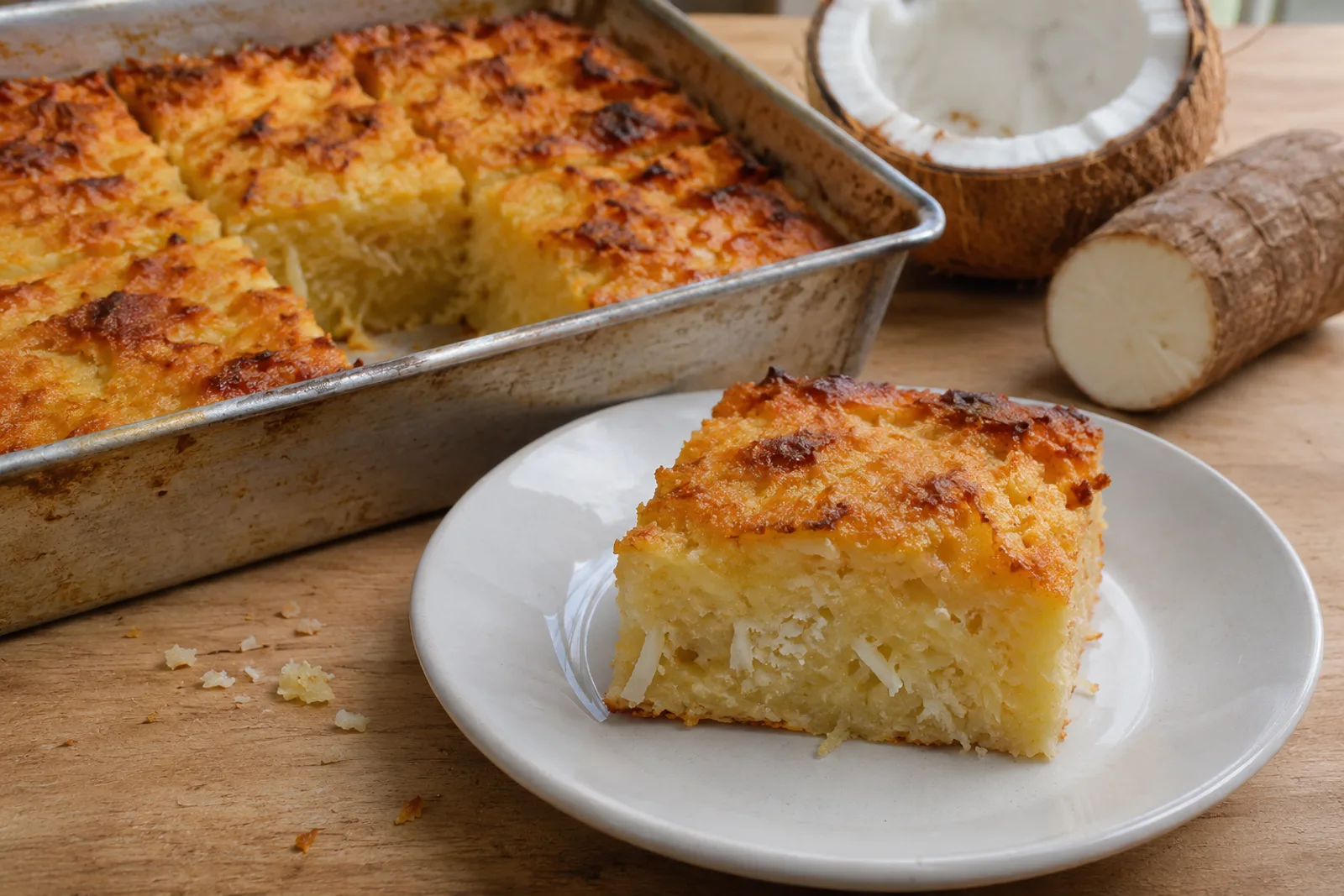

Enyucado is what happens when you bake 2.2 lb (1 kg) of raw grated cassava with salty white cheese, coconut, sugar and a teaspoon of anise seed and leave it alone for an hour. There is no flour, no egg and no leavening; the starch in the root sets it into a dense, slightly chewy slab with brown, crackly edges, sweet first and salty second. This recipe fills a standard 9x13-inch pan, works with frozen grated cassava from an Asian grocery, and spells out how to drain the cassava, which cheese to use outside Colombia and how to tell the center is cooked.
What enyucado is, and what it is not
How do you make Colombian enyucado? Grate 1 kg (2.2 lb) raw peeled cassava, wring it in a towel until it stops dripping, and mix it with 250 g (9 oz) salty cheese, 200 g (1 cup) sugar, grated coconut, coconut milk, melted butter and toasted anise seed. Spread it ¾ inch (2 cm) deep in a buttered 9x13 pan and bake at 350°F (180°C) for 50 to 60 minutes, until the edges are deep brown and pull away. 90 minutes for 12 servings, plus 30 minutes to cool.
It comes from Colombia’s Caribbean coast, where it is sold by the square from the same street trays as Colombian cocadas, the coastal coconut sweets, and cassava rolls; in Barranquilla the palenqueras, women vendors who carry their sweets in big basins, are the classic source. Think of it as a cross between a firm pudding and a very dense cake.
If you know Filipino cassava cake, enyucado is its plainer cousin: the Filipino version is enriched with eggs, condensed and evaporated milk and usually a custard topping, while enyucado has no egg and gets its edge from cheese. From the same coast, the bollo de yuca, cassava rolls boiled in corn husks, is savory and made from boiled, ground yuca, and the Venezuelan bread pudding with caramel is a baked dessert of a different family, built on stale bread and condensed milk.
Time and effort. 35 minutes of hands-on work, most of it grating, then 55 minutes in the oven. Easy: the only skill is judging how much juice to squeeze out.
Ingredients and US or UK swaps
The cheese is a quarter of the cassava’s weight and the sugar a fifth. Less cheese and the cake tastes flat; more sugar and the top darkens before the middle sets.
| Ingredient | In Colombia | US swap | UK swap | What changes |
|---|---|---|---|---|
| Cassava | fresh yuca | fresh yuca in the produce aisle, or frozen grated cassava (16 oz / 454 g packs; you need two plus about 3 oz) at Asian and Filipino grocers | fresh or frozen cassava at African, Caribbean and Asian grocers | frozen grated is finer and wetter: drain, do not squeeze |
| Cheese | queso costeño | queso costeño at Latin markets, or feta, or queso fresco plus a pinch of salt | feta, the closest match on most supermarket shelves | feta is tangier; queso fresco alone is milder |
| Coconut | fresh grated | unsweetened shredded coconut | unsweetened desiccated coconut | dry coconut needs 2 tbsp extra coconut milk |
| Coconut milk | canned or fresh pressed | canned, 13.5 oz can | canned, 400 ml can | heavy cream works but tastes milkier, less of coconut |
| Anise | anise seed | anise seed in the spice aisle | aniseed | star anise is harsher; do not substitute |
Cheese that will not work. Mozzarella, Monterey Jack or cheddar melt into strings and leave the cake greasy and rubbery. Queso costeño is firm, white and quite salty and holds its shape in the oven, so pick something crumbly and salty. Taste it first; if a piece is very salty, soak it in cold water for 10 minutes and pat dry.
Sweetened coconut from the baking aisle is fine, but cut the sugar to 150 g (¾ cup).
Equipment. A box grater or food processor, a clean cotton dish towel, a large bowl and a 9x13-inch (23x33 cm) dish, glass or metal. Glass browns the edges a little more slowly, so trust the visual cues over the clock.
Getting the cassava right
Buy firm roots with no soft spots; when you cut one, the flesh should be evenly white or cream. Black or bluish streaks mean an old root, so cut that part away or skip it. Cassava must be fully cooked before eating because the raw root contains cyanogenic compounds; the sweet cassava sold for cooking is safe once peeled and baked through, which is one more reason the center has to set completely.
How much juice to squeeze. Freshly grated cassava weeps a starchy, milky liquid. Twist it in a towel over a bowl until the stream turns into slow drips. A squeezed fistful should hold together, damp but not dripping. Leave too much water in and the center bakes up gummy and translucent even when the top is brown; wring it bone-dry and the cake turns tough and sandy.
No fine grater? Cut the peeled yuca into small chunks and blend it with the coconut milk into a thick paste. You skip the squeezing, and the cake comes out smoother and more pudding-like, with less chew.
Baking and doneness
The batter is too thick to pour; you spread it. If it crumbles, add coconut milk 1 tablespoon at a time. If it turns runny before all the coconut milk is in, hold back the rest: the cassava was too wet, so drain it a little better next time. Smooth the top: lumps scorch before the rest browns.
In a 350°F (180°C) oven, a ¾-inch (2 cm) layer follows the same pattern every time:
- At 25 to 30 minutes the edges have set but the center is pale and wobbly.
- Around 45 minutes the top turns golden and toasted spots appear where cheese and coconut sit near the surface.
- Done at 50 to 60 minutes: deep brown edges that have shrunk from the dish, a center that does not jiggle and springs back when pressed, and a toothpick that comes out moist but clean of raw white batter.
Want more color once it is cooked through? In a metal pan, slide it under the broiler for 2 to 3 minutes and do not walk away. Glass baking dishes should not go under the broiler, as they can shatter; give it a few more minutes on the middle rack instead. If the top browns too early while the center still wobbles, tent it with foil and keep going.
Cool before cutting. Straight from the oven enyucado is soft and sticky. Give it at least 30 minutes in the dish; fully chilled, it cuts like fudge. Butter the knife and wipe it between cuts.
Half or double. Half the recipe fits an 8-inch (20 cm) square pan at the same depth and time. For 24 squares, use two 9x13 dishes on the same rack or swap them halfway. Do not pour a double batch into one deep dish: at 1½ inches (4 cm) the middle stays raw.
Troubleshooting
Two more problems the chart does not cover: a cake that sticks was cut too soon or the corners were not buttered, and one that is too salty came from an especially salty cheese. Queso costeño varies a lot from block to block, so taste and soak it if needed.
Allergens and diets. Contains milk (cheese, butter) and coconut. Naturally free of gluten, eggs and tree nuts, as long as the cheese and butter have nothing added. Kids usually like it: it is sweet, and a teaspoon of anise reads as a faint licorice note, not a strong one.
Variations
- With panela or dark brown sugar. Swap the sugar weight for weight for grated panela (piloncillo in Mexican shops) or dark brown sugar. Darker, caramel-like, and it browns sooner, so check from 40 minutes.
- Cheese crust. Mix 150 g (5 oz) of the cheese into the batter and scatter the other 100 g (3½ oz) on top. Saltier, crustier top.
- Softer, with cream. Replace half the coconut milk with heavy cream (double cream in the UK). Creamier and a few minutes slower to set.
- Cinnamon and vanilla. Add 1 teaspoon of each with the anise for a more bakery-style flavor.
- No oven, in a heavy pot. Line a 10 to 11-inch (26-28 cm) Dutch oven with banana leaves (in the freezer at Latin and Asian grocers), spread the batter about ¾ inch (2 cm) deep (in two batches if it does not fit), cover with another leaf and the lid, and cook over low heat about 30 minutes, until the bottom leaf is dark brown. Flip it onto a plate, slide it back and brown the other side until the center feels firm, not sticky, when pressed. Moister, with a grassy leaf aroma.
Cost. The cheese is the expensive part, especially imported queso costeño; feta or queso fresco brings it down without losing much. Cassava and coconut are cheap at any Latin, Asian or Caribbean grocery.
Make ahead, storing and reheating
- Make ahead. Bake it a day early, cool, cover and refrigerate. It slices more neatly cold.
- Room temperature. It contains cheese and coconut milk: no more than 2 hours out.
- Fridge. Covered, 3 to 4 days.
- Freezer. I wrap squares individually and keep them up to 2 months. Thaw overnight in the fridge.
- Reheat. Covered nonstick skillet over low heat, 3 minutes per side, which re-crisps the edges, or 10 minutes in a 325°F (160°C) oven. The microwave works in 20 to 30 seconds but leaves it soft and rubbery.
On the coast it is an afternoon snack with black coffee, or dessert after a lunch of golden coconut rice with titoté and fried fish. It also closes a bowl of Colombian mote de queso, the yam and cheese soup, nicely.
Enyucado FAQs
Is enyucado sweet or savory? Sweet, with a salty background from the cheese. It is usually served as a dessert or snack, though it can also go alongside savory dishes such as fried fish.
Can I use frozen cassava chunks instead of grated? Yes. Frozen yuca chunks (often 24 oz / 680 g bags) are peeled and raw. Thaw, pat dry, remove the woody core and grate. They release more water than fresh roots, so squeeze a little harder.
Can I use cooked or boiled cassava? Not for this cake. Boiled, mashed cassava bakes into something closer to a sweet mash, soft and without the chewy texture. For enyucado the cassava goes in raw.
Why is my enyucado gummy in the middle? Too much water left in the cassava, a layer deeper than ¾ inch (2 cm), or too little time. Put it back, tented with foil, for 10 to 15 minutes.
Nutrition per square
One of 12 squares, calculated from the ingredient amounts above:
- Calories: 371 kcal
- Protein: 6 g
- Carbohydrates: 51 g
- Fat: 17 g, including 12 g saturated
- Fiber: 2 g
- Sugars: 19 g
- Sodium: 198 mg
About 133 kcal of each square comes from the cassava and 65 from the sugar; cheese, coconut, coconut milk and butter make up the rest. A very salty cheese pushes the sodium higher.
When I make this away from the coast I use feta and frozen grated cassava, and the only thing I change is the squeeze: I barely press the frozen kind. I always cut it the next morning, cold from the fridge, and the corner pieces, the darkest and chewiest, never last long in my house. Josnaisis.