
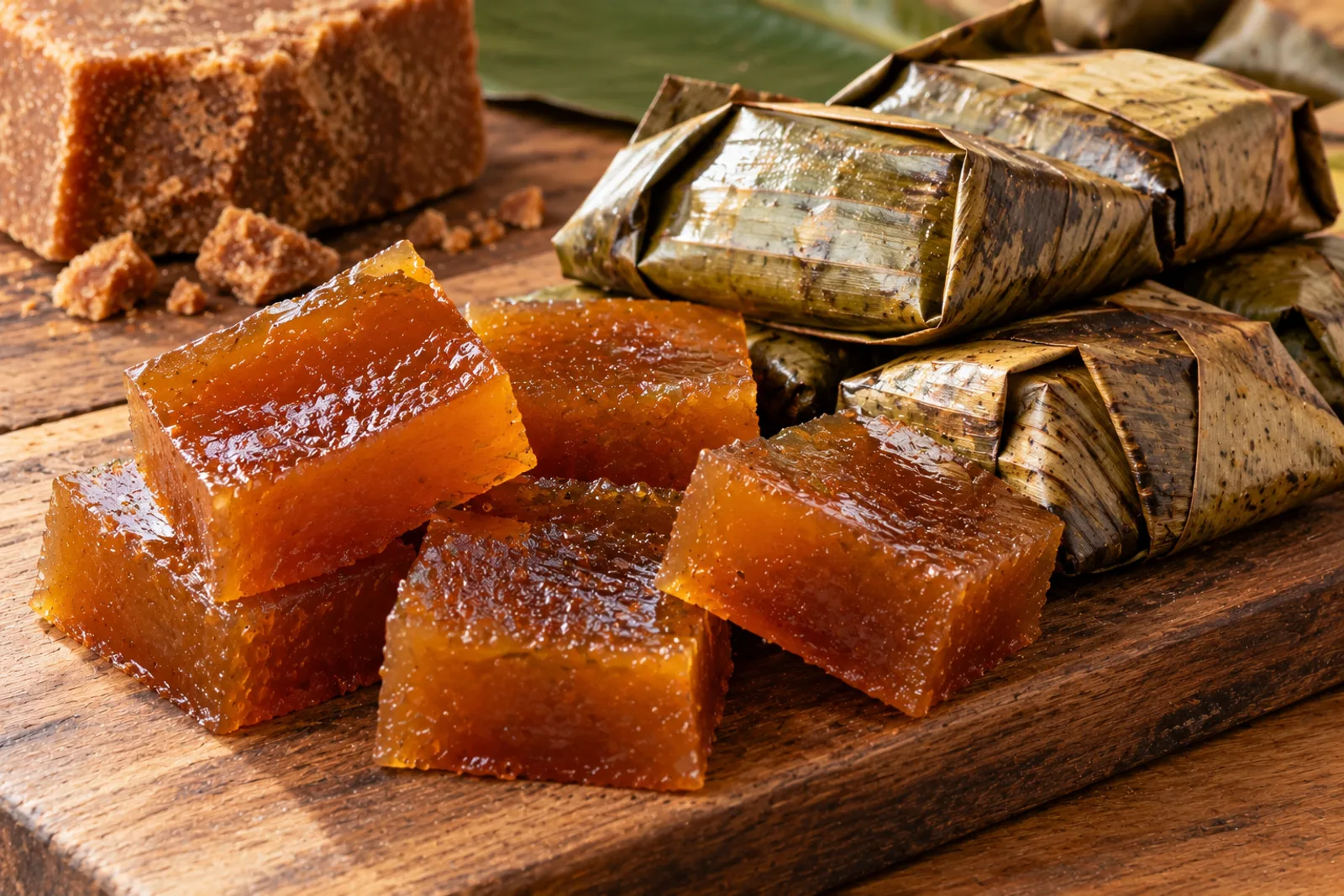

Gelatina de pata (heh-lah-TEE-nah deh PAH-tah) is a Colombian candy, not a dessert jelly. The name means “foot gelatin”: a beef foot is simmered until its collagen dissolves into the stock, that stock is boiled down with panela, Latin America’s unrefined cane sugar, and the warm mass is pulled by hand like taffy until it turns from brown to cream. The result is a soft, springy, slightly chewy sweet sold in small logs dusted with cornstarch. Its home is Andalucía, a town in Colombia’s Valle del Cauca with roadside stalls devoted to it. One foot and 3⅓ lb (1.5 kg) of panela make about 60 pieces in 4 hours with a pressure cooker.
What gelatina de pata is, and whether to make it
How do you make Colombian gelatina de pata? Pressure-cook a cut-up beef foot for 60 minutes (or simmer it about 5 hours), then strain and skim the stock. Boil it with 3⅓ lb (1.5 kg) of panela, cinnamon and cloves for 60 to 90 minutes, until a drop holds its shape on a cold plate. Cool slightly, pull with vanilla-rubbed hands until cream-colored, then cut into small logs on cornstarch. 240 minutes for 60 servings.
If you’ve had British cow heel or Caribbean cow foot soup, you know the sticky body a beef foot gives a broth. Here that body becomes candy. There’s no meaty taste when it’s done right: you get panela, a little cinnamon and the faintest savory depth underneath. In Andalucía there are two kinds: the white, pulled until pale and airy, which is this recipe, and the dark, the same mixture left unpulled and cut into shapes.
It isn’t the same as Mexican mosaic gelatin, a chilled milk jelly set with powdered gelatin, and it isn’t the savory beef-foot aspic some cuisines serve cold.
Is it worth it? Make it if you love old-fashioned sweets, miss it from home or want to see what a beef foot can do. Skip it if you want a quick dessert: it’s a half-day project, and the pulling is real work. Difficulty: hard, mostly because you have to read the finish point of the syrup and pull the candy while it’s still warm.
What you need, and where to find it in the US and UK
| Ingredient | Metric | US / UK | Where to look |
|---|---|---|---|
| Beef foot | 1.2–1.5 kg | 2½–3¼ lb | Latin, Caribbean or Asian butchers (US); halal, Caribbean or traditional butchers as cow heel (UK) |
| Panela | 1.5 kg | 3⅓ lb | Mexican aisle as piloncillo; Latin shops or online |
| Cinnamon sticks | 2 | 2 | Any supermarket |
| Whole cloves | 4 | 4 | Any supermarket |
| Vanilla extract | 10 ml | 2 tsp | For your hands, not the pot |
| Cornstarch | 80 g | ⅔ cup | UK cornflour |
- The beef foot. Ask for it cleaned and cut into 4 to 6 pieces; you can’t saw through the bone at home. In the US it’s sold as beef feet, cow feet or pata de res, often frozen and pre-cut. In the UK, cow heel is the traditional name; Caribbean, African and halal butchers are the places to ask.
- Panela. It gives the color and the deep, earthy sweetness. In the US it’s the cones or blocks labeled piloncillo in the Mexican section. If you can’t find it, dark muscovado (UK) or dark brown sugar (US) is the closest swap: you’ll get a similar color, but a flatter, more molasses-forward taste. Half panela and half white sugar gives a paler, milder candy; all white sugar, an almost white one with little flavor.
- Cornstarch keeps the candy from sticking to the tray, the counter and itself.
Equipment. A 6-quart (6-liter) pressure cooker or a large stockpot, a strainer, a blender, a wide heavy pot for the syrup, a long wooden spoon, a tray and kitchen scissors. Colombian makers pull the candy on a garabato, a hook fixed to the wall; your hands do the same job.
How to make gelatina de pata
Start to finish with a pressure cooker is 240 minutes. To split it, make the stock one day and chill it; the next day you need about 2 hours for the syrup, pulling and cutting.
Clean the foot and boil it once
Even a “cleaned” foot usually has a few stray hairs. Singe them over a gas flame (or a kitchen torch) and scrape the skin with a knife. Then give the pieces a 5-minute boil in water you throw away. This takes off the gray scum and the barnyard smell, and it’s why the candy won’t taste like soup.
Cook until the bones come out clean
- Pressure cooker: 60 minutes at pressure plus about 15 minutes of natural release, with 3 liters (about 3 quarts) of water and the pot no more than two-thirds full or past its max line. If the foot won’t fit, do two batches.
- Regular pot: about 5 hours at a low simmer, partly covered, with 4 liters (about 4 quarts) of water. Top up with hot water if the foot pokes out.
It’s done when the skin falls apart between your fingers and the bones slide out clean. If the skin is still firm, give it 15 more minutes under pressure.
Get every bit of collagen into the stock
Strain the stock and pick out the bones. The soft skin and tendons hold a lot of the collagen, so blend them with 1 cup (240 ml) of the stock and push the purée through the strainer back into the pot. Then skim. The cleanest way is to chill the stock overnight and lift off the hardened fat; in a hurry, let it settle 10 minutes and use a ladle.
The test that saves a batch. Chill a spoonful of stock in the fridge: it should set like jelly. If it stays runny, the stock is too thin and the candy won’t set however much panela you add. Boil it uncovered over medium heat until the test sets.
Cook the syrup to the right point
Stock, panela, cinnamon and cloves go into a wide, heavy pot over medium heat for 60 to 90 minutes, depending on how much stock you have. Stir every few minutes at first; for the last 20 minutes, stir constantly and scrape the bottom, because the thickening syrup catches and scorches.
How to tell it’s there:
- It darkens, thickens and bubbles slowly in big, lazy blisters.
- A wooden spoon dragged across the pot leaves a path where you can see the bottom for a second.
- The cold-plate test: drop a little on a chilled plate. If it spreads, keep cooking. If it holds a round shape and doesn’t run, it’s ready. Once that drop cools, you should be able to pick it up and stretch it like taffy.
Pull until it turns pale
Pour the mixture onto a cornstarch-dusted tray and wait about 10 minutes, until you can handle it without burning yourself but it’s still soft; once fully cold it won’t stretch. Rub your hands with vanilla, pick it up, stretch it, fold it back on itself and repeat for about 15 minutes. The air you work in turns it from dark brown to cream, makes it opaque and stops it sticking to your hands. That color change is what makes it white gelatina.
Roll and cut
On a cornstarch-dusted counter, roll the candy into ropes 1 in (2.5 cm) thick and snip every 1½ in (4 cm). Each piece weighs about 1 oz (30 g). Leave them on the cornstarch until cool and firm before you store them.
When it won’t set, won’t whiten or snaps
- Soft and sticky, never sets → weak stock or the syrup came off the heat too soon. Always do the cold-stock test before adding panela and the plate test before you stop cooking.
- Won’t turn pale, sticks to your hands → undercooked syrup. If it still runs after 15 minutes of pulling, put it back in the pot for 5 minutes and test again on the plate.
- Snaps instead of stretching → overcooked, or it cooled too much. If it’s still warm, pull right away; if it’s already hard, cut it into squares unpulled, the dark way.
- Bitter or burnt → the syrup caught on the bottom near the end. Use a heavy pot, medium heat and constant stirring for the last stretch.
- Tastes of stock → the foot wasn’t cleaned well, skipped the first boil, or the stock wasn’t skimmed.
- Too hot to handle → wait a few more minutes. Thin kitchen gloves rubbed with vanilla help if your hands are sensitive.
Allergens. No gluten, eggs or dairy, as long as your cornstarch is pure. Not vegetarian. Kids usually love it, but it’s very sweet: one piece goes a long way.
White, dark or the shortcut
- Dark gelatina. Same mixture, no pulling: once it reaches the point, pour it into a cornstarch-dusted mold or tray, let it cool and cut squares or shapes. It comes out dark brown, firmer and toastier, and you skip the hardest part.
- Paler. Half panela, half white sugar, as in the ingredient list, and pull it well.
- The unflavored-gelatin shortcut. Some people skip the foot and set a panela syrup with powdered unflavored gelatin (UK powdered gelatine). It saves the hours of simmering and gives you a pleasant panela sweet, but with the texture of a marshmallow or a gummy and none of the beef foot’s depth. I don’t call it gelatina de pata, because it isn’t.
- Half batch. Half a foot to 750 g (1⅔ lb) of panela. With less stock the syrup gets there sooner, so start the plate test well before the hour.
Cost. The foot is one of the cheapest things at the butcher’s. The real spend is the 3⅓ lb of panela and the hours of gas, which a pressure cooker cuts sharply.
Storing and serving
Store it fully cooled, tossed in cornstarch, in a closed jar or container. The candy made in Andalucía is cooked almost dry and keeps at room temperature like any hard sweet; at home you rarely get it that dry, so I leave out only what will be eaten in a couple of days and keep the rest in the fridge for up to 7 days. If it sweats or sticks, roll it in cornstarch again.
How to eat it. On its own, as a candy, with coffee or a glass of cold Colombian aguapanela. It sits well on a tray of Colombian sweets next to Colombian manjar blanco, cuajada with panela syrup, Colombian dulce de leche and Colombian panelitas de leche.
Gelatina de pata FAQ
Is it good for your joints, since it’s collagen? I can’t promise that. It does carry the collagen from the foot, but 84 to 89 g of every 100 g is sugar and starch. Treat it as candy.
Can I use pig’s feet instead? Pig’s feet give a lot of gelatin too, and they’re the usual stand-in for beef feet in a pot of Mexican menudo. But Colombian gelatina de pata is made with beef, and I haven’t made it with pork, so I can’t tell you how the flavor changes.
Does it taste like meat? It shouldn’t. With the first boil, a well-skimmed stock and enough panela, you taste cane sugar and cinnamon; at most there’s a faint savory note at the end.
Why did mine go soft overnight? The syrup came off the heat with too much water left in it. Next time trust the plate test, not the clock. The batch you have is still fine to eat; just keep it in the fridge.
Nutrition per piece
Per piece of about 1 oz (30 g), out of 60. It’s an estimate, worked out from the panela, the cornstarch that clings to the pieces and the usual share of collagen in finished gelatina:
- Calories: 109 kcal
- Protein: 3 g
- Carbohydrates: 25 g
- Fat: 0 g
- Sugars: 24 g
- Sodium: 14 mg
Almost all of the energy is panela. With the stock well skimmed, there’s next to no fat.
I make this over two days on purpose: stock on Saturday, candy on Sunday. The stock spends the night in the fridge, the fat comes off in a single sheet, and I know it has set before I spend 3⅓ lb of panela on it. And I keep a plate in the freezer the whole time the syrup is on, because the clock will lie to you and the cold drop won’t. Josnaisis.