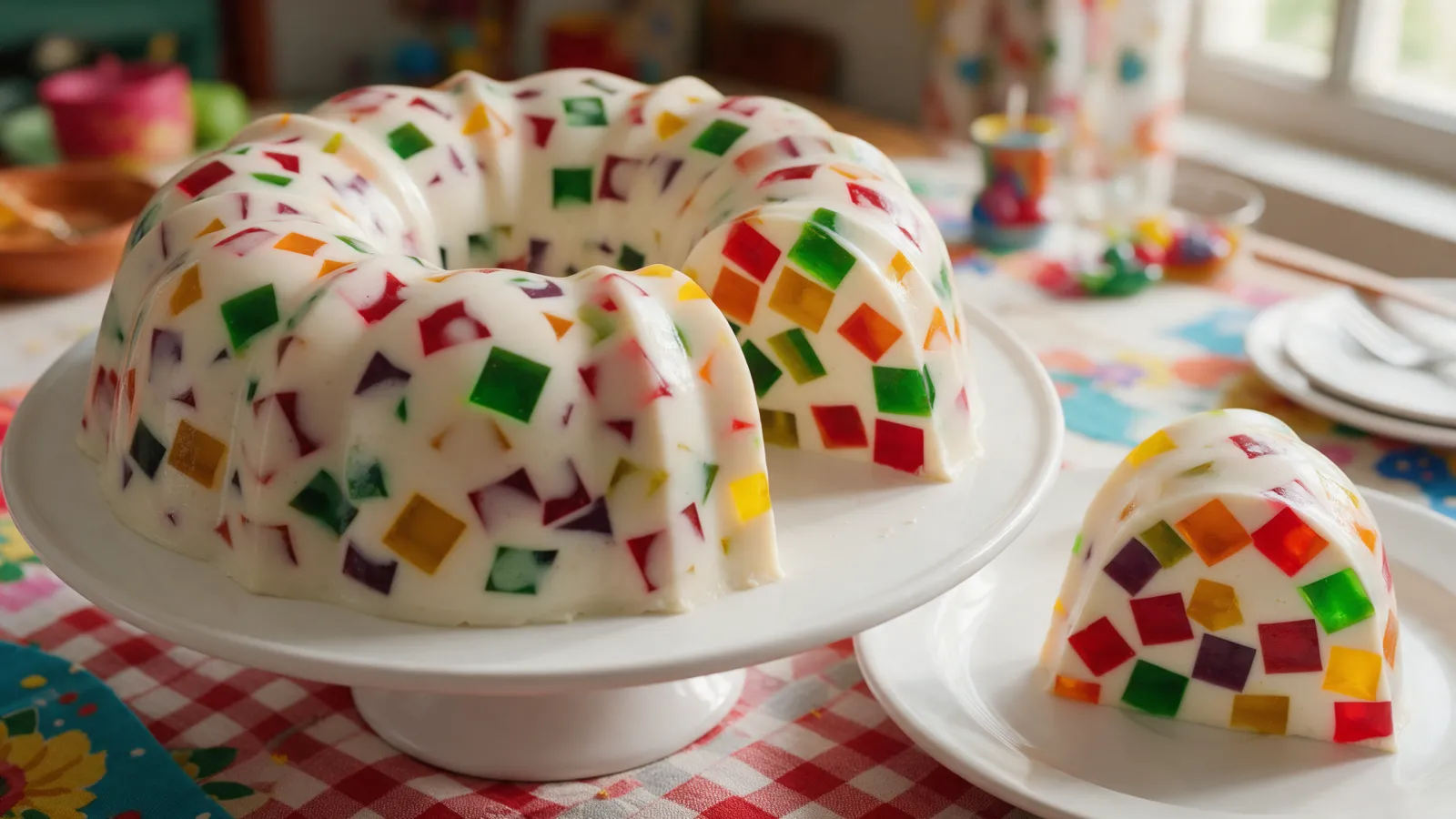

Cut a slice of Mexican gelatina de mosaico and you see stained glass: ¾-inch (2 cm) cubes of red, green and purple gelatin held in a white, vanilla-scented milk gelatin made with evaporated and sweetened condensed milk. It is a Mexican party dessert, the one that turns up at children’s birthdays and big family gatherings, and English-language recipes usually call it Mexican mosaic jello. Making it takes 50 minutes of actual work and a night in the fridge. The one thing that ruins it is pouring the milk layer warm, which melts the edges of the cubes and tints the white pink.
What is Mexican mosaic jello, and is it worth making?
How do you make Mexican mosaic jello? Set three flavored gelatins with a quarter less water than the box says, chill 4 hours and cut into ¾ in (2 cm) cubes. Bloom 28 g of unflavored gelatin, melt it without boiling and whisk it into evaporated milk, condensed milk and cold whole milk. Pour that mix, at about 68°F (20°C), over the cubes in an oiled Bundt pan and chill 6 hours. 650 minutes for 20 servings.
It is worth making if you need dessert for a crowd. One 4-quart Bundt pan serves 20 people at 7 oz (200 g) each, or 26 kid-size slices of about 5 oz (150 g), for roughly $15 of US supermarket ingredients. There is no oven, no egg, and no real technique beyond patience: most of the clock is fridge time.
The flavor is simple. The white part tastes like sweetened condensed milk and vanilla, the cubes bring fruit and acidity, and the texture wobbles and melts on the tongue.
Two reasons to skip it. It is not vegetarian, because gelatin comes from animal skins and bones (an agar version is further down). And it needs at least 10 hours of lead time, so it cannot be a same-afternoon dessert.
Ingredients, and the US and UK swaps
The flavored gelatin makes the cubes, the unflavored gelatin sets the milk, and three dairy products make the white layer. What you buy depends on where you shop.
Flavored gelatin. In Mexico it comes in 120 g (4.2 oz) packets, such as D’Gari, which normally make 1 liter (4 cups); for mosaic you use 3 cups, the cut Excélsior recommends. In the US, Jell-O’s 3 oz (85 g) box normally takes 1 cup boiling and 1 cup cold water. Fatima Madero’s mosaic recipe for the American Dairy Products Institute halves the cold water, to 1½ cups per box, for firmer cubes. Four US boxes give about a third fewer cubes than three Mexican packets, which still fill a 10- to 12-cup pan. In the UK, make jelly crystals or tablets with a quarter less water than the pack says. Pick colors that contrast, like red, green and purple; strawberry next to raspberry reads as one color in the slice.
Evaporated and condensed milk. The cans barely differ between countries: a US 12 oz can of evaporated milk is 354 ml, the UK Carnation tin is 410 g, and condensed milk is 14 oz (397 g) on both sides of the Atlantic. Use them at room temperature.
Whole milk. Cold, from the fridge. It thins the mix and, more importantly, cools it down. Gelatin sets the same way in 2% or lactose-free milk; the white layer is just a little less creamy.
How much unflavored gelatin, and why 28 g
Knox’s own guide puts one envelope, about 7 g, at 1 pint (2 cups, 473 ml) of liquid. That is a standard set. A milk layer that has to hold 5.7 lb (2.6 kg) of cubes and come out of a Bundt pan in one piece needs more, and the published mosaic recipes I compared use between 12.6 and 28.7 g per liter. I use 28 g, four envelopes, for 1.27 liters (5⅓ cups) of milk mix, which is 22 g per liter and close to the middle of that range. In a Bundt pan I wouldn’t go below about 20 g per liter, because it has to carry its own weight when flipped. Serving it outdoors in summer, or using an extra-tall pan? Add a fifth envelope.
In the UK, where leaf gelatine is common, Maricruz Avalos gives 1 tablespoon of powder as 3 sheets, so 12 leaves here. Soak them 5 minutes in cold water, squeeze, and melt them the same way.
Fruit that stops gelatin from setting
Jell-O boxes in the US warn against fresh or frozen pineapple, kiwi, papaya, figs, guava and gingerroot: their enzymes break down the gelatin protein and it won’t set. Canned or cooked fruit is fine, and so is pineapple-flavored gelatin.
Equipment, and what to use without it
A 4-quart (4 L) Bundt pan, or two 2-quart pans, three 8 × 8 in (20 × 20 cm) pans for the slabs, a whisk and a long knife. No Bundt pan? Use a 9 × 13 in glass dish that is at least 2 in (5 cm) deep and serve it in squares without unmolding. A thermometer helps but isn’t needed: the milk should feel cool on the inside of your wrist.
Why the cubes melt, and the 86°F rule
Gelatin gels melt below human body temperature. That is why mosaic jello melts in your mouth, and also why a warm milk layer dissolves the outside of every cube it touches. The ADPI recipe says the milk mixture must be at room temperature, “neither hot nor warm”, or it will dissolve the colored cubes.
My rule is 86°F (30°C) or cooler, which leaves a margin below the 95°F (35°C) where the gel softens. The easy way to stay under it is to never heat the milk. Some recipes bring the milks to a simmer and then ask you to wait for them to cool; that waiting is where most people get impatient. Melt only the gelatin, in its ½ cup of water, and whisk it into cans at room temperature (about 72°F, 22°C) and milk at fridge temperature (about 40°F, 4°C). Even if the melted gelatin is at 140°F (60°C), my math puts the mix at about 68°F (20°C). If your milk is also at room temperature it lands near 79°F (26°C), still under the limit.
The opposite mistake exists too. If the mix sits too long, the gelatin starts to set and stops flowing between the cubes. Once it thickens to the consistency of unbeaten egg white, Knox’s own description, pour it.
Step by step, and the signs that each stage worked
The recipe card has the full method. Here is what to look for at each stage.
- Flavored gelatin dissolved → the spoon comes out with no grains, and the liquid is clear.
- Slabs ready → after 4 hours the center doesn’t stick to your finger and the slab doesn’t slide when you tilt the pan.
- Gelatin bloomed → after 5 minutes it is one firm, opaque block; stir in any dry patches.
- Gelatin melted → clear and smooth, hot to the touch but not bubbling.
- Milk mix → smooth, no strings, cool on your wrist. Strings mean the hot gelatin hit cold milk too fast; strain it and carry on.
- Mosaic set → after 6 hours the whole surface wobbles as one block when you nudge the pan, with no liquid on top.
Unmolding it in one piece
Knox’s advice is a brief dip in warm water, never hot, just up to the gelatin line; I count to ten at most. Hot water melts the white outer layer and smears the pattern. Loosen the outer edge and the center tube with a knife tip to let air in. Rinse the serving plate with cold water, which lets you slide the dessert to the center if it lands off, and flip in one motion. If it doesn’t drop after two shakes, give it another 5 seconds.
Make-ahead plan and party math for 20 to 40
One batch fills a 4-quart Bundt pan: 20 servings of 7 oz (200 g), 26 smaller slices, or about 20 cups of 7 oz (200 ml). For 30 to 40 guests, make two separate batches in two pans. I wouldn’t double it in one mold, because 18 lb (8 kg) of gelatin is hard to flip in one piece.
The day before. Make the colored slabs in the evening, cover them and leave them in the fridge overnight. You can also assemble the whole thing the day before, which gives it a full night to set and unmold more firmly.
The day of the party. Cut the cubes, make the milk layer, fill the pans in the morning, and the mosaic is ready 6 hours later. In 7 oz cups, the milk layer sets in about 3 hours, according to Maricruz Avalos, because each cup is small.
For 6 people. Make a third: one 120 g packet of a single color in 3 cups (750 ml) water, 120 g (4¼ oz) evaporated milk, 130 g (4½ oz) condensed milk, ⅔ cup (170 ml) whole milk, 3 tbsp (40 ml) water and 9 g unflavored gelatin (one envelope plus 1 tsp), in a 5-cup (1.3 L) mold.
Mistakes that ruin mosaic jello
- The cubes bleed color into the white → the milk layer was warm. Keep it under 86°F (30°C) and don’t heat the milks.
- The white layer stays soft → the gelatin boiled, wasn’t bloomed, or there wasn’t enough. Bloom in cold water for 5 minutes and melt gently.
- Strings of gelatin in the milk → it went into cold milk all at once. Temper it with half a cup of milk first, then pour in a thin stream.
- It cracks when you unmold it → not enough gelatin or not enough time. At least 6 hours, ideally 12.
- The outside looks melted → the unmolding water was too hot or the dip too long.
- The cubes float to the top → all the milk went in at once. Pour in two or three additions and push the cubes down as it thickens.
- Nothing sets → fresh pineapple, kiwi, papaya or guava got in.
Variations, from yogurt to vegetarian agar
- With yogurt → replace the whole milk with 500 g (2 cups) plain unsweetened yogurt, whisked in cold. Tangier, same calories. Never heat the yogurt.
- Lower sugar → sugar-free gelatin for the cubes and a second can of evaporated milk, sweetened to taste, instead of the condensed milk. By my calculation with USDA data it drops to about 74 calories a serving, but the white layer is noticeably less creamy.
- Vegetarian, with agar → agar has to be boiled, sets between 95 and 113°F (35-45°C) and doesn’t melt until about 185°F (85°C). That means the cubes must be agar too, made from clear fruit juice with about 10 g agar per 3 cups (750 ml), since a milk layer with agar has to be poured at about 120°F (50°C) and would melt gelatin cubes. For the milk layer, dissolve about 11 g agar in the cold milk (0.9 g per 100 ml, The British Larder’s ratio for neutral liquids), boil 2 minutes, then whisk in the cans. It slices cleanly but doesn’t wobble or melt in the mouth.
- With cream cheese → blend 180 g (6 oz) cream cheese into the milks, as Excélsior does, for a denser, cheesecake-like white layer.
What does mosaic jello cost in the US and UK?
In the US, one pan comes to about $15.07, or 75 cents a serving, made with four Jell-O boxes. These are shelf prices checked in October 2026, plus the BLS average for milk:
- Jell-O, four 3 oz boxes → $7.56 at $1.89 a box (Lowe’s Foods), half the total
- Knox unflavored gelatin, box of 4 envelopes → $3.29 (Lowe’s Foods and Fry’s)
- Sweetened condensed milk, 14 oz → $2.47 (Great Value, Walmart)
- Evaporated milk, 12 oz → $1.22 (Great Value, Walmart, regular price)
- Whole milk, 2 cups → $0.53, per the BLS US city average of $4.229 a gallon in August 2026
In the UK, Tesco lists the Carnation evaporated tin (410 g) at £1.65 and the condensed tin (397 g) at £1.75, so the two cans come to £3.40. I couldn’t find a reliable UK price for jelly and gelatine to complete the total, so I won’t guess.
The flavored gelatin is the expensive part. A store brand instead of Jell-O is the quickest way to cut the cost.
Allergens, kids and the gelatin question, spice level 0 of 5
Dairy is in every part of the white layer. The recipe has no egg, wheat or nuts, but check the flavored gelatin label if you’re cooking for someone with celiac disease. Gelatin is an animal product: most of it, according to Wikipedia, comes from pork skins, pork and cattle bones, or cattle hides, so it isn’t vegetarian, and it isn’t suitable for anyone avoiding pork unless the label says otherwise. Flavored gelatins contain artificial colors.
Kids love it. It is sweet, cold, colorful and easy to eat with a spoon, and individual cups are easier for small hands than slices. There is no heat at all, zero on any spice scale.
Serving and storing mosaic jello
Serve it cold, straight from the fridge, sliced with a knife dipped in hot water and wiped between cuts. On a party dessert table it sits well next to a Mexican flan napolitano or a tres leches cake, which use the same cans, and a no-bake passion fruit dessert or a no-bake Mexican lime pie adds a sharp contrast. For other make-ahead custards, there’s the stovetop Colombian flan and the Venezuelan quesillo I grew up with, and for something warm, Colombian rice pudding.
Fridge. Covered with plastic wrap, 3 to 4 days at 40°F (4°C) or below, per the USDA FSIS guidance for leftovers. At a party, keep it out of the fridge no more than 2 hours, or 1 hour above 90°F (32°C), per FSIS. In heat it also starts to weep and soften.
Freezer. No. Maricruz Avalos and El Diario both advise against freezing it because the texture suffers once it thaws.
If it softens at the party, an hour back in the fridge firms it up again.
FAQ
How much unflavored gelatin goes in mosaic jello? This recipe uses 28 g (4 Knox envelopes) for 1.27 liters (5⅓ cups) of milk mix, about 22 g per liter. The published versions I compared run from roughly half that firmness to a little more.
Why did my jello cubes melt into the milk? The milk layer was warm. Gelatin gels melt below body temperature; pour at 86°F (30°C) or cooler.
How long does mosaic jello take to set? 4 hours for the colored slabs and at least 6 hours for the assembled Bundt pan, ideally overnight. Small cups set in about 3 hours.
Can I make mosaic jello the day before? Yes, and it’s the best plan: a full night in the fridge makes it unmold more firmly.
How many servings does one Bundt pan make? This recipe makes 20 servings of 7 oz (200 g) or 26 smaller slices, or about 20 cups of 7 oz.
How long does mosaic jello last in the fridge? 3 to 4 days covered, at 40°F (4°C) or below. Don’t freeze it.
Can I make it with agar instead of gelatin? Yes, but make the cubes with agar too. An agar milk layer has to be poured at about 120°F (50°C), hot enough to melt gelatin cubes.
What is the difference between grenetina and gelatin? None. Grenetina is the Mexican name for unflavored gelatin, powder or leaves.
Nutrition per serving
Per serving (1/20 of the pan, about 7 oz or 200 g), calculated ingredient by ingredient from USDA FoodData Central (SR Legacy) with the quantities above, using “gelatin desserts, dry mix” for the flavored gelatin:
- Calories: 176 kcal
- Protein: 6 g
- Carbohydrates: 30 g
- Fat: 4 g, of which 2 g saturated
- Sugars: 29 g
- Sodium: 141 mg
Nearly all of it is sugar: the flavored gelatin supplies 39% of the calories and the condensed milk 35%. A 5 oz (150 g) party slice is about 130 calories.
In Venezuela our birthday dessert was quesillo, so I came to mosaic jello late, and my first one came out with a pink-stained white layer because I poured the milk straight off the stove. Now I only melt the gelatin and keep the milks cold, and the slice comes out as sharp as glass. Josnaisis.