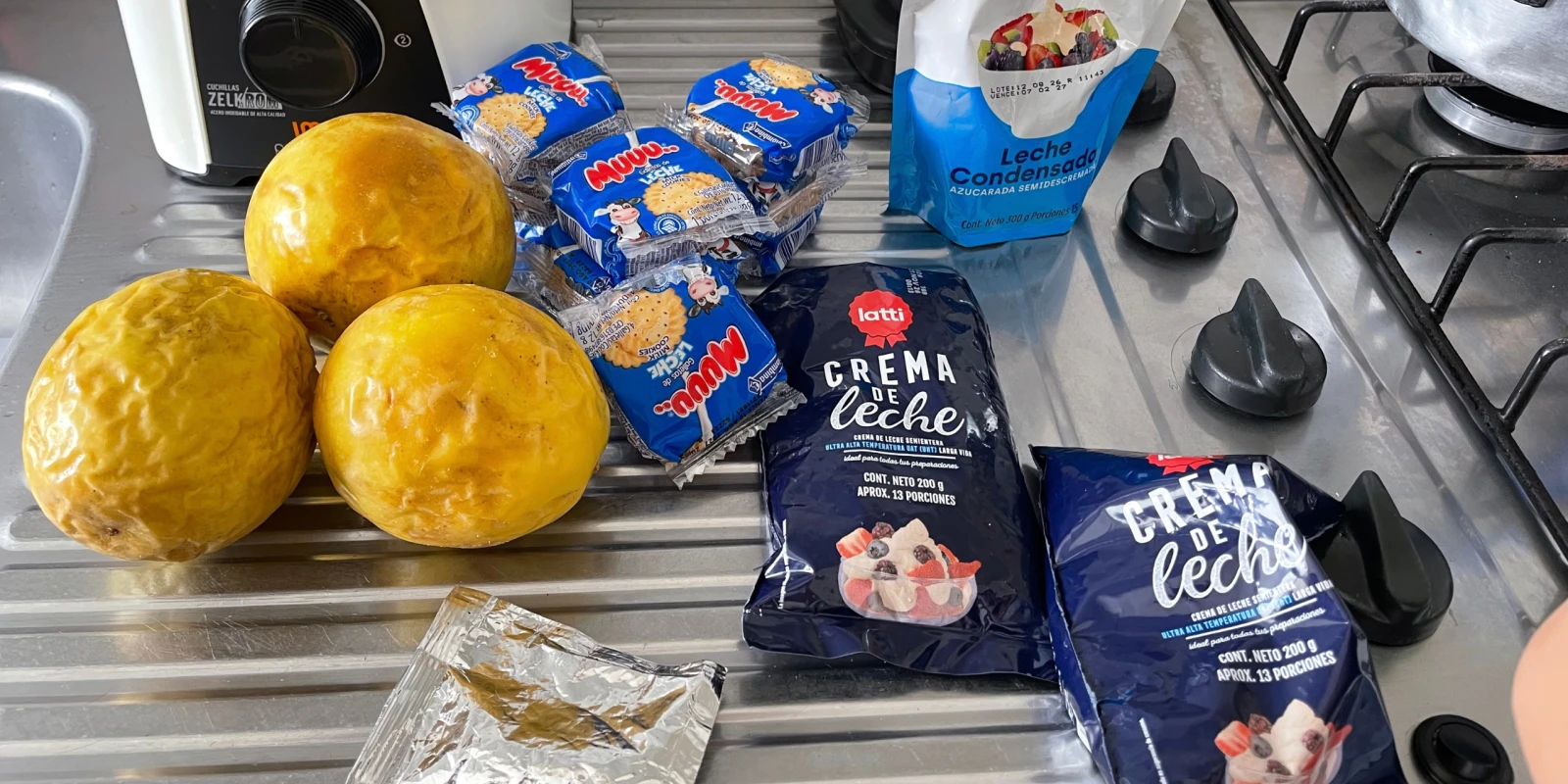
Passion fruit is one of the few tropical fruits you can fold into gelatin raw, straight from the shell, and that single fact is what makes this dessert work without a stove. Three yellow maracuyá, a cup of heavy cream, half a cup of condensed milk and one envelope of gelatin give six glasses that set in the fridge overnight or in three hours flat. It is the dessert Colombian households make when there is no oven, and there often is not. Below: how many fruits you actually need depending on which passion fruit your supermarket stocks, the leaf-to-powder conversion, and what to do when it will not set.
What this dessert is and which passion fruit to buy
How do you make a no-bake passion fruit dessert? Blend the pulp of 3 passion fruit for 10 seconds and strain it to get a scant ½ cup of juice. Bloom 1 envelope of powdered gelatin in 3 tbsp of cold water for 5 minutes, then melt it to 120-140°F (50-60°C). Blend the juice with 1 cup of heavy cream, ½ cup of condensed milk and the melted gelatin for 20 seconds, layer it into glasses with broken cookies and chill for 3 hours. 200 minutes total, 20 of them active, for 6 servings.
The first thing that trips people up outside Latin America is the fruit itself. What Colombia calls maracuyá is the yellow passion fruit, a fruit the size of a large egg that weighs 4 to 5 oz. What a British or American supermarket sells as passion fruit is usually the purple kind, wrinkly and barely bigger than a plum, holding a couple of tablespoons of pulp each. Both work, but the count changes completely, and a recipe that says “three passion fruit” will leave you far short if yours are the small ones.
Frozen pulp is the honest shortcut, and in most of the United States it is easier to find than the fresh fruit: look for the plastic tubs in the freezer aisle of any Latin grocer. The only thing to check is the label, because a good half of them are already sweetened, and if yours is, drop the condensed milk to ½ cup minus two tablespoons or the dessert goes cloying.
Leaf gelatin, powdered gelatin, and how much you need
The whole mixture comes to roughly 2 cups once the juice, cream and condensed milk are together, and one American envelope of powdered gelatin holds ¼ oz, which is 7 g. That works out to 1.4 g of gelatin for every 100 g of mixture, and it is the ratio of a spoon dessert: it holds its shape in the glass but it will not stand up on a plate. For a mould you can turn out, you want 12 g.
If you cook in the UK, Ireland or Australia you are probably holding leaves rather than powder. The grades matter less than people fear, because leaves are sold so that one leaf of any grade sets the same amount of liquid, even though a bronze leaf weighs roughly twice what a platinum one does. Four leaves replace one envelope. The method differs though: leaves soak in a bowl of plenty of cold water for 5 minutes, then get lifted out and squeezed hard before melting, whereas powder is sprinkled over a measured 3 tbsp and absorbs all of it.
Temperature is where most failures happen. Gelatin melts at 120-140°F (50-60°C), which is 15 seconds in a microwave, and above the boil its protein chains break down and lose setting power. At the other end it only begins to gel below 59°F (15°C), which is why the freezer is no shortcut: it firms the outside, leaves the middle liquid, and puts ice crystals through the cream.
Why passion fruit sets raw when pineapple does not
Gelatin is collagen, and collagen is protein almost neat: 100 g of the powder carries 85.6 g of it according to the USDA SR Legacy database. Several raw fruits carry proteases, enzymes that cut protein chains, and they take gelatin apart faster than it can set. Pineapple has bromelain, papaya has papain, kiwi has actinidin, fresh ginger has zingibain. Passion fruit carries none of them in any meaningful amount, which is why its juice goes in raw here while the pineapple in a caramel pineapple upside-down cake has always been through heat or a can.
There is a second, quieter effect. Passion fruit juice is sharply acidic, sitting at pH 3 or a little under, down to 2.8 in ripe yellow fruit, and acid weakens a gel by hydrolysing the gelatin. In this recipe the juice is outnumbered roughly four to one by cream and condensed milk, which buffer it. Make the same dessert with straight juice and one envelope and it sets noticeably softer than the packet promises.
Ingredient swaps outside Latin America
Heavy cream / double cream. American heavy cream at 36% fat is the target. British double cream runs to 48% and is too rich and too thick to blend smoothly; let it down with 2 tbsp of whole milk per cup. Single cream and half-and-half are too thin and the dessert never feels creamy, however well it sets.
Condensed milk. Sweetened condensed milk, not evaporated. This is the same tin behind dulce de leche and Colombian condensed milk lemonade, so an open tin has somewhere to go.
Maria cookies. The Spanish and Latin standard, sold as Gullón or Marías in most supermarkets’ international aisle. Digestive biscuits are the closest British stand-in, Nilla wafers or arrowroot biscuits the closest American ones. Graham crackers work but bring their own honey flavour. Avoid anything soft or filled: soft cookies dissolve into the cream and vanish.
Gelatin. Knox is the standard American powder, one envelope per sachet. Vegetarians cannot substitute agar one for one here, because agar sets brittle and at a much higher temperature; if you must, use 1 tsp of agar powder simmered into the cream for 2 minutes and expect a firmer, sliceable texture rather than a creamy one.
How to make it, step by step
Here is the recipe as I make it at home, filmed in Spanish, with the glasses layered and the sauce spooned on at the end.
Blending without cracking the seeds
Passion fruit pulp clings to the seed in little sacs, and the blender’s job is to knock it loose. Use short pulses of about two seconds, four or five of them, and stop the moment the contents go from a mass of seeds to an orange liquid with whole black specks in it. Half a minute of continuous blending cracks the seeds, which releases a bitterness you cannot rinse out and turns the juice a dull grey-green. Then sieve, pressing with the back of a spoon, and throw away what stays in the sieve.
Layering so the cookies do not sink
Start and finish with cream. About an inch of mixture, then broken cookies in large pieces, then more mixture, on up to the rim. Tap the glass on the counter two or three times after each layer. The mixture is thick enough to trap air pockets around the cookie pieces, and those pockets are what make the dessert collapse when the spoon goes in. Chill the glasses uncovered; covering them warm traps condensation that drips back onto the surface.
Who this recipe is for
- Anyone who has to bring dessert somewhere and has no time to turn the oven on: 20 minutes of work, and the fridge does the rest.
- Anyone with wrinkled, ugly-looking passion fruit sitting on the counter, which are exactly the ripe and fragrant ones.
- Kitchens with no oven at all, which is the norm in a lot of Colombian homes.
- Individual portions served in the glass, with no unmoulding and no cutting.
What goes wrong
The gelatin boiled. The single most common reason a set dessert stays liquid. It melts at 120-140°F (50-60°C) and that is all it needs; a minute at a rolling boil breaks the chains. Fifteen seconds in the microwave, not sixty.
Melted gelatin hit a fridge-cold mixture. It seizes on contact and forms transparent threads that never dissolve, visible as little strings in the finished glass. Bring the juice to room temperature and pour the gelatin in a thin stream with the blender running.
Over-blending the pulp. Ten seconds. Past that the seeds crack and the dessert turns bitter.
Fresh pineapple, papaya or kiwi in the layers. It will not set. Boil them for 5 minutes first to kill the enzyme, or use canned.
Over-blending the cream. Twenty seconds. Keep going and the cream whips, the volume nearly doubles, and you get an airy mousse instead of a dense, creamy set.
The freezer. It sets the rim, leaves the centre loose and leaves ice in the cream. If you are short on time, use smaller glasses, which set in about 2 hours.
Make ahead and storage
This is a dessert that improves with a night in the fridge, so it suits making the day before. Cover the glasses once they are cold and set, never while warm. They keep 3 days, and by day two the cookies have gone completely soft, which a lot of people prefer. Keep the passion fruit sauce in a separate jar and spoon it on within an hour of serving, or it bleeds into the cream and the top layer goes streaky.
It does not freeze. Gelatin gels break when they thaw and weep water, and the texture does not come back. If you need a frozen make-ahead instead, a flan takes the fridge just as well and slices better for a crowd.
Variations
Cookie base instead of layers. Crush the 4 oz of cookies with 3 tbsp of melted butter and press the crumbs into the bottom of each glass. You get something closer to a cold cheesecake, with one compact base rather than layers.
Turned out of a mould. Raise the gelatin to 12 g, pour into an 8-inch mould and chill for 5 hours. It comes out whole and slices, ending up on the plate much like a Venezuelan quesillo, though it tastes nothing alike.
With cream cheese. Swap ½ cup of the heavy cream for 3.5 oz of room-temperature cream cheese. It adds a tang that suits passion fruit and gives a denser set.
Half passion fruit, half mango. Mango carries no protease, so it can go in raw: ¼ cup of each juice. The mango softens the acidity for anyone who finds straight passion fruit too sharp.
With dulce de leche between the layers. A spoonful between each layer, for the sweet-toothed end of the table.
What to serve it with
It is an end-of-a-long-lunch dessert, the kind that comes out after something heavy. On a Christmas table it holds its own next to natilla and rice pudding, and it brings the acidity that a table of milk-and-panela desserts tends to lack. Served in the afternoon, a black coffee alongside balances the condensed milk. After a plate of bandeja paisa, which runs well over 1,000 calories, a cold 339-calorie glass is about all anyone wants.
Frequently asked questions
Can I use frozen pulp instead of fresh fruit? Yes, and out of season it is the usual route. You need a scant ½ cup of thawed, strained pulp. Check whether it is sweetened, and if it is, cut the condensed milk back by about 2 tbsp before you blend.
Mine did not set. Can I fix it? Usually. The three causes are boiled gelatin, gelatin poured into a too-cold mixture, or simply not enough for the volume. If it is still loose after 3 hours, tip it back into the blender with another ½ envelope bloomed and melted, blend briefly, and layer it again.
Can I make it without gelatin? Not with the same texture. The classic stovetop version thickens with 3 tbsp of cornstarch dissolved cold and cooked into the milk, the way natilla is made. It comes out denser and tastes of cooked milk, and it is no longer a no-cook dessert.
How long does it take to set in individual glasses versus one big dish? Small glasses of around 4 oz are firm in about 2 hours. The 6-glass batch here needs 3. A single large dish needs 5 hours and more gelatin, since nothing is holding the sides.
Is it very sweet? Moderately. All 28 g of sugar per serving come from the condensed milk and the fruit; nothing else is added. Dropping the condensed milk to ⅓ cup works if you like desserts sharp, but below that the set gets loose as well as sour.
Nutrition
Per serving, calculated from USDA SR Legacy values for each ingredient, over a total mixture of 24 oz divided into 6 glasses.
- Calories: 339 kcal
- Protein: 5 g
- Carbohydrates: 35 g
- Sugars: 28 g
- Fat: 20 g
- Saturated fat: 12 g
- Fibre: 1 g
- Sodium: 112 mg
Nearly all the fat comes from the cream and nearly all the sugar from the condensed milk. Raw passion fruit is high in fibre, 10.4 g per 100 g according to the same database, but almost all of it sits in the seeds and stays behind in the sieve, which is why a serving here shows barely any.
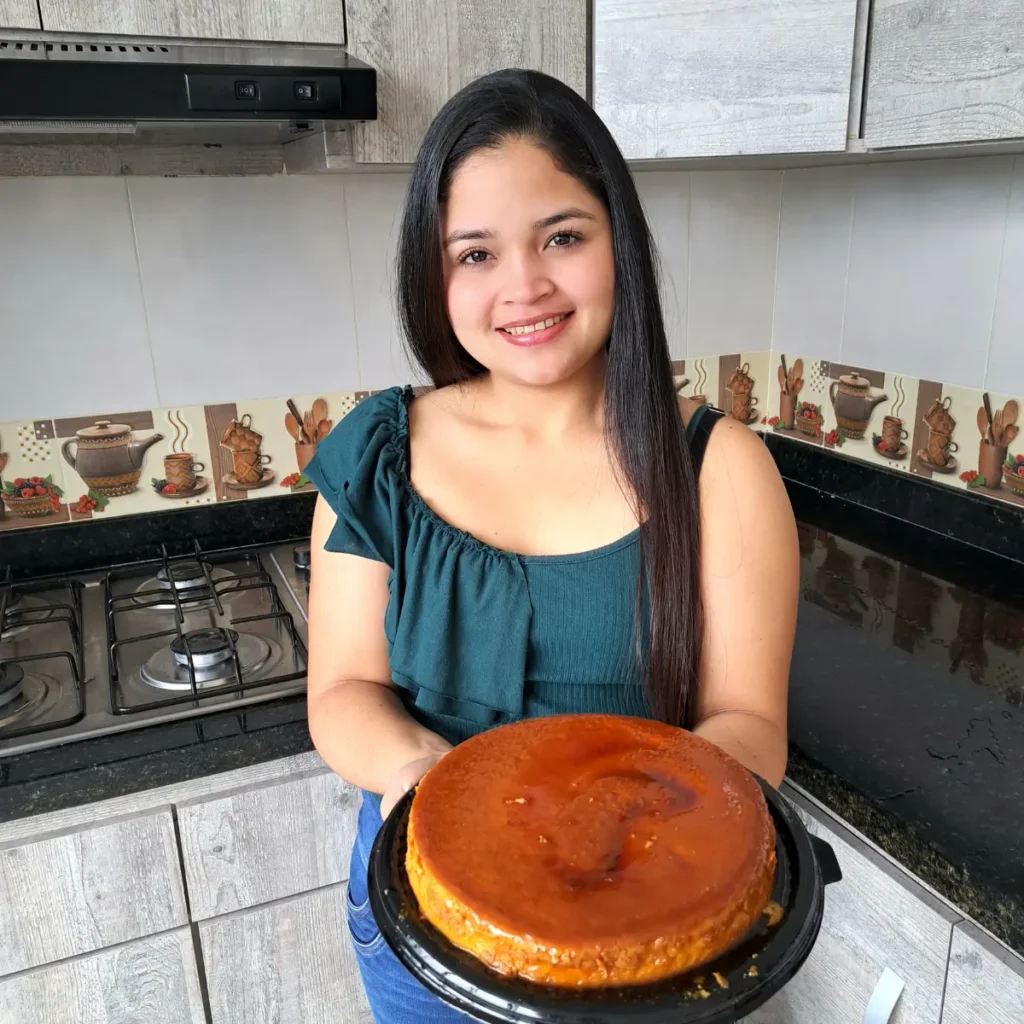
In Venezuela we call this fruit parchita, and growing up it went into the afternoon juice jug and almost nowhere else. It was in Colombia that I learned to put it in a dessert, and now it is what I make when three very ripe maracuyá are sitting on the counter and I do not want to turn anything on. Dylan eats it for the cookie at the bottom, soft after three hours. I eat it for the spoonful of sharp sauce on top, which cuts through everything sweet underneath. Josnaisis.