

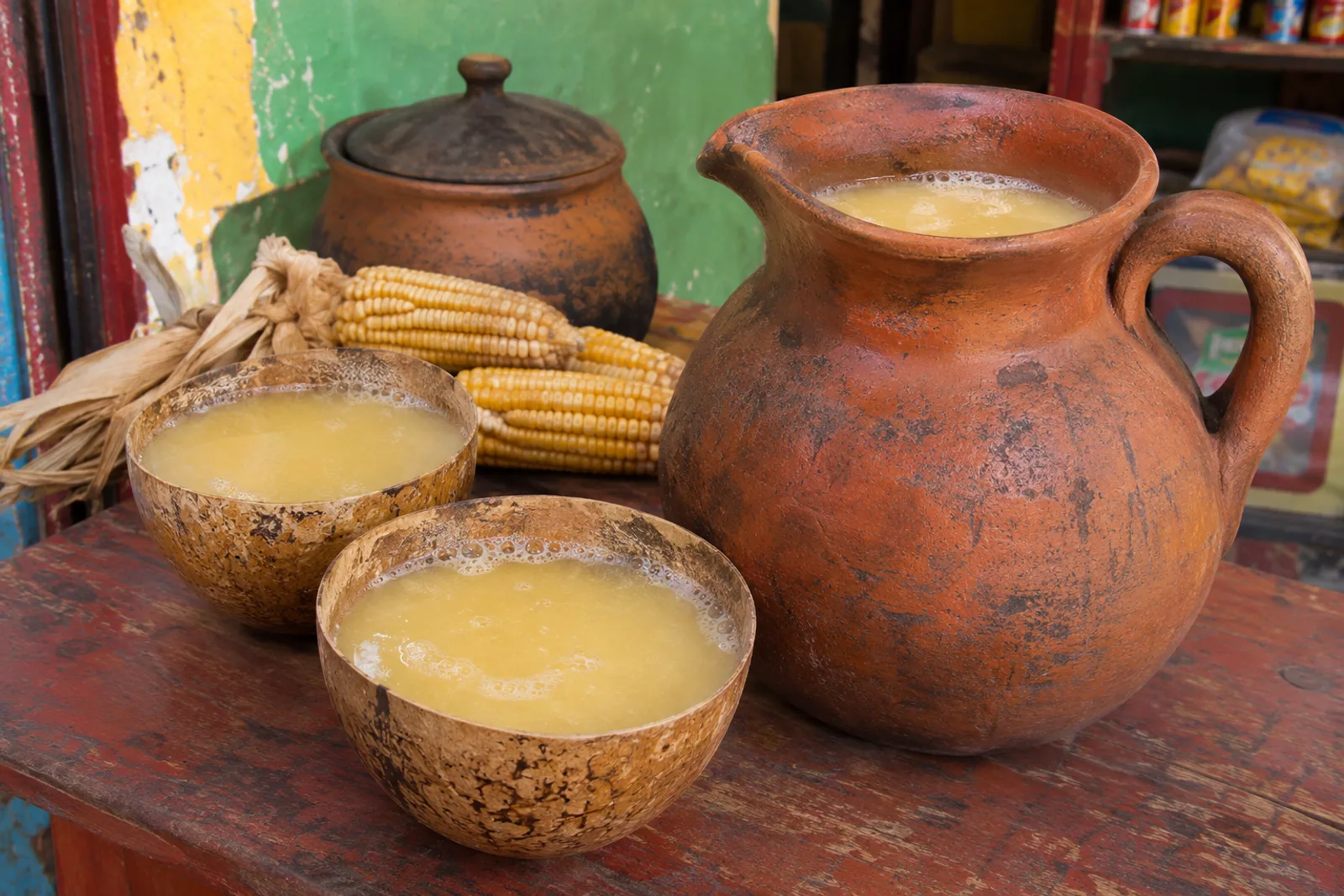

Colombian corn chicha is a cloudy drink of cooked cracked corn and panela that ferments for 2 days at home with half a teaspoon of yeast, turning tart, fizzy and alcoholic. In Bogotá’s traditional chicherías it ferments for two to three weeks, and samples tested at the city’s chicha festival averaged 3.35% alcohol by volume, with no methanol in any of them. This is that version: dried cracked corn and panela, boiled again after blending so the jar starts clean, with the signs that tell you it’s ready and the ones that tell you to pour it away.
What Colombian corn chicha is
How do you make Colombian corn chicha? Soak 250 g (9 oz) dried cracked corn for 8 hours and simmer it 2 hours in 2 liters (8½ cups) water until it falls apart. Blend with 1 liter (4¼ cups) cold water, strain, and boil 20 minutes with 200 g (7 oz) panela, cinnamon and cloves. Cool below 86°F (30°C), add ½ teaspoon instant yeast and ferment 48 hours at 68-79°F (20-26°C), then chill. 3810 minutes (about 64 hours) for 10 servings.
Picture a cloudy, ivory drink, thinner than a smoothie but with body, that tastes of cooked corn and dark sugar up front and finishes tart and lightly fizzy. If you’ve made kombucha or ginger beer, the process will feel familiar: sweet liquid, a living ferment, a jar with a loose lid. The difference is that this one starts from a starchy grain, so it’s richer and needs more care with cooling.
It has a long, rough history. Bogotá had hundreds of chicherías by the late 19th century; after the riots of April 9, 1948, the drink was blamed and hounded, and a law that year required fermented drinks to be made industrially and sold in glass, which pushed chicha underground. The old working-class neighborhood of La Perseverancia has held a yearly chicha festival since 1988, since declared an official event of cultural interest in Bogotá. For the rest of the region’s food, from the stews to the cheese breads, see the guide to food from Bogotá and Boyacá.
How it compares to drinks with similar names
| Drink | Made from | Fermented? | Alcohol |
|---|---|---|---|
| Colombian corn chicha | cooked cracked corn and panela | yes, 2 days at home, 15-20 in a chichería | 3.35% average in Bogotá |
| Venezuelan chicha | cooked rice, milk and condensed milk | no | none |
| Chicha andina | fermented pineapple-peel brew thickened with corn flour and rice | the pineapple brew, 48 hours | some, no fixed figure |
| Chicha morada | purple corn boiled with pineapple, apple and cinnamon | no | none |
| Colombian masato | cooked rice, sugar or panela and yeast | yes, 24 hours | 1.5% in a commercial one |
| Tepache | pineapple peel and piloncillo | yes, 2 to 4 days | under 1% at 3 days |
Masato is the closest cousin: same idea, rice instead of corn, and ready in a day. Chicha morada is the one people mix it up with most, and it’s a boiled soft drink with no fermentation at all.
Ingredients and supermarket substitutes
One batch makes about 2.5 liters (10½ cups), ten 250 ml (1 cup) glasses, at a ratio of 100 g corn and 80 g panela per liter (about 3½ oz corn and 2¾ oz panela per quart).
| Ingredient | Where to find it in the US or UK | Swap, and what changes |
|---|---|---|
| Dried cracked corn (maíz trillado, maíz peto) | Latin groceries in the US, online in both countries | No real swap. Canned hominy is already cooked in brine and won’t give the starch that makes the body |
| Panela | sold as piloncillo in the Mexican aisle in the US, panela or piloncillo online in the UK | Dark brown sugar or dark muscovado, same weight: less molasses flavor |
| Instant dry yeast | baking aisle everywhere | Active dry yeast, same amount, proofed in the warm liquid for 10 minutes |
| Cinnamon sticks and cloves | spice aisle | Leave them out and the chicha tastes of plain corn and sugar |
Why cracked corn. It’s dried field corn with the hull removed, broken into rough pieces. White gives an ivory chicha, yellow a creamier color. It needs the overnight soak; unsoaked it takes much longer to soften and cooks unevenly. The same corn makes Colombian mazamorra, so one bag covers both.
Why add yeast at all. Bogotá’s chicherías ferment without packaged yeast, in seasoned clay vessels or with a splash of the previous batch, and take their two to three weeks. At home, after boiling, the liquid has almost nothing alive in it, so a jar left to chance starts slowly and you don’t control what takes over. Half a teaspoon of instant yeast gets it going on the first day and sours it early, which leaves less room for what you don’t want. That isn’t a guarantee: cleanliness, fast cooling and the signs below are what count.
Equipment. A 4-quart (4-liter) heavy pot, a blender, a fine strainer and a 4 liter (1 gallon) glass jar, or two half-gallon jars: the 2.5 liters of chicha shouldn’t fill more than three-quarters of the container, because it foams. Glass or food-grade plastic, because chicha is acidic. A kitchen thermometer helps; without one, 86°F (30°C) feels barely warm on the inside of your wrist.
Make-ahead schedule
The only thing that has to happen the night before is the soak. Don’t cook the corn ahead and leave it sitting, though: cook, blend, boil and cool in one go.
How to make corn chicha step by step
Soak and simmer the corn
Rinse until the water runs nearly clear, soak 8 hours under 2 inches of water, and pour the soaking water away. Simmer covered on low for 2 hours in 2 liters (8½ cups) of water, stirring every half hour. A kernel should squash flat between your fingers. If the centers are still hard, the chicha will be gritty no matter how long you blend.
Blend, strain and boil again
Blend the corn with its water and 1 liter (4¼ cups) cold water in batches, the jar half full, until smooth, then strain and press. If you end up with less than 2.5 liters (10½ cups), top up with water before the boil so the batch makes 10 glasses at the ratios above. For more body, use a coarser strainer.
Then the panela, cinnamon and cloves go in for a 20-minute gentle boil. This is the step that does most to cut the risk. The corn came out of the pot boiled, but the blender, strainer and cold water put back whatever they carry; boiling again leaves a clean liquid for the yeast and melts the panela completely.
Cool fast, then add the yeast
Stand the pot in ice water and stir until it drops below 86°F (30°C). At that point the yeast goes in safely; liquid that’s still hot can stress or kill it, and the jar is slow to start. Don’t let it cool slowly on the counter: cooked corn sitting warm for hours is exactly where Bacillus cereus, a bacterium whose spores survive cooking, multiplies. Keep it to 1 hour at most from turning off the heat to adding the yeast.
Ferment for two days
Jar three-quarters full, lid resting loosely, somewhere at 68-79°F (20-26°C). Stir once a day with the clean spoon.
- Day one. Fine bubbles at the edge and a faint bread smell. No bubbles at all after 24 hours usually means the liquid was too hot for the yeast, the yeast was out of date or the room is cold.
- Ready, around 48 hours. Fine foam on top, bubbles rising on their own, a smell of bread dough and fruit, and a taste that starts sweet and finishes tart with a prickle on the tongue. Into the fridge it goes.
- Left longer. Drier and sourer every day, and stronger while there’s sugar left. That’s the road to chichería chicha, which takes weeks.
In a cool kitchen, below 68°F (20°C), give it 3 or 4 days and go by taste, not the clock.
For a crowd
It scales in a straight line, with the same timings: for every liter, 80 g panela and 100 g corn. For 5 liters (20 glasses): 500 g (1 lb 2 oz) corn, 400 g (14 oz) panela, 4 cinnamon sticks, 8 cloves and 1 teaspoon yeast, in two 1-gallon (4 liter) jars. To serve on Saturday afternoon, soak on Wednesday night, cook on Thursday and move it to the fridge on Saturday morning.
Is homemade chicha safe? Mold, film and when to throw it out
No home ferment comes with a guarantee, and looks, smell and taste can’t prove a batch is safe; what this method does is take chances away from what you don’t want. The Bogotá samples averaged a pH of 3.44, with almost all of them free of fecal bacteria. Their weak spot was mold, which turned up in 4 out of 10, linked to damp, dark fermenting spaces. At home you avoid it with a scalded jar and spoon, the boil after blending, fast cooling and a dry, airy spot.
A flat white film may be surface yeast, but it can also be mold getting started, and at home there’s no reliable way to tell them apart. Some yeasts and molds also lower the drink’s acidity. A two-day chicha shouldn’t grow one: if it does, throw the batch out.
Throw the whole batch out if you see or smell:
- Mold of any color, fuzzy or raised, on the surface or around the rim.
- Liquid that strings off the spoon, or a pink, orange or black layer.
- A rotten, strong-cheese or nail-polish smell instead of bread and fruit.
- No bubbles at all after 72 hours plus an odd smell.
Common problems.
- It never starts bubbling → the yeast went into liquid that was too hot, it was out of date, or the room is cold. Below 86°F (30°C), with yeast in date.
- Gritty → the corn wasn’t cooked until soft, or wasn’t blended long enough.
- Bitter → the cloves were blended. They go in the boil and come out.
- Very sour by day two → the room was above 79°F (26°C). Next time, chill it at 36 hours.
- Foams over when opened → the cap was tight. It keeps making gas in the fridge.
It’s gluten-free and dairy-free, with none of the major allergens.
How much alcohol is in chicha
Chichería chicha is a proper alcoholic drink: the Bogotá samples averaged 3.35% ABV and the strongest measured 5.2%, around 4% once it has fermented the full 15 to 20 days. Those are figures from the samples, not a ceiling: as long as the yeast has sugar left, it keeps adding alcohol.
I haven’t measured a two-day home batch, so I won’t give you a number: it contains alcohol and its strength isn’t known. It depends on how much panela the yeast eats; if it ate all 200 g, the batch would come out around 4%, like chichería chicha, so don’t treat it as a soft drink. There’s no known safe amount of alcohol in pregnancy, so if you’re pregnant, skip the fermented version; the same goes for children, anyone driving and anyone avoiding alcohol for health reasons. They can have the unfermented version below, or a mug of Colombian aguapanela, the hot panela drink of the same table.
Variations
- Alcohol-free, same day. Skip the yeast: after the boil, cool it in ice water and chill 4 hours. Sweet, corny and smooth, without the tang or fizz. It keeps 3 to 4 days in the fridge.
- Stronger. Leave it up to 7 or 8 days in the jar, tasting daily. It gets drier and sourer, and more alcoholic while sugar remains; chill it as soon as you like the taste, and throw it out at any sign from the list above.
- With pineapple peel. Scrub a small pineapple with a brush, peel it, and add the peel to the boil with the panela; lift it out before fermenting. It adds a fruity background.
- Less sweet. 150 g (5½ oz) panela: about 148 calories per glass, and tart sooner.
- Regional styles. On Colombia’s eastern plains, chicha is made with corn flour and comes out thick; in Boyacá each town has its own, milder or stronger depending on the days it ferments.
Serving and storage
Serve it cold, shaken, in a glass or, the Bogotá way, in a totuma, a dried gourd bowl. Skip the ice so it doesn’t water down.
Fridge. At 40°F (4°C) or below, in glass bottles with loose caps. Cold slows fermentation but doesn’t stop it, so open the bottles once a day to release gas. I drink it within 5 to 7 days; around 10 days after fermenting ends, chicha turns vinegary.
Freezing or reheating. Neither. It’s a cold drink, so make the amount you’ll finish.
FAQ
Is chicha the same as chicha morada? No. Chicha morada is Peruvian purple corn boiled with fruit and spices and served as a soft drink, with no fermentation and no alcohol. Colombian chicha is fermented.
Is chicha really made with spit? Chewing corn and spitting it into the pot is an old way to start fermentation, because enzymes in saliva turn the corn starch into sugar. This recipe skips that step: the yeast ferments mainly the sugar from the panela.
Why isn’t my chicha bubbling? Almost always because the yeast went into liquid that was too hot, it was out of date, or the room is cold. If it’s still flat after 72 hours and smells off, throw it out.
Can I use canned hominy? No. It’s already cooked in brine and doesn’t release the starch that gives chicha its body. Use dried cracked corn.
Nutrition per glass
Per glass (about 250 ml, 1 cup, one tenth of a batch made with 250 g corn and 200 g panela; cinnamon and cloves removed), worked out ingredient by ingredient:
- Calories: 167
- Protein: 2 g
- Carbohydrates: 38 g
- Fat: 1 g, 0 g saturated
- Sugars: 19 g, all from the panela
- Sodium: 14 mg
The figures use whole corn, so the strained drink comes in slightly lower, and they don’t subtract the sugar the yeast eats or add the calories from alcohol. Cut the panela and a glass drops to about 148 calories (with 150 g).
If you know Venezuelan chicha, the sweet rice and milk drink, this one comes as a surprise: sour, fizzy and tasting of corn. I make it with the same bag of corn I use for mazamorra, taste it after two days and chill it once the tang starts winning over the sugar. If there are kids at the table, pour off their share before the yeast goes in: that’s the unfermented version. Josnaisis.