
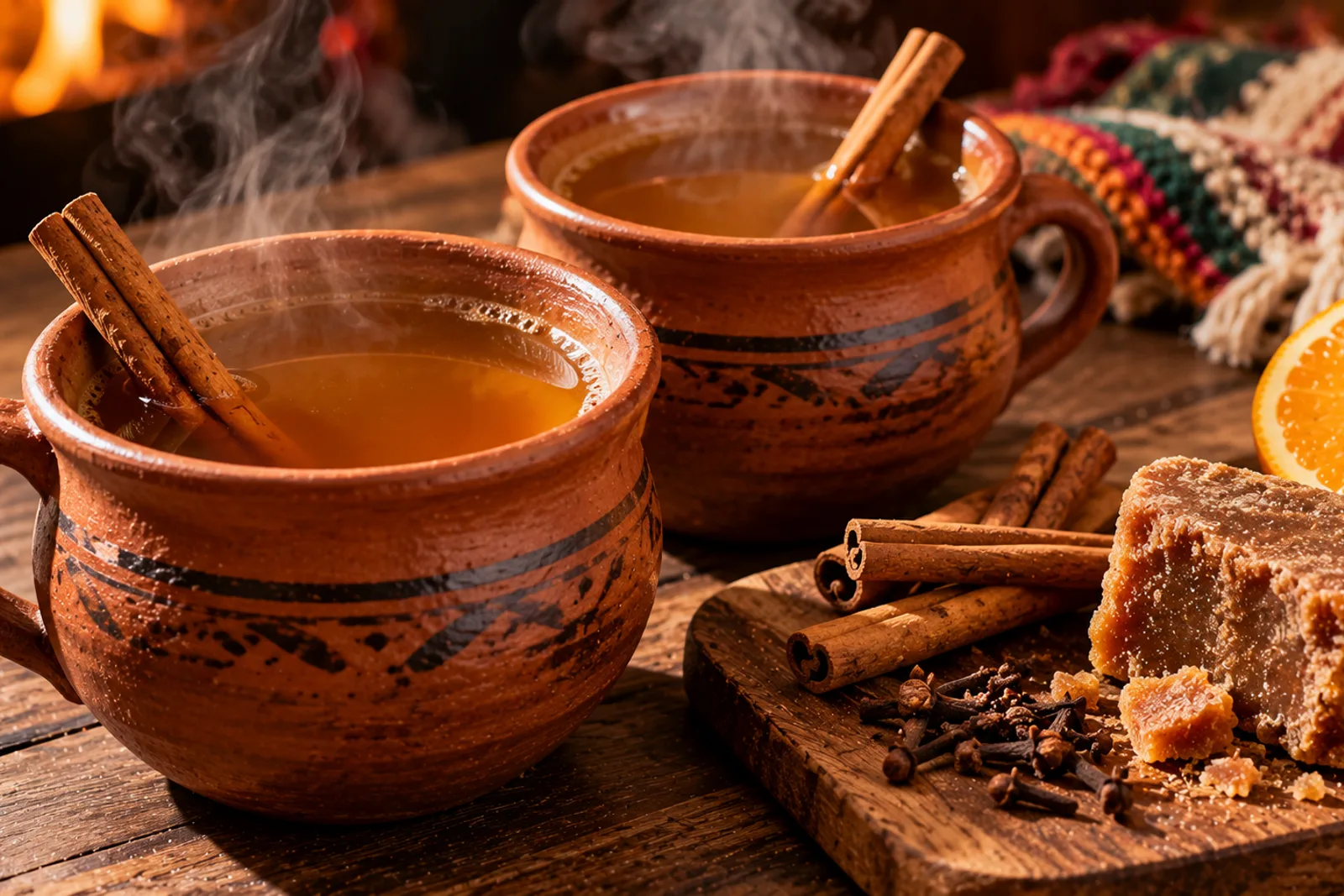

Canelazo (kah-neh-LAH-soh) is a hot, spiced panela drink spiked with aguardiente, and the one rule that matters is that the 1 fl oz (30 ml) of liquor per mug goes in after the heat is off. Simmer it with the base and you lose more than half the alcohol in 15 minutes, along with the anise; pour it into the mug and every serving gets what you measured. Below: what it tastes like, how strong to make it, what to buy in the US or UK when there’s no aguardiente, a version for kids, and a batch for 24.
What canelazo is
How do you make canelazo? Heat 5 cups (1.25 liters) cold water with 7 oz (200 g) panela, 4 cinnamon sticks and 6 cloves until it boils and the panela dissolves, then simmer gently for 12 minutes. Strain, and pour the hot base over 1 fl oz (30 ml) aguardiente per mug, off the heat. 30 minutes for 6 servings.
It’s a Colombian highland drink: panela, the unrefined cane sugar sold in hard blocks, dissolved in water with cinnamon and clove, then spiked with aguardiente, Colombia’s anise-flavored cane spirit. Think of a hot toddy made with brown sugar and spice instead of honey and whiskey, with a faint licorice note at the end. It’s drunk in small mugs on cold nights in Bogotá and the Andes, and in December at the novenas, the nine evenings of prayer and gatherings before Christmas. In Ecuador it’s the street drink of the Quito festivities, often made with naranjilla juice.
Without the aguardiente it’s close to aguapanela, Colombia’s everyday panela drink, with spices added. It’s not related to the Mexican Christmas fruit punch, which is a pot of fruit simmered with piloncillo.
Time: 30 minutes, only 5 of them hands-on. Easy: the only thing to get right is when the liquor goes in.
Ingredients and where to find them
The recipe makes 6 mugs of about 7 fl oz (205 ml): ¾ cup (175 ml) base and 1 fl oz (30 ml) aguardiente each. The base runs 160 g panela per liter of water, a little sweeter than plain aguapanela, because the liquor dilutes it.
- Panela. In the US, the closest thing in most supermarkets is piloncillo, the Mexican cone, in the Hispanic aisle; it’s the same unrefined cane sugar. Latin grocers and online shops in the US and UK sell Colombian panela in blocks. If you can’t get either, use the same weight of dark brown sugar (US) or dark muscovado (UK). It works, but tastes less of molasses and comes out lighter.
- Cinnamon sticks. Not ground cinnamon, which clouds the drink and leaves grit at the bottom of the mug.
- Whole cloves. Six is enough. More and the clove takes over.
- Aguardiente. Colombian aguardiente runs 24 to 29% ABV (48 to 58 proof) depending on the bottling, much lighter than vodka or rum. It’s sold in some liquor stores and Latin shops. Check the label, because the strength changes the substitute math below.
- Lime. Optional. A little juice in the pot cuts the sweetness, and a lime-wet rim holds the sugar.
Equipment. A 2-quart (2-liter) saucepan, a sieve, a ladle and small mugs of about 7 fl oz (200 ml). A thermos if the evening is long.
How strong to make it
This recipe uses 1 fl oz (30 ml) per mug, a light pour. You can taste the liquor, but it doesn’t burn. For a stronger mug go to 1½ or 2 fl oz (45 or 60 ml) without touching the base.
With 29% aguardiente, a 1 oz mug holds about 7 g of pure alcohol: roughly half a US standard drink (14 g) or just under 1 UK unit. It’s sweet and hot, so it goes down fast. Two light mugs over an evening is a better plan than one strong one, and the alcohol-free version is there for whoever is driving.
What to use instead of aguardiente
What makes canelazo taste like canelazo is the anise in the aguardiente, so the closest swaps are anise spirits. All of them are stronger, so use less. The math: divide 870 by the ABV on your bottle to get ml per mug, the same alcohol as 30 ml at 29%. For an 80-proof (40%) spirit that’s 22 ml, about ¾ fl oz or 1½ tbsp.
- Ouzo. Dry and strongly anise-flavored, and often stronger than 40%, so read the label and measure. The anise comes through louder than with aguardiente.
- Sambuca. Very sweet. Taste a mug before serving, since it adds sugar on top of the panela.
- White or gold rum. Also a cane spirit, but with no anise. Simmer 1 star anise in the base with the cinnamon. Gold rum adds a caramel note.
- Vodka. Tastes of nothing, so the star anise does all the work. Cachaça, the Brazilian cane spirit, works the same way as rum.
How to make canelazo step by step
Start the panela in cold water
Put the panela pieces, cinnamon and cloves in the water while it’s still cold, then heat over medium. The panela dissolves as the water warms; dropped into boiling water, the outside seals and it takes longer. Stir every couple of minutes. In about 10 minutes it boils, and when you scrape the bottom with a spoon there are no lumps left.
Simmer with the spices, 12 minutes
Turn the heat down until only small bubbles rise and leave the pan uncovered for 12 minutes. A hard boil reduces it too much and you end up with syrup. It’s ready when it’s dark amber and the kitchen smells of cinnamon and clove. For more spice, go up to 30 minutes, topping up with hot water as it evaporates.
Strain and measure
Strain out the cinnamon and cloves, which keep steeping if you leave them in until the clove dominates. You should have about 4½ cups (1.05 liters). Less than that, add hot water; a bit more and the mugs are just slightly less sweet.
Add the aguardiente off the heat
Alcohol evaporates with heat. Simmered for 15 minutes, only about 40% is left, and you have no idea what each mug holds; stirred into a base that just came off the boil, about 85% of it stays. That’s why I pour it into the mug: 1 fl oz (30 ml) aguardiente, then ¾ cup (175 ml) hot base on top. If everyone drinking is an adult, you can also stir the aguardiente into a warm pitcher, off the heat, right before serving.
How to tell it’s right. The mug is steaming but comfortable to hold and sip. It smells of cinnamon first and anise up close. If it tastes like syrup, the base reduced too much: thin it with hot water.
The sugar rim
Optional, and how many Colombian homes serve it. Rub the edge of each mug with the cut half lime and dip it in a saucer of 3 tbsp sugar. Do it just before pouring, because steam melts it.
Alcohol-free canelazo for kids
Same base, no aguardiente, poured from the same pot, which is the whole point of adding the liquor in the mug. Boiling a canelazo that already has aguardiente in it doesn’t make it safe for kids: it loses some alcohol, not all of it. Theirs is poured before any liquor goes in. It’s a spiced panela drink of about 127 calories a mug, nearly all sugar, so give kids a small one. Simmer 1 star anise with the cinnamon if you want it to echo the grown-up version, or stir some strained blackberry or lulo juice into the pot for a fruity one.
Make ahead and batch for a party
The ratio stays the same at any size: 160 g panela per liter of water and 1 fl oz (30 ml) aguardiente per mug. What changes is the pot. One 750 ml bottle of aguardiente covers 25 mugs.
Make ahead. The strained base, without liquor, keeps up to 5 days in a covered pitcher in the fridge. On the day, heat it until it steams and serve as usual.
Keeping it hot. Leave the base on the lowest heat without letting it boil, or move it to a thermos or slow cooker on warm. Set the aguardiente on the table with a 1 oz jigger so each adult pours their own.
For the rest of a Colombian December table, natilla, the panela custard, and Colombian buñuelos are what go with the novena, and the Colombian Christmas menu has the full spread.
Variations
- Fruit canelazo. Replace a third of the water with strained lulo, blackberry or passion fruit juice and simmer it with the base. In Ecuador, made with naranjilla, it’s called naranjillazo.
- Stronger. 1½ or 2 fl oz (45 or 60 ml) aguardiente per mug, same base.
- With mint. Some families add a sprig of spearmint to the base for the last minutes.
- With rum or an anise spirit. See the substitutes above.
Serving and storing
Serving. Very hot, in small mugs, with natilla, buñuelos or Colombian cheese arepas. For a hot mug at breakfast instead, Colombian hot chocolate with cheese is the other cold-weather classic.
Fridge. Store the base without liquor: 5 days in a covered pitcher. Leftover mixed canelazo keeps covered in the fridge too, but loses some alcohol when reheated; warm it without boiling.
Freezer. The base freezes well in a lidded container. Thaw it in the fridge and heat until steaming.
Frequently asked questions
Is canelazo Colombian or Ecuadorian? Both. It’s drunk in the cold Andean highlands of Colombia, Ecuador and northern Peru. Colombians make it with anise-flavored aguardiente; in Ecuador the cane spirit has no anise and naranjilla juice is common.
What does canelazo taste like? Like a sweet, spiced brown-sugar tea with cinnamon up front and a light anise finish. The 1 oz version is gentle; at 2 oz you feel the liquor.
Does the alcohol cook off? Only if you boil it with the base, and even then not all of it. Added off the heat, most of it stays, which is why the measure in the mug is what counts.
Can I make it in a slow cooker? For keeping it hot, yes. Make and strain the base on the stove, then hold it in the slow cooker on warm. The aguardiente still goes in the mugs.
Nutrition
Per mug of about 7 fl oz (205 ml), with 1 fl oz (30 ml) of 29% aguardiente, worked out from the recipe quantities, without the rim sugar:
- Calories: 175 kcal
- Protein: 0 g
- Carbohydrates: 33 g
- Fat: 0 g
- Fiber: 0 g
- Sugars: 32 g
- Sodium: 9 mg
The panela brings about 127 calories a mug and the alcohol about 48, at 7 calories per gram. The alcohol-free version is about 127 calories; with 2 fl oz (60 ml) aguardiente it’s about 223.
I make the base in the morning, and when people arrive I heat it and set the aguardiente and a jigger next to the mugs. Nobody has to guess what’s in their drink, and the kids get theirs from the same pot. Josnaisis.