

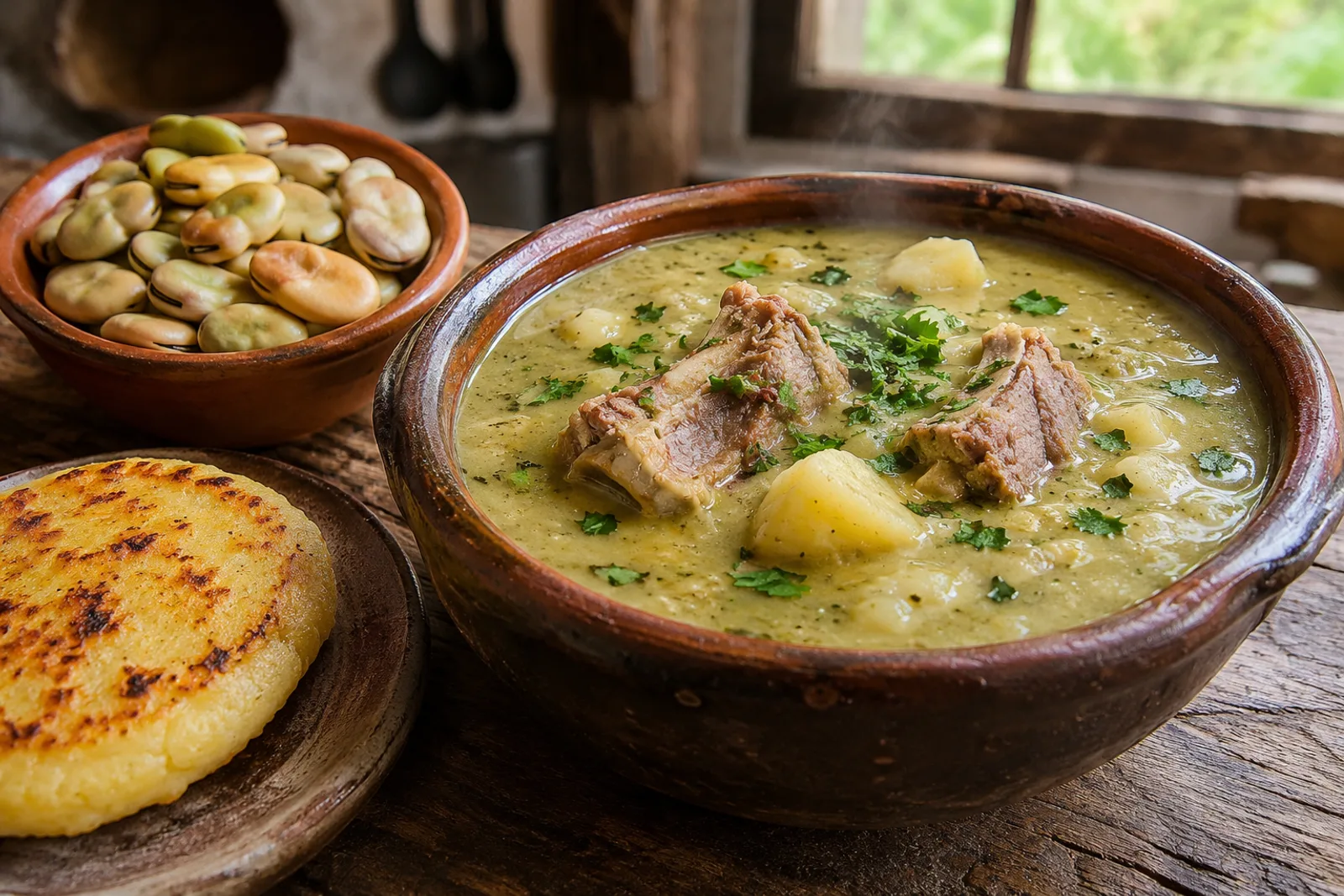

Sopa de habas boyacense (SOH-pah deh AH-bahs boy-ah-SEN-seh) is the everyday fava bean soup of Boyacá, the cold, high farming region north of Bogotá in the Colombian Andes. It’s made with large dried favas, skins left on, soaked for a full day and then simmered slowly with pork bones, garlic, green onion and cumin until part of the beans dissolve and thicken the broth on their own, with no flour or cream. This page covers the soak, the one trimming step that matters, stovetop and pressure cooker timing, and what to buy in a US or UK shop.
What Boyacá fava bean soup is like
How do you make Boyacá fava bean soup? Soak 14 oz (400 g) of dried favas for 24 hours and trim the black tip off each one. Simmer them with 1½ lb (700 g) of pork neck bones in 3¼ quarts (3 liters) of water with green onion, garlic and cumin for 1½ to 2 hours, until they crush against the pot. Blend 2 cups of the beans, stir them back in with the salt and simmer 10 to 15 minutes more. 170 minutes for 6 servings, plus the soak.
Think of a thick split pea soup, but earthier and less sweet, with chunks of soft bean, shreds of pork and the rest of the favas melted into the liquid. It’s a filling one-bowl lunch, served on its own in a deep bowl with fresh green onion and cilantro on top.
It isn’t the Mexican fava bean soup for Lent, which uses yellow favas that are already peeled, a fried tomato base and pasilla chile, and has no meat. Favas show up in many Boyacá soups, from cuchuco, the cracked wheat soup, to the Andean tuber stew called cocido boyacense; here they are the whole point.
About the nickname. You may see it called sopa de chicle or chicle boyacense (“Boyacá chewing gum”). The name really belongs to toasted favas eaten as a chewy snack, and some people in Boyacá find it disrespectful, so I use the plain name.
Total time 170 minutes: 25 to sort and trim, 145 on the stove, mostly unattended. Add a 24-hour soak the day before. Medium difficulty, only because it needs planning and a watchful spoon near the end.
Ingredients and US or UK swaps
Each person gets about 2⅓ oz (67 g) of dried favas, a deep, thick bowlful.
| Ingredient | Metric | US | What to buy outside Colombia |
|---|---|---|---|
| Large dried favas, skin on | 400 g | 14 oz | Middle Eastern or Mediterranean grocers, online; UK: dried fava or broad beans, whole |
| Pork neck bones | 700 g | 1½ lb | Most US supermarkets; UK: butcher, ask for pork neck or spine bones |
| Green onions | 120 g | 4 oz | The thickest scallions you can find; stands in for Colombian cebolla larga |
| Ground cumin | 2 g | 1 tsp | Any brand |
| Fine salt | 9 g | 1½ tsp | With Diamond Crystal kosher salt, use about 1 tbsp |
Which dried favas, and the black tip
- Large favas, skin on, black tip trimmed. The recipe as written, and how it’s made at home in Boyacá. After soaking, each bean has a dark strip at one end where it attached to the pod. Cut it off with the tip of a paring knife; some Boyacá families call this desmitonar. That strip stays hard and dark in the bowl even when the rest is soft. The skin itself stays in: after 2 hours it softens, though it keeps a slight chew.
- Fully peeled. After soaking, squeeze each bean and the skin slips off. Allow about 15 minutes for 14 oz (400 g). The soup comes out smoother and paler and the favas cook faster.
- Split peeled favas (sold as split fava beans). The quickest route: start checking at 45 minutes. The soup is creamier and less rustic. If the beans are done before the pork, lift them into a bowl and keep simmering the bones until the meat comes off easily.
- Small canned favas for ful medames. A different, darker soup without the texture of the large bean. Usable in a pinch (see the FAQ).
Buy from a shop that sells a lot of them. Old dried beans are the most common reason favas never soften, however long they cook.
The pork, and swaps that change the flavor
Pork neck bones give body and a little gelatin to the broth, and the meat pulls off at the end. Meaty spare ribs cut into pieces work too. A smoked ham hock works but turns it into a different, smoky and much saltier soup: skip the salt in the recipe until you’ve tasted it.
Equipment. A 6-quart (6-liter) pot with a lid, a wooden spoon for scraping the bottom, a paring knife, and a blender or a fork. For the fast version, a 10-quart pressure cooker for the full recipe, or a 6-quart pressure cooker or Instant Pot for half.
Soaking dried favas
24 hours, changing the water at 12, with plenty of water on top because they double in size. At 18 hours they’re ready to cook. Very dry or old beans can go to 48 hours with two water changes. Soak them in the fridge, since water left out that long can start to ferment, and always discard the soaking water.
I wouldn’t skip the soak with skin-on favas: unsoaked, the cooking runs past 3 hours and some beans fall apart while others are still hard.
Stovetop or pressure cooker
- Stovetop, as written. 1½ to 2 hours at a gentle simmer once the beans go in, lid ajar, stirring every 15 minutes.
- Pressure cooker or Instant Pot. Skim the bones first with the lid off, then add the beans and aromatics, filling the pot no more than halfway, since favas foam and can block the valve. With the 3 liters of water, the beans and the bones, the full recipe takes up about 4½ quarts, so it needs a 10-quart pressure cooker; in a 6-quart Instant Pot, make half (7 oz / 200 g favas, 12 oz / 350 g bones and 1½ quarts / 1.5 liters water). Cook 15 to 20 minutes at high pressure and let the pressure release naturally. Crush a bean: if it resists, or the meat doesn’t pull off the bone yet, seal and give it 5 more minutes. Then blend and thicken in the same pot, lid off. Counting the boil, coming up to pressure and the natural release, that’s about 70 minutes in the pot instead of 145.
How to tell they’re done. A bean pressed against the pot with a spoon should collapse with no resistance, and the skin should break when you bite it instead of staying leathery. The broth looks cloudy and beige. Salt goes in at the end, once they’re soft, so you can judge it against the reduced broth.
Make-ahead plan
- The day before. Sort and soak, 5 minutes of work, plus one water change.
- Cooking day. About 25 minutes of trimming and slicing, then the bones on to boil and nearly 2 hours of simmering with a stir every 15 minutes.
- Further ahead. Cook the whole soup the day before. It tastes rounder the next day, and the fat sets on top in the fridge so you can lift it off.
Thickness. It’s right when it coats the back of a spoon and falls in a thick ribbon, looser than a purée. Blending 2 cups is the starting point; blend another cup for more body, or add hot water a scant ½ cup (100 ml) at a time to loosen. It thickens a lot as it cools and is almost a purée straight from the fridge. If the skins bother anyone at your table, blend half the pot, or all of it for a creamy soup with pork pieces. Fill the blender only halfway with hot soup, because steam pushes the lid off.
Problems and fixes
- Favas still hard after 2 hours. Old beans or a short soak. Keep simmering with more hot water, and blend part of the soup to rescue the texture. Next time, soak a full 24 hours.
- Hard black specks in the bowl. The tips weren’t trimmed. It can be done after cooking, but soft beans fall apart in your hands.
- Scorched bottom. Once the favas start breaking down, the starch sinks. Scrape the bottom every 15 minutes and keep the heat low. If it catches, pour the soup into a clean pot without scraping.
- Too salty. Usually from a ham hock or bouillon. Add water and simmer 10 more minutes.
Allergens and heat. No gluten, dairy or egg, and not spicy at all, so most kids eat it.
Fava beans and G6PD deficiency. Anyone with G6PD deficiency (favism) should not eat fava beans in any form, dried or fresh, raw or cooked. They can trigger hemolytic anemia, the rapid breakdown of red blood cells, with dark urine and yellowish skin a day or two later. Breastfeeding mothers of a baby with the deficiency should avoid them too. If anyone in your household has this diagnosis, make a different soup.
Variations and scaling
- With potatoes. 10½ oz (300 g) of Yukon Gold potatoes in ¾ in (2 cm) cubes for the last 25 minutes, before blending. Thicker and stretches further.
- Meat-free. Replace the bones with 1½ quarts (1.5 liters) of vegetable stock plus water and stir in 2 tbsp of oil at the end. It tastes flatter, because the pork is half the flavor.
- With fresh favas. That’s another soup: green favas cook in under half an hour and don’t thicken the broth the same way. The Colombian fava and barley soup you may find online is made with them; this one is built on dried favas and pork.
- For 4. 9½ oz (270 g) favas, 1 lb (470 g) bones and 2 quarts (2 liters) water in a 4- to 5-quart pot. Same timing.
- For 12. Double everything in a 10- to 12-quart pot. It takes longer to boil; the simmer is about the same.
The pork is the expensive part; dried favas are cheap and double in volume as they soak. Plain neck bones with less meat keep the cost down.
Serving, storing and reheating
Serving. Hot, in deep bowls, with sliced green onion and cilantro. I serve it with an arepa; the Boyacá-style arepas filled with fresh cheese are a good match, or plain white rice on the side for a bigger lunch. For the rest of the region’s soups and breakfasts, see the guide to Bogotá and Boyacá food.
Fridge. Divide it right away into small, shallow covered containers and refrigerate without waiting for the whole pot to cool, always within 2 hours of cooking; it keeps 3 to 4 days.
Freezer. 2 to 3 months. Potatoes turn grainy when thawed, so freeze it without them if you can. Thaw overnight in the fridge.
Reheating. In a pot over medium heat with a splash of water, about a scant ½ cup (100 ml) per 2 bowls, stirring from the bottom because it catches quickly. Bring to a boil, or to 165°F (74°C). In the microwave, covered, in 1-minute bursts, stirring in between.
Frequently asked questions
Do you have to peel dried fava beans for this soup? No. The home-style version keeps the skins and trims only the black tip. Peeling gives a smoother soup and shortens the cooking; if the skins bother you, blending half the pot is faster than peeling each bean.
Can I use canned fava beans? In a pinch. First simmer the pork bones in the 3 liters of water until the meat comes off the bone, about 1½ hours. You need about 2½ lb (1.2 kg) of drained favas to replace 14 oz (400 g) dried, so check the drained weight on the label. Add them to the broth, simmer 20 minutes, mash half and taste before salting, since canned beans are already salted. The soup is darker and thinner.
Is this the same as Egyptian ful or Moroccan bissara? No. Ful medames is small favas stewed and mashed with oil, lemon and garlic, and bissara is a smooth purée of peeled favas. This soup is brothier, keeps the skins and is built on pork.
Nutrition
Per serving (one sixth of the pot, 2⅓ oz / 67 g dried favas), calculated ingredient by ingredient from the recipe, without arepa or rice:
- Calories: 342 kcal
- Protein: 27 g
- Carbohydrates: 41 g
- Fat: 9 g, of which 3 g saturated
- Fiber: 17 g
- Sugars: 4 g
- Sodium: 635 mg
The figures assume about 10 oz (280 g) of usable meat on 1½ lb (700 g) of bones; meatier bones raise the protein and fat. The favas bring about 227 kcal per serving and nearly all the fiber, which is high because the skins stay on. Adding 10½ oz (300 g) of potatoes adds about 40 kcal per serving.
The first few times I left the black tips on, and every spoonful had a hard dark fleck in it. Now I trim them before the stove goes on, while the beans are still in the colander. At home I keep the skins and blend a little more than the 2 cups, which hides the skins and still leaves chunks. Josnaisis.