

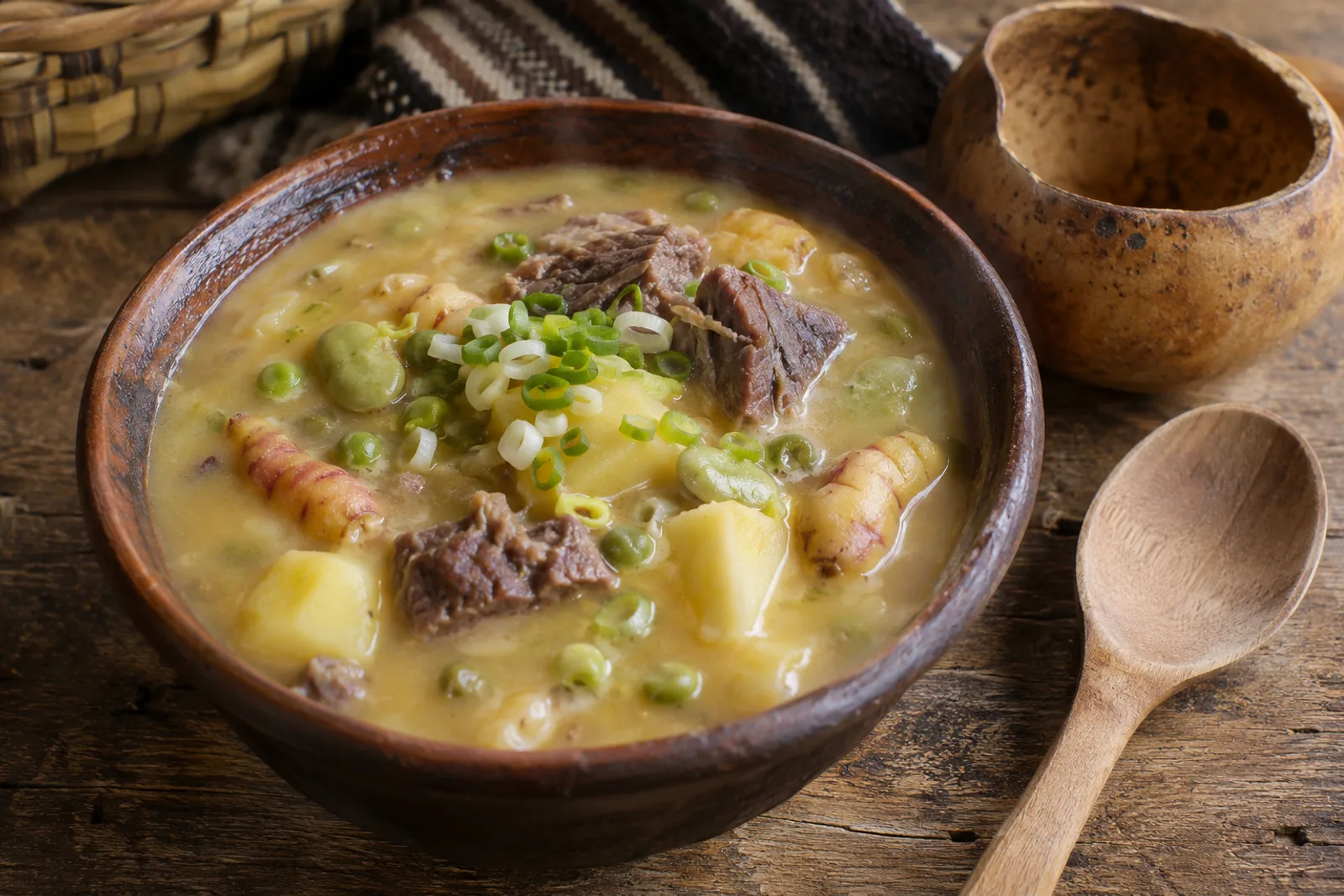

Mazamorra chiquita (mah-sah-MOH-rrah chee-KEE-tah) is a savory beef soup from the cold highlands around Tunja, in Colombia’s Boyacá province, thickened at the end with raw corn flour so it turns creamy and spoonable. It is not the cold, sweet mazamorra of Medellín, which is whole cracked corn served with milk and panela, and it has nothing in common with Peru’s purple corn pudding. Plan on 130 minutes, only about 45 of them hands-on, for 6 deep bowls, using ingredients you can find in a US or UK supermarket.
What mazamorra chiquita is, and what you get
How do you make mazamorra chiquita? Cook beef tripe separately in a pressure cooker while short ribs and shank simmer into a broth for 60 minutes. Add the tripe, fava beans and potatoes for 15 minutes, then pour in 150 g (1¼ cups) of raw corn flour whisked into 2 cups of cold water, stirring constantly, along with small potatoes, peas and turnip. Simmer 20 minutes more, stirring often, finish with chard and a garlic-scallion paste, and let it rest. 130 minutes for 6 servings.
Think of a hearty beef and vegetable soup with the body of a chowder, but the thickness comes from corn rather than cream or roux. Each spoonful has tender meat, whole fava beans, potato that has half melted into the broth, and a faint peppery bite from cubios, a high-Andean tuber that tastes a little like turnip and gets a soup of its own in Colombian cubio soup. It is a lunch dish in Boyacá and the neighboring Cundinamarca highlands, served on its own as a full meal.
If you like grain-thickened soups, its neighbors from the same region are a cracked wheat soup with pork, a Boyacá hominy soup with whole corn kernels and a one-pot stew built on Andean tubers. For the bigger picture, see the food of Bogotá and Boyacá.
Time and difficulty. 130 minutes with a pressure cooker for the tripe; about 1½ hours more without one. Medium: nothing is hard, but the last 20 minutes need you at the stove.
Shopping list, with US and UK swaps
The recipe fills 6 generous deep bowls, each with meat and vegetables. Tripe is traditional but optional; see the variations if you’d rather skip it.
| In Colombia | What to buy in the US | What to buy in the UK | What changes |
|---|---|---|---|
| Harina de maíz (raw corn flour) | White corn flour or fine white cornmeal, not precooked | Fine maize flour from world-food aisles; not cornflour | Nothing, if it’s raw and fine |
| Costilla de res | Beef short ribs, flanken or English cut | Beef short ribs | Nothing |
| Murillo | Beef shank | Shin of beef | Nothing; chuck works too |
| Callo | Honeycomb tripe, Latin or Asian butchers | Dressed tripe from a butcher | Skip it for a less gelatinous broth |
| Cubios | White turnip | White turnip | Same mild bite, firmer and less fragrant |
| Papa criolla | Frozen papa criolla in Latin stores, or baby Yukon Gold | Small waxy yellow potatoes | Yukon Gold holds its shape, so the soup is slightly less creamy |
| Habas | Frozen fava beans, or baby lima beans | Broad beans, fresh or frozen | Lima beans are a little less bitter |
| Cebolla larga | Scallions | Spring onions | Nothing |
Which corn flour, and why it isn’t toasted
You want raw white corn flour, ground fine and not cooked in any way. Precooked arepa flour (masarepa, sold under brands like P.A.N.) absorbs water instantly, forms balls that never dissolve and makes the soup taste like an arepa. In the UK, watch the word cornflour: there it means cornstarch, which sets the soup glossy and jelly-like with no corn flavor at all.
Don’t toast the flour. Dry heat gives it a roasted taste and breaks down some of the starch, so it thickens less. The oldest version of the dish skips bought flour entirely and uses home-ground corn left to ferment into a sour wet dough (see the variations below).
Masa harina, the tortilla flour, also works, though it lumps a little and the lime-treated corn tastes of tortilla. Fine polenta works too and leaves the soup yellow and slightly gritty.
Equipment. A 6-quart (6-liter) pot, a pressure cooker for the tripe (or a second ordinary pot), a wooden spoon, a whisk or fork for the flour and a mortar, or the flat of a knife, for the garlic paste.
Cooking it, step by step
Tripe first, in its own pot
Tripe needs far longer than everything else, and its cooking water smells strong and clouds a broth, so it cooks separately and the water goes down the drain. Give it about 150 minutes in a regular pot, which means starting it an hour and a half before the broth, or 60 minutes once a pressure cooker is up to pressure. It’s done when a fork slides through. It spends another 35 minutes in the soup, so it doesn’t need to fall apart yet. If you bought precooked tripe, as it’s often sold in the UK, skip straight to step 3. The full scrubbing method is in my Colombian tripe soup that doesn’t smell.
The beef broth
Cold water, meat, scallions, garlic, cilantro stems and spices. Gray foam rises as it comes to a boil: skim it for the first 10 minutes and the broth stays clean. Then 60 minutes at a gentle simmer, lid ajar. The shank will still have some chew at this point; it finishes softening over the next 35 minutes.
Adding the vegetables in order
Tripe, fava beans, carrot and russet potatoes go in first, for 15 minutes. The russet cubes fray at the edges and help thicken. The small potatoes and peas wait until the flour goes in, and the turnip 5 minutes after that, so none of them turns to mush.
Thickening with corn flour, without lumps
This is the step that makes or breaks the soup. Mix the flour into cold water: dropped into hot broth, the outside of each clump cooks instantly and seals dry flour inside, and those lumps never dissolve. Whisk 150 g (1¼ cups) into 500 ml (2 cups) of water until it looks like smooth, thick milk; strain it if you still see specks.
With the heat at medium, pour the slurry into the pot in a thin stream with one hand while the other stirs in circles, the spoon touching the bottom. Almost at once the broth turns from clear to opaque and starts to thicken. Keep it at medium-low for 20 minutes, scraping the bottom every few minutes: the flour settles and sticks before anything else does.
It’s ready when:
- It coats the back of a spoon and a finger drawn through leaves a clean line.
- It no longer has a raw-flour taste, that dusty feel in the mouth. If it does, give it 5 more minutes.
- The small potatoes are tender. Papa criolla splits and turns the broth faintly yellow; Yukon Golds hold their shape, so just check them with a knife.
The recipe amount gives a thick soup that stops short of paste. 100 g (¾ cup) makes it brothy enough to sip; 60 g (½ cup) barely clouds it; 200 g (1⅔ cups) is almost spoon-standing and catches on the pan more. For thicker soup, add 25 g (3 tbsp) at a time: it keeps thickening in the bowl and in the fridge.
The finishing paste and the topping
The chard and the raw garlic-scallion paste go in for the last 5 minutes, so they perfume the soup without losing their edge. The 10-minute covered rest finishes the thickening. Top each bowl with a spoonful of chopped scallion and cilantro.
If it goes wrong
- Lumpy. The flour went into hot liquid, went in all at once, or was precooked. Fish out a few lumps with a slotted spoon or crush them against the side of the pot. If there are many, blend 2 ladles of soup without the meat and stir them back in.
- Too thick or pasty. Stir in hot water ½ cup (120 ml) at a time until it coats a spoon without clinging.
- Too thin. Whisk 3 tbsp (about 20 g) more flour into a scant ½ cup (100 ml) cold water, stream it in and simmer gently for at least 15 minutes, until the raw-flour taste is gone.
- Scorched on the bottom. Don’t scrape. Ladle the soup into a clean pot without touching the bottom. If it already tastes burned, it can’t be saved.
- Tastes floury. It needs at least 15 minutes at a gentle simmer after thickening.
- Smells of tripe. The tripe wasn’t scrubbed well, or its water went into the soup. Spices won’t cover that.
Diet notes. No chile heat; hot sauce goes on the side. It is gluten-free if your corn flour is not processed alongside wheat, so check the label. No dairy, no egg. Kids usually like it served without the tripe.
Variations
Traditional fermented corn. Grind dried corn, rinse it in water while skimming off the bran that floats, cover it with fresh water in a clay or glass container (not metal), cover with a cloth and leave 2 to 3 days at room temperature. Drain it and spoon the wet dough into the soup at step 4 instead of the slurry, stirring until it’s as thick as you like. The result has a gentle sour note the flour version lacks. If the dough smells rotten, changes color or grows mold, throw it all out. A pleasant smell doesn’t prove it’s safe, so if you’ve never fermented corn before, start with the flour version.
No tripe. Add 300 g (10½ oz) more short rib or shank and skip step 1. The broth is less gelatinous. The total time barely drops, because the tripe cooks alongside the broth: you save the 10 minutes of scrubbing and one pot.
Fresh corn. Instead of flour, blend 1 cup of fresh corn kernels with a little water and stir it in gradually at step 4. Sweeter, and it thickens less.
With pork. Swap the shank for 400 g (14 oz) of pork shoulder in cubes; same timing.
For 12. Double everything and use a 10 to 12-quart pot. Mix the flour in two batches of 150 g in 500 ml water and pour them in one after the other, stirring.
The meat is what costs money here; tripe and vegetables are cheap. To trim the bill, drop the short ribs and keep the shank.
Serving, make-ahead and storage
Serving. In deep bowls with the scallion-cilantro topping, sliced avocado, hot sauce and either white rice or a Boyacá-style arepa on the side. It’s a full meal.
Make ahead. Cook the beef broth and the tripe up to 2 days ahead and refrigerate them. On the day you serve, the vegetables, flour and rest take about 45 minutes. Chilled overnight, the fat sets on top in a white layer you can lift off.
Fridge. Divide it into small, shallow containers so it cools quickly, and refrigerate it covered within 2 hours of cooking; it keeps 3 to 4 days. It will set almost solid. That’s the corn starch, and it’s normal.
Freezer. 2 to 3 months. Potatoes turn grainy when thawed, so if you plan to freeze, freeze the broth with the meat before the potatoes and flour go in, and finish it after thawing.
Reheating. In a pot over medium-low heat with a scant ½ cup (100 ml) of water for every 2 bowls, stirring from the bottom, until it bubbles gently all over, or reaches 165°F (74°C) in the center if you use a thermometer. In the microwave, covered, in 1-minute bursts with a stir in between, until steaming in the center and at the edges: check a few spots, since microwaves heat unevenly.
Frequently asked questions
Why is it called “chiquita”? It means “little one,” and it separates this savory soup from the sweet mazamorra made in the same highlands. The fine ground corn, which leaves tiny bits in each spoonful, is the other explanation you’ll hear in Boyacá.
Can I use masarepa or P.A.N.? It’s not a good idea: precooked flour lumps and tastes of arepa. If it’s all you have, mix it with cold water, pour it very slowly and stop when the soup is thick enough. It thickens much faster than raw flour, so you probably won’t need all 150 g.
Is mazamorra chiquita always made with tripe? No. Plenty of cooks make it with only short ribs and shank, and some add pork. Tripe gives a more gelatinous broth, but the soup is still mazamorra chiquita without it.
Nutrition
Per bowl, without rice, arepa or avocado, worked out ingredient by ingredient from the amounts above:
- Calories: 600 kcal
- Protein: 40 g
- Carbohydrates: 53 g
- Fat: 25 g, of which 10 g saturated
- Fiber: 9 g
- Sugars: 5 g
- Sodium: 890 mg
Corn flour accounts for about 90 kcal a bowl and the potatoes another 90, while the short ribs bring the most fat, about 195. Skimming the fat off the broth before the flour goes in brings the total down. Cubios were calculated using turnip as the reference.
I mix the flour in a jug with a spout, because then I can pour a real thin stream with one hand and stir with the other. When I have time, I make the broth the night before: in the fridge the fat sets on top, I lift it off with a spoon and the soup comes out cleaner. Josnaisis.