

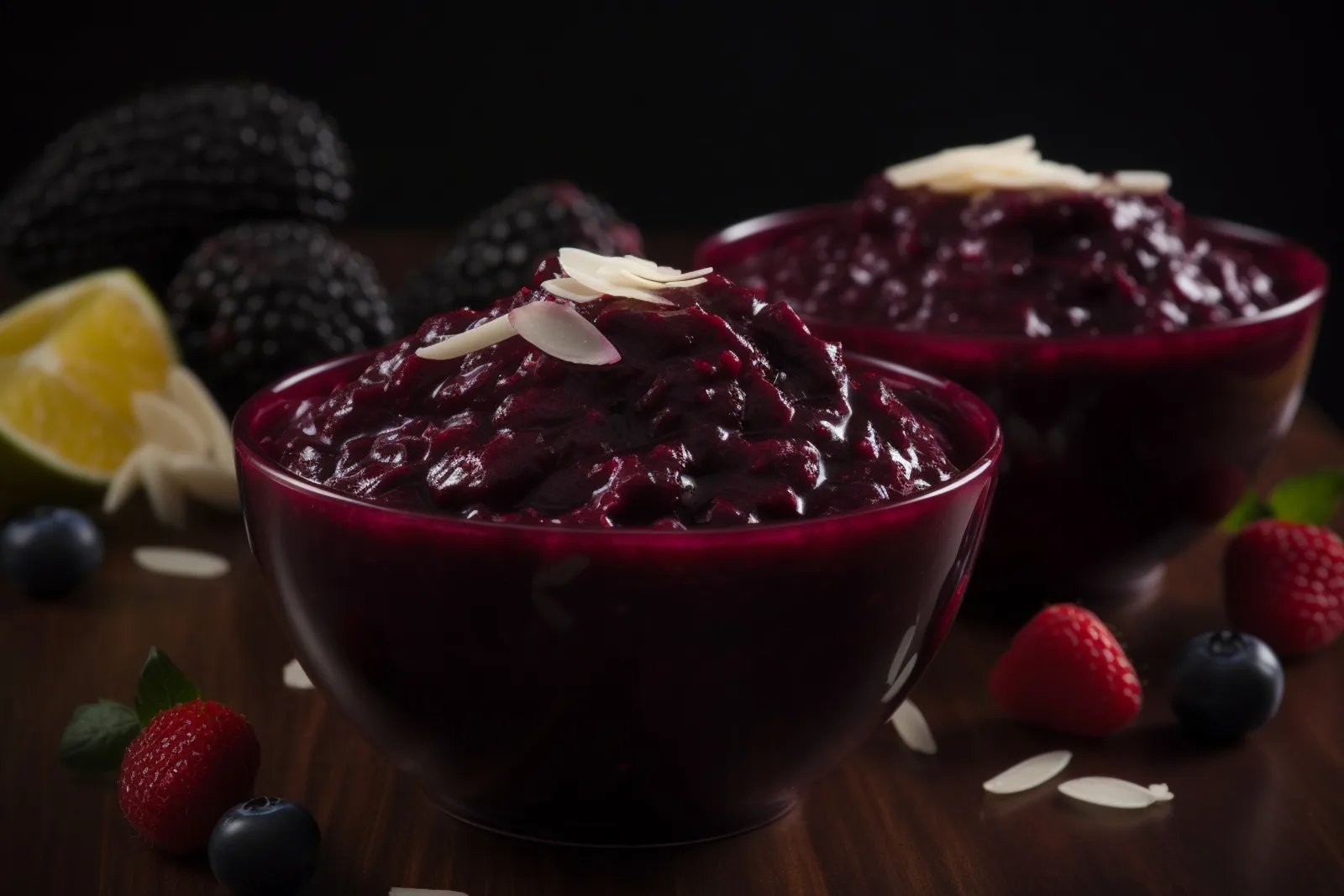

Mazamorra morada (mah-sah-MOH-rah moh-RAH-dah) is Peru’s purple corn pudding: dried purple corn simmered with pineapple peel and spices into a dark, inky broth, then cooked with prunes, dried apricots and fresh fruit and thickened with potato starch until it sets like a soft, glossy jello. It’s tart and sweet, smells of cinnamon and cloves, and has no milk or eggs. In Peru it’s eaten warm or cold, and often shares the bowl with rice pudding. This recipe makes 12 cups, with the details that decide whether it sets: exactly how much starch for the liquid you have, how to add it without lumps, and why the lime goes in after the heat is off.
What mazamorra morada is, and how long it takes
How do you make mazamorra morada? Simmer 15 oz (425 g) of purple corn with its broken cobs, pineapple peel, an apple, cinnamon and cloves in 12½ cups (3 liters) of water for 45 minutes, until you have 8½ cups (2 liters). Strain, cook prunes, dried apricots, diced fruit and 1 cup (200 g) of sugar in it for 20 minutes, whisk in ¾ cup (150 g) of potato starch dissolved in cold water and stir for 5 minutes, then add lime off the heat. 100 minutes for 12 servings.
Total time 100 minutes, but only about 25 of it is hands-on. Most of it is a pot simmering on its own. Easy, with one moment that needs your full attention: the 5 minutes after the starch goes in.
The base is the same purple corn broth used for chicha morada, Peru’s purple corn drink, only more concentrated: the drink uses the same bag of corn in 4 liters of water, the pudding in 3, so there’s enough color and flavor to carry the fruit and starch. Colombia has a dish called mazamorra too, and it’s unrelated: Colombian mazamorra is plain cooked white corn eaten cold with milk.
Ingredients and what to buy in the US and UK
| Ingredient | Metric | US | Notes |
|---|---|---|---|
| Dried purple corn | 425 g | 15 oz bag | Latin grocers or online; no substitute |
| Water for the base | 3 L | 12½ cups | Reduces to 2 L (8½ cups) |
| Prunes, pitted | 100 g | heaping ½ cup | Called guindones in Peru |
| Dried apricots or peaches | 80 g | ⅔ cup | Often sulfured; check the label |
| Raisins | 40 g | ¼ cup | Optional, but they add sweetness |
| Fresh pineapple, diced | 200 g | 1¼ cups | Plus the peel and core for the base |
| Potato starch | 150 g | ¾ cup + 1 tbsp | Not potato flour |
| Sugar | 200 g | 1 cup | 150 g (¾ cup) for a tarter pudding |
| Lime juice | 45 ml | 3 tbsp | From 2 or 3 limes |
Purple corn comes dried, on the cob, in clear bags of 15 oz (425 g). In the US look in Latin American supermarkets with a Peruvian section, or online; in the UK, Latin grocers and online shops selling Peruvian goods are the reliable route. Regular yellow or white corn won’t color the water, and nothing else replaces it.
Equipment. A 6-quart (6-liter) pot, a large strainer, and a whisk or a wooden spoon. A heavy-bottomed pot helps, because once the starch is in, a thin pot scorches at the bottom.
Potato starch, sweet potato starch or cornstarch
The starch decides the texture, so it’s worth choosing on purpose.
- Sweet potato starch. The traditional choice in Lima, sold in Peruvian shops as harina de camote. Glossy and slightly elastic. Use the same 150 g.
- Potato starch. In Peru it’s often simply called chuño, and it’s what most home recipes use. Nearly identical result: translucent, shiny, no flavor of its own. In the US it’s in the baking or gluten-free aisle, labeled potato starch; in the UK it’s easiest to find online or in specialist food shops. Check the packet says starch: it’s a bright white, squeaky powder.
- Potato flour is a different product. It’s ground dried potato, cream-colored, and makes a cloudy purée that tastes of potato. Read the label twice.
- Cornstarch (UK cornflour). It works, but the pudding comes out cloudy, less glossy and more like custard. Start with the same amount; if it’s still loose after 3 minutes of boiling, add 1 to 2 tbsp more dissolved in cold water.
The bag of imported corn and the dried apricots are what this costs you. If you’ve already made chicha morada and kept some unsweetened base, the corn is covered (see the shortcut below).
Cooking it, step by step
The base, 8½ cups and nearly black
Keep the corn at a gentle bubble with the lid off for 45 minutes, which boils away roughly a third of the water. It’s ready when lots of kernels have split and the liquid in a ladle hides the bottom completely. Measure after straining. Much more than 2 liters and the starch in this recipe won’t set it properly; much less and you get a stiff, overly sweet pudding.
Then the 20 minutes with the dried fruit plump the prunes and apricots and let them flavor the broth. Very hard dried fruit can soak for 30 minutes beforehand, but it isn’t necessary.
Thickening without lumps
Lumps form when starch hits hot liquid before it’s fully dissolved. Three rules:
- Dissolve it in cold water, never in the hot base: 150 g in 250 ml (1 cup), whisked until nothing sits at the bottom of the jug. Starch settles within seconds, so whisk it again right before pouring.
- Pour in a thin stream while stirring, with the pot at a gentle boil. Dumped in all at once, it forms balls that are slick outside and dry inside.
- Stir nonstop for 5 minutes once it’s bubbling again, scraping the bottom, where it catches.
How to tell it’s right. As the starch goes in, the pot turns milky and opaque. Within a minute or two it starts to thicken, and by the end of 5 minutes it looks glossy and see-through, bubbles rise thick and burst slowly, and it coats the back of the spoon so that a finger drawn across leaves a clean line. Hot, it should fall from the spoon in a thick ribbon. It firms up considerably as it cools, so resist adding more starch just because it still looks loose.
Lime, off the heat
Turn off the burner, then stir in the 3 tbsp (45 ml) of lime juice. Starch boiled with acid loses strength and the pudding loosens, especially overnight. The lime also nudges the color toward a redder purple and balances the sugar. Taste, and add more lime a spoonful at a time if you like it sharper.
When it goes wrong, and how to fix it
- Lumpy. The starch wasn’t fully dissolved or wasn’t stirred in. Off the heat, whisk hard for a minute; small lumps dissolve. Lift big ones out with a slotted spoon.
- Runny once cold. Too little starch for the liquid, more than 2 liters of base, too short a boil after adding it, or lime that boiled. Fix: dissolve 2 tbsp starch in ¼ cup (60 ml) cold water, stir it into the pudding at a gentle boil for 2 minutes, then add a little more lime off the heat.
- Rubbery or solid. Too much starch or too little base. Warm it gently with a splash of water and stir until it loosens.
- Pale and watery-tasting. The base was under-simmered or the cobs were left out. That can’t be fixed in the pot; measure the 2 liters next time.
- Scorched. High heat with the starch in. Pour it into a clean pot without scraping the bottom.
Who it suits. Not spicy, popular with kids, and free of gluten, dairy, eggs and nuts. Dried apricots may contain sulfites. Each cup carries about 28 g of sugars between the added sugar and the fruit.
The clásico, and other ways to make it
- El clásico, also called combinado or sol y sombra. Half mazamorra morada and half rice pudding in the same bowl or glass, side by side, with cinnamon on top. The rice pudding tones down the sweetness and adds creaminess. Any creamy cinnamon rice pudding works, such as this creamy Colombian rice pudding; the Lima version often has cloves too. For 12 clásicos, half this recipe is enough.
- Shortcut from chicha morada. If you’ve kept unsweetened chicha morada base, start at the dried fruit step with 2 liters (8½ cups) of it and skip the first hour. It comes out a little lighter, since the drink base is less concentrated.
- Instant mazamorra mixes. Peruvian brands sell packets with the starch already in; cook them with water as the label says. They’re quick but lack the fruit and spice of the real broth. Stirring in prunes, diced pineapple and lime at the end helps a lot.
- Less sweet. Use 150 g (¾ cup) sugar and a little more fresh fruit.
- For 24. Double everything in a wide 10- to 12-quart pot. Stirring 4 liters of thickening pudding takes muscle, so use a long wooden spoon and give it the same 5 minutes.
Make ahead, storing and reheating
Serve it cold, once it has had 2 hours in the fridge and is firm enough to hold the shape of the spoon, or warm, a quarter of an hour after turning off the heat. Either way, dust it with ground cinnamon. It’s a natural finish to a Peruvian meal of aji de gallina or grilled anticuchos, and it sits well on a dessert table next to suspiro a la limeña.
- Make ahead. It’s at its best made the day before. The strained base can be made up to 3 days ahead and kept unsweetened in the fridge.
- Fridge. Covered, for 3 to 4 days. Get it into the fridge within 2 hours of turning off the heat, already portioned into cups or shallow containers: the whole pot, close to 3 kg (6½ lb), takes too long to cool. It may weep a little liquid after the second day; stir it back in.
- Freezer. Not the finished pudding: starch gels leak water and turn spongy when thawed. The unsweetened base freezes well.
- Reheating. In a saucepan over low heat with 1 to 2 tbsp water, stirring, or in the microwave in 30-second bursts. It loosens as it warms.
Frequently asked questions
What does mazamorra morada taste like? Like a thick, warm fruit compote with cinnamon and cloves, tart from the lime and pineapple, with an earthy depth from the corn. The texture is the surprise for most people: smooth and wobbly, closer to a soft jello than a rice or bread pudding.
Can I use chicha morada powder? Not the drink powder. It brings sugar and color but none of the body of a real broth, and the pudding tastes flat and artificial. If that’s all you can get, buy an instant mazamorra mix instead, which is designed to set.
Can I make it with less sugar or a sweetener? Yes. Add a sweetener suitable for cooking at the dried fruit step. Sugar also gives some body, so without it the set is a little looser; the prunes and raisins sweeten a fair amount on their own.
Why did mine turn runny overnight? The two most likely causes are lime that boiled with it or starch that didn’t get its full 5 minutes, which is why the lime always goes in off the heat. It recovers: dissolve a tablespoon or two of starch in cold water and stir it in over a gentle boil.
Nutrition
Per cup of about 8 oz (230 g), one twelfth of the recipe, worked out from the quantities above:
- Calories: 170 kcal
- Protein: 1 g
- Carbohydrates: 43 g
- Fat: 0 g, of which 0 g saturated
- Fiber: 2 g
- Sugars: 28 g
- Sodium: 2 mg
Sugar accounts for about 65 kcal a cup, the starch about 42 and the dried fruit about 46. The corn, pineapple peel and base apple are strained out, and what they release into the water isn’t counted.
I take it off the heat a little looser than looks right, because I know the fridge will finish setting it, and I add the lime a spoonful at a time, tasting, rather than all at once. If I have extra purple corn broth, I freeze it, and the next batch takes half an hour. Josnaisis.