

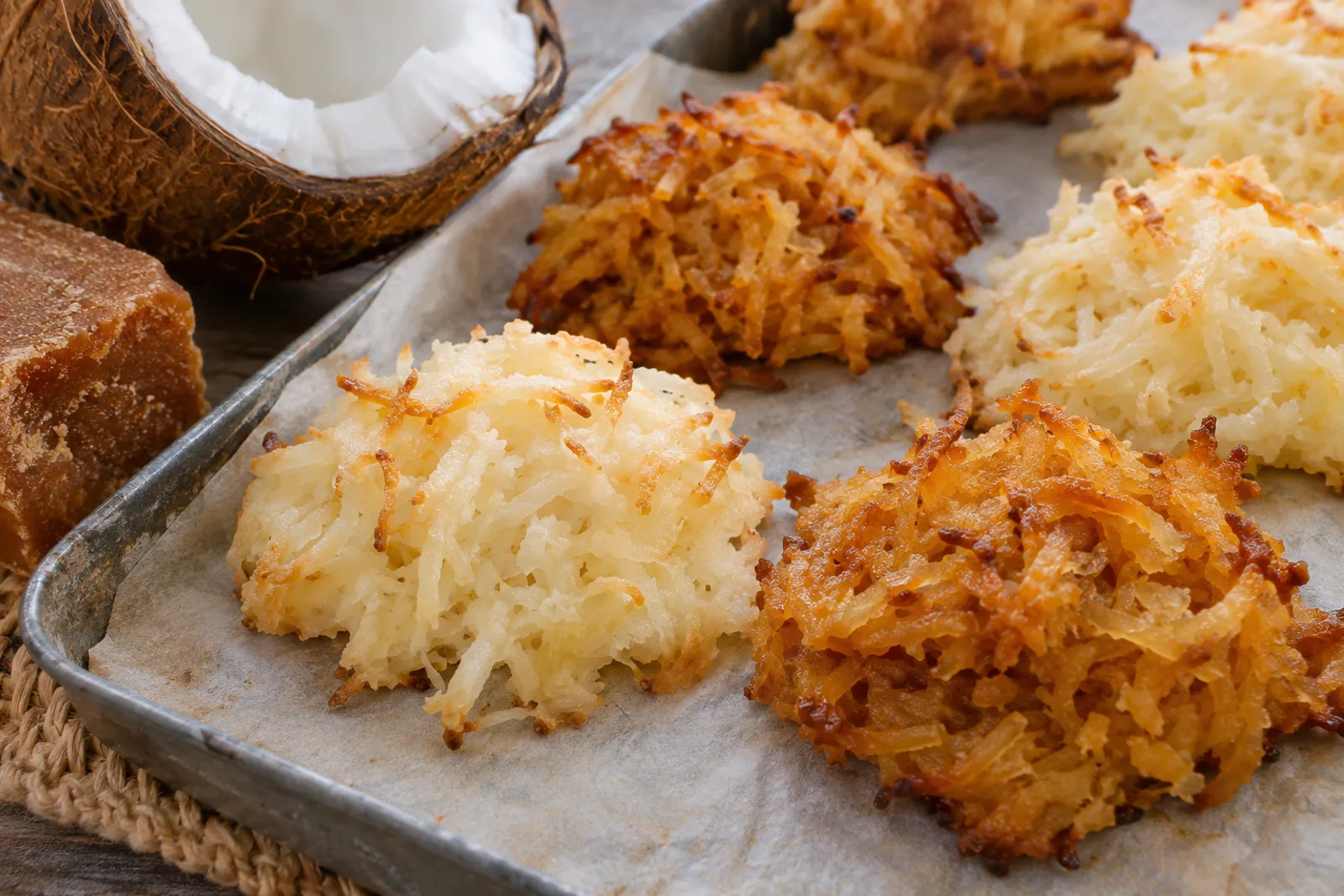

Colombian cocadas (koh-KAH-dahs) are the coconut candy of Colombia’s Caribbean coast: freshly grated coconut cooked in a sugar syrup with coconut water and milk until it clumps into a mass that holds its shape, then dropped from a spoon into rough mounds. They are chewy rather than crunchy, glossy outside and moist inside, with long strands of coconut you can see. Street vendors sell them by the beach and in markets, and in Cartagena a row of sweet stalls by the old city’s clock tower sells them in white, dark panela, guava, pineapple and dulce de leche versions.
The whole recipe turns on one moment. Pull the pot too soon and the mounds slump into puddles of syrup that never firm up; leave it too long and they crumble. This batch makes 20 white cocadas in 145 minutes, 1 hour of it cooling, and below you’ll find exactly how to recognize the set, with or without a candy thermometer.
How do you make Colombian cocadas?
How do you make Colombian cocadas? Dissolve 1¼ cups (250 g) sugar in ½ cup (120 ml) coconut water and ½ cup (120 ml) milk, add 14 oz (400 g) grated fresh coconut and cook 15 minutes over medium heat, then 10 to 15 minutes stirring nonstop until the bottom of the pan stays visible (234°F/112°C). Drop heaped tablespoons onto parchment and cool 1 hour. 145 minutes for 20 servings, 60 of them cooling.
Not to be confused with. In Venezuela, a cocada is a blended fresh coconut drink, and the coconut candy there is Venezuelan coconut conservas, made with dark cane sugar and no milk, pressed into a pan and cut into squares. Colombian cocadas are spooned, usually contain milk and come out softer.
Effort. Medium. Forty of the 85 working minutes are cracking and grating the coconut, which you can skip with dried coconut. The last 12 minutes need you at the stove, stirring.
Ingredients, with US and UK swaps
Which coconut to buy
- Fresh brown coconut. Sold in most US supermarkets and in UK supermarkets and greengrocers. Shake it: you should hear water sloshing. One medium coconut gives about 14 oz (400 g) of meat, exactly what the recipe needs. Grate on the coarse side of a box grater for the long strands of street cocadas, or the fine side for tighter mounds.
- Unsweetened desiccated or shredded coconut. Fresh coconut is nearly half water, so 7.5 oz (215 g) of dried coconut soaked 20 minutes in 200 ml (¾ cup plus 1 tbsp) hot water replaces the 14 oz (400 g) of fresh. UK desiccated coconut is finer than US shredded and gives a smoother, more compact mound. Expect a slightly drier, less coconutty result.
- Sweetened flaked coconut (the baking-aisle kind in the US). Already heavy with sugar. If it’s all you have, use 8.5 oz (240 g), skip the soak and cut the sugar to ¾ cup (150 g). Paler and softer.
- Frozen grated coconut. In the freezer section of Latin and Asian grocers. Thaw and use it like fresh, by weight.
Sugar, panela and the liquid
White sugar makes white cocadas, ivory and milky. Panela, Colombia’s unrefined cane sugar sold in hard blocks, makes the dark version with a molasses edge. In the US look for panela or Mexican piloncillo in the Latin aisle; in the UK, dark muscovado or jaggery from South Asian shops work at the same weight. Coconut water is whatever drains from your coconut, topped up with tap water. Whole milk gives the white ones their dairy flavor; for a dairy-free batch use coconut milk or more coconut water instead.
Equipment
A heavy-bottomed 3-quart (3-liter) saucepan, a long wooden spoon, two tablespoons, two baking sheets and parchment. A hammer and a blunt knife for the coconut. A candy thermometer is useful, not essential. Silicone muffin molds give neat round cocadas if you prefer them to rustic mounds.
Step by step, and what each stage should look like
Day ahead. Grated fresh coconut keeps 3 to 4 days in the fridge in a sealed container, so the messy part can be done the night before.
Cracking the coconut. Pierce two of the three eyes with a skewer or screwdriver and drain. Bake 15 minutes at 350°F (175°C); the meat shrinks and loosens. Wrap the coconut in a towel, hit it around the equator with a hammer and lever the meat out with a blunt knife. Peel off the brown skin with a vegetable peeler, or the white cocadas come out speckled and with tough bits.
First stage, 15 minutes at medium. The coconut boils loosely in the syrup. Stir every minute. The bubbles go from fast and small to slow and fat as the liquid reduces.
Second stage, 10 to 15 minutes at medium-low. Now stir without stopping, scraping the bottom in a figure eight, because sugar sticks in the center of the pan before you see it.
How to tell when cocadas are ready
- The bottom shows. Drag the spoon across the center: you see the bottom of the pan for 2 to 3 seconds before the mixture closes over it.
- It pulls together. The mass turns glossy, comes away from the sides and no loose syrup is left in the pan.
- The plate test. Drop a teaspoonful on a cold plate. It should sit as a little mound without spreading or leaking a ring of syrup. If it spreads, cook 2 more minutes and test again.
- The thermometer. About 234°F (112°C) at sea level, the start of the soft-ball stage, which runs to about 240°F (116°C). At altitude, subtract however many degrees below 212°F (100°C) your water boils.
Shaping. Kill the heat and start right away. Scoop a heaped tablespoon, about 1 oz (30 g), with one oiled spoon and push it onto the paper with the other, 1¼ in (3 cm) apart. Leave them rustic or flatten slightly with a wet spoon. You have 5 to 8 minutes before the mixture stops sticking together; if it does, put the pan back on the lowest heat for a minute with 1 tbsp water.
Cooling. One hour at room temperature and they lift off the paper. For the drier skin of the ones sold on the street, leave them uncovered about 8 hours or overnight.
Scaling. Half the recipe makes 10 and sets sooner; start checking after 8 minutes of the second stage. For 40 or more, cook two batches back to back rather than one double batch: 28 oz (800 g) of coconut in one pan takes far longer to reduce and scorches before the center sets.
Why cocadas don’t set, crumble or taste burnt
- They spread and stay sticky. Undercooked: it never reached 234°F (112°C) at sea level, or the equivalent at your altitude. This is the most common failure. Scrape them back into the pan with 2 tbsp water and cook 3 to 5 minutes more, until the bottom shows.
- They crumble and won’t hold together. Overcooked, past about 244°F (118°C) at sea level, or the dried coconut wasn’t soaked. While still hot, stir in 2 tbsp milk or coconut water off the heat until it binds again.
- Grainy. Sugar crystals on the pan walls seeded the syrup. Brush the sides with a wet pastry brush while the sugar dissolves, and don’t add the coconut until every grain is gone.
- Burnt taste. Thin pan, high heat or a break in stirring. Tip the mixture into a clean pan without scraping the bottom. Panela batches burn sooner than white ones.
Safety and allergens. The mixture is above 230°F (110°C) and spits, so wear long sleeves. Contains coconut and milk; naturally gluten-free and egg-free, and vegan with coconut milk instead of dairy.
Cocada flavors, panela, guava, pineapple and dulce de leche
- Dark panela cocadas. Swap the sugar for 8.8 oz (250 g) grated panela or piloncillo. The dark color hides the stages, so go by the pan bottom, not the shade.
- Guava. I add 3.5 oz (100 g) of Colombian guava paste in ½-inch (1 cm) cubes at the start of the second stage. It melts in 3 to 4 minutes and turns the mixture pink. Guava paste is mostly sugar, so the set comes sooner; start checking at 6 minutes.
- Pineapple. Replace the coconut water and milk with 1 cup (240 ml) strained fresh pineapple juice. No milk here, because the acid would curdle it. Yellow and slightly tart.
- Arequipe (dulce de leche), baked. Mix 5 cups (465 g) sweetened flaked coconut with 1 cup (300 g) of Colombian dulce de leche, press into a greased 8 x 8 in (20 x 20 cm) pan with wet fingers and bake 20 to 25 minutes at 350°F (175°C), until just golden on top. Cool at least 1 hour and cut into squares.
For a milk fudge cut into squares, with no coconut at all, Colombian panelitas de leche are cooked to the same soft-ball range.
Serving and storing cocadas
Serve at room temperature with black coffee, about 2 per person. A glass of cold Colombian coconut lemonade cuts the sweetness.
- Room temperature. Completely cool, in a tin or airtight box with parchment between layers, somewhere cool: up to 1 week.
- Fridge. 2 weeks, though they firm up; take them out 20 minutes before eating.
- Freezer. 2 to 3 months in a freezer bag with parchment between layers. Thaw 30 minutes at room temperature. No reheating needed.
- Throw them out if they smell rancid, taste sour or show mold. Fresh coconut spoils long before the sugar does.
Colombian cocadas FAQ
Why are my cocadas not hardening? They were pulled too early. Return them to the pan with 2 tbsp water and stir over medium-low 3 to 5 minutes, until the pan bottom shows and a teaspoonful holds on a plate.
Can I make cocadas with bagged coconut? Yes, with unsweetened desiccated or shredded coconut: 7.5 oz (215 g) soaked 20 minutes in 200 ml hot water replaces 14 oz (400 g) fresh.
Are cocadas the same as coconut macaroons? No. Macaroons are bound with egg white and baked; cocadas are cooked in syrup on the stove and set as they cool, with no egg or flour.
How many cocadas does one coconut make? One medium coconut gives about 14 oz (400 g) of meat, enough for 20 cocadas of 1 oz (30 g).
Nutrition per cocada
Per piece (1/20 of the recipe, about 1 oz/30 g, white version), calculated ingredient by ingredient from the quantities above:
- Calories: 124
- Protein: 1 g
- Carbohydrates: 16 g
- Sugars: 14 g
- Fat: 7 g, of which 6 g saturated
- Fiber: 2 g
- Sodium: 32 mg
Nearly all the fat comes from the coconut and is saturated, and about 12 g of the sugar per piece is added sugar.
I met cocadas only after moving to Colombia; back home in Venezuela, asking for a cocada got me a glass. I grate the coconut coarse because those long strands are what set a cocada apart from anything made with bagged flakes, and I never trust a timer for the set. I keep dropping teaspoonfuls on a plate until one sits still, and only then do I turn off the heat. Josnaisis.