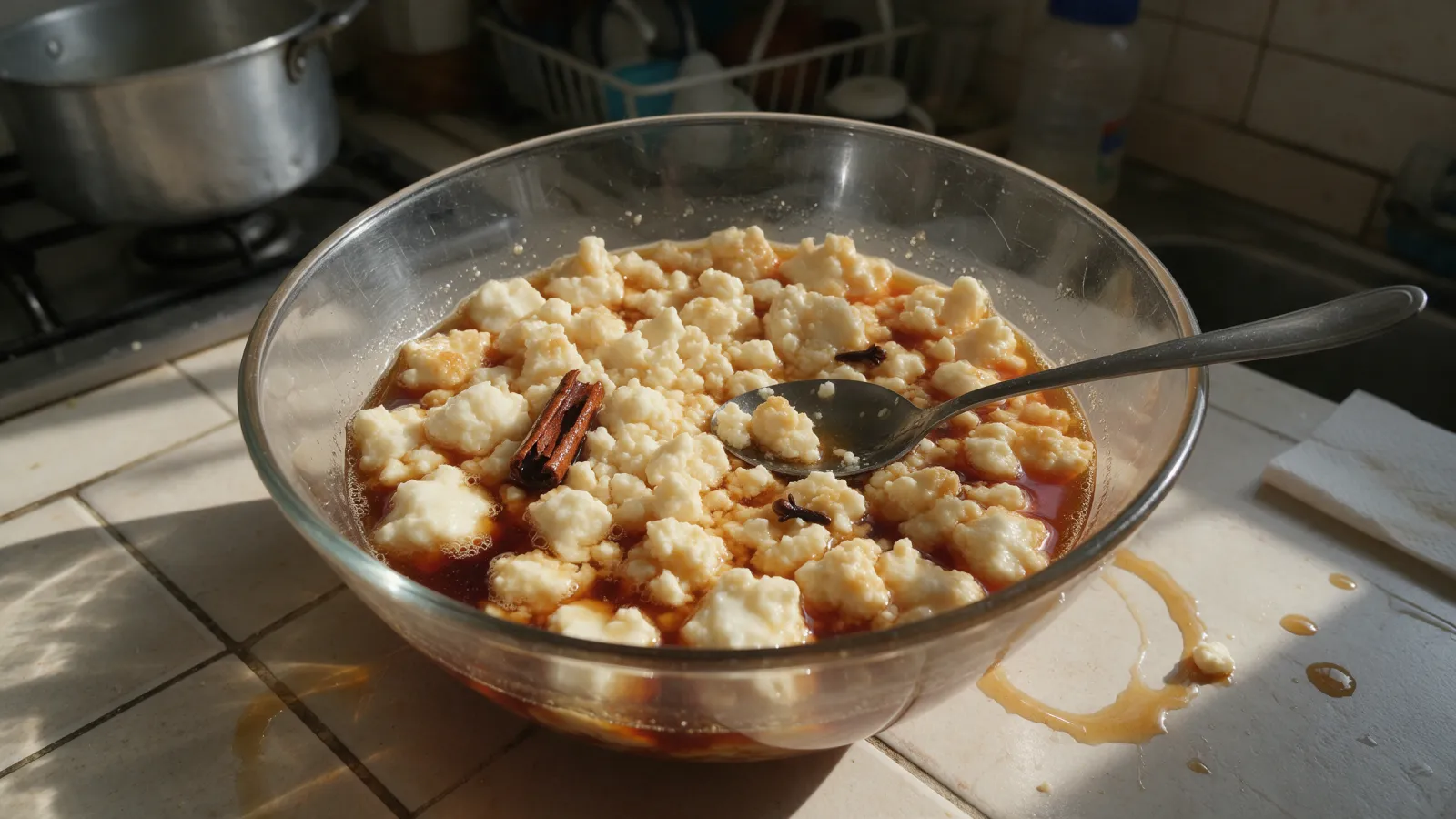

Picture homemade ricotta, the kind you make by pouring lemon juice into milk at 185°F (85°C), except that instead of draining the curds you leave them in their whey, add a cone of brown cane sugar, a cinnamon stick and a few cloves, and simmer until the whey turns into syrup. That is leche cortada, or dulce de leche cortada: Venezuelan “cut milk” sweet, served cold in little bowls. Despite the name, it has nothing to do with the smooth caramel spread most English speakers know as dulce de leche.
What is leche cortada?
How do you make dulce de leche cortada? Heat 2 liters (about 2 quarts) of whole milk to 185-194°F (85-90°C), turn off the heat and add 3-4 tablespoons of lemon juice without stirring; after a 10-minute rest you have firm curds. Add 400 g (14 oz) of piloncillo, cinnamon and cloves and simmer on the lowest heat for 60 minutes, swirling, until the whey is an amber syrup at 217°F (103°C). Ready in 105 minutes for 10 servings.
It is a home dessert in Venezuela, where it is also called miguelucho, and it turns up in Colombia, Cuba and the Dominican Republic as well. The curds are soft and mild, a little like fresh cheese, and the syrup tastes of molasses and warm spice. One pot makes about 1.1 kg (2.4 lb) in my kitchen, 10 servings of roughly 110 g (4 oz).
The closest relative outside Latin America is Indian rasgulla: balls of chhena, milk curdled with acid, drained and kneaded, cooked in light sugar syrup. Leche cortada skips the draining and kneading. The curds never leave the pot, and the whey, with all its milk sugar, becomes the syrup.
| Dessert | How it’s made | Texture |
|---|---|---|
| Leche cortada | Milk curdled with acid, simmered in its own whey with piloncillo | Tender curds in syrup |
| Dulce de leche / arequipe | Milk and sugar reduced without curdling, often with ½ tsp baking soda per liter | Smooth spread, set at 225°F (107°C) |
| Ricotta-style fresh cheese | Milk curdled with acid at 185°F (85°C), then drained | Unsweetened soft cheese |
| Rasgulla | Chhena drained, kneaded, rolled into balls, cooked in light syrup | Spongy balls soaked in syrup |
If it’s the smooth spread you’re after, my Colombian dulce de leche is the one to make; there, curdling is the thing you avoid.
The milk you buy decides the curds
This is where most batches go wrong outside Latin America, and it’s about the carton, not your technique.
Ultra-pasteurized milk has been heated far higher than regular pasteurized milk. Cheesemakers avoid it for fresh cheese, because the heat changes the milk proteins and the curds struggle to form. It still curdles, but into small, soft bits that break apart during the simmer. In the US, read the label: organic milk is often processed this way for a longer shelf life. In the UK, long-life cartons are UHT; buy fresh whole milk from the chiller.
Skim or 2 % milk makes tough, dry curds; fat is what keeps them tender. Lactose-free milk is usually ultra-pasteurized, and because its lactose is already split into glucose and galactose, the syrup browns faster and overshoots. Whole milk powder works, at about 125 g per liter of water, a scant cup per quart. Raw milk curdles well, but boil it first; it can carry Salmonella, E. coli and Listeria. And never use milk that has gone sour on its own. That’s spoiled milk, not a shortcut.
How much lemon per quart of milk
Lemon juice, at pH 2.00 to 2.35, only has to pull milk from its natural 6.4-6.8 down to pH 4.6, where casein, the main milk protein, clumps and drops out. A little goes a long way.
I use 2 tablespoons per quart (30 ml per liter), in two rounds: 3 tablespoons for the whole pot first, the last tablespoon only if the whey is still cloudy after 5 minutes. Fresh cheese lands in the same range: queso blanco takes ¼ cup of white vinegar per gallon at 185°F, or ½ cup of lime juice per gallon. Watch the whey rather than the spoon. Clear, greenish-yellow whey means you’re done. Milky whey needs more acid; far too much makes rubbery, sour curds.
White vinegar works in the same amount. I prefer lemon or lime, because its aroma sits better with the piloncillo. If you add peel for scent, use only the colored zest; the white pith turns bitter.
Ingredients and US and UK swaps
| Ingredient | What it is | US | UK |
|---|---|---|---|
| Papelón | Unrefined cane sugar in a cone or block, with its molasses | Piloncillo in the Mexican aisle, or dark brown sugar | Panela online or in Latin shops, or dark muscovado |
| Whole milk | Pasteurized, not ultra-pasteurized | Check the label, many organic milks are UHT | Fresh whole milk from the chiller, not long-life |
| Lemon | Venezuelan cooks use green limones, which are limes | Lemons or limes | Lemons or limes |
| Cinnamon, cloves | Whole, so they can be fished out | Spice aisle | Spice aisle |
White sugar makes a paler, golden syrup without the molasses depth; it’s how some Venezuelan family recipes do it, and still good. Equipment: a silicone spatula, an instant-read thermometer if you have one, and a wide, heavy pot that holds at least 4 quarts (4 liters), so the syrup reduces and the curds sit in one or two layers.
How to make it, step by step
The method is in the recipe card below. Three moments matter.
Curdling without stirring
Heat the milk to 185-194°F (85-90°C), turn off the burner, pour the juice over the whole surface and walk away for 10 minutes. Hot milk makes big curds quickly; in my kitchen, cold milk with lemon just thickens like yogurt and gives fine bits. In Lara, in Venezuela, they put it plainly: for thick curds, don’t stir.
I curdle before sweetening. Some cooks dissolve the sugar in the milk first and it works, but curdling first lets me see the whey and correct the acid before the piloncillo goes in.
The syrup temperature, 217°F (103°C)
I take it off at 217°F (103°C), or 5°F (3°C) above your local boiling point. That’s below the jelly point for jams, 8°F above boiling, because the whey proteins thicken the syrup as it cools and I don’t want paste in the fridge. Cold, it should be like thin honey. No thermometer: freeze a plate when the simmer starts, drop a little syrup on it, wait 30 seconds; if it runs slowly, it’s ready.
Who this recipe is for
- If you’ve made ricotta or paneer → you already know step one; the new part is simmering the curds instead of draining them.
- If you only have ultra-pasteurized milk → it will work, with smaller curds; swirl, never stir.
- If you’re lactose intolerant → not this one; all the lactose stays in the syrup.
- If you want a make-ahead dessert for 10 → this is it.
Make-ahead plan and scaling
Of the 105 minutes, about 20 are hands-on. Make it the day before: it’s served cold, and the syrup finishes thickening overnight.
| Servings | Milk | Juice | Piloncillo | Spices | Pot |
|---|---|---|---|---|---|
| 4-6 | 1 liter (1 quart) | 30 ml (2 tbsp) | 200 g (7 oz) | ½ stick, 3 cloves | 3 quarts |
| 10 | 2 liters (2 quarts) | 60 ml (¼ cup) | 400 g (14 oz) | 1 stick, 6 cloves | 4-5 quarts |
| 12-20 | 4 liters (1 gallon) | 120 ml (½ cup) | 800 g (1¾ lb) | 2 sticks, 12 cloves | two 4-5 quart pots |
With 1 liter the simmer drops to about 40 minutes in my kitchen. For 4 liters, use two pots; in one, the bottom scorches and the curds break when you swirl. Go by color and the plate test rather than the clock.
Mistakes that ruin leche cortada
- Grit instead of curds → lukewarm milk, acid dribbled in, or stirring afterwards.
- It won’t curdle → not enough acid, or the milk cooled. Add the reserved tablespoon and warm it briefly, without boiling.
- Rubbery curds → skim milk, too much acid, or a hard boil during the simmer.
- Curds falling apart → ultra-pasteurized milk, or stirring with a spoon. Swirl.
- Scorched bottom → thin pot or high heat near the end, when little syrup is left.
- Syrup set hard in the fridge → overcooked. Warm it with 100 ml (scant ½ cup) of water and boil 2 minutes.
Variations
- Shortcut → after the rest, ladle out 1 liter (1 quart) of whey; in my kitchen the simmer drops to about 30 minutes, with a little less syrup.
- Dominican style → in the Dominican Republic they whisk 1 egg with the sugar for every 600 ml (2½ cups) of milk and curdle it with lime; the curds come out softer, more like custard.
- From milk powder → 250 g (about 2 cups) whole milk powder in 2 liters of water.
- Less sweet → 300 g (10½ oz) piloncillo; thinner syrup.
- With raisins → 50 g (⅓ cup) in the last 15 minutes; it’s often topped with raisins and served with queso blanco.
What it costs
At US average prices for August 2026, the pot comes to about $3.92, roughly 39 cents a serving.
Milk is 57 % of the cost at $4.229 a gallon. White sugar at $1.024 a pound stands in for piloncillo as the floor; piloncillo from a Latin market costs more. Lemons are priced at $2.114 a pound, about 0.37 lb for two. Cinnamon and cloves are left out.
Serving and storing it
Serve it cold, in small bowls with syrup spooned over, with a slice of mild white cheese or a cup of black coffee. On a Venezuelan dessert table it sits well next to green papaya in piloncillo syrup a square of majarete, the corn and coconut pudding, and a wedge of Venezuelan bread pudding with caramel; on a hot afternoon, with a glass of papelón con limón. After a Venezuelan quesillo it’s one milk dessert too many; pick one.
Fridge. Like any cooked leftover, it keeps 3 to 4 days at 40°F (4°C) or below, and shouldn’t sit out more than 2 hours at room temperature. Keep it covered and use a clean spoon.
Freezer. I don’t freeze it. Camila Made warns that the curds separate and the syrup turns watery once thawed.
Serving again. No reheating needed. If the syrup is too thick straight from the fridge, let it sit out 15 minutes or fold in 2 tablespoons of hot water.
Frequently asked questions
Is leche cortada the same as dulce de leche? No. Dulce de leche is milk and sugar cooked down without curdling into a smooth spread. Leche cortada is curdled on purpose and stays in curds in a syrup.
How much lemon juice curdles a quart of milk? About 2 tablespoons per quart (30 ml per liter) with the milk at 185-194°F (85-90°C). Start with less and add more only if the whey stays cloudy.
Can I use vinegar instead of lemon? Yes, white vinegar in the same amount. The piloncillo and spices cover most of its flavor.
Why are my curds tiny? The milk was too cool, the acid went in slowly, you stirred, or the milk was ultra-pasteurized.
Is it safe to eat curdled milk? Yes, when you curdle fresh pasteurized milk with acid on purpose and cook it. Milk that soured by itself is spoiled; throw it out.
How long does it keep? 3 to 4 days in the fridge at 40°F (4°C) or below, like any cooked leftover.
What’s a substitute for piloncillo? Dark brown sugar in the US or dark muscovado in the UK, same weight. White sugar works too, with a lighter syrup.
Nutrition
Per serving (about 110 g / 4 oz, one tenth of the pot), calculated using this recipe’s quantities, with brown sugar standing in for piloncillo. Nothing is drained, so everything in the milk ends up in the dessert.
- Calories: 279 kcal
- Carbohydrates: 50 g
- Sugars: 49 g
- Protein: 7 g
- Fat: 7 g, of which 4 g saturated
- Fiber: 0 g
- Sodium: 100 mg
About 39 g of the sugar comes from the piloncillo and the rest is lactose. With 300 g (10½ oz) of piloncillo, a serving drops to about 241 kcal. For other cold milk desserts, the Colombian manjar blanco sets firm with ground rice, and the Colombian natas dessert is made from the skin of boiled milk.
I learned this one by watching, with no measurements at all, and it took me longer to write down than to cook. The day I measured the lemon and stopped stirring was the day I understood why my curds were sometimes big and sometimes sand. Josnaisis.