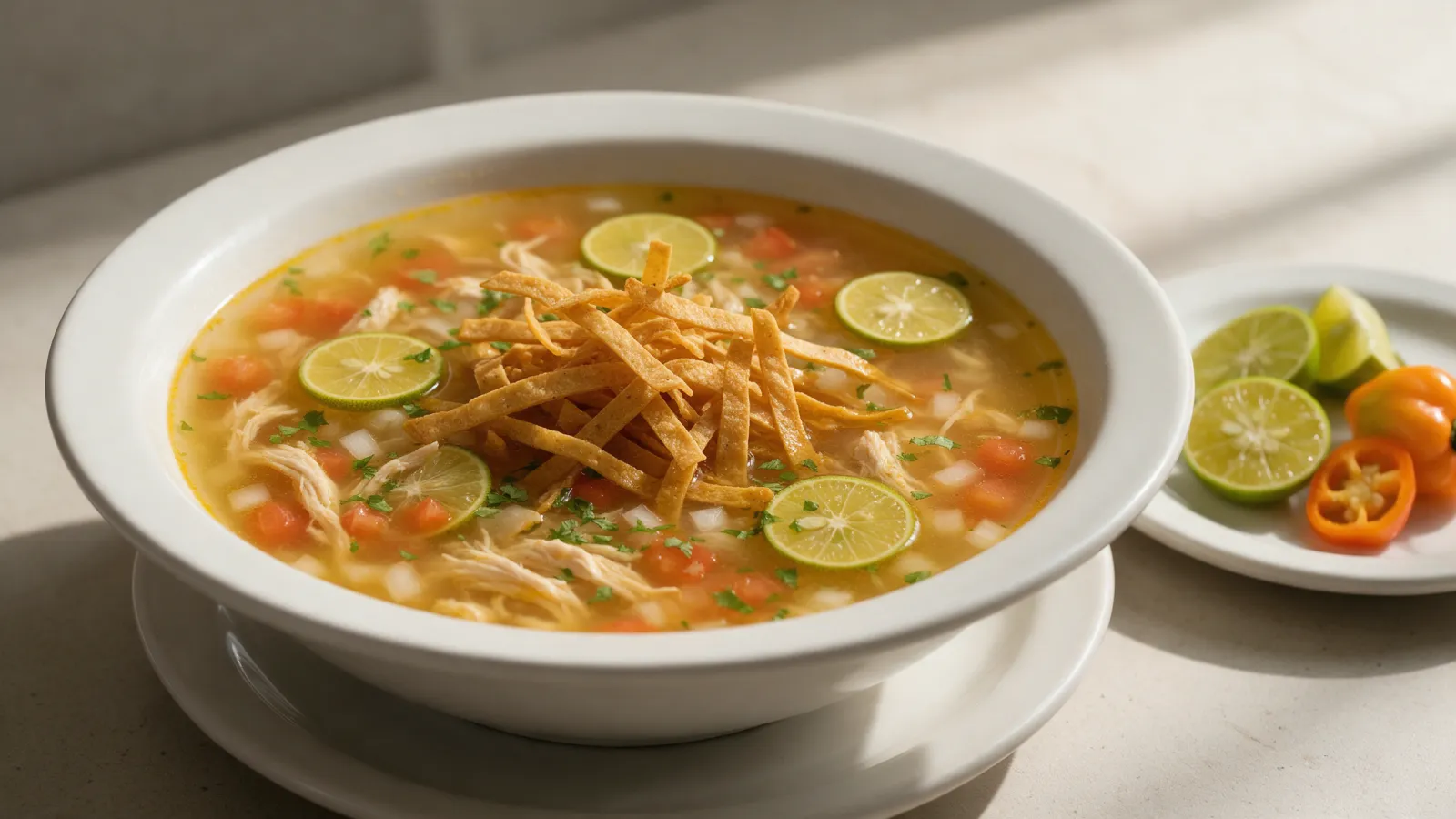

Most of what makes sopa de lima (SOH-pah deh LEE-mah) taste the way it does comes from a fruit you almost certainly can’t buy outside southeastern Mexico: the lima of Yucatán, a thin-skinned citrus that is softer and more floral than a supermarket lime, with a faint bitter edge. The rest is easy. It’s a clear chicken broth scented with allspice, clove and cinnamon, a quick sofrito of onion, sweet pepper and tomato, shredded chicken, and fried corn tortilla strips that crackle when the hot broth hits them. Below is how to rebuild that citrus from a US or UK grocery store, when to add it so it doesn’t turn bitter, and a 90-minute plan for 6 bowls.
What is sopa de lima?
How do you make sopa de lima? Simmer bone-in chicken breast with charred onion and garlic, allspice, clove, cinnamon and peppercorns for 35 minutes. Strain, then simmer the broth 10 minutes with an onion, sweet pepper and tomato sofrito and the shredded chicken. Turn off the heat, steep lime slices 5 minutes, stir in the juice and ladle over fried tortilla strips. 90 minutes for 6 servings.
It’s a chicken soup from the Mexican state of Yucatán. Think chicken soup with a sour, perfumed finish and a crunchy topping. The broth is thin and clear rather than creamy or tomato-red, and it doesn’t burn: the heat comes from habanero passed at the table.
Where it came from is unsettled. Larousse Cocina, cited by the Mexican food site Grupo Animal, credits a Mérida restaurateur known as maestro Katún in 1946, while a historian from the Universidad Autónoma de Yucatán told Afar she thinks it descends from a Maya turkey broth.
Is it worth making? Yes, if you like chicken soup and want something brighter. 90 minutes on the clock, about 50 of them hands-on, and nothing in it is technically hard. It’s ideal as a light dinner, a starter before something rich like cochinita pibil, Yucatán’s achiote pulled pork, or a pot for a crowd, since nearly everything can be made a day ahead. It’s the wrong choice if sour food isn’t your thing, because the citrus is the point, or if you want a thick, filling bowl: this is broth.
The lima, and what to buy instead in the US and UK
What a Yucatán lima actually is
A green-yellow citrus with a thin, slightly bumpy rind and juice that is less sharp than a lime’s. Afar describes the flavor as somewhere between a tangy Meyer lemon and a sweet key lime. Yucatán grows sour lima (lima agria), sweet lima and a variety called chinalima. Rick Bayless and the old Yucatecan recipe reproduced by Yucatan Living call for lima agria; Grupo Animal names the chinalima as the soup’s fruit.
The botany isn’t settled either. Yucatan Living and Wikipedia identify the lima as Citrus limetta, but I couldn’t find a botanical source that pins down the sour one, and the University of Yucatán’s dictionary of Yucatecan Spanish classifies chinalima as a sweet lime, Citrus limetioides. What matters in the kitchen: it isn’t a Persian lime, it isn’t a key lime, and fresh ones rarely leave the peninsula.
The swap I use, and the alternatives
Three parts lime juice to one part grapefruit juice: a scant ¼ cup (55 ml) of lime and 4 tsp (20 ml) of grapefruit for 6 bowls, with a strip of grapefruit peel standing in for the lima slices. Tulum Times uses this 3:1 ratio with grapefruit and Excélsior uses it with sweet orange; grapefruit is the one that brings back the bitter note.
Lime alone works, but start at 55 ml (a scant ¼ cup) and taste: it’s sharper and flatter. Orange makes it rounder and sweeter, which kids tend to prefer. Where his recipe calls for two limas, Bayless allows two Persian limes or four key limes. Seville oranges, the bitter marmalade oranges sold in the UK roughly from late December to mid-February, also work mixed with lime, though they’re more bitter.
Everything else on the list
| Ingredient | What it does | US | UK | What changes |
|---|---|---|---|---|
| Allspice berries | the sweet, clove-like scent of the broth | spice aisle | supermarket spice rack | I use whole berries; ground allspice clouds the broth |
| Yucatecan sweet chile (chile dulce) | mild pepper flavor, no heat | green bell pepper | green pepper | almost nothing; Ricardo Muñoz Zurita and Excélsior both suggest it |
| Mexican oregano | herbal, slightly citrusy | Latin aisle | online spice shops | Mediterranean oregano is a different plant; it works, with a slightly different herbal note |
| Corn tortillas | the strips | any supermarket | Mexican brands online; check the pack says corn, not wheat | flour tortillas puff and go chewy |
| Habanero | heat, at the table only | most supermarkets | scotch bonnet, its close relative | same fierce heat; a sliver per bowl |
Boxed stock works in a hurry. A US ready-to-serve chicken broth carries 371 mg of sodium per 100 ml in the USDA database, over 7,000 mg in 2 liters (8½ cups), so don’t add salt until you’ve tasted.
Tools. A 5-liter (5-quart) pot, a 24 cm (9½ in) skillet, a strainer and a deep pan for frying. No thermometer? Drop in one strip: if it fizzes immediately, the oil is at 350-360°F (175-180°C).
When to add the lime so the soup doesn’t turn bitter
With the heat off, at the very end. Slices or peel get 5 minutes in the hot broth and come out; the juice goes in after that and the pot never boils again. Sources disagree here, which is why I time it. Ricardo Muñoz Zurita, author of Mexico’s Larousse gastronomic encyclopedia, puts one lima slice and a tablespoon of juice in each bowl and pours the broth over. A Yucatecan cook quoted by Grupo Animal pulls the slices after 3-5 minutes so they don’t turn bitter. Tulum Times warns that a whole lima simmered for about half an hour makes the soup bitter, and that boiling the juice makes it taste flat and metallic.
If you’re short on time or cooking for a crowd, the Muñoz Zurita way is the safest: juice and a slice in each bowl, broth on top.
Timeline and what you can make the day before
90 minutes, about 50 hands-on. The strips and sofrito fit inside the 35 minutes the chicken simmers by itself.
Make ahead. The strained broth and shredded chicken keep separately in the fridge overnight, and you can lift off the set fat in the morning. The sofrito keeps in a jar. I fry the strips up to 2 days ahead and keep them airtight at room temperature, not in the fridge. On the day, that leaves 20 minutes of work. The citrus is always last-minute.
How to tell each step is right.
- Charred onion and garlic → cut faces nearly black, smelling toasty, not acrid.
- Broth → barely trembling; a rolling boil makes it cloudy.
- Chicken → 165°F (74°C) in the thickest part, the safe minimum for poultry from USDA FSIS.
- Strips → bubbling has almost stopped and they’re rigid, 1-2 minutes per batch.
- Sofrito → tomato collapsed, pan nearly dry, about 10 minutes in.
Scaling to 10 or 20
| Ingredient | 6 bowls | 10 bowls | 20 bowls |
|---|---|---|---|
| Bone-in chicken breast | 800 g (1¾ lb) | 1.35 kg (3 lb) | 2.7 kg (6 lb) |
| Water | 2.75 L (11½ cups) | 4.5 L (19 cups) | 9 L (9½ quarts) |
| Tomatoes | 300 g (10½ oz) | 500 g (1 lb 2 oz) | 1 kg (2¼ lb) |
| Onion, total | 225 g (8 oz) | 375 g (13 oz) | 750 g (1⅔ lb) |
| Bell pepper | 150 g (5 oz) | 250 g (9 oz) | 500 g (1 lb 2 oz) |
| Lime juice or swap | 75 ml (5 tbsp) | 125 ml (½ cup) | 250 ml (1 cup) |
| Corn tortillas | 8 | 14 | 27 |
For 10 you need an 8-liter (8-quart) pot; for 20, two of those. Simmering times stay the same, but the water takes longer to boil. For 20, put the citrus in each bowl rather than the pot: you control the sourness and the leftovers keep better.
Mistakes, heat level, kids and allergens
- Bitter soup → peel or a whole lima stayed in the boiling broth. Pull slices at 5 minutes, heat off.
- Tastes only of lime → too much juice, or lime with no grapefruit. Add it a tablespoon at a time.
- Flat, dull citrus → the juice boiled. Squeeze a fresh tablespoon into each bowl.
- Cloudy broth → hard boil or ground spices.
- Soggy strips → oil below 350°F (175°C), or strips stirred into the pot.
Heat, 0 out of 5. The soup itself isn’t spicy; sweet peppers have no heat. Habanero, served on the side, runs 100,000-350,000 Scoville units, so a sliver per bowl is plenty.
Kids usually like it for the chicken and the crunch. I give them half the juice, or the lime-and-orange mix.
Allergens. None of the major ones: no gluten, dairy, egg or nuts. Corn tortillas contain no wheat, but check labels if you’re cooking for someone with celiac disease, and check the stock too. Lard, if you use it, is pork.
Which version should you make?
Compared with Mexican tortilla soup with pasilla chile, sopa de lima shares the fried strips but swaps the dark tomato-chile broth for a clear one; compared with Mexican caldo de pollo with vegetables, it shares the clear broth but adds citrus and warm spices instead of big chunks of vegetables. If you’d rather have the heat inside the pot, caldo tlalpeño, the chicken chipotle soup with chickpeas, blends smoked chile straight into the broth.
- Short on time → 2 liters (8½ cups) of reduced-sodium boxed stock and 450 g (1 lb) of cooked chicken: sofrito, 10 minutes’ simmer, citrus. 30 minutes.
- For a party of 20 → broth, chicken, sofrito and strips the day before; on the day, reheat and add the citrus bowl by bowl.
- Lighter → bake the strips at 400°F (200°C) for 8-12 minutes, the timing the University of Kentucky gives, with 1 tbsp of oil: 262 kcal a bowl instead of 272. Without strips, 172 kcal.
- With turkey → the old recipe in Yucatan Living says chicken or turkey, and Tulum Times uses 1.2 kg (2⅔ lb) of bone-in turkey pieces. Cook to 165°F (74°C), which takes longer than breast.
- Richer broth → Rick Bayless adds 900 g (2 lb) of chicken wings and 900 g (2 lb) of pork neck bones and simmers for 2 hours.
- Vegetarian → vegetable stock with the same whole spices. It’s a good soup, but in Yucatán nobody would call it sopa de lima.
What it costs
That’s about $7.94 for 6 bowls, $1.32 each, using BLS August 2026 averages for whole chicken ($2.012/lb) and tomatoes ($1.977/lb) and the USDA AMS advertised prices from 9 October 2026 for limes ($0.50 each), white onion ($1.22/lb) and cilantro ($0.97 a bunch). BLS doesn’t track bone-in breast, so whole chicken stands in; at the boneless-breast average of $4.173/lb for 600 g (1⅓ lb) of meat, the total rises to $9.91. I haven’t found an official UK average for these items, so there’s no sterling figure. What makes it expensive is the chicken; the citrus costs a couple of dollars.
Yield. 6 bowls of about 330 ml (1⅓ cups) broth with 100 g (3½ oz) raw chicken each, plus strips. As a starter it serves 8.
Serving, storing and reheating
How it’s served. In a deep bowl over the strips, very hot, with a fresh lima slice floating on top and habanero on the side. Wikipedia, citing Tortilla Digital, notes that extra strips are often brought to the table so they stay crisp. A bowl of guacamole with chips before it and a glass of agua de jamaica, Mexican hibiscus water, make it a meal. If you like bone-broth soups, Colombian sancocho de gallina is the thick, citrus-free cousin.
Fridge. Broth and chicken, covered, 3-4 days at 40°F (4°C) per USDA FSIS, refrigerated within 2 hours. If you expect leftovers, put the citrus in each bowl, not the pot. Strips stay out of the fridge in an airtight tub.
Freezer. Broth and chicken for 2-3 months (FSIS for soups), without strips and ideally without the juice.
Reheating. Bring what you’ll eat to 165°F (74°C), steaming with small bubbles at the edge, without a rolling boil. Then a tablespoon of fresh juice per bowl brings the fragrance back. Limp strips crisp up in 3 minutes in a hot oven.
Sopa de lima FAQ
What does “lima” mean in sopa de lima? Not the bean, and not quite a lime. It’s a Yucatán citrus, softer and more floral than a Persian lime, with a slight bitterness.
Can I use regular limes? Yes. Use about 55 ml (a scant ¼ cup) for 6 bowls and taste before adding more, or mix 3 parts lime with 1 part grapefruit to get closer.
Why is my sopa de lima bitter? The peel or a whole lima boiled in the broth. Pull slices after 5 minutes and add juice off the heat.
What’s the difference between sopa de lima and tortilla soup? Tortilla soup is a red broth of fried tomato and dried pasilla chile. Sopa de lima is a clear broth with allspice, clove and cinnamon, finished with citrus. Both get fried tortilla strips.
Is sopa de lima spicy? No. The heat is habanero passed at the table.
Can you freeze sopa de lima? Yes. Freeze broth and chicken without the strips, use within 2-3 months for best quality, and add the citrus when you reheat.
Nutrition per bowl
Each of the 6 bowls, strips included, comes to:
- Calories: 272 kcal
- Protein: 25 g
- Carbohydrates: 21 g
- Fat: 10 g, including 1 g saturated
- Fiber: 4 g
- Sugars: 4 g
- Sodium: 839 mg
These figures come from USDA SR Legacy data for the whole pot: 12 g salt, 36 g oil (an estimated 21 g soaked up by the strips plus 15 g for the sofrito), 192 g tortillas, 600 g breast meat, 300 g tomato, 150 g each of onion and bell pepper, 9 g garlic and 75 ml citrus juice. Almost all the sodium is the salt: halve it to 1 tsp and a bowl drops to about 450 mg.
I first made this in Colombia with plain limes and it tasted like chicken broth with lime squeezed in, nothing more. A strip of grapefruit peel and a spoonful of its juice brought back the faint bitterness that makes the soup what it is. Turn off the heat before the citrus goes in, and the soup stays bright down to the last spoonful. Josnaisis.