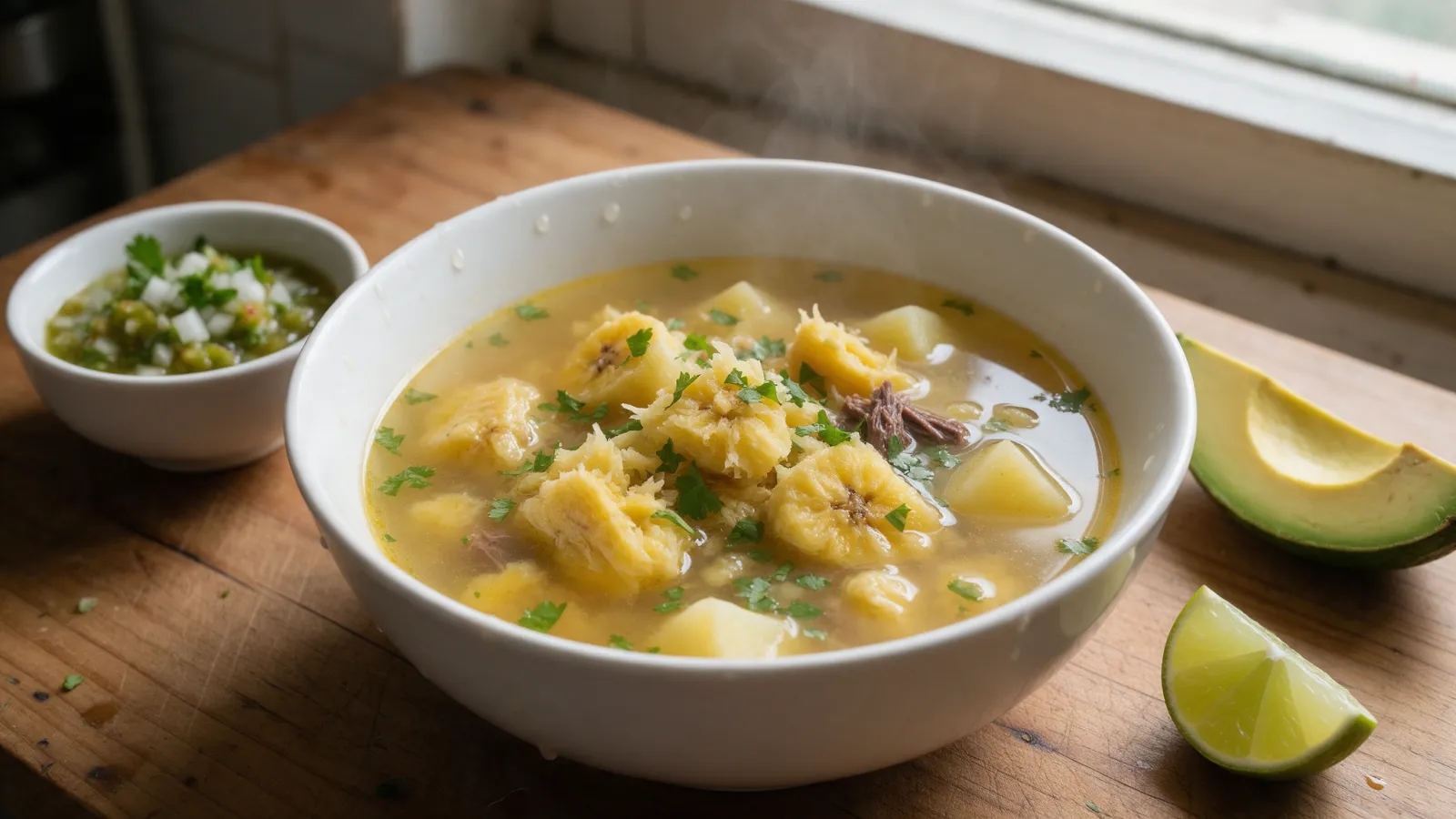

Sopa de plátano (SOH-pah deh PLAH-tah-noh) is what Colombian home cooks make when there’s a good beef bone and three green plantains in the kitchen. Green plantains are the big, starchy, unripe cousins of the banana, and here they do two jobs at once: one is grated and melts into the broth to thicken it, and two are broken into rough chunks by hand that stay whole. Think of a beef and potato soup where the potato’s role is played by something firmer and earthier. Below: whether it’s worth your afternoon, how to buy and peel plantains in a US or UK store, why they turn dark and what actually prevents it, and how to scale it for a crowd.
Is Colombian plantain soup worth making?
How do you make Colombian plantain soup? Simmer 1 kg (2.2 lb) of beef short ribs in 3 liters (12½ cups) of water, skimming for 15 minutes and then cooking 70 at the lowest heat with scallions, garlic and cilantro stems. Add two green plantains broken into rough pieces by hand, one grated, potatoes and cumin, and cook 30 minutes, stirring the bottom, until the broth thickens. Serve with rice and avocado. 120 minutes for 6 servings.
Yes, if you like thick, savory soups and want a pot that feeds six for little money. The plantains are cheap; the ribs are where the cost is. What you get is a broth with body and no flour, cream or blender involved.
When it shines. A weekday dinner with leftovers for lunch, feeding a crowd on a budget, a cold weekend.
When to skip it. If you need dinner in 40 minutes and haven’t cooked the ribs ahead: they need their 85. If all you can find is green bananas. And if you want a clear, light broth, because this one is thick on purpose.
Real time. 2 hours total, about 35 minutes hands-on. Cook the ribs the night before and serving day takes 35 minutes.
Honest difficulty, easy. The only skills are peeling a green plantain (it doesn’t peel like a banana) and remembering to stir the bottom once the grated plantain is in.
How it differs from sancocho and sopa de patacón
Plantain turns up in several Colombian soups, and readers often mix them up. The difference is what the plantain is doing.
If you’d rather have a clear rib broth with just potato, that’s Colombian caldo de costilla, built on the same short ribs. For the Sunday pot with cassava, corn and potato, make Colombian sancocho, or the three-meat version, sancocho trifásico.
What you need, with US and UK swaps
The exact amounts are in the recipe card: 1 kg (2.2 lb) of short ribs, 3 green plantains and 600 g (1.3 lb) of potatoes for 6 large bowls.
Buying green plantains, and why green bananas won’t do
Look for plantains with dark green skin, no yellow patches, rock-hard when you squeeze them. One plantain gives about 267 g (9.4 oz) of flesh by the USDA’s reference portion, so three make about 800 g (1.75 lb) peeled. A plantain with yellow on it has started turning starch into sugar: the soup comes out sweetish and the grated one won’t thicken as well.
- In the US, green plantains sit next to the bananas in most supermarkets and in every Latin grocery store.
- In the UK, Tesco lists plantain by the each (£0.75 when I checked), though it isn’t always green; African and Caribbean grocers reliably have hard green ones.
- Green bananas (unripe Cavendish) are not a swap. They’re smaller and less starchy, and the soup turns out thin and soft.
How to peel them. Cut off both ends, run a knife along the length of the peel without cutting into the flesh, and push the peel off in strips with your thumb. The sap stains hands and clothes; I rub a little oil on my fingers first.
Grated, broken by hand or sliced, and what each does
This decides the texture more than anything else. Grated plantain disappears into the broth within 20 minutes and releases all its starch. Pieces broken with your thumbnail have rough, torn edges that release some starch and still hold their shape. Neat knife-cut coins thicken the least.
Other recipes reach the same thickness by blending: My Colombian Recipes purees half the soup, and colombia.com blends half a cooked plantain with a little broth. In Ecuador, raspado de verde scrapes the plantain straight into the boiling pot. I’d rather grate one and break two: thick without a blender, and the chunks are still there.
Why plantain turns black, and what stops it
Peeled plantain darkens because an enzyme in the flesh, polyphenol oxidase, reacts with oxygen in the air, the same reaction measured in Gros Michel bananas in a study published in Vitae, the University of Antioquia’s science journal. Heat switches the enzyme off. Water only slows it: in a study of fresh-cut green banana slices, the ones kept in plain water still browned.
In Colombia you’ll hear that plantain broken with a fingernail doesn’t go black and plantain cut with a knife does. I couldn’t find any evidence for it, and in my kitchen it darkens either way if it sits out. What works is timing: peel last, and drop it straight into boiling broth. Dark plantain isn’t harmful, but the soup turns grayish.
Short ribs, potatoes and equipment
Bone-in short ribs make the broth; ask for them sawn into 5 cm (2 in) pieces, sometimes sold as flanken or, in the UK, as short ribs or Jacob’s ladder. Meaty beef soup bones work too and cost less, with less meat in each bowl. Russet (US) or Maris Piper (UK) potatoes break down a little and help the thickening.
A 6-quart (6-liter) pot, a box grater, a ladle and a wooden spoon. No grater? Break all three plantains by hand and, after 20 minutes, mash 4 or 5 pieces against the side of the pot.
How to plan it, and how to tell each stage is right
2 hours on the clock, about 35 minutes hands-on. Most of it is ribs simmering on their own. The one rushed moment is the plantain: peel it during the last 20 minutes of the ribs, not earlier.
Make ahead. Cook the ribs, strain the broth and refrigerate them together. The fat sets on top and lifts off in one piece. On the day: reheat, peel the plantains while it comes to a boil, then 30 minutes in the pot. 35 minutes total. Don’t peel the plantains the night before; they darken even under water.
How to tell it’s going right.
| Stage | What you should see |
|---|---|
| Skimming, 15 min | no more gray foam, only white bubbles |
| Ribs, 70 min | a fork slides in, meat still on the bone |
| Grated plantain, 15 min | strands gone, broth turns from clear to cloudy |
| Plantain pieces, 25 to 30 min | a fork goes through, but they hold together |
| Thickness | broth coats the back of a spoon; if not, mash a few pieces and give it 5 more minutes |
Scaling for 6, 10 or 20
| People | Short ribs | Water | Green plantains | Potatoes | Pot |
|---|---|---|---|---|---|
| 6 | 1 kg (2.2 lb) | 3 L (12½ cups) | 3 | 600 g (1.3 lb) | 6 qt |
| 10 | 1.7 kg (3.75 lb) | 5 L (5.3 qt) | 5 | 1 kg (2.2 lb) | 8 qt |
| 20 | 3.4 kg (7.5 lb) | 10 L (10.6 qt) | 10 | 2 kg (4.4 lb) | 16 qt, or two 8 qt pots |
Keep one grated plantain for every three. For 20, add the plantain in two batches and let the pot return to a boil in between; give the ribs 10 to 15 extra minutes.
Before you cook, mistakes, spice, kids and allergens
The two critical moments. Plantain goes into boiling broth as soon as it’s peeled, and once the grated plantain is in, run the spoon along the bottom every 5 minutes for the full 30.
Mistakes and how to avoid them.
- Plantain turned dark → it sat peeled too long. Peel last and add straight away.
- Thin soup → all knife-cut, or cooked covered. Mash a few pieces against the pot, or grate half a plantain more and give it 15 minutes.
- Gluey, like paste → all three grated. Add 2 cups (500 ml) of hot broth or water and a pinch of salt.
- Stuck to the bottom → the grated plantain sank. Medium heat, wooden spoon on the bottom.
- Sweet → the plantains were turning yellow. Green and hard only.
- Cloudy, greasy broth → it boiled before skimming, or the fat wasn’t skimmed. Skim from cold and ladle off fat before the plantain goes in.
Spice level, 0 out of 5. Nothing is hot. Colombians often spoon ají, the Colombian hot sauce, on top at the table.
Will kids eat it? Usually. It’s mild and thick, and cooked green plantain has no strong flavor. Check for bone splinters when you serve the ribs, and shred the meat for small children.
Allergens. No gluten, dairy, egg, nuts or fish. If you boost it with a bouillon cube, read the label; some contain wheat or milk.
Which version should you make?
- Short on time → pressure cooker or Instant Pot for the ribs: skim on sauté, 30 minutes at high pressure, 10 minutes natural release. Then cook the plantain with the lid off, never under pressure, where the grated one scorches. About 95 minutes in all.
- No pressure cooker → cook the ribs the night before; that saves more than any appliance.
- For a crowd → the scaling table above, ribs the day before, plantain on the day.
- Lighter → chill the broth and lift off the fat, and use 1½ tsp salt: sodium drops to about 660 mg a bowl.
- Cheaper → meaty soup bones instead of short ribs. The broth tastes nearly the same.
- With chicken → bone-in chicken pieces, 35 minutes instead of 70. My Colombian Recipes has a chicken and green plantain version with corn.
- Vegetarian → vegetable stock, an extra teaspoon of cumin and a quick sauté of onion and garlic for depth. A good plantain soup, flatter.
Close relatives. The Dominican Republic has its own green plantain soup, aguají, and Ecuador’s raspado de verde grates the plantain into the pot. In Colombia, frying the plantain first and flattening it makes it sopa de patacón; the same fried and smashed plantain as a side dish is Colombian patacones.
What it costs, and what makes it expensive
The short ribs are the price of this pot. The BLS publishes no short rib price, so I use its closest series, boneless chuck roast at $9.448 per pound in August 2026: the roughly 1.3 lb (600 g) of meat on these ribs comes to about $12.50. White potatoes were $0.976 a pound, so 1.3 lb is about $1.29. The BLS doesn’t track plantains, cumin or cilantro; in Colombia the three plantains are about a tenth of the cost of the whole pot.
Yield. 6 large bowls of about 600 ml (2½ cups), each with a piece of rib, plantain and potato. As a starter, 10.
What drives the price. Only the meat. Soup bones with some meat on them cut the cost most; check your butcher’s per-pound price, since short ribs vary a lot by store.
What to expect, how to serve it and how to store it
Taste and texture. A thick, cloudy beef broth with the starchy, slightly earthy taste of green plantain, cumin in the background, and rough chunks that are firm inside and soft at the edges. Not sweet at all.
How it’s served in Colombia. In a deep bowl, a piece of rib in each, chopped cilantro on top. Colombian white rice goes on the side, or a spoonful straight into the soup, depending on the family, with sliced avocado. A cold glass of aguapanela with lime is the usual drink.
Fridge. Soups with meat should be refrigerated within 2 hours and keep 3 to 4 days at 40°F (4°C) or below, according to USDA FSIS figures. Use shallow containers so it cools fast.
Freezer. The broth, ribs and plantain freeze well for 2 to 3 months (FSIS). The potatoes turn grainy, so if you plan to freeze, leave them out and cook fresh ones for 25 minutes when you reheat. Thaw overnight in the fridge.
Reheating without ruining it. Plantain keeps releasing starch as it cools, and the next day the soup is almost solid. Add ½ cup of water or broth for every 2 cups of soup and bring it to a boil over medium heat, stirring, which is what FSIS advises for soups, or to at least 165°F (74°C). In the microwave, 2-minute bursts, stirring between them.
Frequently asked questions
Should the plantain be grated or chopped? Both. One grated plantain thickens the broth within 20 minutes; two broken into rough pieces by hand stay whole. All knife-cut makes a thin soup.
Why do green plantains turn black, and how do I stop it? An enzyme reacts with air once the flesh is exposed. Peel last and drop the plantain straight into boiling broth; plain water only slows it down.
Can I use green bananas instead of plantains? Not really. They’re less starchy and the soup comes out thin. Use green plantains, sold in most US supermarkets and in African and Caribbean grocers in the UK.
How long does plantain take to cook in soup? About 30 minutes at a steady simmer for 1-inch (2 to 3 cm) pieces. Grated plantain melts in under 20.
Can I freeze plantain soup? Yes, for up to 3 months, ideally without the potatoes. Add water or broth when you reheat, because it thickens a lot.
Can I make it in an Instant Pot? The ribs, yes: half an hour at high pressure, then a natural release of about 10 minutes. Cook the plantain on sauté with the lid off for 30 minutes.
What’s the difference between plantain soup and sancocho? In plantain soup the plantain is the point and thickens the broth. In sancocho it’s one of several starches, with cassava, corn and potato, in big pieces.
Nutrition
Per bowl (one sixth of the pot, about 600 ml / 2½ cups, without rice or avocado), calculated ingredient by ingredient from the USDA FoodData Central database (SR Legacy) with the quantities above. I count 600 g of meat on the 1 kg of bone-in ribs, with lean-only values because the broth is skimmed, and the 2 teaspoons of salt:
- Calories: 463 kcal
- Protein: 23 g
- Carbohydrates: 69 g
- Fat: 11 g, of which 5 g saturated
- Fiber: 6 g
- Sugars: 4 g
- Sodium: 854 mg
The plantains supply nearly three quarters of the carbohydrates (293 g of the pot’s 411). Half a cup of cooked white rice adds roughly 100 kcal and 22 g of carbohydrate; a sixth of the avocado, about 70 kcal. Almost all the sodium is the salt in the pot: 4,650 of the 5,120 mg, or 91 %.
In the Venezuelan kitchen I grew up in, green plantain went into the hervido in neat slices, one starch among many. Colombia taught me to grate one and break the others by hand, and that small change is the whole recipe. When the fridge is nearly empty, three plantains and a good beef bone still feed six. Josnaisis.