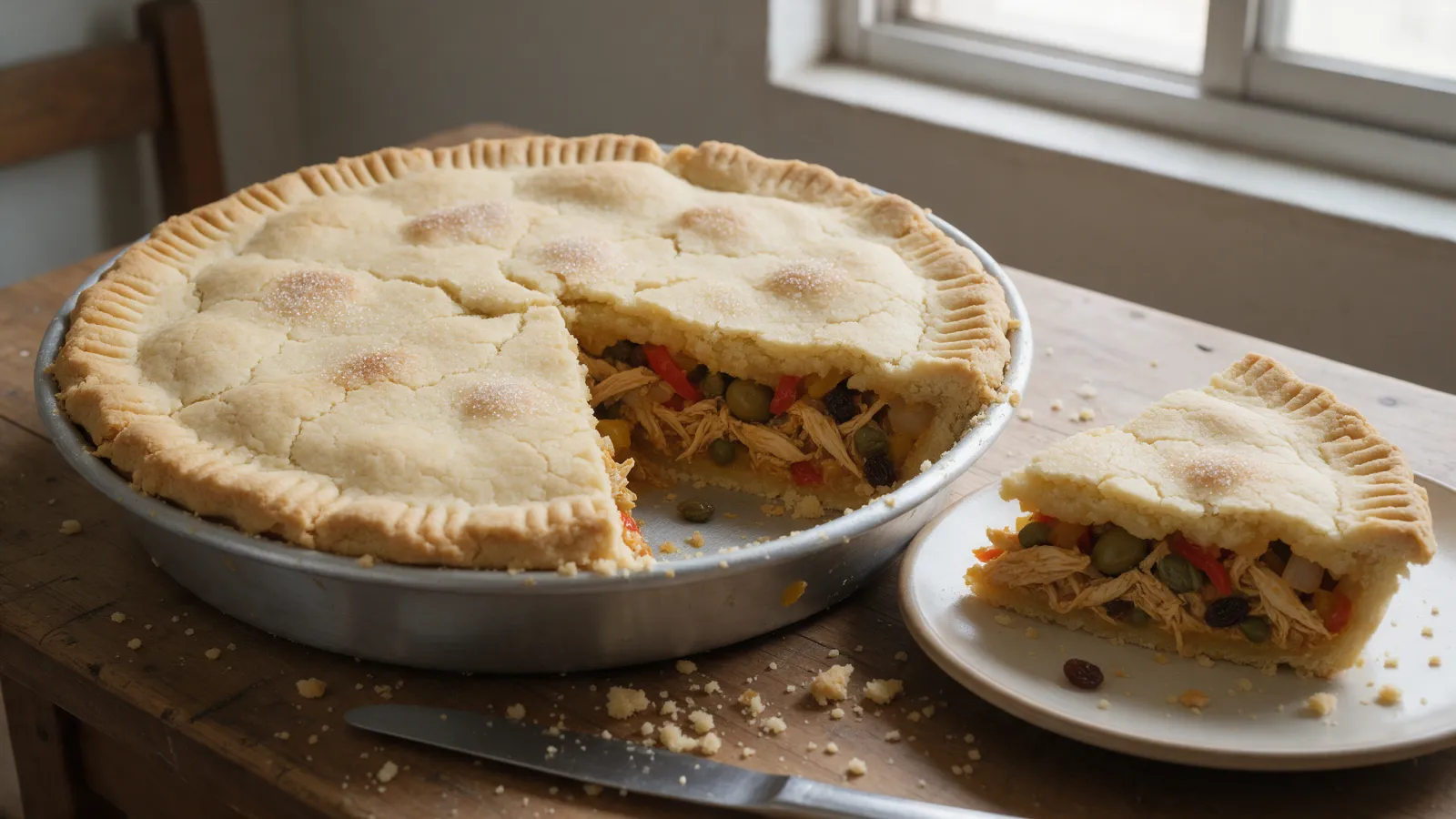

Polvorosa (pol-voh-ROH-sah) comes from the Spanish polvo, dust, and that is exactly what the lid does under a knife: it breaks into sweet, buttery crumbs, much like shortbread, over a tangy chicken stew studded with raisins, green olives and capers. It’s a baked chicken pie from Caracas, Venezuela, made in a big rectangular dish for birthdays and family gatherings, and served warm or at room temperature. If you’ve only met chicken pie as a flaky crust over a creamy filling, this one will surprise you on both counts.
What is polvorosa de pollo, and is it worth making?
How do you make Venezuelan polvorosa de pollo? Simmer boneless chicken for 35 minutes in a sofrito of onion, leek, bell pepper, ají dulce and tomato with red wine and panela, shred it, and reduce it with raisins, olives and capers until no liquid remains; chill it. Make a water-free crust of flour, butter, shortening, powdered sugar and egg yolks. Line a 9 x 13 in dish, blind-bake 15 minutes at 350°F (175°C), fill, cover and bake 55 minutes. 250 minutes for 12 servings.
It’s worth it when you’re feeding a crowd. One 9 x 13 in (23 x 33 cm) dish serves 12 people alongside a green salad, it doesn’t need to be hot, and both the filling and the dough are better made the day before. For a weeknight for two, it’s the wrong recipe: 250 minutes on the clock, about 105 of them hands-on.
What it tastes like. A crust that’s sweet and sandy, close to a sablée cookie, against a filling that’s savory, sour from the wine and capers, salty from the olives and sweet again from the raisins and panela. Sweet-and-savory is the whole point. If you don’t like sugar near your chicken, this isn’t for you.
Honest difficulty, medium. The crust looks fragile and is actually forgiving. With no gluten, it doesn’t shrink or spring back, and tears press shut with a fingertip. What goes wrong is the filling: warm or wet filling makes a soggy base.
How it compares with chicken pot pie, empanadas and pastilla
| Crust | When you cut it | Filling | Sweet note | |
|---|---|---|---|---|
| Polvorosa de pollo | short, sweet, water-free | crumbles | chicken stew with raisins, olives, capers | in the crust and the stew |
| American chicken pot pie | flaky pie crust or puff pastry | flakes | creamy, flour-thickened, peas and carrots | none |
| Venezuelan empanada | cornmeal dough, fried | crunches | shredded meat, cheese or beans | none |
| Moroccan pastilla | paper-thin warqa or brick pastry | shatters | chicken, almonds, egg, cinnamon | powdered sugar and cinnamon on top |
Pastilla is its closest relative in spirit, sweet against savory, but its crust is crisp layers rather than crumb. Polvorosa doesn’t puff, doesn’t flake and doesn’t use any liquid in the dough.
The crust, and why it has no water in it
Everything that makes a polvorosa a polvorosa happens in the dough. The proportions I use come from the recipe attributed to Armando Scannone, the Caracas cookbook author: 305 g (10.7 oz) of fat to 500 g (1.1 lb) of flour, about 60 % of the flour’s weight, with powdered sugar and four yolks as the only liquid.
- Fat at 60 % of the flour. It coats the flour so gluten can’t form. Less fat and the crust turns hard; much more and it can’t hold up the filling, and the sides split.
- No water, no kneading. Water plus mixing builds gluten, and gluten is what turns a crumbly crust into a chewy, tough one. The yolks bind it; your fingertips finish it.
- Powdered sugar, not granulated. It dissolves into the fat without water and gives a fine, even crumb. Granulated sugar leaves gritty specks.
Why two fats. Vegetable shortening is 100 % fat; butter is 81 % fat by USDA data, and most of the rest is water. Shortening gives the crumble and stays firm in a warm kitchen while you line the dish. Butter gives the flavor. An all-butter crust (305 g, 2¾ sticks) tastes better but softens faster in your hands and tears more; give it 15 extra minutes in the fridge. Lard, sold in most UK and many US supermarkets, makes it even shorter, with a faintly savory note that suits the filling.
Ingredients and what to buy in a US or UK supermarket
The full quantities are in the recipe card. Most of the list is ordinary; four items need a word.
| In the recipe | US | UK | What changes |
|---|---|---|---|
| Manteca vegetal (shortening) | Crisco or any vegetable shortening | Trex or Cookeen white vegetable fat | nothing |
| Ají dulce | Latin or Caribbean grocers | rare; online | without it, add ½ red bell pepper; you lose a floral note, no heat either way |
| Papelón / panela | panela or piloncillo in the Latin aisle, or dark brown sugar | panela online, or dark muscovado | sugar alone is flatter, less caramel |
| Ajoporro | leek | leek | nothing |
The chicken. I use 1 kg (2.2 lb) boneless, half thighs and half breast. Thigh survives two cookings, 35 minutes in the pot and 55 in the oven, without drying out; breast alone ends up stringy. Buying bone-in, figure on 1.33 kg (3 lb) and keep the bones for stock.
The dish. A 9 x 13 in (23 x 33 cm) glass baking dish is the US standard and works; the crust comes out a touch thinner than in the 12 x 8 in (30 x 20 cm) dish Venezuelan recipes use. A 10-inch (26 cm) springform lets you unmold it whole. Metal pans brown faster than glass, so check at 45 minutes.
A make-ahead plan, and scaling for 4 to 20
In one day, it’s 250 minutes. Overlap the jobs, dough while the chicken simmers, lining the dish while the filling chills, and it doesn’t take longer.
The way I do it, over two days.
- Day before, about 75 minutes hands-on. Make the filling, reduce it, refrigerate it covered. Make the dough, wrap the two discs. The filling actually tastes better the next day.
- Serving day, about 2¼ hours, 30 minutes of it hands-on. Roll, line, blind-bake 15 minutes, fill, lid, bake 55 minutes, rest 20.
- A week or more ahead. Assemble the whole pie unbaked and freeze it (see storage below), then bake it straight from the freezer.
Everything else scales in proportion. For a party of 20 or more, two dishes beat one deep pan: a very deep filling takes so long to heat through that the edges burn first.
Step by step, keeping the base crisp
The method is in the recipe card. These are the three moments that matter.
Reduce the filling until the spoon leaves a path
After the chicken is shredded and back in the pot, cook it uncovered for about 15 minutes. Drag a spoon across the bottom: when the path stays open for 2 seconds and no juice pools if you tilt the pot, it’s ready. A wet filling is the single biggest cause of a soggy polvorosa, and you can’t see it until you cut. I use the same spoon test for the Venezuelan cazón guisado that goes into empanadas.
Chill the filling, chill the dough
Spread the filling on a sheet pan and refrigerate it for at least 1 hour, until it’s cold to the touch. Filling at 105-120°F (40-50°C) melts the fat in the raw base before the oven can set it. The dough comes out of the fridge only 10 minutes before rolling: cold enough to hold, warm enough not to crack.
Blind-bake the base and roll to 5 mm
15 minutes at 350°F (175°C) seals the base; Scannone’s recipe does it, and it’s the biggest single difference between a crisp bottom and a pale, soft one. The dough weighs about 970 g (2.1 lb), which covers the base, sides and lid of a 12 x 8 in (30 x 20 cm) dish at 5 mm (about ¼ in); in a 9 x 13 in dish it rolls out closer to 4 mm, which still holds. Thicker and the inner layer stays pasty; thinner and it breaks when you lift a slice.
Who this recipe is for
- If you’re hosting 10-12 → make it as written, over two days.
- If it’s your first time → use shortening, not all butter; it’s easier to handle.
- If you’re cooking for 4-6 → halve it and use an 8-inch (20 cm) square dish, about 45 minutes after blind-baking.
- If you want it lighter → skip the bottom crust and bake it with a lid only, pot-pie style.
Mistakes that ruin a polvorosa
- Tough, cookie-hard crust → water was added, or it was kneaded. Stop as soon as it holds when squeezed.
- Dough cracks when rolling → too cold. Wait 5 minutes; press the cracks shut.
- Dough slumps down the sides → the kitchen is warm. Chill the lined dish 15 minutes before blind-baking.
- Soggy base → warm or wet filling, or no blind-bake.
- Lid cracks or domes → no steam vents. Three small cuts before baking.
- Burnt edges → the crust has 90 g (¾ cup) of sugar and browns fast. Foil over the edges after 40 minutes.
- Too sweet → cut the panela in the filling to 25 g (1 oz) and leave the crust alone.
Spice level, 0 out of 5. Ají dulce has no heat. Scannone’s version includes a pinch of dried hot pepper; add ⅓ teaspoon cayenne to the filling if your table likes it.
Kids. The sweet crust usually wins them over; raisins and capers are the usual objections, so leave them out of half the filling. The wine simmers about 50 minutes and then bakes, so little alcohol is left, but not none: the USDA nutrient retention table gives roughly 25 % of the original alcohol after an hour of cooking. For small children or pregnancy, use ½ cup (120 ml) chicken stock with 1 tablespoon vinegar instead.
Allergens. Wheat (gluten), egg, dairy (butter) and fish: classic Worcestershire sauce contains anchovies. Wine, olives and capers may contain sulfites. All-shortening crust and a vegan Worcestershire make it dairy- and fish-free.
Versions worth making
- Faster → use 1 kg (2.2 lb) leftover roast or poached chicken: sofrito, 10 minutes with the chicken, 15 to reduce. Saves about 25 minutes.
- All butter → 305 g (2¾ sticks) butter, 15 extra minutes of chilling. Better flavor, slightly less crumble.
- Individual polvorositas → 4-inch (10 cm) tart tins, no blind-bake, 25-30 minutes. Good for a buffet.
- Lid only → filling in the dish, half the dough on top. About 200 kcal less per serving.
- Vegetarian → 800 g (1.75 lb) mushrooms and 400 g (14 oz) cooked chickpeas instead of chicken, reduced the same way.
- Tuna → Venezuelans make it with tuna too: 4 drained cans (about 560 g / 20 oz), stirred in at the end just to heat.
What it costs
At US city average prices from the Bureau of Labor Statistics for August 2026, the measurable ingredients come to $13.81, about $1.15 a serving. Chicken, priced at the boneless breast series ($4.173 a pound), is two thirds of that.
Yield. 12 main-course servings with salad, 8 generous ones, or 16-18 small squares on a buffet.
What drives the price. Chicken. Bone-in chicken legs averaged $1.670 a pound in the same BLS data, so buying thighs on the bone and deboning them yourself cuts the biggest line by almost half (about 1.33 kg / 3 lb bone-in comes to roughly $5 instead of $9.20). The BLS has no series for shortening, raisins, olives, capers, wine or Worcestershire, so they aren’t in the total.
Serving, storing, freezing and reheating
How it’s served. Cut into squares in the dish, at the table, warm or at room temperature, almost always with a sharp green salad to cut the richness. On a Venezuelan party table it sits next to Venezuelan chicken salad, and at Christmas next to pan de jamón, the ham-filled bread. The filling belongs to the same family as the stew inside Venezuelan hallacas: panela, wine, raisins, capers and olives. For a second make-ahead bake, Venezuelan pasticho works the same way, pastel de chucho is the other big Venezuelan tray bake, with plantain and fish, and Venezuelan quesillo is the dessert you can also make the day before.
Fridge. Per the USDA Food Safety and Inspection Service rules for leftovers: no more than 2 hours out, then 3 to 4 days at 40°F (4°C) or below, covered. The crust softens a little; cold day-two slices cut more cleanly than fresh ones.
Freezer. Cooked chicken dishes keep 2 to 6 months frozen per FSIS. For the pie, I freeze it assembled and unbaked, up to 2 months, wrapped in plastic and foil, without the glaze. Bake it straight from frozen at 350°F (175°C), covered with foil for the first 30 minutes, about 80 minutes in all, until the center of the filling reaches 165°F (74°C). A baked pie freezes too, but the crust loses some of its crumble.
Reheating. In the oven at 350°F (175°C), loosely covered with foil, 15-20 minutes for slices or 30-40 for the whole dish, to 165°F (74°C) in the center. The microwave makes the crust soft and greasy; one slice, 1 minute at half power, only if you must.
Frequently asked questions
What does polvorosa mean? It comes from polvo, Spanish for dust or powder, after the way the crust crumbles. There’s also a sweet polvorosa cookie in Venezuela and Colombia based on the same idea.
Is polvorosa the same as chicken pot pie? No. Pot pie has a flaky crust and a creamy filling. Polvorosa has a sweet, short, water-free crust that crumbles, and a sweet-and-sour chicken stew with raisins, olives and capers.
What temperature do you bake polvorosa de pollo at? 350°F (175°C): 15 minutes for the base alone, then about 55 minutes filled and covered, until pale gold. Rest 20 minutes before cutting.
Why does my polvorosa crust fall apart? When rolling, it’s too cold or short on fat. When slicing, it didn’t rest 20 minutes or you pressed instead of sawing. Tears while lining the dish don’t matter; press them shut.
Can I make polvorosa ahead of time? Yes. Make the filling and dough the day before and bake on the day, or bake it the day before and reheat it covered at 350°F (175°C) for 30-40 minutes.
Can you freeze polvorosa de pollo? Yes, best assembled and unbaked, for up to 2 months. Bake from frozen, about 80 minutes at 350°F (175°C), foil on for the first 30, to 165°F (74°C) in the center.
Can I use store-bought pie crust? You’ll get a good chicken pie, not a polvorosa: shop-bought crust is unsweetened, made with water and bakes flaky. The homemade crust takes 15 minutes and no special skill.
How many people does one polvorosa feed? A 9 x 13 in dish gives 12 servings with salad or 8 large ones. For 20-24, make two.
Nutrition
Per serving (one twelfth of the dish), calculated ingredient by ingredient from the USDA FoodData Central database (SR Legacy) with the quantities above, counting half of the glaze egg:
- Calories: 600 kcal
- Protein: 24 g
- Carbohydrates: 53 g
- Fat: 32 g, of which 11 g saturated
- Fiber: 3 g
- Sugars: 17 g
- Sodium: 715 mg
The crust is two thirds of the calories, about 4,880 of the dish’s 7,230, which is why the lid-only version is the most effective way to lighten it. Most of the sodium comes from the salt and the olives, which alone add about 930 mg to the whole dish.
The first time I made polvorosa in Colombia, I put the filling in warm because guests were already at the door, and the base came out pale and soft. Since then the filling always spends the night in my fridge. Make it cold, bake it hot, and let it rest before the knife goes in. Josnaisis.