
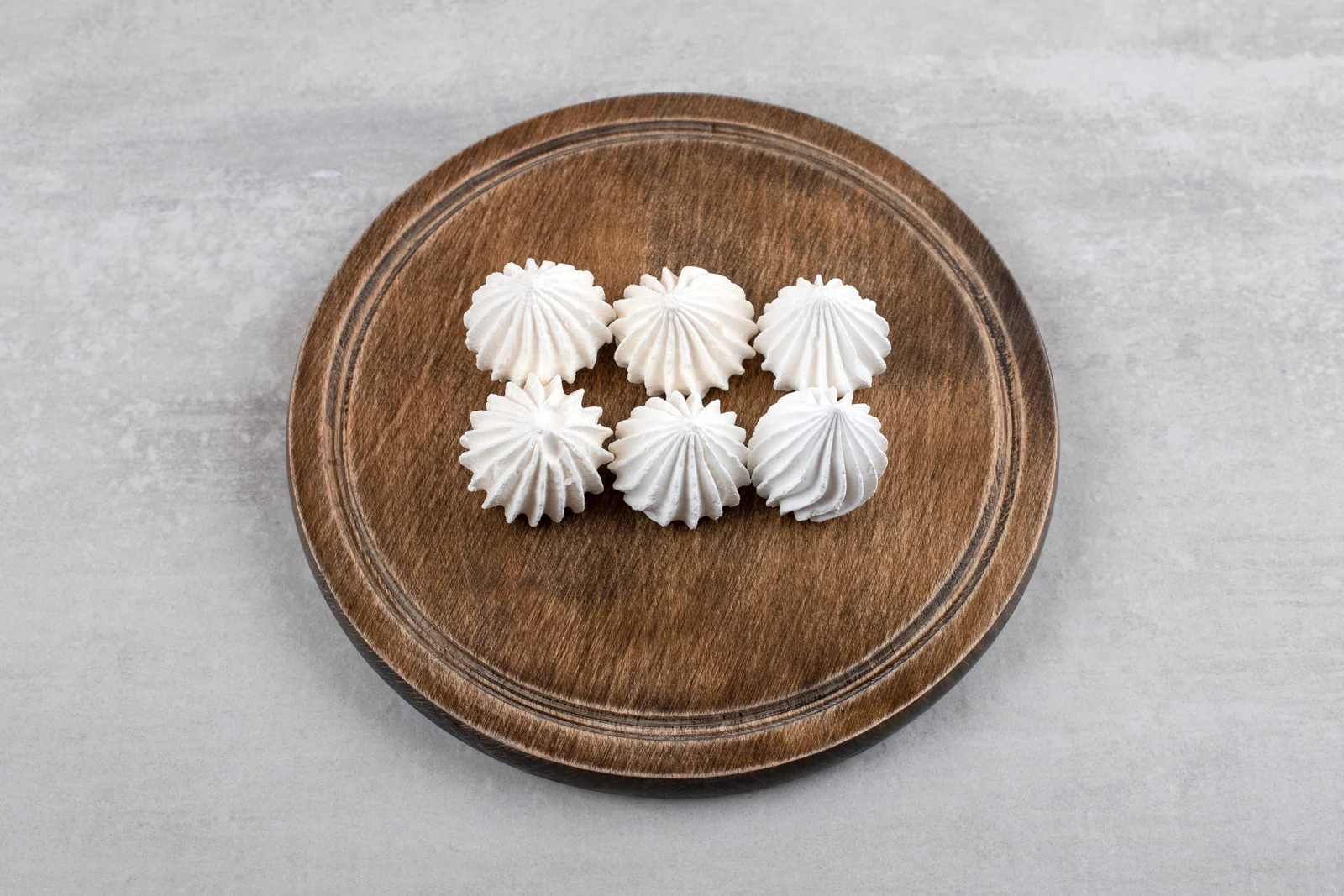

Suspiros (soos-PEE-rohs, Spanish for “sighs”) are what much of Latin America calls the small, crisp meringue cookies that Americans know as meringue kisses and the British simply call meringues. They’re nothing but egg whites and sugar, whipped until glossy, piped into little peaks and left in a very low oven until they’re dry right through. Four egg whites make about 60 bite-size kisses. Below: how to tell when the meringue is ready to pipe, how long to bake each size, why meringues weep, stick or go chewy, and how to keep them crisp for weeks.
What are suspiros, and what should they be like?
How do you make suspiros? Whip 4 egg whites with a pinch of salt and a few drops of lemon juice until foamy, beat in 260 g (1⅓ cups) of sugar a spoonful at a time until glossy and stiff, pipe 1¼ in (3 cm) kisses and dry them at 210°F (100°C) for 60 to 75 minutes, then 1 hour in the turned-off oven. Ready in 155 minutes for 10 servings of 6 kisses.
A good suspiro is white or barely ivory, crisp from the outside to the very center, and melts away on the tongue a second after you bite it. It should come off the parchment on its own and leave nothing behind. If it’s tan, sticky or chewy, something went wrong, and every one of those faults has a fix further down.
The base is the simplest meringue there is, the kind pastry books call French meringue: raw whites and sugar beaten together, no hot syrup, no double boiler. In Mexico these are usually just called merengues, and in Spain suspiros or merenguitos.
Don’t mix them up with two relatives. The Colombian merengón uses the same meringue spread into two 9 in (22 cm) discs, layered with whipped cream and fruit. And Peru’s suspiro limeño isn’t a cookie at all: it’s a dessert in a glass, a creamy milk caramel called manjar blanco topped with port-flavored meringue. In Venezuela, “suspiro” can also mean soft, unbaked meringue used to frost cakes, the kind on top of Venezuelan bienmesabe.
Honest difficulty: easy. About 20 minutes of hands-on work, then 135 minutes of oven time and cooling that need nothing from you. You do need an electric mixer and, ideally, a dry day.
Ingredients for suspiros and the sugar ratio
One rule to remember: twice as much sugar as egg white, by weight. A large white weighs about 33 g (1.2 oz) and takes 65 g (⅓ cup) sugar. If your eggs are an odd size, weigh the whites and double the number for the sugar.
Home recipes range from about 1.5 to nearly 3 parts sugar to 1 part white. Less sugar whips faster but dries less well and goes soft sooner; much more is hard to dissolve and the cookies weep. Two to one gives firm kisses that keep in a tin.
Granulated, superfine or powdered sugar?
- Granulated sugar. What this recipe uses. It works fine as long as you add it slowly and beat until no grit is left.
- Superfine sugar (sold as caster sugar in the UK, and sometimes as baker’s sugar in the US). Dissolves faster and is the easiest choice. Same weight. To make your own, pulse granulated sugar in a food processor for 30 to 60 seconds.
- Powdered sugar (icing sugar). Dissolves instantly and gives a finer, more powdery melt. US powdered sugar contains a little cornstarch, which does no harm. Same weight.
- Half and half. About 200 g (1 cup) granulated whipped in, then 60 g (½ cup) powdered sugar sifted over and folded in by hand at the end. Somewhere in between.
- Brown sugar, no. It carries moisture and molasses, so the cookies come out tacky and soften within hours.
Egg whites and a grease-free bowl
Fat is the one thing that stops egg whites from whipping. A speck of yolk is enough, and so is the film of grease that clings to a plastic bowl even when it looks clean. Use glass or stainless steel, and if in doubt, wipe it with a paper towel dampened with lemon juice or vinegar, then dry it. Crack each egg over a small cup before adding the white to the bowl, so one broken yolk only costs you one egg.
Room-temperature whites whip faster and higher. If they’re straight from the fridge, let them sit in the bowl for 30 minutes. Leftover whites from another recipe are perfect: a Venezuelan chocolate marquesa or a Colombian natas dessert each uses 4 yolks, which leaves exactly the 4 whites you need here.
Lemon juice, vinegar or cream of tartar make the foam steadier and less likely to turn grainy if you overbeat. They’re optional, but they give you more margin for error.
Equipment
- An electric mixer, hand-held or stand. A whisk works in theory, but it’s a long, tiring job and hard to reach stiff peaks.
- A piping bag with a ½ in (1 cm) star or round tip. No bag? A zip-top freezer bag with one corner snipped off, or two teaspoons: scoop with one, push off with the other. They’ll look rustic and dry just the same.
- Two baking sheets and parchment or silicone mats. Not foil: the meringues stick.
- If you can, an oven thermometer. Many home ovens are inaccurate at such low settings, and an extra 20 to 35°F (10 to 20°C) is enough to brown them.
How to make suspiros step by step
Turn the oven on before you separate the eggs; it needs to be at temperature when the meringue is ready.
Whipping to stiff peaks
- Foam. Whites, salt and lemon juice on medium for 1 to 2 minutes. They turn white and opaque, and peaks fall over as soon as you lift the beaters.
- Sugar, slowly. On high, a tablespoon every 20 to 30 seconds, about 8 minutes in total. Dump it in all at once and the foam loses air and the sugar won’t dissolve.
- Stiff peaks. Beat 1 to 2 minutes past the last spoonful. It’s ready when:
- it shines like satin, not dull or curdled-looking;
- a peak on the lifted beater stands straight, with only the very tip curling;
- you can tilt the bowl and the meringue doesn’t slide;
- a dab rubbed between thumb and forefinger feels smooth. If it’s gritty, beat 1 more minute and test again.
- Vanilla and color at the end, 10 seconds on low.
Overbeaten meringue looks dull and lumpy, and more beating won’t bring it back, so stop as soon as it passes the tests. At high altitude, stop the moment it’s glossy and holds a peak, because the foam breaks down sooner.
Piping
Fill the bag halfway and hold it straight up, ½ in (1 cm) above the sheet. Squeeze without moving until you have a mound 1¼ in (3 cm) wide, stop squeezing and lift sharply to leave a peak. Leave ¾ in (2 cm) between them: they barely spread, but air needs to move around them. A dab of meringue under each corner keeps the parchment from lifting.
Pipe everything within 30 minutes. Meringue left waiting in the bowl loses air and the kisses come out flat.
Baking and drying by size
At 210°F (100°C), conventional bake, no fan if your oven lets you choose. Halfway through, swap the sheets between racks and turn them front to back.
- Small, 1¼ in (3 cm) (about 60): 60 to 75 minutes.
- Medium, 2 in (5 cm) (about 30): 1½ hours.
- Large, 2½ in (6 to 7 cm): 1¾ to 2 hours.
For every size, turn the oven off, prop the door open a crack and leave them inside for 1 hour. Slow cooling finishes the drying and stops them cracking from a sudden drop in temperature.
How to tell they’re done. They lift off the paper cleanly, the bottoms are dry to the touch and they sound hollow when you flick them with a fingernail. Straight from the oven they can feel slightly soft; the crunch comes as they cool. If a cooled kiss sticks to your teeth in the middle, the rest needed more time.
If your oven won’t go below 250°F (120°C), set it to the lowest setting and wedge the door open with a wooden spoon. Start checking at 45 minutes: they dry faster but may turn ivory.
Why meringues weep, stick or go chewy
- Beads of syrup on the surface → undissolved sugar or an oven that’s too hot. Add the sugar more slowly, check for grit between your fingers and lower the heat.
- Chewy in the middle → not dried long enough, or a humid day. Put them back at 210°F (100°C) for 15 to 20 minutes and let them cool in the turned-off oven.
- Stuck to the parchment → not dry yet. Don’t pry them off; give them 15 more minutes and they’ll release on their own.
- Flat or spreading on the sheet → grease in the bowl, yolk in the whites, sugar added before the foam formed, meringue that never reached stiff peaks or sat too long before piping. Liquid food coloring does it too, because it adds water.
- Beige or golden → the oven runs hot. Lower it by 20°F (10°C) or prop the door open with a wooden spoon.
- Cracked or caved in → too much heat (they puff, then collapse) or a sudden move into cold air. Always cool them in the turned-off oven.
- Soft a few hours later → humidity. On rainy days, or with a pot boiling on the stove, they struggle to dry and to stay crisp. Make them on a dry day and store them as soon as they’re cool.
Colors, flavors and batch sizes
Use gel or powder coloring, never liquid: liquid adds water and loosens the meringue. A toothpick tip or a few drops is plenty, as the color deepens slightly as they dry. For striped kisses, paint 3 or 4 lines of gel coloring up the inside of the piping bag with a small brush or toothpick before you fill it.
Flavors go in at the end, once the meringue is stiff:
- Vanilla, 1 tsp. Clear vanilla keeps them white.
- Cocoa, 2 tbsp sifted, folded in with a spatula in 3 or 4 strokes for a marbled look. They lose a little height.
- Cinnamon, ½ tsp, sifted.
- Lemon or orange zest, from 1 fruit, colored part only.
- Almond or coconut extract, ¼ tsp; it’s strong.
Scaling. For every large egg white, 65 g (⅓ cup) sugar.
- 2 whites → 130 g (⅔ cup) sugar, about 30 small kisses, one sheet.
- 6 whites → 390 g (2 cups) sugar, about 90 small kisses, three sheets. If they won’t all fit in your oven, bake two and pipe the third when there’s room, so the meringue doesn’t sit.
Cost. Few desserts are cheaper: egg whites often left over from another recipe, plus sugar. The real expense is running the oven for about 2 hours.
How to serve and store suspiros
Serving. On their own with coffee, on a party dessert table (they hold for hours without refrigeration), with ice cream, with strawberries and whipped cream, or crushed over a cake. For a showpiece made from the same meringue, the Colombian merengón layers it with cream and tropical fruit.
In an airtight tin or jar, at room temperature and away from the stove, they keep up to 2 weeks in dry weather. In humid weather, expect only a few days. Store them only once they’re completely cool; warm ones sweat inside the container.
Not in the fridge. It’s humid in there and they go soft within hours.
Freezer. Not needed, and they pick up moisture if opened while cold. If you do freeze them, leave the container closed until it’s back at room temperature.
If they’ve gone soft, spread them on a sheet, give them 10 to 15 minutes at 210°F (100°C) and let them cool in the turned-off oven. The crunch comes back.
Allergens. Just egg: no gluten and no dairy, unless the label on your coloring or extract says otherwise.
Suspiros FAQ
What’s the difference between suspiros and pavlova? Same egg whites and sugar, different goal. Suspiros are dried until crisp right through; a pavlova is a large disc baked to stay soft and marshmallowy in the center, usually with cornstarch and vinegar added.
Can I make meringue cookies without an electric mixer? Yes, with a balloon whisk and a cold, clean bowl, but expect a sore arm and a hard time reaching stiff peaks. Underwhipped meringue gives flatter kisses that take longer to dry.
Can I use egg whites from a carton? It depends on the brand. Some pasteurized carton whites whip slowly or never reach stiff peaks, and the label usually says whether they work for meringue. For suspiros I prefer whites from fresh eggs.
How many meringue kisses does one egg white make? One large white with 65 g (⅓ cup) sugar makes about 15 kisses 1¼ in (3 cm) wide.
Nutrition
Per serving (6 small kisses, 1/10 of the recipe), worked out from the weights above.
- Calories: 109 kcal
- Protein: 1 g
- Carbohydrates: 26 g
- Fat: 0 g, of which 0 g saturated
- Fiber: 0 g
- Sugars: 26 g
- Sodium: 34 mg
Almost all of it is sugar: each small kiss is about 18 kcal.
Back in Venezuela, suspiro to me meant the soft meringue on birthday cakes, and the crisp kind came in little bags from the bakery. The first batches I made in Colombia came out chewy and glued to the paper, because I took them out too early on a rainy afternoon. Now I wait for a sunny day, set the oven low, forget about them, and tip them into a cookie tin the moment they’re cool. Josnaisis.