
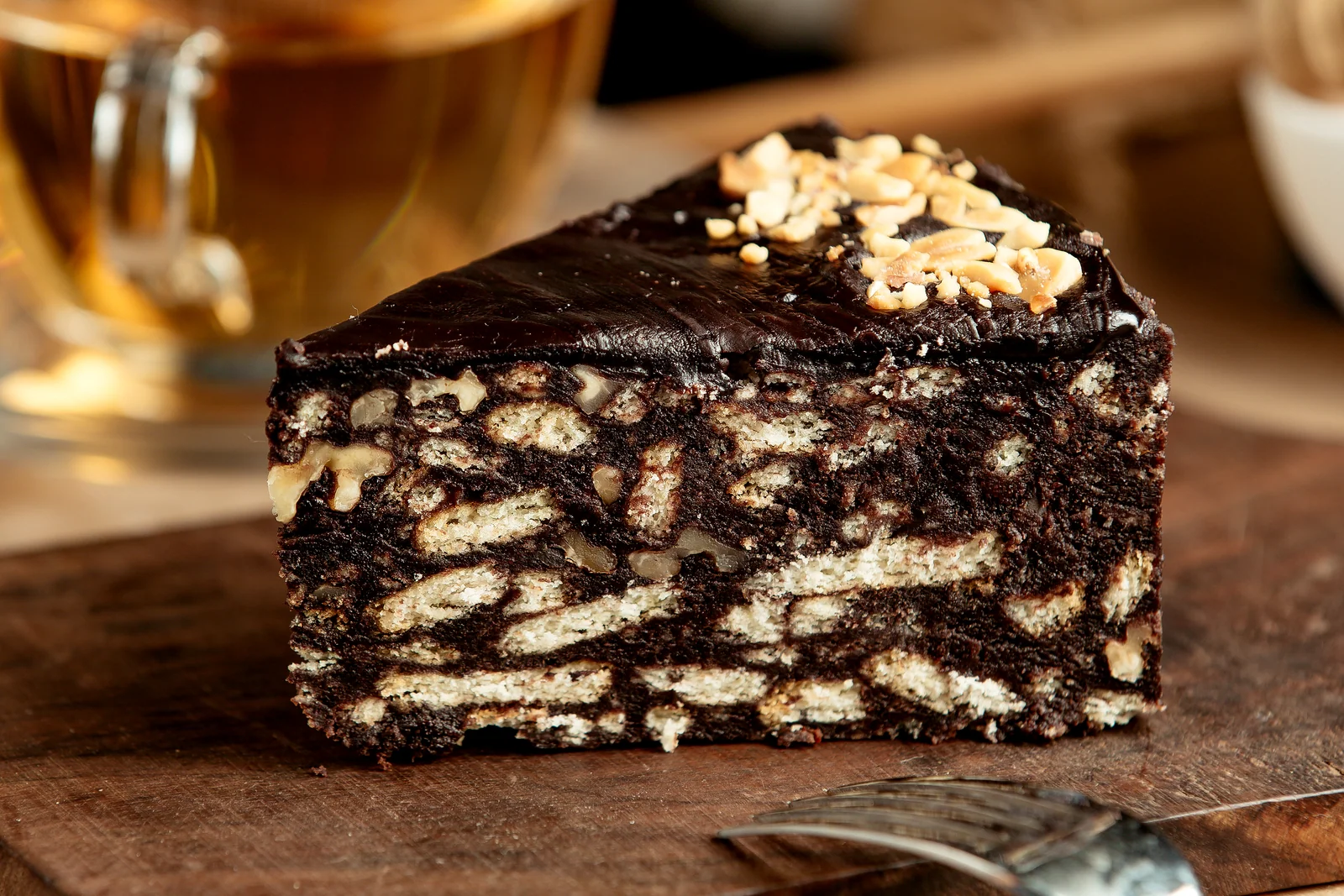

Marquesa de chocolate (mar-KEH-sah) is Venezuela’s answer to the icebox cake. Plain Maria cookies get a two-second dip in cold milk and are stacked with a dense chocolate buttercream, then the whole thing sits in the fridge overnight until the cookies turn cake-soft and the cream sets firm enough to slice into clean squares. If you grew up with a chocolate biscuit cake in Britain or Ireland, the flavor will feel familiar, but the build is different. My version cooks the egg yolks, which many home recipes leave raw, so it is safe for kids and anyone pregnant.
What is a Venezuelan marquesa?
How do you make a Venezuelan chocolate marquesa? Cook 4 egg yolks with ½ cup (100 g) sugar and ½ cup (120 ml) milk over low heat to 160°F (71°C), melt in 7 oz (200 g) chocolate and let it cool. Beat 7 oz (200 g) soft butter, add the chocolate, and layer the cream with 4 rows of milk-dipped Maria cookies in an 8x8 in (20x20 cm) pan. Chill at least 6 hours. In total, 420 minutes (about 40 hands-on, 30 of cooling and 6 hours of chilling) for 12 servings.
It is a cold layered dessert from Venezuela, served in squares, that never goes near an oven. Think of it as a cousin of two desserts you may know:
- An American icebox cake layers thin chocolate wafers with whipped cream and lets them soften in the fridge. A marquesa uses the same trick, but with a much richer cream of butter, chocolate and yolks, so it sets firm and cuts like a cake rather than spooning like a trifle.
- A British chocolate biscuit cake breaks rich tea biscuits into melted chocolate and butter, usually with golden syrup, and sets them in a tin. A marquesa keeps the cookies whole, softens them in milk first and stacks them in tidy rows, so each slice shows clear stripes.
In Venezuelan kitchens you will meet three different creams under the same name. This recipe uses the buttercream one, the firmest. Others thicken a cocoa pudding with cornstarch, or cook the chocolate with a can of sweetened condensed milk, which gives a softer, sweeter marquesa.
Ingredients, with US and UK swaps
The full list with weights is in the recipe card. Here is what to buy and what changes if you swap.
| You need | Where to find it | Swap and what changes |
|---|---|---|
| Maria cookies, 300 g (10½ oz) | US: Latin aisle of most supermarkets (Goya, Gamesa) or a Latin grocery. UK: Marie biscuits, sold in many supermarkets and world-food aisles | UK: rich tea biscuits, the closest match. Vanilla wafers work but are sweeter. Avoid graham crackers (different flavor) and butter cookies (they fall apart in milk) |
| Dark or semisweet chocolate, 50 to 60% cacao, 200 g (7 oz) | Baking aisle, in bars | Above 70% the marquesa turns bitter for kids. Milk chocolate makes a cream that never fully firms. Chips contain stabilizers and melt less smoothly |
| Unsalted butter, 200 g (7 oz) | Anywhere | Salted butter is fine: skip the pinch of salt |
| Egg yolks, 4 large | Anywhere | See the egg safety section below for pasteurized eggs and an egg-free version. The 4 spare whites are exactly enough for a batch of suspiros, Latin meringue kisses |
| Whole milk, about 1¼ cups (320 ml) in all | Anywhere | 2% milk works for dipping; keep whole milk in the cream |
Equipment. An 8x8 in (20x20 cm) square pan or glass baking dish, plastic wrap, a small saucepan, an electric hand mixer (a whisk works, with 6 to 8 minutes of effort for the butter) and, if you have one, an instant-read thermometer. A 9 in (23 cm) springform pan has about the same area if you prefer a round cake.
How to make it, step by step
Make the chocolate cream and let it cool properly
Stir the yolks, sugar and milk together cold, then cook over low heat, stirring all the time, for 6 to 8 minutes. Without a thermometer, the sign is a coating on the back of a spoon that holds a clean line when you run your finger through it; by then it is past 160°F (71°C). If the edges start to bubble, pull the pan off the heat, because boiling scrambles the yolks.
Off the heat, the chopped chocolate melts in a minute. Then comes the part that matters most: the mixture has to drop to about 77°F (25°C), cool to the touch, before it goes into the butter. Left on the counter it needs around half an hour; set the bowl in a larger one of cold water and stir, and it is ready in about a third of that.
The dip that keeps cookies from falling apart
Pour cold milk into a shallow bowl and give each cookie a dip of no more than 2 seconds, in and out. It should come out wet on the surface and still crisp in the middle. The moisture from the cream finishes the job in the fridge; a cookie that is already soft when it leaves the bowl will be mush by morning.
Layering
Start with a thin smear of cream (2 tablespoons) so the first row stays put. Lay the cookies edge to edge without overlapping and fill every gap with broken pieces, or the slices will have holes. Spread a quarter of the remaining cream to the edges, and repeat until you have 4 rows of cookies. Finish with cream and the grated chocolate. Each cream layer ends up a little thicker than ⅛ in (4 mm).
Chilling and unmolding
Give it at least 6 hours in the fridge for the cream to firm and the cookies to soften. For clean slices with sharp stripes, leave it overnight, about 12 hours. At 3 or 4 hours it is edible, but the center cookies are still crunchy and the cream squashes under the knife.
Do not turn it out upside down. Lift it by the overhanging plastic onto a board and peel the plastic off. A long knife dipped in hot water and wiped dry gives the cleanest cuts. If you built it in a glass dish, serve it straight from the dish with a spatula.
Raw eggs and how to make it safe
In many home recipes for marquesa, raw yolks are beaten straight into the butter, and some versions fold in raw whipped whites too. Raw egg can carry salmonella, and since this dessert is served cold, nothing kills it. The risk matters most for pregnant women, young children, older adults and anyone with a weakened immune system. Egg mixtures are considered safe once they reach 160°F (71°C), which gives you three options:
- Cooked yolks, as in this recipe. Same ingredients and almost the same texture; the cream is slightly firmer and more chocolatey.
- Pasteurized in-shell eggs. Many US supermarkets sell them. With these you can beat the yolks in raw, the old way, for the texture closest to the home recipe.
- No eggs. Heat the ½ cup (120 ml) of milk with the sugar until it steams, melt the chocolate in it and carry on. The cream is less silky, tastes more of butter and chocolate, and sets a little harder. This is the version for egg allergies.
When it goes wrong
- Runny, shiny cream. The chocolate mixture was still warm and melted the butter. Chill the bowl 15 minutes and beat again for 1 minute.
- Curdled or grainy cream. The opposite: cold butter or a chocolate mixture that got too cold. Warm the bowl for a few seconds over hot water and beat again.
- Cookies breaking up as you layer. Too long in the milk, or the milk was warm. Cold milk, in and out.
- Slices that squash and smear. Not enough time in the fridge. Under 6 hours, it happens every time.
- Lumps in the yolk mixture. It boiled. Push it through a sieve before adding the chocolate.
Make-ahead, storing and freezing
This is a make-the-night-before dessert, and I think it is at its best on day two. I take it out of the fridge 10 minutes before cutting, because cold buttercream is hard and mutes the chocolate.
- At room temperature. No more than 2 hours: it contains dairy and egg, and the butter softens.
- Fridge. 3 to 4 days, covered with plastic wrap so it does not pick up odors.
- Freezer. Up to 2 to 3 months, whole or in wrapped squares inside an airtight container. Thaw overnight in the fridge, never on the counter. The cookies end up a little softer than on day one.
Feeding a crowd. Double everything in a 9x13 in (23x33 cm) pan with the same 4 layers; that gives 24 squares.
Variations. Swap 50 ml (3 tbsp) of the dipping milk for cold strong coffee, add a spoonful or two of rum to the milk for an adults-only version (the alcohol is not cooked off), stir ½ tsp cinnamon into the cream, or top it with 40 g (⅓ cup) chopped roasted peanuts, a common finish in Venezuela. For small parties, break the cookies into quarters and layer them in 5 oz (150 ml) glasses; you get about 10 and nothing to unmold.
If you are putting together a Venezuelan dessert table, the marquesa sits well next to a cool, caramel-topped Venezuelan quesillo or a coconut-soaked Venezuelan bienmesabe. And if no-bake desserts with Maria cookies are your thing, the Mexican lime pie uses them as a crust.
Frequently asked questions about marquesa
Can I use cocoa powder instead of chocolate? Not in this buttercream: the bar chocolate is what makes it set in the fridge. Cocoa powder works in the pudding-style marquesa, the one thickened with cornstarch.
Is a marquesa the same as a marquise au chocolat? They share a name and a love of butter and chocolate, but the French marquise is a dense chocolate mousse-like terrine with no cookie layers. The Venezuelan marquesa is built around the cookies.
Can I make it gluten-free? Yes, with gluten-free Maria-style cookies. Dip a test cookie first, since every brand soaks up milk differently.
Can kids eat it? This version, with yolks cooked to 160°F (71°C) and no rum, yes. Keep the raw-yolk and rum versions for adults.
Nutrition
Per square, with the cake cut into twelve, worked out ingredient by ingredient from the quantities in this recipe and counting all the dipping milk:
- Calories: 393 kcal
- Protein: 5 g
- Carbohydrates: 39 g
- Fat: 25 g, of which 14 g saturated
- Fiber: 2 g
- Sugars: 24 g
- Sodium: 147 mg
More than half of the calories come from the butter and chocolate. Allergens: milk, egg and wheat, plus soy if the chocolate contains lecithin (check the label). On a cold afternoon it goes well with a mug of Colombian hot chocolate.
I make marquesa when I want dessert sorted the day before: half an hour of work at night and it is waiting in the fridge the next afternoon. I started cooking the yolks because of the children at home, expecting to lose something, and the only difference I noticed is that it slices even better. Josnaisis.