
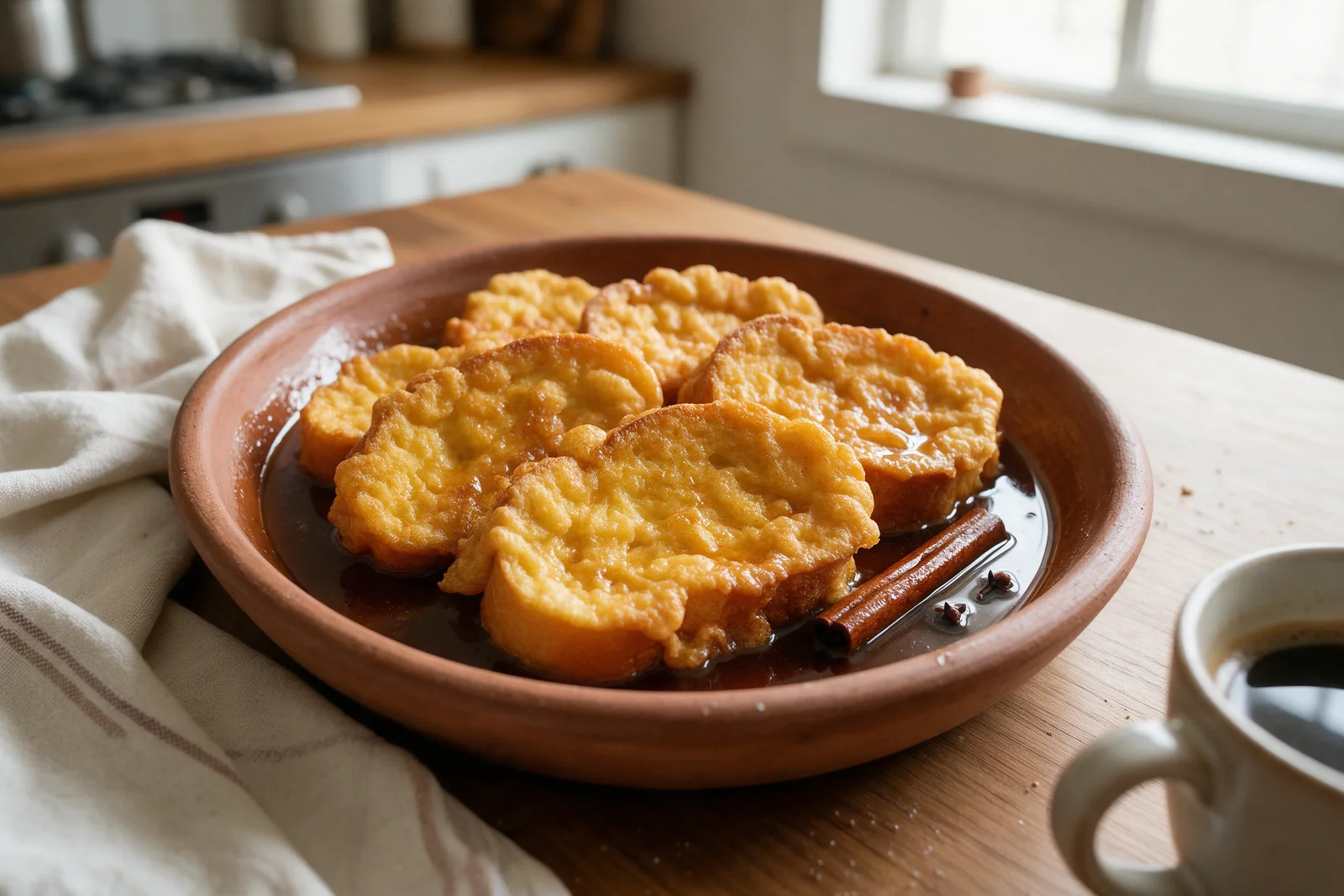

Torrejas (tor-REH-hahs) look like French toast and are made the other way round. Instead of soaking bread in an egg and milk custard and browning it in butter, you dip dry, day-old bread in whipped egg, fry it in oil until it puffs, and then drop the hot slices into a thin syrup of piloncillo, Mexican unrefined cane sugar, simmered with cinnamon, cloves and orange peel. The syrup does the soaking. Below you’ll find which bread to buy in a US or UK supermarket, what to use if you can’t find piloncillo, how runny the syrup should be, and how to fry them so they don’t turn greasy.
What are torrejas, and how are they different from French toast?
How do you make torrejas? Simmer 1 lb (450 g) of piloncillo in 1 liter (4¼ cups) of water with cinnamon, cloves and orange peel for 15 to 20 minutes, until lightly syrupy. Slice 4 day-old bolillo rolls ¾ in (2 cm) thick, dip them in whipped egg and fry at 350°F (175°C) for 1 to 2 minutes a side. Soak them in the hot syrup for 10 minutes. Ready in 55 minutes for 8 servings.
Torrejas are a Lent and Holy Week dessert in Mexico and Central America, and plenty of families make them at Christmas too. They are eaten warm or cold, in a bowl, with extra syrup.
Three dishes get mixed up here, and each comes out differently:
- American French toast is soaked in eggs and milk, pan-fried in butter and topped with maple syrup at the table. Soft and custardy all the way through.
- Spanish torrijas are soaked in milk (or wine) first, dipped in plain beaten egg, fried and finished with cinnamon sugar or honey.
- Torrejas go in dry. The whipped egg puffs in the oil, much like the batter on Mexican chiles rellenos, and the bread only gets wet afterward, from the syrup. You get a light, eggy crust around a crumb that tastes of dark caramel and spice.
One naming trap if you search further: in Venezuela, “torrejas” are thin fried discs of wheat dough dusted with sugar, and in Colombia the bread version is usually called tostada francesa. This recipe is the bread one.
Honest difficulty, easy. The only thing to watch is the oil temperature. Plan on 15 minutes of prep and 40 of cooking, most of it at the stove.
Ingredients, with US and UK swaps
Serves 8, three slices each.
| Ingredient | Metric | US | Notes and swaps |
|---|---|---|---|
| Day-old bolillo rolls | 4 rolls, about 360 g | about 13 oz | Baguette or crusty French loaf, same weight |
| Piloncillo | 450 g | 1 lb, 2 cones | Panela, or dark brown sugar (UK: dark muscovado) |
| Water | 1 liter | 4¼ cups | |
| Cinnamon stick | 10 cm | 4 in | Mexican canela is softer and flakier, but any stick works |
| Whole cloves | 3 | 3 | |
| Orange peel | 1 strip | 1 strip | No white pith, which turns bitter |
| Large eggs | 4 | 4 | Separated |
| All-purpose flour | 16 g | 2 tbsp | UK: plain flour |
| Vegetable oil | 500 ml | 2 cups | About ½ in (1 cm) deep |
Which bread to use
Bolillos are Mexico’s everyday white rolls: crisp crust, fairly tight crumb, about the size of a small sub roll. Latin bakeries and many US supermarkets with a Mexican bakery section sell them. If you want to bake your own, homemade bolillo rolls come out at the right size, and four is all you need.
Without bolillos, use a baguette or a crusty French or Italian loaf, a day old. In the UK, a supermarket baguette or a white bloomer works. Avoid sliced sandwich bread: it’s too thin and soft and dissolves in the syrup. Brioche or challah will work, and Central American cooks often use a soft sweet bread, but it soaks faster, so take it out of the syrup after about 5 minutes.
The bread has to be a day old because fresh bread is soft and damp: the egg won’t stick, and in the syrup it falls apart. If yours is fresh, slice it and leave it uncovered on a rack for a few hours or overnight.
Piloncillo, and what to use instead
Piloncillo is unrefined cane sugar, boiled down from cane juice and set in hard cones. It tastes like dark brown sugar with a deeper caramel flavor. In the US it’s in the Hispanic aisle in 8 oz (227 g) cones; you need two. Colombian panela, sold in blocks, is the same product and swaps 1 for 1 by weight.
- Dark brown sugar is the easiest swap, same weight: about 2 packed cups for 1 lb. The syrup comes out lighter in color and less deep.
- UK dark muscovado sugar is closer in flavor than standard soft dark brown sugar, same weight.
- Molasses is not a 1-for-1 swap. Used alone it turns the syrup bitter and too thick. If your syrup made with brown sugar tastes flat, I’d stir in no more than a tablespoon.
- White sugar gives a sweet syrup with no depth. I wouldn’t use it.
Equipment
A 3-liter (3-quart) pot for the syrup, a deep 24 cm (9½ in) skillet, an electric mixer for the egg whites and, ideally, a thermometer. A wire rack for draining keeps the bottoms crisp.
How to make torrejas, step by step
Start the syrup first, since it needs 15 to 20 minutes; heat the oil and whip the eggs while it simmers.
The syrup and how to tell it’s ready
Simmer the piloncillo in 4¼ cups (1 liter) of water with the spices, uncovered, over medium-low heat for 15 to 20 minutes. It’s ready when the sugar has fully dissolved and a spoon dipped in comes out with a thin coating that runs off in a steady thread, a little runnier than maple syrup. Thin syrup soaks into the bread; thick syrup sits on the outside and leaves the center dry. If you overshoot, add a splash of hot water.
Oil at 350°F (175°C)
Use a thermometer if you have one. If not, drop in a little whipped egg: it should rise and sizzle immediately. Below 340°F (170°C) the egg coating turns into a grease sponge; much hotter and it browns before it puffs. Let the oil come back up to temperature between batches.
Coating and frying
Whip the whites with the salt to stiff peaks, 3 to 4 minutes: they shouldn’t slide when you tilt the bowl. On low, beat in the yolks one at a time, then the flour, just until even. Coat each slice on all sides and fry 4 at a time, 1 to 2 minutes per side, until golden all over and puffed. Drain on a rack.
The soak
With the heat off and the syrup still hot, add all the slices and press them under. Leave them 10 minutes, turning once. Cut one open: the crumb should be dark right to the middle, and the slice should still lift out in one piece. Very hard bread may need 5 minutes more.
Why torrejas fall apart, stay dry or turn greasy
- They break up in the syrup → fresh bread, thin slices or too long a soak. Use day-old bread at ¾ in (2 cm) and lift them out once the crumb is dark through.
- Dry in the center → syrup too thick or too cool, or very stale bread. Keep the syrup hot and runny, and add 5 minutes to the soak.
- Greasy → oil below 340°F (170°C), or too many slices at once. Four at a time, and wait for the oil to recover.
- Egg slides off → damp bread, or egg whites that deflated while waiting. Whip them just before frying.
- Dark outside, raw egg inside → oil too hot. Turn it down and let it settle back to 350°F (175°C).
- Bitter syrup → scorched or over-reduced. Keep it at a gentle simmer and don’t let it thicken.
Variations and scaling up
- Milk-dipped. Some cooks in Mexico and El Salvador dip the bread quickly in milk boiled with cinnamon and cooled, before the egg. The result is softer and creamier, but the egg grips less well, so the bread must be very dry and the dip a quick in-and-out.
- Central American syrups. In Guatemala the panela syrup gets cinnamon, cloves, orange zest and sometimes a splash of rum; in El Salvador, black pepper, ginger and nutmeg; in Honduras, grated rapadura sugar with cinnamon, cloves and vanilla.
- For 16 to 20 people → double everything: 8 rolls, 2 lb (900 g) piloncillo and 2 liters (8½ cups) water in a 5-liter (5-quart) pot. Whip the eggs in two batches of 4, because whipped egg deflates as it waits. For 4 people, halve it.
- Got leftover bread but don’t want to fry? Mexican capirotada uses the same piloncillo syrup with oven-toasted bread, and Venezuelan bread pudding bakes stale bread into a custard.
Cost. Piloncillo and the frying oil are what you actually pay for; the bread is the loaf you were about to throw out. Strain the cooled oil and it’s good for another round of frying.
Serving, making ahead and storage
Serving. Warm or cold, in a shallow bowl with 2 to 3 tablespoons of syrup over each serving. A mug of Mexican café de olla, which is sweetened with the same piloncillo and cinnamon, or a glass of cold milk goes well alongside. For a piloncillo dessert spread, add Mexican candied sweet potatoes.
Making ahead. Make the syrup the night before and keep it in a jar in the fridge; warm it before soaking. Finished torrejas can also be made a day ahead and served cold.
Fridge. Covered, in their syrup, 3 to 4 days. Refrigerate within 2 hours of cooking, since they contain egg.
Freezer. I don’t freeze them. Soaked bread weeps as it thaws and turns mushy.
Reheating. In a pot with their syrup over low heat for a few minutes, or in the microwave in 30-second bursts.
Torrejas FAQ
Are torrejas the same as French toast? No. French toast is soaked in egg and milk and browned in butter. Torrejas are coated in whipped egg, fried in oil and then soaked in piloncillo syrup.
Can I make torrejas with regular sandwich bread? Not well. It’s too thin and soft and falls apart in the syrup. A day-old baguette is the closest swap for bolillo.
Why are my torrejas greasy? The oil was below 340°F (170°C) or the pan was crowded. At 350°F (175°C), four at a time, the egg sets and puffs instead of soaking up oil.
Do torrejas have to be eaten hot? No. In Mexico and Central America they’re eaten warm or at room temperature, and they’re also good cold from the fridge the next day.
Nutrition
Per serving (3 slices, ⅛ of the recipe), worked out from the weights above. I counted the piloncillo as brown sugar and included all the syrup; the absorbed oil, about 15 g per serving, is my own estimate for egg-coated slices fried at 350°F (175°C).
- Calories: 515 kcal
- Protein: 7 g
- Carbohydrates: 80 g
- Fat: 19 g, of which 2 g saturated
- Fiber: 2 g
- Sugars: 55 g
- Sodium: 310 mg
The syrup brings about 215 kcal per serving, the absorbed oil about 135 and the bread about 125. Leave half the syrup in the bowl and a serving drops to about 410 kcal. Contains gluten (bread and flour) and egg, plus milk if you make the milk-dipped version.
Growing up in Venezuela, “torrejas” to me meant the sugared dough discs we ate in the afternoon, so the bread kind was new when I first made it. I dipped the slices in milk out of French toast habit, and the egg slid straight off in the oil. Now I fry the bread dry and let the syrup do the soaking. Josnaisis.