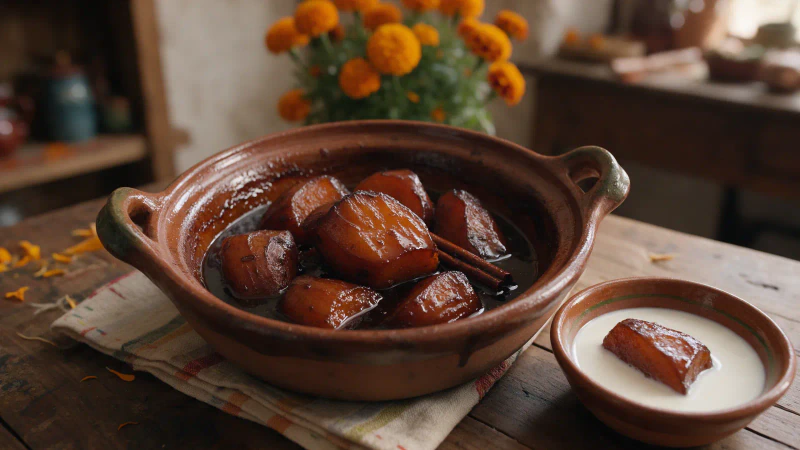
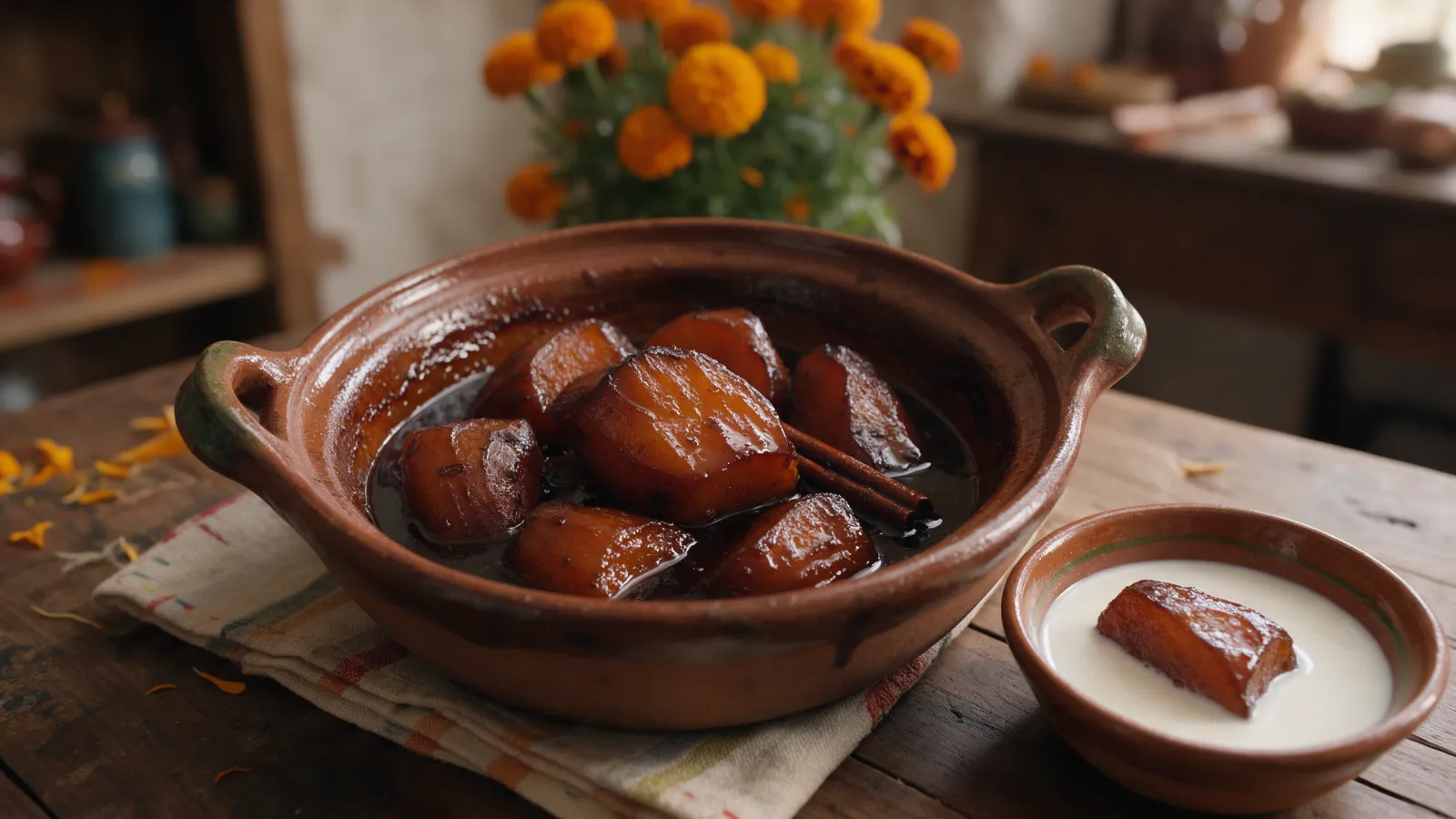

Camote enmielado (kah-MOH-teh en-mee-eh-LAH-doh) is a Mexican dessert of sweet potatoes simmered for 60 minutes in piloncillo, an unrefined cane sugar, with cinnamon, star anise and orange, until they are soft, glossy and dark at the edges. The name means honeyed, but there is no honey in it. It’s set on Day of the Dead altars and eaten from a bowl with cold milk. The only real decision is which sweet potato to buy, because the orange one in every US supermarket softens faster than the Mexican kind.
What is camote enmielado, and is it worth making?
How do you make camote enmielado? Dissolve 1.1 lb (500 g) of piloncillo in 3 cups (750 ml) of water with cinnamon, cloves, star anise and orange, then add 3.3 lb (1.5 kg) of sweet potatoes in 2 in (5 cm) chunks, skin on. Simmer covered on medium-low for 40 minutes, flipping once at 20, then uncovered for 20 minutes, basting, until the syrup coats a spoon at 220°F (104°C). 85 minutes for 8 servings.
This is not the Thanksgiving casserole. There are no marshmallows, no butter and no oven: just sweet potatoes in their own dark syrup, served as dessert. In Mexico it is a dessert, not a side dish. The texture is somewhere between a baked sweet potato and a poached pear, soft enough to cut with a spoon, and the syrup tastes of molasses and spice.
Make it if you want a cheap, make-ahead dessert for 8, you are setting up an ofrenda, or you like the idea of sweet potato with a glass of cold milk. Skip it if you want something lightly sweet: a serving with all its syrup carries about 2¼ oz (62 g) of piloncillo.
Time and effort. 85 minutes on the clock, about 45 hands-on. Easy. The skill is knowing when to pull the sweet potatoes out.
It shares its syrup with calabaza en tacha, Mexican candied pumpkin, and in some homes both go into the same pot for the Day of the Dead.
Which sweet potato to buy in the US and UK
In Mexico the usual choices are purple-skinned camote, which is sweeter and firmer, and white or yellow camote. Outside Mexico, what matters is the flesh. Moist, orange varieties turn more of their starch into sugar as they cook and go soft sooner; drier, paler ones hold their shape.
- Japanese sweet potatoes (purple-red skin, pale yellow flesh) are the closest match. In the US and the UK, look for them at Asian grocers and in some larger supermarkets.
- White sweet potatoes or boniato, at Latin and Caribbean grocers, work if you watch the knife.
- Orange sweet potatoes, the everyday kind, often labeled yams in the US, are fine. They are softer and sweeter, so start testing at 30 minutes covered and expect to lift them out before the syrup is done.
- Canned yams are already cooked and soft. They will turn to mash in syrup.
Pick slim, even sweet potatoes so all the chunks cook at the same pace.
Ingredients and the piloncillo question
Piloncillo is unrefined cane sugar pressed into cones, the same product as Colombian panela or Venezuelan papelón. Its molasses is what makes the syrup dark. In the US it is in the Latin aisle at Walmart and H-E-B in 8 oz (227 g) cones; you need two. In the UK, look in Mexican and Latin online shops, or buy panela from a Latin grocer, which works the same. Grate it or chop it with a serrated knife so it dissolves in 10 minutes.
No piloncillo? Use 500 g (2¼ cups packed) of dark brown sugar, or dark muscovado in the UK, plus 2 tablespoons of molasses or black treacle. The syrup is a little lighter and less deep. White sugar alone gives golden sweet potatoes, not dark ones.
Why 3 cups of water. That’s about 1 cup per pound (500 ml per kg), twice what calabaza en tacha uses. Pumpkin releases its own juice under the lid; sweet potato doesn’t, and its starch thickens the syrup early. With less water the syrup reaches the right stage before the centers are cooked and can scorch. Dissolve the piloncillo completely before the sweet potatoes go in, or the syrup can break.
Equipment. A wide 5 to 6 quart (5 to 6 liter) pot with a lid, tongs, a ladle and a slotted spoon. A thermometer helps but the spoon test works.
Why candied sweet potatoes fall apart, and how to stop it
Overcooking is what does it. A pumpkin wedge has a hard rind that holds it together for an hour and a half; a sweet potato has a thin skin that holds nothing. So the rule here is the opposite of the pumpkin one: test early, and take the sweet potatoes out the moment a knife slides in with little resistance, even if the syrup isn’t ready yet. Then reduce the syrup alone and pour it back over.
- Thick chunks, 2 in (5 cm), not slices.
- One layer, two at most. In a deep pot stacked four high, the bottom layer is mush before the top is cooked.
- Lid on, low heat, no spoon. One flip with tongs at 20 minutes.
- Knife test at 35 minutes covered, or at 30 with orange sweet potatoes.
The syrup stage, 220°F (104°C)
Stop when the syrup coats the back of a spoon and still looks loose. On a thermometer at sea level that’s 220°F (104°C), the jelly point, about 8°F above boiling.
At altitude, measure where water boils in your kitchen and add 8°F. Take it much past 230°F (110°C) and the syrup sets chewy in the fridge and sticks to the cold sweet potatoes. If that happens, warm it with 3 tablespoons of water until it loosens.
Make-ahead plan for the Day of the Dead and for a crowd
Make it the day before; it’s better after a night in the fridge, when the sweet potatoes have soaked up more syrup. Cut them on the day you cook.
For an ofrenda, set two chunks with a little syrup on a small clay or ceramic plate on the altar, separate from what the family will eat. Food on an altar sits out for hours, and cooked food shouldn’t stay at room temperature for more than 2 hours, so serve guests from the pot you kept in the fridge.
Scaling.
| Servings | Sweet potatoes | Piloncillo | Water | Pot |
|---|---|---|---|---|
| 4 | 750 g (1.65 lb) | 250 g (9 oz) | 375 ml (1½ cups) | 3-4 qt (3-4 L), test at 30 min |
| 8 | 1.5 kg (3.3 lb) | 500 g (1.1 lb) | 750 ml (3 cups) | 5-6 qt (5-6 L) |
| 20 | 3.75 kg (8.3 lb) | 1.25 kg (2.75 lb) | 1.9 L (8 cups) | two 6-8 qt pots, same times |
Cooking time depends on how thick the chunks are, not how many there are. On a Day of the Dead table with pan de muerto, one chunk per person stretches 8 servings to 16.
Variations
- Quicker: slim whole sweet potatoes or 1¼ in (3 cm) chunks, about 25 minutes covered, then reduce the syrup on its own. Less juicy inside.
- With guava: 4 guavas with a cross cut, added at the flip. They perfume the syrup.
- With pumpkin: start big pumpkin wedges first, and add the sweet potatoes on top once the pumpkin has had about 35 minutes.
- Less sweet: 375 g (13 oz) piloncillo. The syrup is thinner and needs 5 to 10 more minutes uncovered.
- Pressure cooker or oven: both cook the sweet potatoes, but you still have to reduce the syrup with the lid off, and the stovetop gives you more control over the moment to pull them. I use a regular pot.
- Dairy-free: serve with oat or almond milk; the pot itself has no dairy.
Allergens, kids and spice level, 0 of 5
No gluten, egg, nuts or dairy in the pot; milk comes in only at serving. Not spicy at all. Kids usually love it, but a serving with all its syrup is 69 g of sugar, so give small children one chunk with a little syrup, and peel it for the youngest.
What it costs in the US
At October 2026 store prices, the pot for 8 comes to about $6.88, or 86 cents a serving: 3.3 lb of sweet potatoes at $1.08/lb at Walmart ($3.57), two H-E-B piloncillo cones at $1.28 each ($2.56), and an orange ($0.75). With Goya cones at $2.62 each it is about $9.56. Piloncillo is more than a third of the bill. I don’t give a UK price, since piloncillo and Japanese sweet potatoes vary too much there.
Serving and storing
Serve two chunks per person in a shallow bowl, syrup spooned over, with 1 cup (240 ml) of cold milk around them. Warm it’s juicier; cold, the syrup is thicker and the sweet potato firmer. A mug of café de olla, sweetened with the same piloncillo and cinnamon, goes well alongside, and on a cold night so does a thick champurrado or a vanilla atole. As dessert after a Sunday lunch of chicken mixiotes in chile adobo, one chunk per person is enough.
Fridge. Leftovers keep 3 to 4 days at 40°F (4°C) or below, refrigerated within 2 hours, covered in their syrup. Some people keep it a week; I stick to 4 days.
Freezer. The syrup freezes perfectly. The sweet potatoes can be frozen for 3 to 4 months, but they thaw watery and fall apart, so freeze the extra syrup and eat the sweet potatoes within 4 days. Leftover syrup is good on pancakes.
Reheating. Covered, on low, with the syrup and 2 to 3 tablespoons of water, about 10 minutes without stirring, to 165°F (74°C) in the center. In the microwave, covered, in 1-minute bursts.
FAQ
What is the difference between camote enmielado and candied yams? Candied yams are a side dish of orange sweet potatoes baked with butter and brown sugar, often with marshmallows. Camote enmielado is a dessert: sweet potatoes simmered on the stove in a spiced piloncillo syrup, with no butter, served with milk.
Is camote en dulce the same thing? Yes. Camote enmielado, camote en dulce and camotes en almíbar are names for the same dessert.
Which sweet potato is best? Mexican purple-skinned camote or Japanese sweet potatoes, which are drier and hold their shape. Orange sweet potatoes work if you take them out earlier.
Do you peel the sweet potatoes? No need. Scrub them well and cook them skin on; eat the skin or leave it on the plate.
What can I use instead of piloncillo? Panela or papelón, same weight. Otherwise dark brown sugar or dark muscovado with 2 tablespoons of molasses or black treacle.
Why did my sweet potatoes turn to mush? They were overcooked or stirred. Use 2 in (5 cm) chunks, one flip with tongs, and lift them out as soon as a knife slides in easily.
How do I thicken the syrup? Cook it uncovered for the last 20 minutes on medium, basting, until it coats a spoon at 220°F (104°C). It thickens more as it cools.
How long does camote enmielado last? 3 to 4 days in the fridge, covered in syrup. Freeze the syrup, not the sweet potatoes.
Is it eaten hot or cold? Either. Warm is juicier; cold, with cold milk, is how it’s most often served.
Nutrition per serving
Per serving, about 6.7 oz (190 g) of raw sweet potato with an eighth of the syrup, calculated from this recipe’s amounts. I counted piloncillo as brown sugar and the skin as flesh:
- Calories: 403 kcal
- Protein: 3 g
- Carbohydrates: 100 g
- Sugars: 69 g
- Fat: 0 g (0 g saturated)
- Fiber: 6 g
- Sodium: 193 mg
Piloncillo supplies 59% of the calories; the sweet potato itself, about 160 kcal a serving. Leave half the syrup in the bowl and a serving drops to about 280 kcal. A cup of whole milk adds 146 kcal, 8 g of protein and 8 g of fat.
In Venezuela we call it batata and eat it boiled or roasted, never in syrup, so the first time I made this I treated it like candied pumpkin, gave it a long hour under the lid and ended up with sweet potato purée. Now the knife goes in at 35 minutes and I pull them out without waiting for the syrup. Josnaisis.