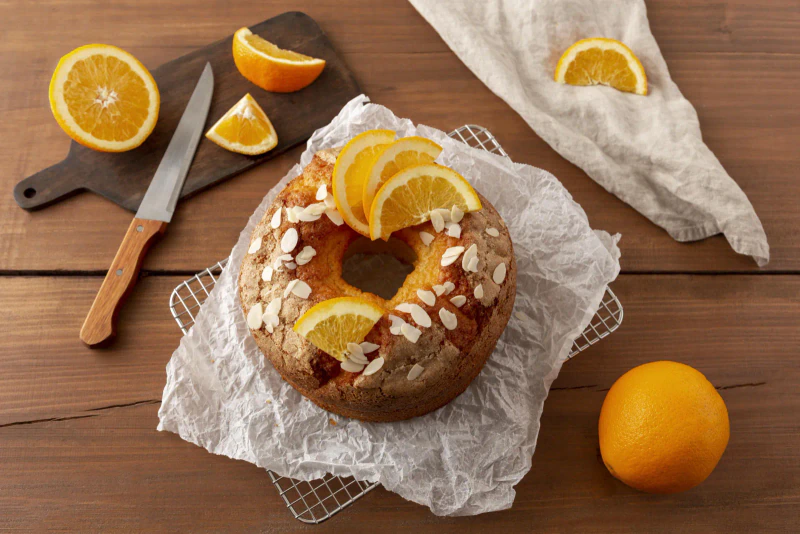
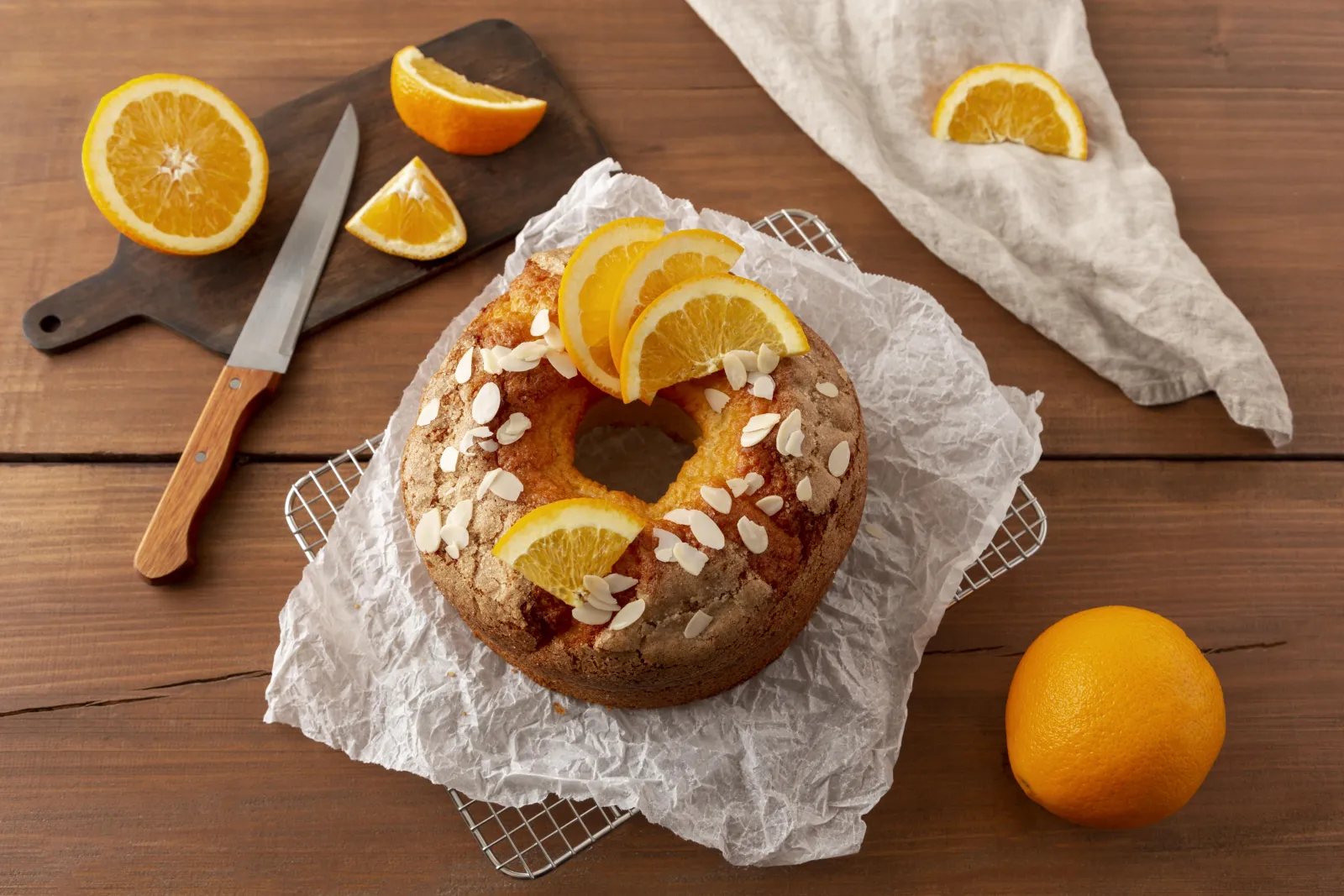

Across Venezuela and Colombia, torta de naranja (TOR-tah deh nah-RAHN-hah) is the cake people bake when there’s a bag of juicing oranges and an afternoon free. Mine is an oil-based sponge flavored three times over, with zest rubbed into the sugar, fresh juice in the batter and a warm orange syrup spooned over the hot cake, baked in a Bundt pan at 350°F (180°C) for 40-45 minutes. No butter, no milk, no mixer-hogging creaming step. The whole thing hinges on two small moves most cooks rush: grating only the orange layer of the peel, and soaking the cake while it’s still hot.
What is Latin orange cake, and who is it for?
How do you make a Latin orange cake from scratch? Rub the zest of 2 oranges into 1 cup (200 g) of sugar, beat it with 4 eggs until thick and pale, then add ⅔ cup (150 ml) oil and ¾ cup (200 ml) fresh orange juice. Fold in 2½ cups (300 g) flour with baking powder, bake in a 10-cup Bundt pan at 350°F (180°C) for 40-45 minutes, and soak the hot cake with a syrup of fresh juice and sugar. 65 minutes for 12 servings.
It’s a plain, everyday cake, the kind you slice for coffee rather than frost for a party. Think of a light sponge with a bright, slightly tart orange flavor and a crumb that stays moist for days. It’s dairy-free as written, uses pantry staples plus a handful of oranges, and the only equipment beyond a bowl is a hand mixer.
Make it if you want a not-too-sweet cake for afternoon coffee, lunchboxes or a weekend breakfast, or you have oranges going soft in the fruit bowl.
Skip it if you’re after a tall layer cake with frosting, or you can’t get fresh oranges. Bottled juice works in the batter, but the zest has to be fresh: it carries most of the aroma.
Time. 20 minutes hands-on, 65 minutes until it leaves the oven, and about 2 hours until it cuts cleanly.
Difficulty, honestly. Easy. The two things that go wrong, a bitter edge and a dry or sunken cake, are both covered below.
How it compares with an American orange Bundt
Most American orange Bundt cakes start by creaming butter and sugar, often with sour cream, and finish with a powdered-sugar glaze. This one whips the eggs instead and uses oil, so it’s lighter, softer when cold and costs less. If you’ve made a British lemon drizzle, the syrup step will feel familiar: hot cake, warm citrus syrup, lots of small holes.
In Venezuela I’ve seen it both with butter and a hot orange syrup, and with oil and whipped egg whites folded in. In Colombia it’s also made with oil, juice and zest, sometimes with a powdered-sugar glaze on top. This version takes the oil from one and the syrup from the other.
Ingredients, the right oranges and US and UK swaps
Everything is in the recipe card. Buy 5 medium juicing oranges, about 2 lb (900 g): a medium orange gives roughly 3 oz (86 g) of juice, so five cover the 350 ml (1½ cups) for batter and syrup with a little left for the glaze.
Which oranges to buy
Valencias are the summer juicing orange in the US and the easiest choice when you can find them. In winter, navels are what most stores carry, and they work, with one catch: navel juice turns bitter if it sits, because a bitter compound forms in the juice after squeezing. Squeeze navels right before you use them, never the night before. In the UK, any heavy, thin-skinned orange will do. Clementines or mandarins work in the same amounts and give a sweeter, more floral cake.
Zest without the pith
The colored layer of the peel holds the oils that make the cake smell of orange. The white pith under it has no aroma and tastes of peel. Orange pith is far milder than grapefruit pith, but in a cake this simple you notice it.
- Use a fine rasp grater and light pressure.
- Turn the orange as soon as you see white; don’t go over the same spot twice.
- Wash and dry the fruit first, since the zest goes straight into the batter.
- 2 oranges give about 2 tbsp (12 g). More zest adds peel flavor, not more fruit.
Rubbing the zest into the sugar before you beat the eggs is the step I’d never skip. The sugar crystals scrape the zest, release the oil, and spread it through the whole batter.
Swaps for a US or UK kitchen
| If the recipe says | Use | What changes |
|---|---|---|
| Fresh orange juice | Not-from-concentrate juice, unsweetened | Fine in batter and syrup; flavor is flatter |
| Orange zest | Nothing works as well | Without fresh zest the cake loses most of its aroma |
| Neutral oil | 170 g (1½ sticks) melted butter | Richer flavor, firmer crumb when cold, no longer dairy-free |
| All-purpose flour | Self-rising flour (self-raising in the UK) | Leave out the baking powder |
| Granulated sugar | Caster sugar | No change; it dissolves a little faster |
| Oranges | Clementines or mandarins | Sweeter, more floral |
Butter has about 81 % fat, which is why 170 g of it stands in for 150 ml of oil. If what you really want is a buttery, close-crumbed cake, my Colombian pound cake has an orange variation and is built for butter from the start.
Equipment
A 10-cup Bundt pan, a hand or stand mixer, a fine grater, a strainer, a spatula and a small saucepan. No mixer: whisk the eggs and sugar by hand for 6-8 minutes; it rises a little less. No Bundt pan: see the pan chart below. An instant-read thermometer is optional but takes the guesswork out of a deep pan.
Pan sizes and bake times
The full batter weighs about 2 lb 6 oz (1,070 g). Any of these pans works; only the depth, and so the time, changes.
The Bundt pan is my first choice for a reason beyond looks: heat comes in through the center tube too, so the middle of the cake sets at the same pace as the edges and is much less likely to sink. Times outside the Bundt pan are my own, and in every pan the thermometer beats the clock.
Half batch for 4-6 people. 2 eggs and half of everything else in a 7-8 in (18-20 cm) round at 350°F (180°C) for about 25-30 minutes.
For 20-24. Make two separate batches and bake two Bundt pans at once, swapping shelves at minute 30 if they’re on different racks. A home mixer won’t whip 8 eggs as well as 4.
How to plan it, from zest to first slice
Make ahead. The syrup keeps covered in the fridge for a couple of days; warm it before using. The whole soaked cake is even better the next day, moister and easier to slice. Don’t squeeze the batter juice ahead, especially from navels, and don’t leave mixed batter waiting: the baking powder starts working as soon as it’s wet.
Signs each stage is right.
- Zest → fine, damp and orange, with no white flecks.
- Zested sugar → smells of orange and looks like damp yellow sand.
- Whipped eggs → pale and thick; lifted beaters leave a ribbon that sits on the surface for a moment.
- Finished batter → smooth and pourable, thinner than a pound cake batter. That’s normal with oil and juice.
- Minute 30 → golden and set at the edges, still soft in the middle.
- Minute 40-45 → springs back, edges pull away slightly, skewer clean, 200-205°F (93-96°C) in the center.
The orange syrup, when and how much
150 ml (scant ⅔ cup) of juice and 75 g (6 tbsp) of sugar, simmered 3 minutes. That’s two parts juice to one part sugar by weight, a light syrup that soaks in without making the cake soggy or sticky. Reduce it longer and it turns thick and sits on top.
The rule is a hot cake and a warm syrup. Ten minutes out of the oven, the crumb is still open and drinks the syrup in; once it’s cold, the crumb tightens and the syrup runs off. Poke holes every ¾ in (2 cm), spoon the syrup over in 3 rounds, and keep the plate under the rack so you can pour the drips back on.
Leave the syrup off if the cake is going into lunchboxes or you want a crisp white glaze. The glaze always goes on a completely cool cake, or it melts and disappears.
How to tell it’s done
No thermometer: push a long wooden skewer to the bottom, halfway between the tube and the edge. It should come out clean or with a few moist crumbs, never wet batter. Start checking at 40 minutes.
The blender shortcut
Blend the eggs, sugar, zest, oil, juice and vanilla for about half a minute, until smooth and foamy, pour into a bowl, and fold in the flour by hand. Never blend the flour: the motor overworks it and the cake turns tough. The blender version rises a little less and has a tighter crumb, but it’s just as moist. Some cooks blend a whole washed orange, seeds out, in place of the juice and zest. It tastes more intense and a bit bitter from the pith; if you try it, use a thin-skinned orange, trim the ends, and don’t skip the syrup.
Mistakes, allergens and kids
Why did my cake sink? Usually an underbaked center, an oven door opened before minute 30 while the egg foam was still setting, or too much baking powder. Level the baking powder, keep the door shut and bake to 200°F (93°C).
Why is it bitter? Pith in the zest, or navel juice squeezed hours earlier. No fix once baked; a glaze helps hide it.
Why is it dry? Flour scooped straight from the bag can add 20-35 g (about ¼ cup) per cup; weigh 300 g (10.6 oz). Or it baked too long. The syrup rescues a slightly dry cake.
Dense and flat? Cold eggs or not enough whipping, or overmixing after the flour.
Stuck in the pan? Ungreased ridges. Brush every ridge, flour it, and turn the cake out after 10 minutes.
Syrup sitting on top? The cake was cold or the syrup was too thick. Warm the cake for 5 minutes in a low oven and try again.
Heat level, 0 out of 5. Kids usually love it, especially glazed. Allergens: wheat (gluten) and egg; no milk as written; no nuts.
Versions worth making
- Faster → the blender method and a muffin tin: about 19 muffins, 20-22 minutes, no waiting to slice.
- Layer cake → two 8 in (20 cm) rounds, no syrup, filled with Colombian dulce de leche. That’s close to Colombia’s torta María Luisa, an orange-scented layer cake filled with arequipe or jam.
- Lighter → skip the syrup and each slice drops from 321 to about 291 kcal. Cutting the batter sugar to 150 g (¾ cup) works; less than that and the cake turns pale and dry.
- Glazed for a birthday → syrup while hot, glaze once cold. The glaze adds about 40 kcal a slice.
- Clementine → same amounts, clementine juice and zest.
If you’d rather bake with fruit that’s past its best, Colombian banana cake uses the same oil-based approach in a sheet pan. And if “Venezuelan cake” brings to mind something savory-sweet for the dinner table, that’s the Venezuelan plantain cake, layered fried plantains with cheese, no flour at all.
What it costs
At US city average prices for September 2026, the oranges, eggs, flour and sugar add up to about $5.15 for the cake, roughly 43 cents a slice, before oil, baking powder, salt and vanilla.
What drives the cost. The oranges, at $1.723 a pound for navels, are two thirds of the bill. In Bogotá, the same cake came to about 7,223 Colombian pesos at mid-September wholesale prices, and there too the oranges were the single biggest cost.
Yield. 12 slices from a 10-cup Bundt, or 16 thinner ones for a crowd.
Serving, storing and freezing
How it tastes. A soft, yellow, springy crumb, lighter than pound cake, with fresh orange flavor and a tart edge that keeps it from tasting sugary. The syrup leaves the top slightly glossy and extra moist.
How to serve it. At room temperature, with coffee or tea, or with a mug of Colombian hot chocolate. A glass of Colombian kumis, the tangy drinkable fermented milk, is a very Colombian pairing. For dessert, add whipped cream or vanilla ice cream.
Room temperature. Covered or airtight, 2-3 days. If it’s glazed and the kitchen is warm, move it to the fridge, because the glaze weeps.
Fridge. Up to 5 days, wrapped once completely cool. Let slices sit out 15 minutes before eating.
Freezer. At 0°F (-18°C) food stays safe indefinitely; quality is what fades. Wrap unglazed slices individually, bag them, and eat within 2-3 months. The syrup can already be on.
Thawing. Overnight in the fridge or 1-2 hours at room temperature, still wrapped. 10-15 seconds in the microwave makes a slice taste fresh-baked. Glaze after thawing.
Frequently asked questions
Why does my orange cake taste bitter? Pith in the zest, or navel juice squeezed too far ahead. Grate only the orange layer and squeeze right before mixing.
How do I keep orange cake moist? Use oil, weigh the flour, pull it at 200-205°F (93-96°C) and soak it with warm syrup 10 minutes after it comes out.
Do you pour the syrup on a hot or cold cake? Hot cake, warm syrup. On a cold cake it doesn’t soak in.
Can I use store-bought orange juice? Yes for the batter and syrup, ideally not-from-concentrate and unsweetened. The zest must come from fresh oranges.
How many oranges do I need? 5 medium juicing oranges, about 2 lb (900 g): 2 for zest and all 5 for the juice.
Can I make it without a Bundt pan? Yes. A 9 in (23 cm) round at least 2 in deep takes 35-40 minutes, and an 8x12 in (20x30 cm) pan 30-35, both at 350°F (180°C).
Can I make it dairy-free? It already is, as long as the glaze uses juice, not milk.
Can I freeze orange cake? Yes, in wrapped slices without glaze, for 2-3 months.
Nutrition
Per slice (1/12 of the cake, with syrup, without glaze), calculated ingredient by ingredient:
- Calories: 321 kcal
- Protein: 5 g
- Carbohydrates: 46 g
- Fat: 13 g, of which 2 g saturated
- Fiber: 1 g
- Sugars: 26 g
- Sodium: 203 mg
Oil, flour and sugar supply nearly all the calories. Nearly all the sugar is the granulated sugar in the batter and syrup; the orange juice adds only about 30 g to the whole cake. Without syrup a slice is about 291 kcal.
The first orange cake I remember was a buttery one from my childhood in Venezuela, still warm and shiny with syrup. In Colombia I switched to oil because it holds up better in Dylan’s lunchbox, but I never dropped the syrup. Rub the zest into the sugar, soak the cake hot, and the oranges do the rest. Josnaisis.