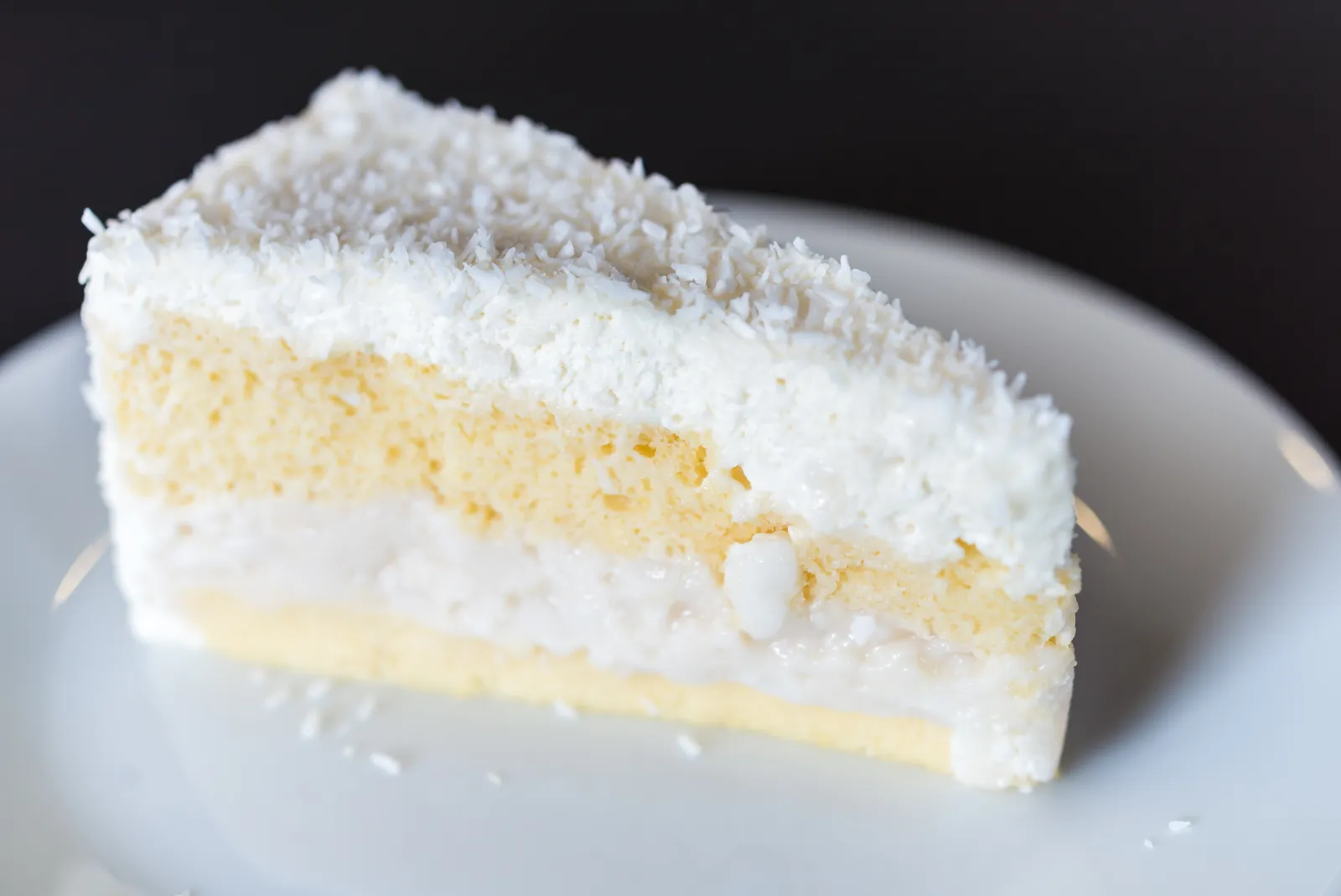

Picture a tiramisu where the coffee has been swapped for sweet wine and the mascarpone for a thick coconut custard made with 10 egg yolks, then crowned with cinnamon-dusted meringue. That’s the closest map I can give you to bienmesabe (byen-meh-SAH-beh), the cake Venezuelans bring out at Christmas, birthdays and christenings. The name just means “it tastes good to me.” Below you’ll find whether it’s worth the egg count (16), how to stop the custard splitting, which meringue to use if kids or pregnant guests are eating, what to buy in a US or UK supermarket, and how to have the whole thing done the day before.
What is Venezuelan bienmesabe, and is it worth making?
How do you make Venezuelan bienmesabe? Bake a 6-egg sponge at 350°F (180°C) for 25 minutes and split it into 2 sheets. Cook 800 ml (3⅓ cups) coconut milk with 10 tempered yolks, sugar and cornstarch until it boils for 1 minute, then layer sponge, sweet wine and custard in a 9 x 13 inch dish. Chill 4 hours and top with Swiss meringue and cinnamon. 330 minutes for 15 servings.
It’s a chilled, spoonable layered dessert from Venezuela: thin sheets of plain sponge (or ladyfingers) moistened with sweet wine, each one covered with a cooked coconut custard thickened with egg yolks, and the top finished with meringue and cinnamon. Served straight from the fridge, cut in squares.
Worth it when you’re feeding 12 to 16 people and want dessert finished the night before. A 9 x 13 inch (23 x 33 cm) dish gives 15 squares of about 150 g (5 oz), and it actually improves after a night in the fridge.
Skip it when you want something sweet tonight, because it needs 4 hours of chilling at minimum. Also if you prefer desserts on the less-sweet side (each square carries about 44 g of sugars), or if someone at the table can’t eat eggs.
Real time. 330 minutes on the clock, about 65 of them hands-on.
Honest difficulty, medium. Two steps decide it: tempering the yolks so the custard stays smooth, and whipping the sponge until it doubles. Neither needs pastry training, just a timer and a thermometer.
Not the Canary Islands bienmesabe, and not tres leches
If you’ve had bienmesabe in Gran Canaria, that’s a different dessert: a thick almond, sugar and egg-yolk cream, often spooned over ice cream. In Antequera, southern Spain, it’s almond with candied citron and sponge fingers; in Cádiz the same word means marinated fried dogfish. Puerto Rico’s version is a coconut, yolk and sugar cream poured over cake. The Venezuelan one swaps almond for coconut and builds it into layers.
Shopping list, with US and UK swaps
The recipe card has exact weights: 16 eggs in total, two 13.5 oz (400 ml) cans of coconut milk, 650 g (3¼ cups) of sugar across three components, 150 g (1¼ cups) flour, 30 g (¼ cup) cornstarch and 180 ml (¾ cup) sweet wine.
| Ingredient | US | UK | Notes |
|---|---|---|---|
| Coconut milk | full-fat unsweetened, 13.5 oz can (international aisle) | full-fat, 400 ml can (world foods aisle) | not “coconut milk beverage” in a carton |
| Cream of coconut | Coco López, cocktail aisle | mostly online | sweetened; halve the custard sugar to 150 g (¾ cup) |
| Ladyfingers (instead of baking) | ladyfingers or savoiardi, about 14 oz (400 g) for 2 layers | sponge fingers, same weight | dry-fit them before you start |
| Sweet wine | sweet sherry or moscato | cream sherry or moscatel | raw in the cake, so the alcohol stays |
| No-alcohol swap | white grape juice, 180 ml (¾ cup) | same | flatter, sweeter result |
| Cornstarch | cornstarch | cornflour | same thing, 30 g (¼ cup) |
| Sugar | granulated | caster or granulated | caster dissolves faster in the meringue |
Fresh coconut milk. Blend the flesh of 2 coconuts with 720 ml (3 cups) hot water and squeeze through a thin cloth. I get roughly 800 ml (3⅓ cups); measure, and top up with water if you’re short. It tastes cleaner and adds about 30 minutes.
Ladyfingers versus a homemade sponge. The card’s sponge is a fatless whole-egg sponge that soaks up wine and custard without falling apart. Ladyfingers (sponge fingers in the UK) skip the baking and soak faster, so drizzle the wine with a spoon rather than dunking. A store-bought pound cake works but gives a denser, cakier result.
What about all those egg whites? The 10 yolks leave 10 whites. Four go into the meringue; the other 6 freeze raw in a jar for up to 12 months, per the USDA, or bake straight into the meringue discs of a Colombian merengón, which takes exactly 6.
Equipment. A 9 x 13 inch (23 x 33 cm) metal pan for baking, a glass dish of the same size for layering, a heavy 2 to 3 quart (2 to 3 liter) saucepan, a whisk, an electric mixer, a serrated knife and an instant-read thermometer. No thermometer? The cornstarch custard tells you itself: once it has bubbled for a full minute it’s well past 160°F (71°C). The meringue is harder to judge by eye, so without a thermometer use pasteurized egg whites from a carton.
Make-ahead plan, and how to tell each stage is right
The trick is cooking the custard while the sponge is in the oven, then letting the fridge do the rest.
The day before: everything except the meringue. The sponge alone keeps 2 days wrapped at room temperature, and the layered cake is better after a night in the fridge, when wine and custard have soaked all the way through. Serving day: the meringue, 15 minutes, up to a few hours before you serve.
Scaling for a crowd.
| Guests | Dish | Whole eggs + yolks | Coconut milk | Total sugar | Cornstarch | Sweet wine |
|---|---|---|---|---|---|---|
| 6-8 (half batch) | 8 x 8 in (20 x 20 cm) | 3 + 5 | 400 ml (1 can) | 325 g (1⅔ cups) | 15 g (2 tbsp) | 90 ml (6 tbsp) |
| 15 (this recipe) | 9 x 13 in (23 x 33 cm) | 6 + 10 | 800 ml (2 cans) | 650 g (3¼ cups) | 30 g (¼ cup) | 180 ml (¾ cup) |
| 20-22 (1½ batches) | 9 x 13 + 8 x 8 in | 9 + 15 | 1.2 L (3 cans) | 975 g (4¾ cups) | 45 g (6 tbsp) | 270 ml (1⅛ cups) |
| 30 (double) | two 9 x 13 in | 12 + 20 | 1.6 L (4 cans) | 1.3 kg (6½ cups) | 60 g (½ cup) | 360 ml (1½ cups) |
A half batch takes 2 whites and 100 g (½ cup) sugar for the meringue; a double, 8 whites and 400 g (2 cups). I cook the custard in batches of 800 ml (2 cans) at most: a fuller pan thickens unevenly and catches on the bottom.
How to tell it’s going right.
- Sponge batter: after 8 to 10 minutes, pale, doubled, and the ribbon holds for a few seconds.
- Baked sponge: golden all over at 25 minutes, top springs back.
- Custard: at 6 to 8 minutes the whisk leaves trails and fat bubbles break the surface; count one more minute.
- Layering: warm custard spreads on its own. If it has set too firm, whisk it for 20 seconds.
- Meringue: at 160°F (71°C) the sugar has dissolved; whipped, it holds stiff peaks that don’t droop.
The custard, by temperature
A yolk custard with no starch coats a spoon at 175 to 180°F (79 to 82°C), and above 180°F (82°C) the egg proteins tighten and split from the liquid, according to America’s Test Kitchen. That narrow window is why older all-yolk versions break so easily. This one has 30 g (¼ cup) cornstarch: the starch gets between the egg proteins and lets the custard boil without curdling. The catch is that it must boil for 1 minute. Yolks carry amylase, an enzyme that breaks down starch and only dies near boiling point, as Cook’s Illustrated explains. Pull it early and the custard looks thick in the pan but is runny by morning.
Tempering is the other safeguard. Hot coconut milk goes into the sugared yolks in a thin stream, two cups’ worth, and only then does everything go back on the heat.
Which meringue, raw, Swiss or Italian
Venezuelan bakeries often top bienmesabe with a raw meringue of whipped whites and sugar. The FDA says egg dishes should reach 160°F (71°C) and that recipes served with raw or undercooked eggs should use pasteurized eggs. A Swiss meringue meets that: the whites and sugar are heated together over simmering water to a measured 160°F (71°C), then whipped. Italian meringue is the most stable, but the 245°F (118°C) syrup hits cold whites and doesn’t guarantee every bit of them gets hot enough.
Liliana, the Venezuelan cook whose recipe Familia Kitchen publishes, says older bienmesabe had no meringue at all; bakeries added it to make the cake look better and sell more. If you’d rather skip it, finish with cinnamon straight on the custard.
Mistakes that ruin bienmesabe
- Split custard. The heat jumped or the yolks went in untempered. Small lumps: blitz 30 seconds with a stick blender and strain. Separated into liquid and scrambled egg: start again.
- Runny custard the next day. It didn’t boil the full minute, so the yolk enzyme broke down the starch. Time it with a clock next round.
- Flat sponge. The batter didn’t double, or the flour was stirred rather than folded. Whip 8 to 10 minutes and fold.
- Soggy, collapsing layers. Too much wine at once. Spoon 90 ml (6 tbsp) per layer, evenly.
- Weeping meringue. The sugar never fully dissolved. Heat to 160°F (71°C) and rub a drop between your fingers.
- Layers slide when you cut. Under 4 hours in the fridge. Overnight is best.
Spice level: none. Kids: they usually love it, but the wine is never cooked, so 180 ml of a 15 to 18 % sweet wine leaves 1.4 to 1.7 g of alcohol in each square. Make the grape juice version, or a small separate dish without wine.
Allergens: egg, gluten (flour or ladyfingers) and coconut; sweet wines usually declare sulfites. There’s no dairy: with coconut milk and no butter it’s lactose-free. For gluten-free, use a store-bought gluten-free sponge and check the cornstarch label.
Variations worth making
- Short on time: ladyfingers instead of the sponge saves about 65 minutes of whipping, baking and cooling, and means no oven at all.
- No alcohol: 180 ml (¾ cup) white grape juice, or a syrup of 120 ml (½ cup) water, 60 g (5 tbsp) sugar and vanilla.
- Old-school, no cornstarch: 12 yolks to 800 ml coconut milk, sugar first cooked to a syrup, and the custard kept below 180°F (82°C) without boiling, as in several traditional Venezuelan recipes. You need the thermometer.
- Toasted coconut: 60 g (¾ cup) shredded coconut toasted 7 to 8 minutes at 300°F (150°C), over the meringue or between layers.
- Lighter: there’s no honest light version, because the sugar holds the custard and meringue together. Cut 20 squares instead of 15 and each drops to about 300 kcal.
Bienmesabe or another Latin layered dessert? Tres leches cake soaks a sponge in three uncooked dairy milks, about 900 ml, and has no coconut. Bienmesabe uses a cooked coconut custard that forms its own layer, plus sweet wine, so it eats more like a coconut trifle than a soaked cake. If you want the same coconut with no eggs at all, Venezuelan majarete is a coconut and cornmeal pudding; if you’re after caramel and custard, Venezuelan quesillo is the flan with tiny holes.
What it costs to make
With US city average prices from the BLS for August 2026, 16 eggs cost $3.03 ($2.272 a dozen), 650 g (1.43 lb) of sugar $1.47 and 150 g (0.33 lb) of flour $0.18: $4.68 before the coconut milk and wine, which the BLS doesn’t track. Add those from your own receipt. Coconut and eggs are the expensive part wherever you shop; at Bogotá wholesale prices they make up 85 % of the cost. I found no official UK price series I could cite for the coconut milk or wine.
Yield: 15 squares about 3 x 2½ inches (7.5 x 6.5 cm), or 20 smaller ones after a big holiday meal.
Serving and storage
Taste and texture. Cold, creamy and damp: the soaked sponge cuts with a spoon, the custard tastes of cooked coconut with a custardy depth, the wine comes through at the end, and the cinnamon meringue lightens it.
How it’s served. Very cold, in squares or spooned from the dish, with coffee. On a Venezuelan Christmas table it sits next to Venezuelan black cake and a glass of ponche crema, after a plate of hallacas. For a coconut side dish on another day, the browned-coconut Colombian coconut rice uses the same cans.
Fridge. Leftovers keep 3 to 4 days at 40°F (4°C) or below, per the USDA, and the FDA says egg dishes shouldn’t sit out more than 2 hours (1 hour above 90°F / 32°C). The meringue weeps from day two; the taste holds, the look doesn’t.
Freezer. Not once assembled. Cream and custard desserts don’t freeze well, per Iowa State and University of Maine extension guidance: the custard leaks water as it thaws and the meringue collapses. Freeze the spare egg whites, or the plain sponge, wrapped.
Bienmesabe FAQ
What does bienmesabe mean? “It tastes good to me” in Spanish. The same name covers several unrelated desserts in Spain and Latin America, and a fried fish dish in Cádiz.
What’s the difference between bienmesabe and tres leches? Tres leches is soaked in three uncooked milks. Bienmesabe has a cooked coconut and egg-yolk custard as its own layer, plus sweet wine, and is topped with meringue and cinnamon.
Can I make bienmesabe with ladyfingers? Yes, about 400 g (14 oz) for two layers in a 9 x 13 inch dish. Spoon the wine over rather than dipping, since they absorb fast.
Can I make it without alcohol? Yes. Swap the 180 ml (¾ cup) sweet wine for white grape juice or a light vanilla syrup. It’s the version to make for kids.
Is the meringue raw? The traditional one is. The Swiss meringue here heats the whites to 160°F (71°C) before whipping. If you make it raw, use pasteurized whites.
Can I use cream of coconut instead of coconut milk? Yes, but it’s sweetened, so cut the custard sugar from 300 g to 150 g (1½ cups to ¾ cup). Never the carton coconut drink.
How far ahead can I make it? Assemble it the day before; the sponge alone up to 2 days ahead. Add the meringue on serving day.
How long does bienmesabe last? 3 to 4 days in the fridge at 40°F (4°C). Don’t freeze it assembled.
Nutrition per serving
Per square (1/15 of the recipe, about 150 g / 5 oz), worked out ingredient by ingredient from USDA FoodData Central (SR Legacy) with the amounts above, wine included:
- Calories: 400 kcal
- Protein: 7 g
- Carbohydrates: 57 g, of which 44 g sugars
- Fat: 16 g, of which 11 g saturated
- Sodium: 95 mg
Almost all the saturated fat comes from the coconut milk, 144 of 170 g for the whole dish. The sweet wine adds about 20 kcal per square between sugar and alcohol.
Outside Venezuela, the can is where bienmesabe goes wrong for me: sweetened cream of coconut sits on the same shelf as coconut milk and nearly doubles the sugar. So I read the label twice, keep the thermometer next to the stove, and count that minute of boiling out loud. Make it the night before; the fridge finishes the job. Josnaisis.