
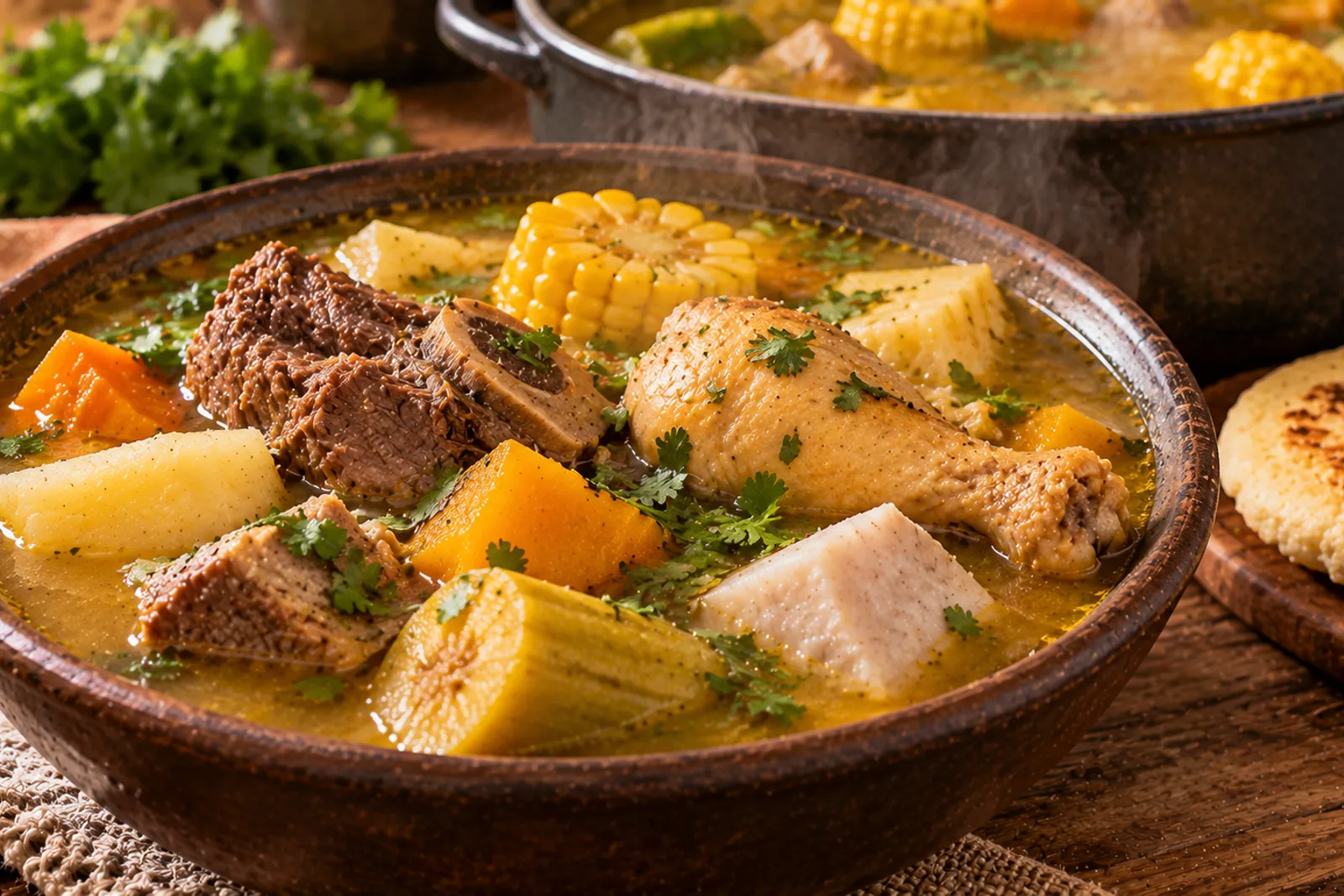

Venezuelan cruzado puts 1 kg (2.2 lb) of bone-in beef and a whole stewing hen, or chicken, in one pot to simmer with cassava, malanga, white yam, squash, plantain and corn until the broth turns golden and slightly thick. The trick is the clock. Beef and poultry soften at different speeds, so each goes in at its own minute and both arrive in the bowl whole. This recipe feeds 10, and below you’ll find what to buy in the US or UK, how to judge the broth, and how to scale it for a party.
What is Venezuelan cruzado?
How do you make Venezuelan cruzado? Simmer 1 kg (2.2 lb) of bone-in beef in 4 liters (4.2 qt) of cold water, skimming for 15 minutes, then add the aromatics. At minute 30 add the hen in pieces. At minute 105 add cassava, yam, corn, green plantain and diced squash; at 120, malanga and potato; at 130, squash chunks; cilantro and scallion greens last. 170 minutes, 10 bowls.
In Venezuela, hervido and sancocho are two names for the same big meat and root vegetable soup, and it’s called cruzado (“crossed”) when it combines two meats. Beef and hen is the classic pairing, the one most linked to the Llanos, the cattle plains; plenty of families use chicken instead, and some do beef and pork. With one meat it’s Venezuelan beef hervido with malanga, yam and squash; with three, it’s a trifásico.
What the second meat buys you is broth. The beef brings depth and gelatin from the bone, the hen brings its golden fat and a proper poultry flavor. It’s a whole meal in a bowl, the soup for a Sunday or a crowd.
Time. 170 minutes, of which about 60 are hands-on: skimming, cutting up the hen and peeling roughly 3 kg (6½ lb) of vegetables, which you do while the meat simmers. Difficulty, medium, not for technique but for order.
It isn’t the Colombian three-meat sancocho with beef, pork and chicken, which uses small yellow potatoes and no malanga or squash, or the Dominican sancocho with seven meats, which browns marinated meat before the water goes in. Venezuelan cruzado browns nothing: everything goes into water, and the flavor comes from the bones, leek and ají dulce.
What to buy
Exact quantities are in the recipe card. Each bowl gets about 280 g (10 oz) of bone-in meat and 300 g (10½ oz) of vegetables, with broth to cover.
The beef
It needs bone and connective tissue, because the bone makes the broth. I use short ribs for fat and flavor and bone-in shank (sold as osso buco or beef shin in the UK) for gelatin and neat rounds of meat. All short ribs works too, with a richer, fattier broth. Boneless stewing beef gives tender meat and a thin broth.
Stewing hen or chicken
A stewing hen is a mature laying bird: firmer meat and more fat than a supermarket chicken, which is exactly why the broth tastes richer. It needs about 2 hours in the pot and holds together the whole time. In the US, look for stewing hen or fowl at Latin and Asian butchers, usually frozen; thaw it in the fridge overnight. In the UK, ask a butcher for a boiling fowl. Before it goes in, trim the loose lumps of yellow fat at the tail and neck, or the broth ends up under a thick layer of fat.
Chicken is easier and cheaper but turns stringy after 45 minutes. Use 1.5 kg (3.3 lb) of bone-in thighs and drumsticks, which hold up better than breast, and add them at minute 105. The broth comes out lighter and clearer; that’s the difference you’ll taste.
The vegetables, and US or UK swaps
- Cassava (yuca) and white yam (ñame) are the hardest and go in first. In US supermarkets, the orange “yam” is a sweet potato and will sweeten the broth; the white yam you want is in Latin or African grocers. No yam? Use more cassava. Frozen peeled cassava works and goes in without thawing.
- Malanga (ocumo) turns creamy in the broth. Latin grocers sell it as malanga or yautía, sometimes as eddoes in the UK. A floury potato is the fallback.
- Green plantain adds starch and a faint sweetness. It has to be fully green and firm.
- Calabaza (West Indian pumpkin in UK shops) or butternut squash. The diced half melts and gives the broth its color and body.
- Corn on the cob, fresh or frozen in pieces, straight into the pot.
Aromatics. Venezuelan ajoporro is simply leek and cebollín is scallions, so those are exact. Ají dulce, a small sweet pepper with a floral smell and no heat, is the one thing you may not find: Latin grocers in the US sell it frozen. Without it, use 200 g (7 oz) of red bell pepper in total and accept a little less perfume. Some Venezuelan cooks also add a sprig of fresh mint at the end; just one, as it takes over quickly.
Equipment. A 12-liter (12-quart) stockpot, a ladle for skimming and a heavy knife for the cassava and yam. With a 10-quart pot, start with 3 liters (3.2 qt) of water and add 1 liter (1 qt) of hot water when the vegetables go in.
How to make it, minute by minute
The meats, hardest first
Beef goes into cold water and gets skimmed for the first 15 minutes, before it boils hard, so the gray foam rises in one piece and lifts off with a ladle. At minute 15 the aromatics go in and the heat comes down.
Half an hour in, add the hen. It throws off a second wave of foam, so skim again for 10 minutes. From then until minute 105, the pot just trembles while you peel.
At minute 105, test with a fork. Beef and hen should give without falling off the bone. If a big or old hen is still tough, give it 15 more minutes before the vegetables go in, never after, because the vegetables won’t wait.
With chicken, the beef simmers alone until minute 105 and the chicken goes in with the first vegetables. Bone-in thighs usually take 40 to 45 minutes: check one by the bone and, as soon as it reads 165°F (74°C), lift the pieces onto a covered plate and return them when you serve, so they don’t fall apart.
The vegetables, in three rounds
Counting from when the beef went in:
- Minute 105: cassava, yam, corn, plantain and the diced squash.
- Minute 120: malanga and potato, with another teaspoon of salt.
- Minute 130: the large squash chunks.
- Minute 145: cilantro leaves, scallion and leek greens, and the last of the salt.
All at once, and the malanga and potato fall apart before the cassava is tender.
How thick the broth should be
A good cruzado broth is orange, with body, but still a soup: it coats a spoon and you can see the pieces through it. The melted squash, the plantain and the malanga do the thickening.
- Too thin? Crush 3 squash chunks and 2 pieces of malanga against the side of the pot and simmer 10 minutes uncovered.
- Too thick? Add hot water, never cold, a cup at a time.
- Prefer it clearer? Cut all the squash into big chunks and leave out the plantain.
How to tell it’s done
- Heat → small bubbles at one edge only; if the center is rolling, turn it down.
- Beef → a fork slides in and the meat starts to pull from the bone.
- Hen → the drumstick comes away from the joint when pushed.
- Cassava → it splits open in the middle; if it’s still closed, it isn’t ready.
- Malanga and potato → a knife goes in easily and the piece stays whole.
- Salt → at the end, since the broth reduces over two and a half hours.
What goes wrong
- Hen still tough when the vegetables are done. The vegetables went in before anyone tested the hen. Lift them out with a little broth, give the meat 20 more minutes, then return them.
- Chicken in shreds. It went in with the beef, or at minute 30 as if it were a hen. Chicken waits until minute 105.
- Cloudy, greasy broth. It boiled hard, or wasn’t skimmed. Rest it 10 minutes off the heat and ladle the fat from the top.
- Malanga dissolved. It went in with the cassava. It belongs 15 minutes later, in big pieces.
- Cassava won’t open. An old or fibrous root; if it hasn’t split by 45 minutes, it won’t. Good cassava is bright white with no dark streaks.
- Too salty. All the salt went in at once. Add it in three goes, the last after tasting.
Heat level, none. Ají dulce isn’t spicy; any hot sauce goes on the table. Kids usually love it, with the squash and corn making it sweet; check for bone splinters. Allergens: no gluten, dairy, egg, nuts or fish in the pot, and with corn arepas the whole meal is gluten-free.
Cruzado for a party, 20, 30 or 50 people
Cruzado is the pot people make for big gatherings, and it scales well if you keep the order and go easy on the salt.
| Bowls | Beef, bone-in | Hens, 1.8 kg (4 lb) | Vegetables and corn | Water | Pot | Salt to start |
|---|---|---|---|---|---|---|
| 10 | 1 kg (2.2 lb) | 1 | 3 kg (6½ lb) | 4 L (4.2 qt) | 12 L (12 qt) | 15 g (2½ tsp) |
| 20 | 2 kg (4.4 lb) | 2 | 6 kg (13 lb) | 8 L (8½ qt) | 25 L (26 qt) | 25 g |
| 30 | 3 kg (6.6 lb) | 3 | 9 kg (20 lb) | 12 L (12½ qt) | two 20 L (21 qt) | 35 g |
| 50 | 5 kg (11 lb) | 5 | 15 kg (33 lb) | 20 L (21 qt) | two 30 L (32 qt) | 55 g |
Everything multiplies except the salt, which starts lower and gets adjusted at the end by taste.
Timing in a big pot. The water takes longer to heat, and longer to come back to a simmer every time a round of vegetables goes in. From 20 liters up, allow 15 to 20 extra minutes for the meat and test before moving on. Vegetable times stay the same, counted from when the pot trembles again.
One pot or two. A 50-liter pot on a home burner takes so long to recover that the bottom vegetables overcook while the top ones are still raw. Two 30-liter pots on two burners, or an outdoor propane burner, work better.
A day ahead. Cook the beef and hen with the aromatics up to minute 105, cool quickly and refrigerate. Next day, lift off the set fat, bring it back to a simmer and carry on with the vegetables: about 60 minutes from when the broth trembles again. Peel the vegetables on the day; cassava and malanga peeled the night before darken even under water.
Keeping it hot and safe.
A pot that sits out all afternoon is exactly what can’t be left lukewarm. Keep it on the lowest flame, above 140°F (60°C), or turn it off and serve everything within 2 hours. Leftovers go into shallow containers and into the fridge before those 2 hours are up; a big pot left whole takes far too long to cool in the middle.
Other ways to make it
- With chicken, easier. Beef alone until minute 105, then chicken with the first vegetables. Same total time, less poultry flavor.
- Pressure cooker or Instant Pot, with chicken. The beef with 2.5 liters (2⅔ qt) of water, skimmed uncovered for 15 minutes, aromatics in, 40 minutes at high pressure and 10 minutes natural release. Open, move everything to the big stockpot, top up with 1.5 liters (1½ qt) of hot water and continue uncovered with the chicken and vegetables on the same timings. I don’t pressure-cook a hen: it’s too easy to over- or undershoot.
- Beef and pork. Swap the hen for 1 kg (2.2 lb) of pork ribs, which go in with the beef at minute 0. Richer and fattier.
- Leaner. Shank only for the beef, and the hen skinned. Clearer broth, less fat.
Serving, storing and reheating
Serving. Deep bowls, each with a piece of beef, a piece of hen, some of every vegetable and broth to cover. On the side, freshly griddled Venezuelan arepas and sliced avocado, which many people drop straight into the bowl, with lime wedges on the table. A spoonful of guasacaca, the Venezuelan avocado and herb sauce, is good with the meat, and a cold glass of papelón con limón is the classic drink.
Fridge. 3 to 4 days at 40°F (4°C) or below, as long as it goes in within 2 hours of coming off the heat.
Freezer. 2 to 3 months for best quality. Potato goes grainy and malanga rubbery; the meat, broth, cassava and corn freeze well. If you plan to freeze, set the potato and malanga aside and add fresh ones when reheating, 25 minutes.
Reheating. Covered, over low heat, to a gentle simmer and 165°F (74°C) in the center. On high heat the squash catches on the bottom. If it has thickened in the fridge, add ½ cup of water for every 2 cups of soup.
Frequently asked questions
Why is it called cruzado? Because it “crosses” two meats in one pot. With one meat it’s hervido or sancocho; with three, trifásico.
Do both meats go in at the same time? No. The beef always starts alone. A stewing hen joins it half an hour later, while chicken waits for the first round of vegetables.
Is a stewing hen worth tracking down? If you have 3 hours, yes: the broth is noticeably richer. Chicken thighs make a lighter cruzado that’s just as filling and far easier to shop for.
Can I add noodles or rice? Some families stir in a handful of noodles near the end. I’d rather serve white rice on the side, because noodles in the pot swell, soak up the broth and turn the leftovers into a stew.
Nutrition
Per bowl, one-tenth of the pot, without arepas or avocado. I worked it out ingredient by ingredient from the recipe card, using the edible weight of each meat (about 60% of the short ribs, 80% of the shank and 60% of the hen, skin on), malanga counted as yautía, and all the salt:
- Calories: 742 kcal
- Protein: 37 g
- Carbohydrates: 70 g
- Fat: 35 g, of which 12 g saturated
- Fiber: 7 g
- Sugars: 8 g
- Sodium: 731 mg
More than a third of the pot’s calories come from the hen, skin and fat included. Chill the broth and lift off the set fat and each bowl gets noticeably leaner, though by how much depends on how much you remove.
Since moving to Colombia I mostly make cruzado with chicken, because a stewing hen isn’t always at the market and chicken always is. When I do find one, Sunday is a hen day. The one thing I never change is the order: beef alone first, and the bird at its own minute depending on which one I bought. Josnaisis.