
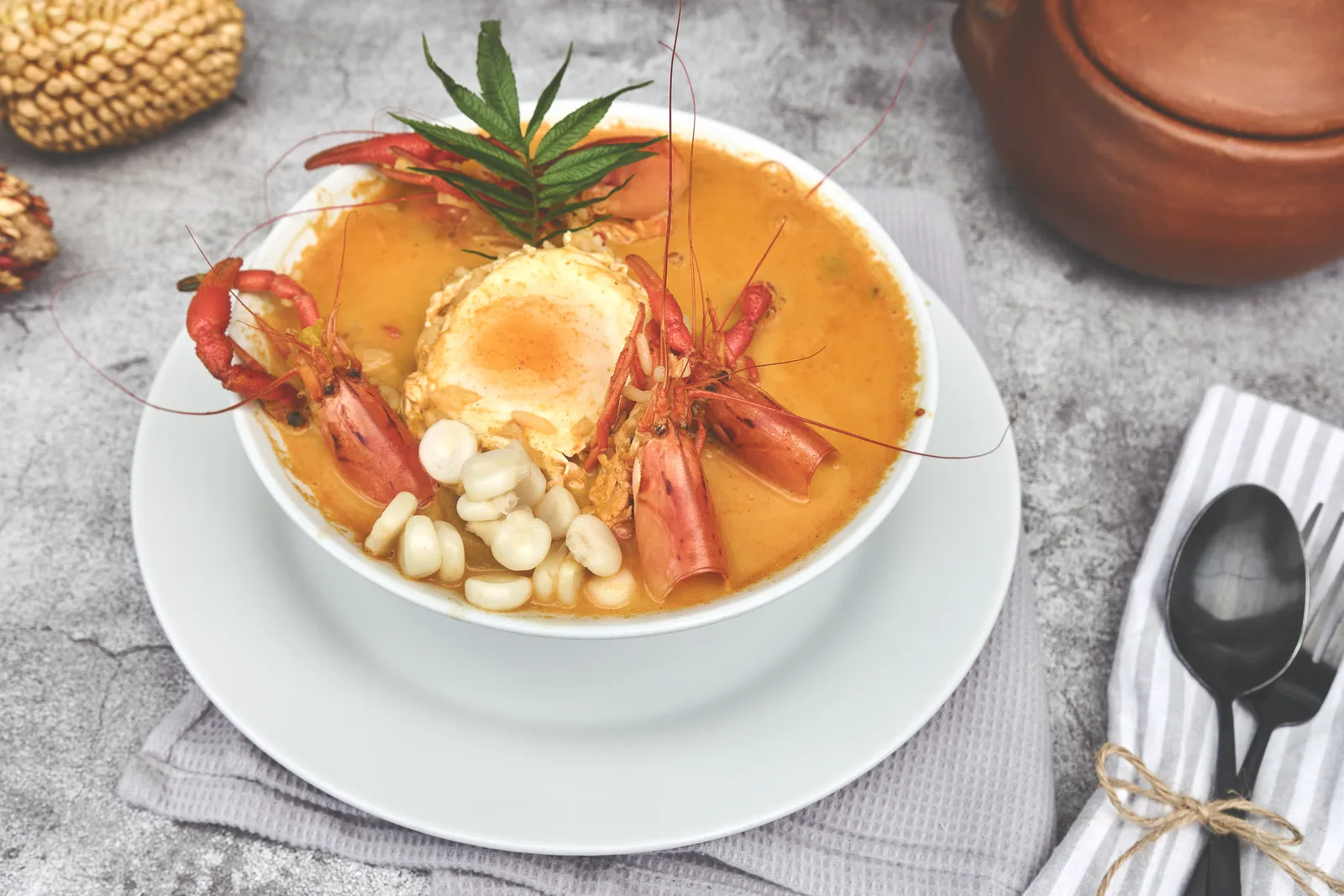

Chupe de camarones (CHOO-peh deh kah-mah-ROH-nehs) is the shrimp chowder of Arequipa, in southern Peru: a thick, orange soup of potato, rice, corn on the cob, fava beans and fresh cheese in a stock made from shrimp heads, colored with two Peruvian chiles, softened with a cup of evaporated milk and finished with an egg poached right in the pot. It eats like a full meal. The trick is that all the shrimp flavor goes into the stock early, while the shrimp meat itself only spends the last couple of minutes in the pot. Below is how to get both right with shrimp from a US or UK store.
What chupe de camarones is, and how long it takes
How do you make chupe de camarones? Toast the heads and shells from 1¾ lb (800 g) of shrimp and simmer them 20 minutes in 6⅓ cups (1.5 liters) of water. Strain that stock over a base of onion, garlic, aji panca and aji amarillo, and simmer rice, potato, corn, squash, fava beans and peas in it for 18 minutes. Over low heat add evaporated milk and queso fresco, then one egg per person, and the shrimp last, for 2 to 3 minutes. 85 minutes for 4 servings.
In Arequipa it’s made with river shrimp, a freshwater prawn from the rivers of Peru’s southern coast, and it’s a staple of the city’s traditional lunch houses, the picanterías. It’s not a New England chowder: there’s no flour, no cream and no bacon, and the broth is thinner, a spoonable soup rather than a thick bisque. The milk rounds off the chile, so it tastes of shellfish and fruity pepper with only mild heat.
If you know the Venezuelan chupe andino, that one is a chicken, corn and cream soup with the cheese at the bottom of the bowl. The Mexican shrimp soup is a red guajillo broth with no dairy or egg.
Total time 85 minutes: 25 to peel and chop, 60 at the stove, nearly half of it with the stock simmering untouched. Medium difficulty: nothing is technically hard, but the last 7 minutes need your attention.
Ingredients, with US and UK shopping notes
| Ingredient | Metric | US | Notes and UK swaps |
|---|---|---|---|
| Raw shrimp, head-on and shell-on | 800 g | 1¾ lb | UK: raw whole king prawns, usually frozen |
| Aji panca paste | 30 g | 2 tbsp | Latin shops and online; swaps below |
| Aji amarillo paste | 15 g | 1 tbsp | Same shelf as the panca |
| Yellow potatoes | 500 g | 1 lb 2 oz | Yukon Gold; UK: any yellow-fleshed boiling potato |
| Corn on the cob | 1 large ear | 1 large ear | Frozen Peruvian choclo in Latin shops |
| Butternut squash | 150 g | 5 oz | Any orange winter squash |
| Fava beans | 75 g | ½ cup | UK broad beans, frozen in most supermarkets |
| Evaporated milk | 240 ml | 1 cup | UK: sold in tins in supermarkets |
| Queso fresco | 150 g | 5 oz | UK: halloumi or paneer |
| Long-grain white rice | 100 g | ½ cup | Not risotto rice |
The shrimp, and why the heads matter
Peruvian river shrimp aren’t sold outside Peru. What you want instead is shrimp that’s raw and still has its head, because the heads are where the stock gets its color and depth.
- Head-on shrimp (US) or raw whole king prawns (UK). The best choice. Look in Asian and Latin markets and fishmongers, fresh or frozen. Asian markets sometimes carry whole frozen freshwater prawns, the closest thing to the Peruvian river shrimp.
- Headless, shell-on. Fine, with a milder stock from the shells alone.
- Peeled raw. No stock of its own: make the soup with 1.2 liters (5 cups) of low-sodium seafood or fish stock.
- Precooked. The weakest option. It adds nothing to the broth and toughens as soon as it heats up; if it’s all you have, add it in the final minute only.
Good raw shrimp smells mild and briny, never of ammonia, and the heads shouldn’t have black spots or fall off on their own. Thaw frozen shrimp overnight in the fridge in a colander set over a bowl, or in a sealed bag submerged in cold water, changing the water every 30 minutes. Never on the counter.
Aji panca and aji amarillo, and what to use instead
Both come as pastes in jars from Latin and Peruvian shops and online, and some US supermarkets carry them in the Hispanic aisle. Aji panca is a dried red chile with almost no heat that gives the soup its brick color; aji amarillo is a fruity yellow chile that brings most of the heat. In these amounts the soup is mildly spicy.
- No aji panca: 1 dried ancho or 2 guajillo chiles, stemmed and seeded, soaked 20 minutes in hot water and blended with a little of it. Ancho is earthier, guajillo tangier; the color is close.
- No aji amarillo: a quarter of a roasted, peeled yellow bell pepper blended with a small piece of yellow habanero or a quarter of a serrano. Similar color and heat, without the fruity flavor.
The same base and the same swaps go into Peruvian arroz con mariscos.
Everything else
- Potatoes. Peruvian yellow potatoes are floury and crumble a little at the edges, which is what thickens the broth. Some Latin shops sell them frozen; Yukon Golds are the closest fresh option.
- Corn. Peruvian choclo has big, chewy, not very sweet kernels. With ordinary sweet corn, the soup is sweeter and the corn cooks faster: add it with the peas, for 6 minutes.
- Queso fresco. You want a cheese that softens without turning stringy. Mozzarella and cheddar melt into threads; halloumi and paneer hold their shape.
- Evaporated milk. Whole milk makes a thinner, less creamy soup that splits more easily if it boils.
- Huacatay. A Peruvian herb with a strong minty, anise-like smell, sold as a paste in Peruvian shops. It’s optional; without it, parsley or cilantro (UK coriander) on top adds freshness.
Equipment. Two pots, one of at least 4 quarts (4 liters) with a lid, a large strainer and a ladle for pressing the heads.
A make-ahead game plan
The stock simmers on its own while you make the chile base, so the two overlap:
The night before, you can make the stock and the chile base and refrigerate them in covered containers, and peel the shrimp. On the day, dinner is about 30 minutes away: reheat the stock over the base, cook the vegetables, and do the finish.
How to make it, and what to look for
The stock. Toast the heads and shells 4 minutes over medium-high heat, mashing the heads with the spoon, until they turn bright red and smell like roasted shellfish. Don’t push the heat higher: burnt shells make a bitter stock. Add cold water, the onion quarter, the garlic and salt, and simmer 20 minutes from the boil. When you strain it, press the heads hard with the back of a ladle: an orange, thick juice comes out, the fat from inside the heads, and it carries most of the flavor. Measure: you need 1.2 liters (5 cups).
The chile base. Onion over medium heat, 7 to 8 minutes, until it’s soft enough to crush with the spoon and still pale. Garlic for a minute, then the chile pastes, cumin and oregano for 4 minutes. It’s ready when the oil turns red and starts to pool at the edge.
The vegetables. Pour in the stock hot, so it returns to a boil quickly and the potatoes cook evenly. Rice, potatoes, corn, squash and fava beans for 12 minutes with the lid ajar, then the peas for 6 more. A knife should slide through the potato with no resistance.
Thickness. It should be thick but still a soup, with broth covering everything. Too thick? Add hot water half a cup at a time. Too thin? Crush 2 or 3 potato chunks against the side of the pot.
The last 7 minutes, in order
- Low heat, until only small bubbles appear at the edge.
- Evaporated milk, cheese and huacatay, 2 minutes, stirring gently. Taste for salt now; the cheese and chile pastes are already salty.
- Eggs, each cracked into a cup first and slid onto the surface, spaced apart. Cover, 2 minutes.
- Shrimp, tucked between the eggs and pushed under. Cover, 2 to 3 minutes, then turn off the heat.
That gives the eggs 4 to 5 minutes covered, enough for set whites and soft yolks, and the shrimp just 2 to 3. Add the shrimp first and they get those extra 5 minutes, shrink and turn rubbery.
Shrimp doneness. Gray and translucent turns pink and opaque, pearly inside, and the shrimp curls into a loose C. A tight O means overcooked. With a thermometer, 145°F (63°C) in the thickest one.
Egg doneness. Whites firm and white, yolk wobbling when you nudge the pot. For young children, pregnant people or older adults, cook the yolks firm: give the eggs 4 minutes covered before adding the shrimp, then touch a yolk with a spoon at the end; if it still wobbles, give them 1 to 2 more minutes covered.
Troubleshooting
- Rubbery shrimp. They went in too early, or the soup boiled with them in it. Last in, 2 to 3 minutes, heat off.
- Grainy, curdled milk. It boiled hard after the milk went in. From then on, bubbles only at the edge. It still tastes fine, it just looks grainy.
- Flat stock. Heads not toasted, not simmered long enough, or not pressed. With peeled shrimp, buy a good seafood stock.
- Bitter stock. Scorched shells. Medium-high heat, 4 minutes, keep stirring.
- Soup turned to stew. The rice keeps swelling, especially if the pot waits. Thin with hot water right before the milk.
- Broken eggs. Cracking them straight into the pot breaks them. Use a cup and slide each one in gently.
- Too salty. Stock, chile pastes and cheese all add salt. Go easy early and adjust at the end.
Heat, kids and allergens. One tablespoon of aji amarillo makes it mildly spicy, and panca barely registers; pass hot sauce at the table for anyone who wants more. Most kids are happy with it, yolks cooked firm. It contains shellfish, egg and milk. It’s gluten-free if your chile pastes and stock are: check the labels.
Variations and cooking for a crowd
- Quick, with peeled shrimp and boxed stock. Skip the head stock and use 1.2 liters (5 cups) of hot, low-sodium seafood or fish stock over the chile base. About 50 minutes in all, with less shrimp flavor.
- With a fried egg on top. Some cooks fry the eggs separately and set one on each served bowl instead of poaching them in the pot. Tidier for many bowls.
- For 8 or 12. Double or triple the recipe in an 8 or 12 quart pot. The eggs won’t fit on the surface: poach them in a wide pan of barely simmering water for 3 to 4 minutes for soft yolks and set one on each bowl. The shrimp take a little longer in a big pot because they cool it down; count the 2 to 3 minutes from when the small bubbles return.
For a Peruvian meal, start with Peruvian ceviche, or make Arequipa’s other famous dish, rocoto relleno, another day. To drink, chicha morada, the purple corn drink.
Storing and reheating
Fridge. Refrigerate in a covered container within 2 hours of turning off the heat. It keeps 3 to 4 days, but I eat it within a day or two: shrimp and eggs suffer on reheating, and the rice drinks up the broth.
Freezer. I don’t freeze the finished soup: the potatoes go grainy, the milk separates and the shrimp dries out. Freeze the head stock instead, for 2 to 3 months, and make the chupe fresh. The stock keeps 2 days in the fridge.
Reheating. In a pot over low heat with ½ cup (120 ml) of water or stock, since it will have thickened, stirring, until steaming and 165°F (74°C) in the center. No hard boil, because of the milk. A reheated egg goes hard, so I serve leftovers with a freshly poached one.
Frequently asked questions
Can I use frozen shrimp? Yes, and outside Peru it’s the usual choice. Buy them raw, head-on if you can, thaw overnight in the fridge (or about 1 hour per pound, 450 g, in a sealed bag in cold water) and pat dry before peeling.
Is chupe de camarones the same as a seafood chowder? It’s close in spirit, a milky soup of potatoes, corn and shellfish, but it has no flour, cream or bacon. It’s thickened by potato and rice, colored and flavored with Peruvian chiles, and served with a whole egg in each bowl.
What’s the orange liquid that comes out of the heads? It’s the fat inside the shrimp heads. Pressing the heads in the strainer gets it into the stock, and it gives the soup its color and deep shellfish flavor.
Can I make it without the milk or the egg? Without the egg, yes; it’s just lighter. Without the milk it becomes a different dish, a shrimp and vegetable broth, without the creaminess that softens the chile.
Nutrition
Per serving (a quarter of the pot, with one egg), calculated ingredient by ingredient from the amounts above:
- Calories: 734 kcal
- Protein: 49 g
- Carbohydrates: 69 g
- Fat: 31 g, of which 11 g saturated
- Fiber: 6 g
- Sugars: 15 g
- Sodium: 1,180 mg
It’s a one-bowl meal: shrimp, cheese and egg supply the protein, and potato, rice and corn most of the carbs. Evaporated milk adds about 85 kcal per bowl and the queso fresco about 110. Store-bought chile pastes and boxed stock can push the sodium higher.
The habit that made the biggest difference in my kitchen was putting the eggs in before the shrimp, which feels backwards at first: the egg needs time and the shrimp needs almost none. And whenever I buy head-on prawns for something else, the heads go into a freezer bag for the next pot of stock. Josnaisis.