
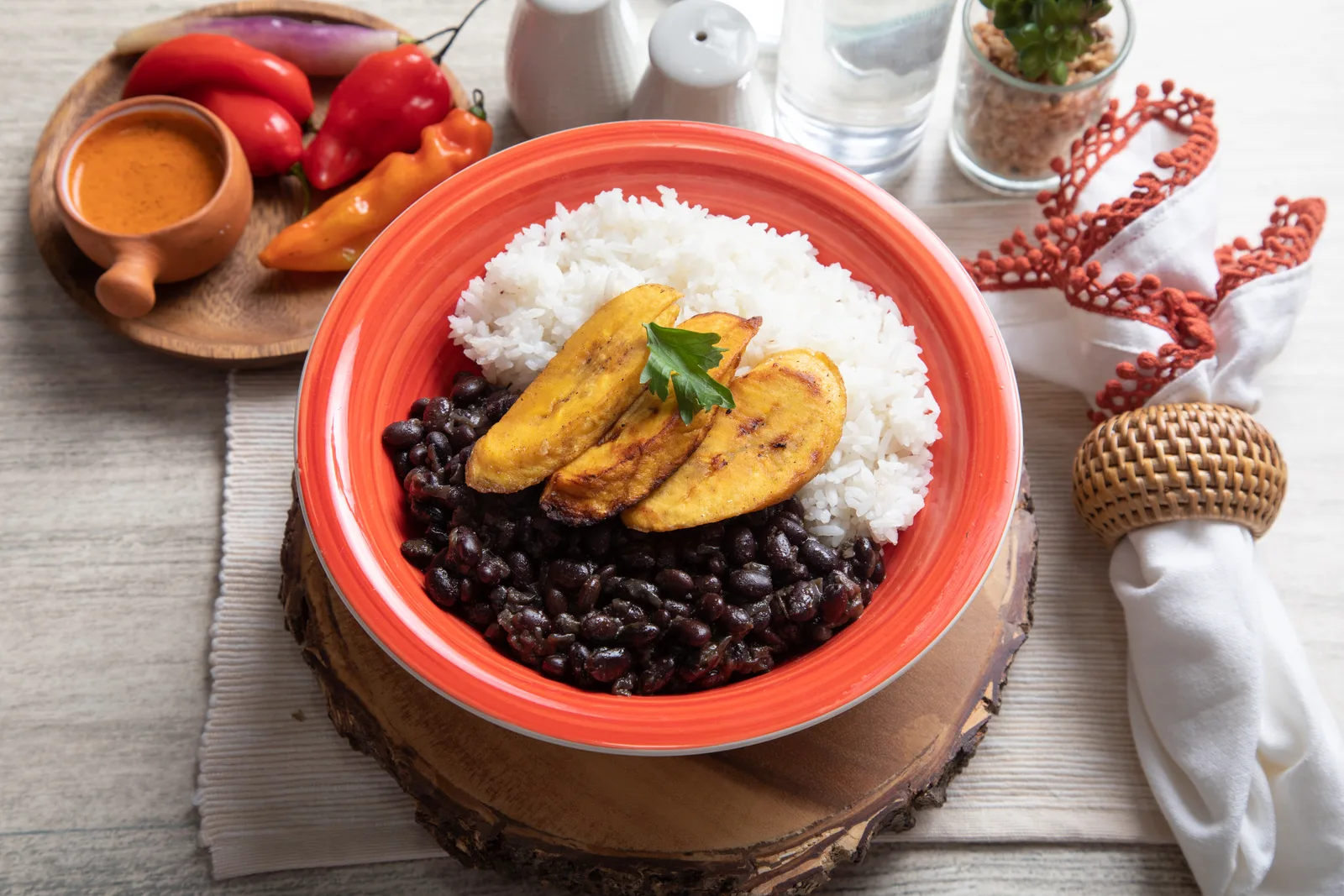

Cuban black beans, frijoles negros (free-HOH-lehs NEH-grohs), are simmered on their own for 60 to 90 minutes with half a green pepper and a bay leaf until tender, and only then get the sofrito, a cup of mashed beans to thicken the pot and, off the heat, a splash of vinegar with a little sugar. That order is what gives you whole beans in a thick, inky sauce rather than a soup or a mash. This recipe makes 6 servings from dried beans, with stovetop, pressure cooker and canned options, the overnight rest Cubans call “dormidos” (asleep), and fixes for beans that turn out watery or stay hard.
What Cuban black beans are, and how long they take
How do you make Cuban black beans? Soak 1 lb (500 g) of dried black beans overnight, then simmer them in 8½ cups (2 liters) of water with half a green pepper and a bay leaf for 60 to 90 minutes. Cook onion, pepper, garlic, cumin and oregano in olive oil, mash 1 cup of the beans into that sofrito, stir it back into the pot and simmer uncovered for 20 to 30 minutes. Finish with vinegar and sugar and rest 10 minutes. 130 minutes plus soaking, for 6 servings.
In Cuba this is everyday food: a ladle of beans in their thick black liquid spooned over plain white rice, next to whatever else is on the table. They taste of cumin, bay and sweet pepper, with a light tang from the vinegar that the sugar rounds off. They are not sweet and not spicy, which makes them an easy sell for kids.
They are different from Venezuelan black beans, which are noticeably sweet from panela, from Brazilian feijoada, a black bean stew loaded with pork cuts, and from Cuban congri, where the rice cooks inside the bean liquid.
Time. 2 hours 10 minutes with soaked beans, of which about 20 minutes is chopping and 30 is actual stirring; the rest is the pot simmering on its own. Add 8 to 12 hours of soaking the night before, or make the 30-minute canned version below. Difficulty: easy.
Ingredients, and what to buy in the US and UK
This makes 6 servings, about 3 oz (85 g) of dried beans per person; for 4, 12 oz (340 g) is enough.
- Dried black beans. Any US supermarket stocks them; in the UK, look for black beans or black turtle beans in large supermarkets, health food shops and Latin or Caribbean grocers. Buy a fresh-looking bag: old beans can stay tough after 2 hours of simmering. Skip any with dull, wrinkled or mostly broken beans.
- Ají cachucha. A small, wrinkled, aromatic pepper with no heat. It perfumes the sofrito, but the dish works without it. In the US you’ll find it fresh in Latin markets in areas with a Cuban or Puerto Rican community, sometimes labeled ají dulce. Otherwise, chop the whole green bell pepper into the sofrito and add half a Cubanelle (Italian frying pepper), which is thinner-skinned and milder than a bell pepper. In the UK, use the whole green pepper plus a little extra. You’ll lose a little aroma and gain a little sweetness.
- Vinegar. White, red wine or cider vinegar all work.
- Dry wine. Optional. Dry white wine or dry sherry adds depth; leave it out and the dish is still the same dish.
- Sugar. Just enough to balance the vinegar. These beans are not meant to taste sweet.
Equipment. A 5 to 6 quart (5 to 6 liter) pot with a lid, a medium skillet, a mortar and pestle (or crush the garlic with salt under the flat of a knife) and a fork or potato masher.
Soak or not, and stovetop, pressure cooker or slow cooker
- Soaked, stovetop. 8 to 12 hours in cold water, then 60 to 90 minutes at a gentle simmer. The beans cook evenly and few split. This is the method I recommend if you can plan a night ahead.
- Unsoaked, stovetop. It works, but takes about 2 hours or more, and some beans burst before others are done. Keep a kettle of hot water handy for topping up.
- Quick soak. Forgot to soak? Boil the beans in plenty of water for 2 minutes, turn off the heat, cover and leave for 1 hour. Drain and carry on as if they were soaked overnight.
- Pressure cooker or Instant Pot. Soaked beans: 10 to 15 minutes at high pressure with 5 cups (1.25 liters) of water. Unsoaked: 25 to 35 minutes with about 7 cups (1.75 liters). Either way, let the pressure release naturally for 15 minutes before opening. Never fill the pot more than halfway, since beans foam and can block the valve. Cookers vary: if the beans don’t squash easily when you open the lid, seal it and give them 5 more minutes. Then make the sofrito and finish them on the sauté setting or the stove.
- Slow cooker. Soak the beans, then boil them hard in a regular pot for 30 minutes first: a slow cooker doesn’t always reach a full boil, and undercooked dried beans can make you sick. Then 6 to 8 hours on low or 3 to 4 on high, with the sofrito in from the start. Keep the vinegar and sugar for the end, and check that the beans are tender before adding them, since every slow cooker runs differently.
How to tell they’re tender: scoop out three or four beans and blow on them. If the skins wrinkle and peel back, you’re close. Press one between thumb and finger: it should squash completely, with no hard or chalky center.
How to make Cuban black beans, step by step
Cooking the beans
The water gets nothing but half a pepper and a bay leaf. The sofrito, vinegar and sugar wait, because acid slows down how fast bean skins soften and can leave them hard after an hour of simmering. Keep it at a low simmer with the lid ajar: a rolling boil splits the beans and loosens the skins. Never pour off the cooking liquid. It is half the dish.
The sofrito
Pounding the garlic with the salt makes a paste that spreads through the pot with no chunks. Onion, pepper and ají cook over medium heat for 8 to 10 minutes, until the onion is translucent and soft but not browned. Garlic and spices go in last for 1 minute, because cumin and garlic scorch fast and turn bitter.
Mash a cup to thicken
The Cuban trick is 1 cup of cooked beans mashed right in the skillet with the sofrito. The sofrito binds with the starch from the beans, and back in the pot it thickens all the liquid without flour or cornstarch. For creamier beans, mash another half cup at the end.
Simmer uncovered until thick
20 to 30 minutes over low heat, uncovered, stirring from the bottom, because the mashed beans settle and catch. They’re ready when the liquid turns from dark gray to glossy black, coats the back of a spoon, and a line drawn across the bottom of the pot closes slowly. They thicken a lot as they cool, so stop when they’re a little looser than you want them on the plate.
Vinegar, sugar and rest
Vinegar and sugar go in with the heat off. Taste: if the vinegar hits hard, add a pinch more sugar; if the beans taste flat, they need salt or a few more drops of vinegar. A drizzle of olive oil and 10 minutes covered finish them.
Frijoles dormidos, the overnight rest
“Dormidos” means asleep: beans left to rest after cooking, ideally overnight in the fridge. The liquid thickens, the cumin and bay settle in and the vinegar mellows. It’s the reason to cook them the day before a dinner with guests.
To rest them safely, spread them into shallow containers so they cool fast and refrigerate within 2 hours. By the next day they’ll be nearly set. Reheat over low heat with ½ cup (120 ml) of water for every 4 servings, stirring, until they loosen and come to a boil.
What goes wrong, and how to fix it
- Still hard after 2 hours. Old beans, very hard water or vinegar added too early. Keep simmering and topping up the water; next time, buy fresher beans. In hard water a pinch of baking soda in the cooking water helps, ½ tsp at most for 1 lb of beans: more and the beans taste soapy and fall apart.
- Soupy. Too much water or not enough time uncovered. Mash another ½ cup and simmer 10 minutes more with the lid off.
- Mushy or pasty. Over-reduced or boiled hard. Stir in hot water gently; next time, keep the heat low.
- Scorched on the bottom. The mashed beans sink. Stir from the bottom every 5 minutes; if they catch, move them to a clean pot without scraping up the burnt layer.
- Flat-tasting. They need salt or vinegar. Adjust off the heat, a little at a time.
- Split beans and loose skins. A rolling boil, or unsoaked beans.
Heat, kids and allergens. Not spicy: ají cachucha and bell pepper are sweet peppers. They are free of gluten, dairy and eggs. The wine contains sulfites, so leave it out for anyone sensitive.
Shortcut, variations and cooking for a crowd
Canned black beans in 30 minutes
For 4 servings, use two 15 oz (425 g) cans of plain black beans with their liquid (in the UK, two 400 g tins). Cook a sofrito of 2 tbsp olive oil, ½ onion, ½ green pepper and 3 garlic cloves for 5 to 7 minutes. Add ½ tsp cumin, ½ tsp oregano and 1 bay leaf, mash ½ cup of the beans in the skillet, then tip everything into a saucepan with the rest of the beans and ½ cup (120 ml) water. Simmer 15 to 20 minutes on low, turn off the heat and finish with 1 tbsp vinegar and 1 tsp sugar. Taste before salting, because canned beans are already salted.
They’re good for a weeknight, though they lack the deep, dark liquid of beans cooked from dried.
Variations
- With bacon or ham. Brown 3½ oz (100 g) diced bacon in the skillet before the sofrito and use its fat for half the oil. Smokier and richer, and no longer vegetarian.
- Brothy, as a soup. Leave in an extra 2 cups (500 ml) of liquid and skip the mashing. Serve in bowls with rice on the side.
- For 12. Double everything: 2¼ lb (1 kg) beans, 4 liters (about 4 quarts) of cooking water and an 8 to 10 quart pot. Make the sofrito in a large skillet or in two batches, and allow 20 to 30 minutes more to thicken, since there’s more liquid to reduce.
- For 20. 3¾ lb (1.7 kg) of dried beans, split between two pots. Cook them the day before and reheat: rested beans taste better, and your stove is free on the day.
Serving with rice, congri vs moros, storing and reheating
Serving. Spoon them over or beside fluffy white rice, with a drizzle of olive oil and, if you like, chopped raw white onion on top. They belong next to ropa vieja, Cuban roast pork, yuca with garlic mojo and crispy tostones or sweet fried plantains. Plan on 1 cup of cooked rice per person.
Beans with rice, congri and moros. This recipe is beans served alongside the rice. In congri, the rice cooks in one pot with the sofrito and the bean liquid, and the classic version in eastern Cuba uses small red beans. Made the same way with black beans, it’s usually called moros y cristianos, though plenty of Cuban families call that congri too: the names vary across the island. The rice-to-liquid ratios are in the congri recipe linked above.
Fridge. Refrigerate in a sealed container within 2 hours, at 40°F (4°C) or below. They keep 3 to 4 days and are better on day two.
Freezer. Up to 3 months, in portions with their liquid, leaving ¾ in (2 cm) of headspace since the liquid expands. Thaw overnight in the fridge.
Reheating. In a pot over low heat with a splash of water, stirring, until they boil and are hot through, 165°F (74°C). In the microwave, covered, in 1-minute bursts with a stir in between, because the thick liquid splatters.
Frequently asked questions
Does salt make beans tough? No, although it’s a common belief. I add the salt with the sofrito, once the beans are tender, simply because the liquid reduces for half an hour and it’s easier not to overdo it. What really slows softening is acid: vinegar, tomato or citrus.
Should I discard the soaking water? Yes. Drain and cook in fresh water; the soaking water carries dust and some of the sugars that cause gas. The cooking water, on the other hand, always stays.
Why do Cuban black beans have sugar in them? To balance the vinegar. At 2 tsp for 6 servings they don’t taste sweet. If you want properly sweet black beans, that’s the Venezuelan style with panela.
What’s the difference between Cuban and Mexican black beans? Mexican frijoles de olla are usually simmered with onion, garlic and often epazote, then served brothy or refried, with no vinegar finish. Cuban black beans get a cumin and oregano sofrito, are thickened by mashing a cup of beans and finished with vinegar and sugar.
Nutrition
Per serving (3 oz / 85 g dried beans with their share of sofrito and liquid, no rice), worked out ingredient by ingredient from the quantities above:
- Calories: 444 kcal
- Protein: 19 g
- Carbohydrates: 59 g
- Fat: 15 g, of which 2 g saturated
- Fiber: 14 g
- Sugars: 5 g
- Sodium: 590 mg
The beans bring about 284 kcal per serving and the olive oil about 121. For a lighter pot, cut the sofrito oil to 2 tbsp and skip the final drizzle: about 365 kcal. A cup of cooked white rice adds about 200 kcal.
I grew up on Venezuelan caraotas sweetened with panela, and these taught me something different: here the flavor comes from the vinegar at the end, with just enough sugar to soften its edge. I make them the day before and put a couple of portions in the freezer before serving, because reheated they’re thicker, and that’s how I like them best. Josnaisis.