
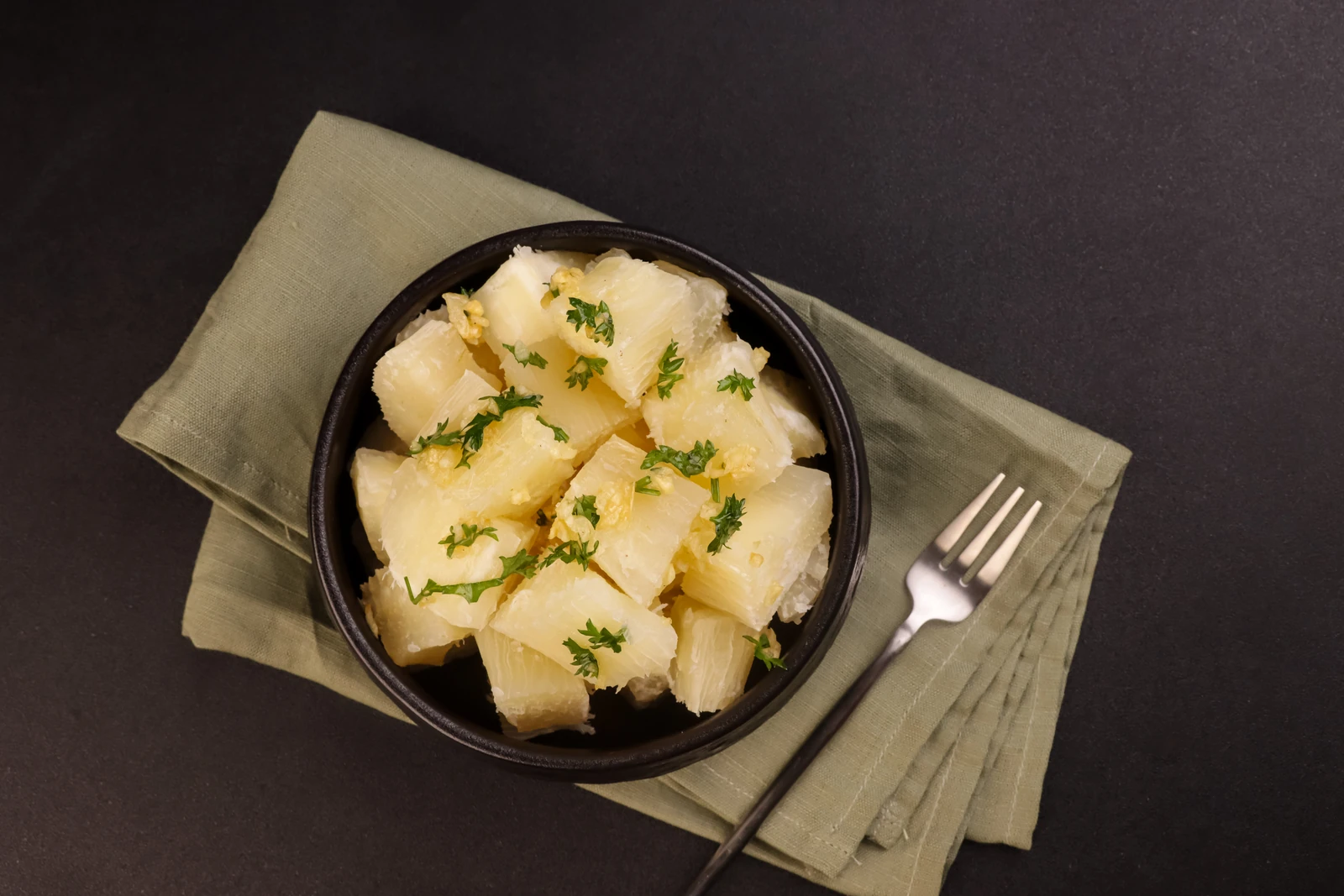

Yuca con mojo (YOO-kah kohn MOH-hoh) is boiled cassava root, simmered about 25 minutes until the pieces crack open along the edges, then flooded with a hot sauce of olive oil, garlic, onion and sour orange juice. In Cuban homes, from Havana to Miami, it shares the Christmas Eve table with roast pork and rice and beans, and it works as an everyday side the rest of the year. Think of a starchier, denser, slightly sweeter potato, with a sharp garlicky dressing that soaks right in. Here’s how to buy, peel and boil yuca safely, fresh or frozen, how to make the mojo, what to use if you can’t find sour oranges, and how much to cook for a crowd.
What yuca con mojo is, and how long it takes
How do you make Cuban yuca with garlic mojo? Peel 2¼ lb (1 kg) of yuca, boil it in salted water for about 25 minutes from the boil, until a knife slides in and the pieces split open, and pull out the woody core. Soften an onion in ½ cup (120 ml) of olive oil, add mashed garlic and ½ cup of sour orange juice, and pour the hot mojo over the hot yuca. 75 minutes for 6 servings.
Time. 75 minutes in all, but only about 30 of them hands-on: 15 to peel, 10 for the mojo, 5 to core. Frozen yuca skips the peeling.
Difficulty. Easy. The only thing that takes attention is knowing when the yuca is done.
Yuca, not yucca. Yuca is the starchy root also sold as cassava or manioc, the same plant tapioca comes from. Yucca, with two c’s, is an ornamental desert plant. US stores often mislabel one as the other; you want the long, brown, bark-skinned root.
Mojo is the Cuban garlic and sour orange sauce. The same family of sauce marinates Cuban lechon asado, roast pork with sour orange mojo, and the serving mojo in that recipe is the one used here, with more onion, cooked longer, because here you eat it. It’s not the Mexican mojo de ajo of Mexican garlic shrimp, where garlic is slowly toasted in fat and finished with lime.
Ingredients and what to buy in the US or UK
For 6 side servings, about 6 oz (165 g) of peeled yuca per person:
| Ingredient | Metric | US | Notes |
|---|---|---|---|
| Fresh yuca root | 1.25 kg | 2¾ lb | Peels down to 1 kg (2.2 lb) |
| or frozen yuca pieces | 1 kg | 2.2 lb | Already peeled; Latin freezer aisle |
| Garlic | 24 g | 8 cloves | Fresh, not jarred |
| White onion | 150 g | 1 medium (5 oz) | Yellow onion works |
| Olive oil | 120 ml | ½ cup | Or a neutral oil, see below |
| Sour orange juice | 120 ml | ½ cup | Or orange plus lime, see below |
| Salt | 12 g + 3 g | 2 tsp + ½ tsp | Water, then mojo |
Fresh or frozen yuca
Fresh root. Look in the produce section of many US supermarkets under yuca or cassava; in the UK, in Caribbean, African, Asian and Latin grocers. It’s usually waxed to keep longer, which is normal. Pick roots that are hard and heavy for their size, with unbroken skin. If a cut end is visible, the flesh should be evenly white or cream. Blue-black streaks mean the root is old, and it will never turn tender no matter how long you boil it.
Frozen pieces. Peeled and cut, in 24 oz (680 g) and 5 lb bags in the US Latin freezer aisle, and in African and Caribbean shops in the UK. For this dish they’re as good as fresh, and they’re what I use for a crowd. They go into already-boiling water without thawing and take 20 to 30 minutes. They still have the woody core, so you’ll pull that out after boiling.
Sour orange, and what to use instead
Sour orange (naranja agria) is the Seville orange: tart as a lime, with a bitter, perfumed edge.
- US. Fresh in Latin and Caribbean grocers, and bottled sour orange juice is in the Hispanic aisle year-round.
- UK. Seville oranges are in the shops in January and February for marmalade. Juice a few and freeze the juice in ice cube trays for Christmas.
- Anywhere, my go-to swap: 2 parts orange juice to 1 part lime juice, ⅓ cup plus 2½ tbsp (80 + 40 ml) here. A little sweeter and less fragrant than the real thing, with the sharpness the sauce needs.
- Lemon or lime alone is sharper and loses the orange note. If that’s all you have, use ⅓ cup (80 ml) and taste.
- Orange juice alone gives a sweet, flat sauce. I wouldn’t.
Oil. Olive oil gives the classic flavor. A neutral oil like canola or sunflower lets the garlic and citrus come through more and works fine.
Equipment. A pot of at least 5 quarts (5 liters), a sharp paring knife, a small saucepan, a mortar and pestle if you have one, and a deep serving dish with a lid or a plate to cover it.
Is yuca safe to eat?
Yes, peeled and fully cooked. Raw cassava contains natural compounds that can release cyanide, so it’s never eaten raw. The yuca sold for cooking is usually the sweet kind, which is low in them, and three steps already built into this recipe make it safe: peel off all the brown skin and the pink layer beneath it, boil until completely tender, about 25 minutes for fresh pieces, and pour the cooking water away. If a piece is still hard and chalky white in the center, it isn’t done; if it won’t soften with more time, or the flesh has dark streaks, don’t serve it.
Peeling and boiling, step by step
Peel with a knife, not a peeler. Cut the root into 2½-3 in (6-7 cm) sections so they stand up on the board. Slice once down the length through the bark, then work the knife tip under the edge: the brown skin and the thick pink layer come away in one sheet. A vegetable peeler leaves the pink layer behind.
Start fresh yuca in cold salted water. It heats up with the water, cooks more evenly and takes in salt from the start. Count about 25 minutes from the boil for 2½-3 in pieces; very fresh roots are quicker, older ones slower.
How to tell it’s done
- A knife slides into the center with no resistance.
- The pieces start to split open along the edges, as if cracking lengthwise.
Don’t wait until it falls apart. Overcooked yuca crumbles when you core it and turns to mush in the sauce. Lift out pieces as they’re ready and leave the rest.
Pull out the core. Every piece has a tough string through the middle, like a piece of twine. It’s harmless but unpleasant to bite. While the yuca is hot, split each piece lengthwise and the string pulls out in one go.
Making the garlic mojo
Garlic mashed with salt. In a mortar the salt grinds the garlic into a smooth paste in about a minute, so it spreads over every piece. Minced works, but leaves bits.
Onion first, 4 to 5 minutes in the oil over medium heat, until soft, translucent and bending. Browned onion makes the sauce taste of fried onion rather than garlic and orange.
Garlic, 30 to 60 seconds. Just enough to take off the raw edge. If it turns golden it goes bitter, so pull the pan off as soon as it looks straw-colored.
Juice off the heat. It sputters when it hits hot oil; pour slowly and stand back. Taste: it should be tart, salty and very garlicky.
Hot on hot. Freshly drained yuca soaks up the sauce. Cold yuca doesn’t, and the oil just pools in the dish. That’s why the mojo goes back on the heat for a minute before you pour it, and why the dish rests 10 minutes covered.
Common problems
- The yuca won’t soften. It was an old or streaky root. Longer boiling won’t fully fix it: serve the pieces that are tender and discard the hard ones. Next time check the flesh, or buy frozen.
- It fell apart. Overcooked, or pieces of very different sizes. Start checking at 20 minutes and take each piece out when it’s ready.
- Bitter mojo. The garlic browned. Medium heat, 30 to 60 seconds.
- Tastes oily, not tangy. Cold sauce on cold yuca, or yuca that wasn’t drained well and watered down the juice.
- Too sour. Sour orange plus lemon, or lemon alone. Stick to one citrus, at the amount given.
Allergens and kids. Free of gluten, dairy, egg and nuts, and not spicy at all. Kids usually like the soft yuca; the mojo is very garlicky, so I give them the yuca with a little oil and onion and leave the garlic at the bottom of the pan.
Make-ahead and Christmas Eve for a crowd
At a Cuban Nochebuena (Christmas Eve) yuca con mojo sits beside the pork and a pot of Cuban congri, rice cooked with red beans, or moros y cristianos, its black bean cousin. Plan on 6 oz (165 g) of peeled yuca per person when there’s meat, rice and beans too.
| People | Fresh yuca | or frozen | Mojo |
|---|---|---|---|
| 6 | 2¾ lb (1.25 kg) | 2.2 lb (1 kg) | the recipe |
| 12 | 5½ lb (2.5 kg) | 4.4 lb (2 kg) | double |
| 20 | 9 lb (4.1 kg) | 7¼ lb (3.3 kg), about 1½ five-pound bags | triple, then taste |
For 12 or more, use two pots or boil in batches. Too much yuca in one pot takes ages to come back to the boil, and the bottom pieces overcook before the top ones are done.
The day before.
- Boil and core the yuca, then refrigerate it, without the mojo, in a covered container.
- Make the mojo and keep it in a sealed jar in the fridge. Take it out an hour ahead, as olive oil thickens when cold.
On the day. Drop the yuca into a pot of boiling, lightly salted water for 3 to 5 minutes, until hot in the center, and drain. Bring the mojo back to a bubble, pour it over, cover for 10 minutes and serve.
Keeping it warm. Covered, in the oven at its lowest setting, about 200°F (95°C), for up to an hour. Longer than that and the top dries out. Don’t leave it out of the fridge for more than 2 hours in total.
When I’m also roasting a pork shoulder, the yuca goes on during the last half hour, while the meat rests.
Storing, reheating and leftovers
Fridge. 3 to 4 days in a covered container at 40°F (4°C) or below, as long as it goes in within 2 hours of cooking. The mojo on its own keeps no more than 4 days in a sealed jar in the fridge: garlic in oil is not something to leave at room temperature, even with citrus.
Freezer. Freeze the boiled, cored yuca without the mojo for up to 3 months. I don’t freeze it dressed; I make the mojo fresh when I serve it.
Reheating. In a covered skillet over medium-low with 2 or 3 tbsp of water, 5 to 8 minutes, turning gently, until steaming in the center. In the microwave, covered, in 1-minute bursts. Reheated yuca is a little firmer and drier than on day one; a splash of olive oil and a squeeze of orange bring it back.
Turning leftovers into yuca fries
The best thing that can happen to Christmas Eve leftovers. Cold yuca from the fridge cuts cleanly:
- Set the onions aside and pat the pieces dry with paper towels. The citrus in the mojo makes hot oil spit.
- Cut into sticks about ¾ in (2 cm) thick.
- Fry in batches at 350-355°F (175-180°C) for 5 to 7 minutes, until golden and crackly. In an air fryer, 400°F (200°C) for 15 to 20 minutes, shaking the basket.
- Warm the onions in the leftover mojo and spoon them over.
Timing, oil and the oven version are all in my fried yuca recipe. If your family knows yuca from the Colombian coast instead, the Colombian bollo de yuca takes boiled yuca in a completely different direction, ground and steamed in corn husks.
Yuca con mojo FAQ
Can I use bottled mojo criollo? Bottled mojo criollo is a ready-made meat marinade that already contains salt, and it doesn’t give you the hot oil that makes this sauce. If you use it in place of the juice, follow the recipe as written, leave out the ½ tsp salt in the mojo and taste at the end.
Is it served hot or cold? Hot or warm. Cold, the olive oil firms up and the yuca turns dense. Leftovers are better reheated or fried.
What else goes with it, besides Christmas pork? Roast chicken, grilled pork chops, or Cuban ropa vieja, shredded beef in tomato and pepper sauce with white rice and black beans. It also soaks up the sauce of a Puerto Rican carne guisada, beef stewed in sofrito with olives. If you like two starches on one plate, it also sits well next to twice-fried tostones.
How many calories are in yuca con mojo? About 450 kcal a serving with all the mojo, roughly a third of it from the olive oil. Leave the oil at the bottom of the dish and it drops a lot.
Nutrition per serving
Per serving (one sixth of the recipe: about 6 oz / 165 g peeled yuca with its share of mojo), calculated ingredient by ingredient from the amounts above:
- Calories: 450 kcal
- Protein: 3 g
- Carbohydrates: 69 g
- Fat: 18 g, of which 3 g saturated
- Fiber: 4 g
- Sugars: 5 g
- Sodium: 220 mg
The yuca accounts for about 267 kcal and the olive oil about 159; garlic, onion and juice make up the rest. The sodium counts the salt in the mojo only. Some of the salt from the cooking water ends up in the yuca too.
I grew up in Venezuela with boiled yuca next to grilled meat, and I only learned Cuban mojo when I made lechon for the first time. One taste of yuca soaked in that garlic and orange oil and I understood why no Cuban Christmas table goes without it. These days I nearly always use frozen yuca, and I keep a few pieces back without sauce on purpose, because Dylan prefers them fried the next day. Josnaisis.