
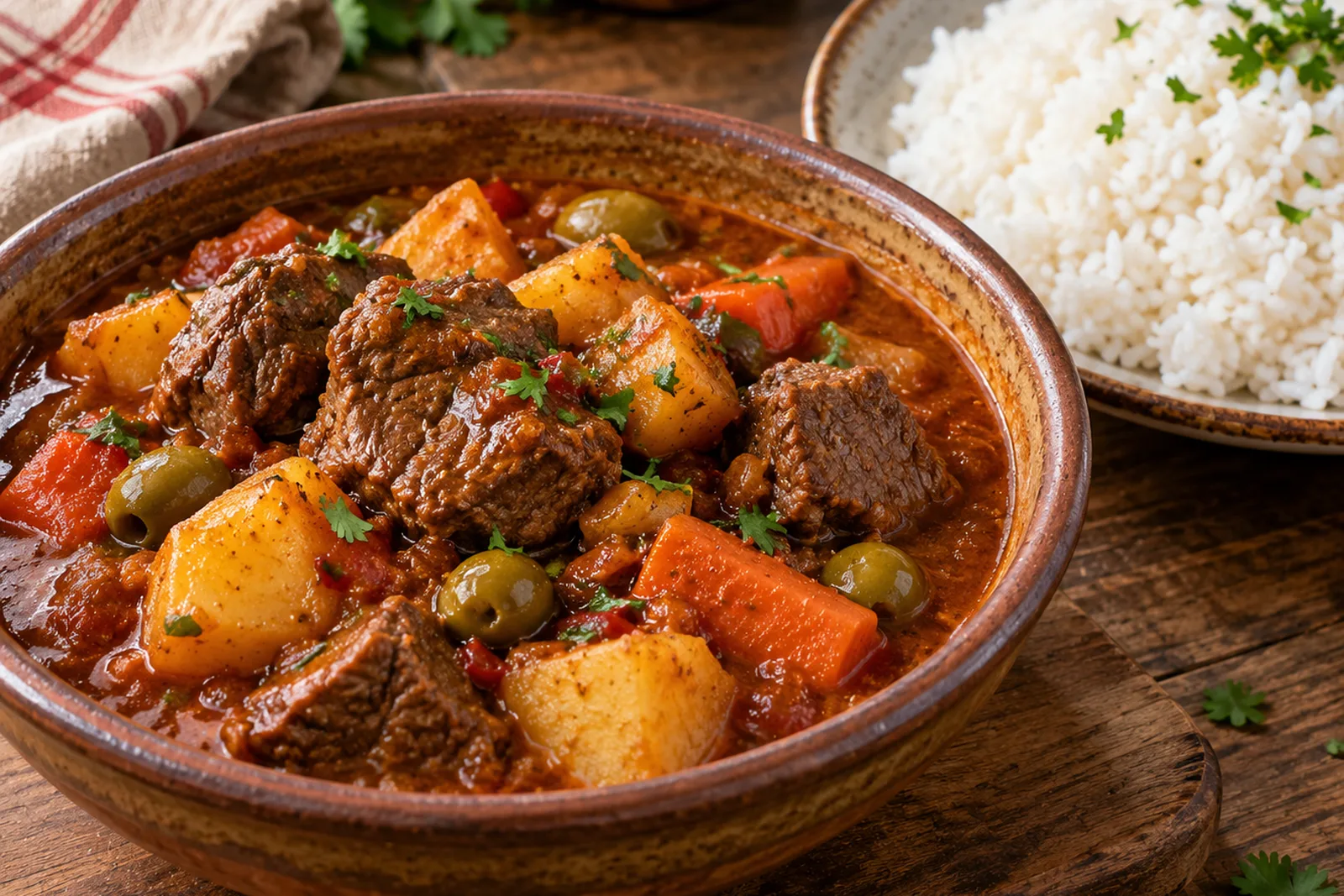

Carne guisada (KAR-neh ghee-SAH-dah) means stewed beef, and in Puerto Rico it’s the everyday version: 2.2 lb (1 kg) of chuck in 1¼-inch cubes, browned and simmered for 1½ hours in green sofrito, annatto sazón and tomato sauce, with potatoes, carrots and olives added for the last half hour. It’s mild, a little tangy from the olives, and always served over white rice. If you searched “carne guisada recipe” and expected the Texas version, the difference is explained below. This is the island stew, made on the stovetop or in a pressure cooker.
What Puerto Rican carne guisada tastes like
How do you make Puerto Rican carne guisada? Brown 2.2 lb (1 kg) of chuck cubes in three batches, cook an onion and ½ cup of sofrito with a packet of sazón, add an 8 oz can of tomato sauce, bay leaves and 2½ cups (600 ml) of water, and simmer covered on low for 1½ hours. When a fork slides into the beef, add 1.1 lb (500 g) of potatoes, 7 oz (200 g) of carrots and olives, and cook 25 to 30 minutes more. 160 minutes for 6 servings.
Think of an American beef stew, then swap the thyme and red wine for an herbal green base of culantro, sweet peppers and garlic, tint the sauce orange-red with annatto, and add olives and capers. The beef ends up in whole chunks that fall apart under a spoon, and the sauce is thick enough to cling to rice without pooling on the plate. It isn’t hot at all.
The same dish is cooked all over the Dominican Republic, with a citrus-and-oregano marinade and a drier finish; that version is further down.
Time and difficulty. 2 hours 40 minutes on the stovetop: 20 minutes of chopping, about 25 of browning and sautéing, and close to two hours of mostly hands-off simmering. A pressure cooker gets it on the table in a little under 2 hours. Easy, as long as you judge the beef by feel rather than the clock.
Puerto Rican vs. Tex-Mex carne guisada
Both start with cubes of chuck and a slow simmer, and both are called carne guisada; the similarity ends there. In the Puerto Rican pot, ½ cup (120 g) of green sofrito does the work that cumin and chili powder do in Texas.
| Puerto Rican | Tex-Mex | |
|---|---|---|
| Flavor base | Green sofrito, annatto sazón, adobo | Cumin, chili powder, garlic, sometimes jalapeño |
| Sauce | Tomato sauce, thickened by the potatoes | Brown gravy, usually thickened with flour |
| In the pot | Potatoes, carrots, olives or alcaparrado | Usually beef only, sometimes bell pepper and tomato |
| Heat | None | Mild to medium |
| Served with | White rice, beans, tostones | Flour tortillas or rice |
On this site, two more beef stews sit close to this one. Colombian carne sudada is braised in a tomato and scallion hogao with potatoes and cassava, no olives, and Mexican carne con papas simmers in a tomato and serrano sauce with real heat. Cuban ropa vieja is a different idea altogether: shredded beef with strips of bell pepper, cumin and wine.
Ingredients, with US and UK swaps
Each serving gets about 165 g (6 oz) of raw beef plus plenty of sauce for the rice.
The beef
- Chuck roast, the one in the recipe. In the UK, ask for chuck steak or braising steak. It’s marbled and full of connective tissue, which melts into gelatin over a long, gentle simmer: the beef turns tender and the sauce thickens. Buy it in one piece and cube it yourself.
- Pre-cut stew meat. Fine if it’s cut from chuck. Ask, because packs sometimes mix in lean leg trimmings that dry out.
- Shank. More gelatinous and very flavorful, but it needs about 2 hours before the vegetables go in.
- Round (top or bottom round, UK topside or silverside). Too lean for a long braise: it ends up firm and dry. If it’s all you have, cut it smaller, ¾ inch (2 cm), and start testing at the 1-hour mark.
Sofrito, sazón and adobo
These three are the flavor of the dish, and the one you’re most likely to be missing is sofrito.
- Sofrito or recaito. Puerto Rican sofrito is green: culantro, ají dulce peppers, onion, green pepper and garlic, blended. The homemade version, which makes about 1½ cups and freezes in ice cube trays, is in the Puerto Rican arroz con gandules recipe along with a homemade sazón. In jars, buy green recaito; the red jarred “sofrito” is tomato-based and tastes different. If you can’t find either, blend ½ onion, ½ green bell pepper, 3 garlic cloves and a handful of cilantro: the stew still works, with less of the herbal aroma.
- Sazón with coriander and annatto. A 5 g packet gives the orange-red color and a good amount of salt. US supermarkets stock it in the Hispanic aisle; in the UK, look in world food aisles, Caribbean shops or online.
- Adobo. An all-purpose seasoning salt with garlic, oregano and pepper. The recipe uses a homemade mix so you control the salt; if you use jarred adobo, add no more salt until you taste at the end.
Tomato sauce, olives and vegetables
- Tomato sauce here means the plain, unseasoned canned kind sold in 8 oz cans in the US, not ketchup or pasta sauce. In the UK, use passata, the same cup.
- Alcaparrado is a jarred mix of manzanilla olives, pimientos and capers. Pimento-stuffed green olives with a teaspoon of capers are an exact enough stand-in, and plain green olives are fine too.
- Potatoes. A waxy or all-purpose potato holds its shape: Yukon Gold or red in the US, Charlotte or Maris Peer in the UK. Russets and floury potatoes such as Maris Piper break down at the edges and thicken the sauce more; if you like it that way, use them and cook 5 minutes less.
- Carrots, in thick ½-inch (1.5 cm) rounds so they’re tender at the same time as the potatoes.
Equipment. A heavy 5-quart (5-liter) pot with a lid, such as a Dutch oven. In a thin pot the bottom sticks: stir more often and use the lowest heat that keeps a simmer.
How to make carne guisada step by step
Brown the beef in batches
Dry beef, hot oil and 3 batches. Put all 2.2 lb in at once and the pot cools, the meat releases water and it steams instead of browning. Give each batch 4 to 5 minutes, about 15 in all, and leave it alone until it releases from the pot by itself. The browned film on the bottom is where the sauce gets its color and depth, so don’t wash it out: the onion lifts it.
Build the base
Onion for 4 minutes over medium heat, then sofrito for 3 to 4 more, until it stops smelling raw and most of its liquid has cooked off. Sazón for just 30 seconds: annatto and the other spices in the packet scorch fast and turn bitter. Tomato sauce for 2 minutes to cook off the canned taste.
The braise, and how to tell the beef is tender
Once the water is in, bring it to a boil, then low heat and the lid on: you want slow, lazy bubbles. A hard boil toughens the outside of the beef before the inside softens, and reduces the sauce too fast.
Chuck goes through a firm stage, around the 30-minute and 1-hour marks, when it seems like it will never soften. That’s normal. At about 1½ hours it turns: poke one cube with a fork and press another against a plate with a spoon. It’s ready for the vegetables when the fork slides in with little resistance and the cube splits, even if it still holds together. If it bounces back or feels rubbery, give it 15 minutes more and test again. Cube size and the piece of beef shift the timing either way, so trust the fork over the clock.
Vegetables and the right thickness
With the lid ajar, 1¼-inch potato cubes and the carrots need 25 to 30 minutes, and the sauce reduces while they soften. Add them at the start and by the time the beef is tender the potatoes have turned to mush.
The finished sauce should coat a spoon and run off slowly, not be brothy or pasty. Over rice it settles between the grains instead of flooding the plate.
- Too thin. Mash 3 or 4 potato cubes against the side of the pot and stir. If it needs more, simmer 10 minutes uncovered over medium heat.
- Too thick or catching on the bottom. Hot water from the reserve, 2 tablespoons at a time.
- Allow for resting. It thickens a lot as it cools, so if you’re serving it later, leave it a little loose.
Instant Pot or stovetop pressure cooker
Pressure speeds up the beef, not the potatoes. Follow steps 1, 2 and 3 in the pressure cooker pot itself, then:
- Instant Pot or electric pressure cooker. Brown and sauté on the Sauté setting, then scrape the bottom well before sealing so you don’t get a burn warning. Add the beef, bay leaves and only 2 cups (480 ml) of water, since nothing evaporates under pressure. Cook 25 minutes at high pressure and let it release naturally for 10 minutes.
- Stovetop pressure cooker. Same 2 cups (480 ml) of water. Once it reaches pressure, turn the heat to low and cook 20 minutes, then let the pressure drop on its own, about 10 minutes.
- Test the beef with the same fork check. If it’s still firm, seal it for 5 more minutes.
- Vegetables with the lid off. Add potatoes, carrots and olives and cook 20 to 25 minutes on Sauté or over medium-low, uncovered, until the potatoes are tender and the sauce has thickened. Under pressure they fall apart before the sauce has a chance to reduce.
What goes wrong, and how to fix it
- Tough beef. It almost always needed more time, not less. Keep going in 15-minute stretches on low and test.
- Dry, stringy beef. A lean cut like round, or the pot boiled hard. Use chuck and the lowest heat.
- Pale sauce, gray meat. The beef went in all at once or was wet. Small batches, dry meat.
- Too salty. Adobo, sazón, jarred sofrito and olives all bring salt, so salt only at the end. If it’s already too salty, add another cubed potato and ½ cup (120 ml) of water and cook 20 minutes.
- Mushy potatoes. They went in too early, were very floury, or boiled hard. 1¼-inch cubes, last half hour only.
- Scorched bottom. Thin pot or too little water. Don’t scrape the burnt layer: move the stew to a clean pot and carry on.
Heat and allergens. Not spicy: the ají dulce in sofrito is a sweet pepper. Kids usually like it; if they don’t like olives, use a few whole ones they can pick out. No gluten or dairy, though some adobo, sazón and jarred sofrito contain additives, so check the labels.
Dominican carne guisada and other variations
- Dominican-style. The beef is first marinated with lime juice (or a splash of vinegar), garlic crushed with oregano, salt and pepper. It’s browned and then braised by adding water a little at a time, about 4 tablespoons at once, covering between additions, for 35 minutes to 1½ hours depending on the cut, until a fork goes in with little resistance and only a little sauce is left in the bottom. Bell pepper, cubanelle pepper, onion, tomato and tomato sauce go in at the end, finished with cilantro or parsley. The result is drier and more concentrated, served with white rice, beans and tostones.
- With wine. Some cooks add ⅓ cup (80 ml) of red wine with the water and a teaspoon of vinegar at the end. Deeper, a little less sofrito-forward.
- Pork or chicken. Some Puerto Rican households make the same stew with pork shoulder or chicken. The timing changes with the cut, so go by the fork test, not by the beef times.
- For 12. Double everything in an 8-quart (8-liter) pot and brown in 5 or 6 batches. Start with 4½ cups (1.1 liters) of water instead of 5, because a full pot loses less to evaporation, and add more if needed. The timing barely changes.
Cost. The beef is nearly all of it, and chuck is usually cheaper than flank or skirt. To stretch the pot, add more potatoes and carrots rather than more meat.
Serving, make-ahead and storage
Serving. Spoon it over fluffy white rice, about 1 cup cooked per person, with Puerto Rican stewed beans on the side, a few slices of avocado and, if you have time, crispy tostones.
Make it a day ahead. Cook through step 5, without the potatoes and carrots. Divide it into shallow containers and refrigerate within 2 hours; it can cool uncovered in the fridge and be covered once cold. The next day the fat sets in a white layer you can lift off with a spoon; bring the stew back to a boil, add the vegetables and carry on for 25 to 30 minutes.
Fridge. In shallow, covered containers, 3 to 4 days.
Freezer. Meat stews keep their best quality for 2 to 3 months. Frozen potatoes turn grainy and watery when thawed, so I freeze the beef in its sauce with the carrots but no potatoes, in flat bags, and add fresh potatoes when I reheat: 20 to 25 minutes. Thaw overnight in the fridge.
Reheating. In a covered saucepan over medium-low heat with 2 to 3 tablespoons of water per serving, stirring gently so the potatoes don’t break, until it boils or reaches 165°F (74°C) in the center. In the microwave, covered, in 1 to 2 minute bursts, stirring in between. It always thickens in the fridge: loosen it with water back to the spoon-coating stage.
Carne guisada questions
Is carne guisada the same as beef stew? It’s a beef stew, but the flavor comes from sofrito, annatto and olives rather than thyme, red wine and stock, and the sauce is thickened by the potatoes rather than flour.
Can I use store-bought stew meat? Yes, if it’s chuck. If the pieces are uneven, cut the big ones down to 1¼ inches so they all turn tender at the same time.
Why does my carne guisada taste sour? Usually the jarred sofrito or the olive brine. Drain the olives well and, if the stew is already done, 10 more minutes uncovered mellows the acidity.
Can I make it without sazón? Yes. Use 1½ teaspoons of the homemade sazón from the arroz con gandules recipe, mixed in a jar ahead of time. Without any sazón at all the stew still tastes good, but it comes out brown rather than orange-red and needs a little more salt at the end.
Nutrition per serving
Per serving (one-sixth of the pot, without rice), calculated ingredient by ingredient from the recipe quantities with homemade sofrito:
- Calories: 560 kcal
- Protein: 35 g
- Carbohydrates: 24 g
- Fat: 36 g, of which 13 g saturated
- Fiber: 4 g
- Sugar: 5 g
- Sodium: 945 mg
The beef provides about 405 kcal per serving and almost all of the fat; the potatoes about 65 and the oil about 40. Skimming off the fat that sets on top after chilling brings it down. Jarred sofrito and store-bought adobo push the sodium up, which is why the salt goes in last. A cup of cooked white rice adds about 200 kcal.
I grew up with Venezuelan beef stews built on cumin and annatto, so what caught me off guard with carne guisada was how green it smells: that’s the culantro, and you notice it the moment the sofrito hits the oil. These days I cook the beef on Saturday without the potatoes, and on Sunday I add them while the rice cooks. Dylan eats his carrots first and leaves the olives lined up on the edge of his plate. Josnaisis.