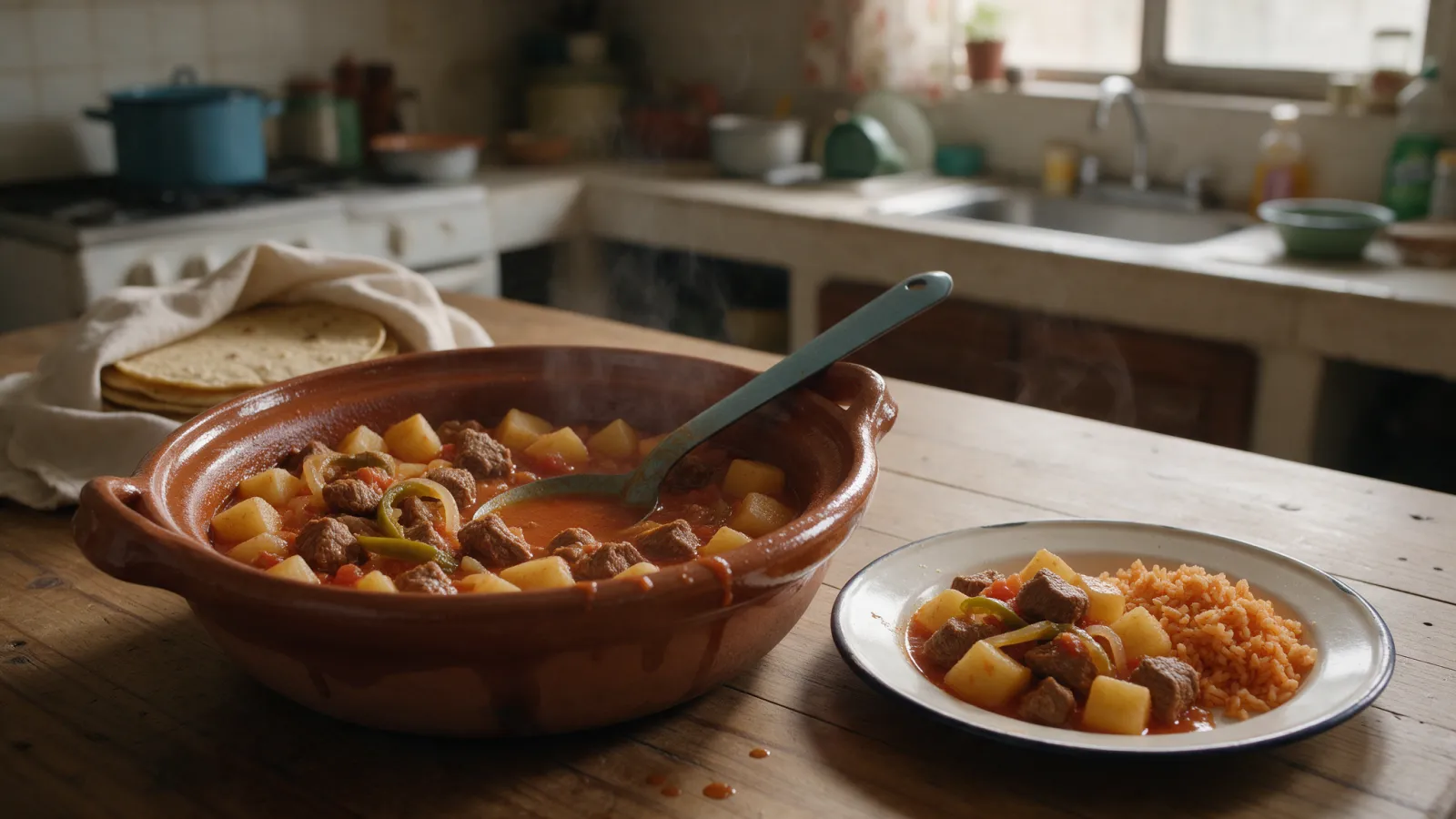

A 1½-inch cube of beef chuck needs about 75 minutes at a bare simmer to stop being chewy; a 1¼-inch cube of potato is tender in 20 and falling apart by 40. Carne con papas (KAR-neh kohn PAH-pahs) means beef with potatoes, and the whole recipe hinges on those two very different speeds. It’s an everyday Mexican home-style stew: beef browned and simmered in a blended sauce of tomato, onion, garlic and chile, with potatoes, eaten with rice and tortillas. Here you’ll find which cut to buy in the US and the UK, stovetop, pressure cooker and Instant Pot timings, how to scale it for a crowd and what it costs.
What is carne con papas, and is it worth making?
How do you make carne con papas? Brown 2.2 lb (1 kg) of chuck cut into 1½-inch cubes in three batches, soften some onion, fry a blended sauce of 1⅓ lb (600 g) of tomatoes with garlic and 2 serranos, then braise the beef covered over low heat with 3 cups (750 ml) of water for 75 minutes. When a cube splits under a fork, add 1¾ lb (800 g) of potatoes in 1¼-inch cubes and cook uncovered for 20 minutes until the sauce thickens. Serves 6 in 140 minutes.
Think of it as a Mexican cousin of beef stew, without flour or red wine: the body comes from the browned beef, the fried tomato sauce and the gelatin the chuck gives up as it braises. In Mexican American kitchens in Texas, carne guisada con papas is everyday family food rather than restaurant fare, and that’s the spirit of it.
Is it worth it? Yes, if you have a weekend afternoon or want lunches for the week. One pot feeds 6, and it’s better the next day, when the sauce has settled and the fat lifts off cold in one piece.
The real time. 140 minutes, roughly 55 hands-on. For an hour and a quarter the covered pot needs nothing but the occasional stir. A stovetop pressure cooker saves about half an hour, an Instant Pot about 20 minutes.
Who might skip it. Anyone who needs dinner in half an hour; bistec a la mexicana, thin steak seared in batches, is ready in half an hour, and its potato version feeds six. And anyone after lean meat: chuck carries fat, and that fat is what keeps it juicy.
Ingredients, the right cut and US and UK swaps
The recipe card has it all: 2.2 lb (1 kg) of chuck, 1¾ lb (800 g) of potatoes, 1⅓ lb (600 g) of tomatoes, 2 serranos and 3 cups (750 ml) of water for 6 servings.
| Ingredient | Best choice | US | UK | What changes with the swap |
|---|---|---|---|---|
| Beef | Chuck (diezmillo in Mexico) | Chuck roast, cut it yourself | Chuck steak or braising steak | Pre-cut stew meat can include lean round, which dries out |
| Potatoes | Waxy, holds a cube | Yukon Gold or red | Charlotte or a bag labelled for boiling | Floury russets or Maris Pipers break up and thicken the sauce; give them 15 minutes, not 20 |
| Chile | 2 serranos | Serranos or 1 jalapeño | 1 jalapeño or a mild green chilli | Jalapeño is a little milder; bird’s-eye chillies are far hotter |
| Smoky version | 2 chipotles in adobo | Canned, Mexican aisle | 1 tbsp chipotle paste | Darker, smokier, a bit hotter and saltier |
| Tomatoes | Ripe Roma | 28-oz (794 g) can whole tomatoes | Two 400 g tins plum tomatoes | Canned is sweeter and salted, so hold the second tsp of salt until you taste |
| Liquid | Water | Unsalted beef stock | Low-salt beef stock | Stock deepens the flavor; taste before salting |
Which cut of beef makes it tender
Chuck has marbling and plenty of connective tissue, and with time at a bare simmer that tissue turns to gelatin: the meat softens and the sauce gets body. The ideal braising liquid sits just below the boil, at 185 to 195°F (85 to 90°C). Shank works too, though it wants about 2 hours, which is why it’s the cut in a Mexican beef soup. Round is lean and goes dry and stringy in a long braise. Flank or skirt pulls into shreds after a couple of hours, which is what you want for Colombian shredded beef, not here.
Buy the chuck as a whole piece and cube it yourself. Smaller than 1½ inches and it shreds; larger and it needs more than 90 minutes.
Equipment
A heavy 10-inch (24-26 cm) pot of about 5 quarts (5 liters), a blender and a fork for testing. If your pot is thin and catches, brown the beef in a large skillet and move it over. No blender? Grate the tomatoes on the coarse side of a box grater, discard the skins and mince the garlic and chile very finely.
How to plan the 2 hours 20 minutes
Nearly all the work happens in the first 45 minutes: cutting, blending, browning and frying the sauce. Then the pot simmers on its own for 75 minutes, and that’s when you peel the potatoes.
Make-ahead. Cook everything up to the end of the beef braise, without potatoes. Cool it uncovered and get it into the fridge within 2 hours. Next day the fat sets as a white layer you can lift off with a spoon; bring the beef back to a boil, add the potatoes and finish as written, 20 minutes.
Browning without steaming
The browning is where the flavor comes from. Dry meat, a hot pot and small batches: a 10-inch pot takes about 12 oz (330 g) at a time with room between cubes. Crowd it and the beef releases water, boils in it and turns gray. Don’t move the cubes for the first 2 minutes; they stick at first and let go when the crust has formed. The brown film on the bottom of the pot stays: the onion and the sauce lift it later.
When to add the potatoes
When the beef is tender, not before. At 75 minutes, fish out a cube and press it with the side of a fork. If it splits without effort, add the potatoes; if it springs back, give it 15 more minutes. The potatoes take 20 minutes uncovered over medium-low heat. Uncovered for two reasons: the sauce reduces while they cook, and the pot stays at a simmer instead of a rolling boil, which is what breaks potatoes.
Signs it’s going right
- Browning → the beef sizzles as it hits the pot. Silence means the pot is too cold.
- Crust → dark brown, never gray, on at least two sides.
- Fried sauce → turns from orange-red to deep red and stops tasting of raw tomato, at about 5 minutes.
- Braise → small, slow bubbles under the lid. A hard boil means the heat is too high.
- Beef → a cube splits under the side of a fork, after 1¼ to 1½ hours.
- Potatoes → a knife slides in and out without breaking them, at 20 minutes.
- Finished sauce → coats the back of a spoon, neither soupy nor mashed.
Scaling for 4 to 20
Allow about 6 oz (167 g) of beef and 4¾ oz (133 g) of potato per person. Big pots lose less water to evaporation, so don’t scale the water all the way up.
| Servings | Chuck | Potatoes | Tomatoes | Onion | Serranos | Water |
|---|---|---|---|---|---|---|
| 4 | 650 g (1.4 lb) | 550 g (1.2 lb) | 400 g (14 oz) | 130 g (4½ oz) | 1 | 500 ml (2 cups) |
| 6 | 1 kg (2.2 lb) | 800 g (1¾ lb) | 600 g (1⅓ lb) | 200 g (7 oz) | 2 | 750 ml (3 cups) |
| 10 | 1.7 kg (3¾ lb) | 1.35 kg (3 lb) | 1 kg (2.2 lb) | 330 g (11½ oz) | 3 | 1.1 l (4½ cups) |
| 20 | 3.4 kg (7½ lb) | 2.7 kg (6 lb) | 2 kg (4.4 lb) | 650 g (1.4 lb) | 6 | 2 l (8½ cups) |
For 10, use an 8-quart pot; for 20, two. What stretches when you scale up is browning: 7½ lb is around 10 batches, so run two skillets at once or do it the day before. The braise itself still takes 1¼ to 1½ hours once the pot is back at a simmer.
Stovetop, pressure cooker or Instant Pot?
Pressure speeds up the beef, not the potatoes. Small stewing cubes soften under pressure in about 15 to 20 minutes if they are 1 inch, and some cooks give stewing beef 30 to 45 minutes. For 1½-inch cubes, here’s what I do.
Either way the potatoes go in after the pressure is down, in the open pot: under pressure nothing evaporates, and the potatoes would collapse long before the sauce thickened. Use 2 cups (500 ml) of water instead of 3 for the same reason. I haven’t tested this dish in a slow cooker, so I won’t give you a timing.
Food safety, heat, kids and allergens
Critical points. Brown in batches of about 12 oz (330 g), and hold the potatoes back until the beef splits under a fork.
Common mistakes.
- Tough beef → it needed more time, not less. Chuck goes through a firm stage before it softens; keep going in 15-minute steps.
- Dry, stringy beef → a lean cut such as round, or the pot was boiling hard. Use chuck and the lowest heat.
- Potatoes falling apart → they went in too early, were floury, or boiled hard under a lid.
- Gray beef and a boiled taste → the pot was too cold or the batches too big.
- Watery sauce → that’s what the uncovered 20 minutes fixes; if it’s still thin, 5 minutes more at slightly higher heat.
- Greasy → skim the surface with a spoon, or braise ahead and lift the fat off cold.
Is it safe? Whole cuts of beef, cubes cut from a roast included, are safe at 145°F (63°C) with a 3-minute rest. A braise at 185 to 195°F (85 to 90°C) passes that within minutes. The 75 minutes are for tenderness, not safety.
Heat level. Medium with two blended serranos, about 2 on my 0-5 scale. Use one serrano for mild; chipotles push it toward 3.
Kids. Usually a hit: soft beef, potatoes and tomato sauce. For them, don’t blend the serranos; drop them in whole with the sauce and fish them out before serving. The heat drops to almost nothing.
Allergens. None of the major ones: no gluten, dairy, egg or nuts. Check store-bought stock, which can contain wheat or celery, and the adobo on canned chipotles.
Which version should you make?
Among the Mexican beef dishes on this site, what sets carne con papas apart is the cut and the time. Bistec a la mexicana is thin steak seared 2 minutes a batch; Mexican picadillo is ground beef simmered about 20 minutes with potato and carrot; and carne en su jugo is steak in a tomatillo broth with beans and bacon, ready in 60 minutes.
- Short on time → bistec a la mexicana with potatoes, or this recipe in a pressure cooker.
- No pressure cooker → make it exactly as written; it’s a stovetop dish.
- For a party → use the scaling table and braise the beef the day before. It holds on the lowest heat, with a splash of water if needed.
- Smoky → 2 chipotles in adobo instead of the serranos (UK: 1 tbsp chipotle paste).
- More vegetables → a couple of carrots in ½-inch (1 cm) slices with the potatoes, or two zucchini (courgettes) in cubes for the last 8 minutes.
- Lighter → 1¾ lb (800 g) of beef and 2.2 lb (1 kg) of potatoes, and the fat lifted off cold. Every tablespoon of fat you remove takes about 115 calories out of the pot.
- Vegetarian → without beef it isn’t carne con papas. What I make instead is the same sauce with the potatoes and 1 lb (500 g) of mushrooms browned in two batches, about 40 minutes in all.
- Texas style → carne guisada con papas in Texas uses round steak in ½-inch cubes, a paste of peppercorns, garlic, cumin and salt ground in a molcajete, a little flour to thicken, and the potatoes for the last 10 minutes.
- Green → there are also versions in a tomatillo salsa instead of red tomato.
What carne con papas costs
US average prices for August 2026, plus October retail prices for onion and chile, put the pot at $25.74, or about $4.29 for each of 6 servings, leaving out oil, garlic, spices and cilantro:
With pre-cut beef for stew, at $8.59 a pound, the pot drops to $23.84, about $3.97 a serving. Beef is more than 80% of the bill. Potatoes are the cheap way to stretch it: 1¾ lb of beef and 2.2 lb of potatoes still makes 6 plates.
Real yield. 6 plates with rice and tortillas; 4 hungry ones without sides.
What to expect, how to serve it and how to store leftovers
Taste and texture. Beef that splits under a fork but holds its shape, soft potatoes that keep their edges, and a thick red sauce that tastes of fried tomato, browned beef and serrano, with cumin underneath.
How it’s served. In a shallow bowl with plenty of sauce, next to Mexican red rice and frijoles de la olla, with warm corn tortillas. It’s also good wrapped in a flour tortilla as a taco.
Fridge. For leftovers: no more than 2 hours at room temperature, stored in shallow containers so it cools fast, and 3 to 4 days at 40°F (4°C) or below.
Freezer. Soups and stews with meat keep 2 to 3 months for best quality. Frozen potatoes turn grainy and watery when thawed, so I freeze the beef in its sauce without potatoes, in 1-lb (500 g) bags, and cook fresh potatoes in it when reheating: 20 minutes.
Reheating. Over low heat, covered, with ¼ cup (60 ml) of water to loosen the sauce, stirring until it boils or reaches 165°F (74°C) in the center. If it already has potatoes, stir as little as you can. In the microwave, cover and heat in 2-minute bursts, stirring in between.
Carne con papas FAQ
What is the best cut of beef for carne con papas? Chuck: chuck roast in the US, chuck or braising steak in the UK, diezmillo in Mexico. Its fat and connective tissue soften in 1¼ to 1½ hours at a bare simmer. Round is too lean and dries out.
Why is my carne con papas tough? Almost always too little time or too hard a boil. Keep it at a bare simmer and test with a fork every 15 minutes.
When do you add potatoes to beef stew so they don’t fall apart? Once the beef is tender, for the last 20 minutes, uncovered. Waxy potatoes such as Yukon Gold hold their shape best.
How long in an Instant Pot? 30 minutes at high pressure for 1½-inch cubes with 2 cups of water, 10 minutes of natural release, then the potatoes on Sauté, uncovered, for 20 minutes.
And in a stovetop pressure cooker? 25 minutes from when it comes to pressure, over low heat, 10 minutes of natural release, then the potatoes in the open pot.
Is carne con papas spicy? Medium with two serranos. For a milder pot, use one serrano or add the chiles whole and remove them before serving.
What’s the difference between carne con papas and carne guisada? They overlap. Carne guisada is the broader name for braised beef; with potatoes it’s carne guisada con papas, which in Texas is often thickened with a little flour and seasoned with cumin and pepper.
Can you freeze carne con papas? Yes, though the potatoes suffer; up to 3 months for best quality. Better to freeze the beef and sauce alone and add fresh potatoes when reheating.
How many calories are in a serving? About 605 calories, without rice or tortillas. Two corn tortillas add about 105 and a cup of white rice about 205.
Nutrition per serving
Per serving (one sixth of the pot, without rice or tortillas), calculated ingredient by ingredient from this recipe’s quantities, using chuck trimmed to ⅛ inch of fat and no fat skimmed from the stew:
- Calories: 605 kcal
- Protein: 36 g
- Carbohydrates: 31 g
- Fat: 37 g, of which 13 g saturated
- Fiber: 5 g
- Sugars: 5 g
- Sodium: 766 mg
The beef accounts for two thirds of the calories, about 407 per plate; potatoes add 103 and the oil 60. Almost all the sodium, 646 of the 766 mg, comes from the 2 teaspoons of salt. Each tablespoon of fat you lift off cold saves roughly 19 calories a plate, 115 across the pot.
The Venezuelan beef stews I grew up cooking start with sweet peppers and annatto, and I used to put everything in the pot at once and hope. Carne con papas is what taught me to treat the potatoes as a second, short cooking, and to fry the blended sauce before the beef goes back in. These days I braise the beef a day early, mostly for the cold fat that lifts off in one sheet, and any beef left without potatoes gets shredded into a Colombian cheese arepa the next morning. The hardest part, still, is leaving the cubes alone while they brown. Josnaisis.