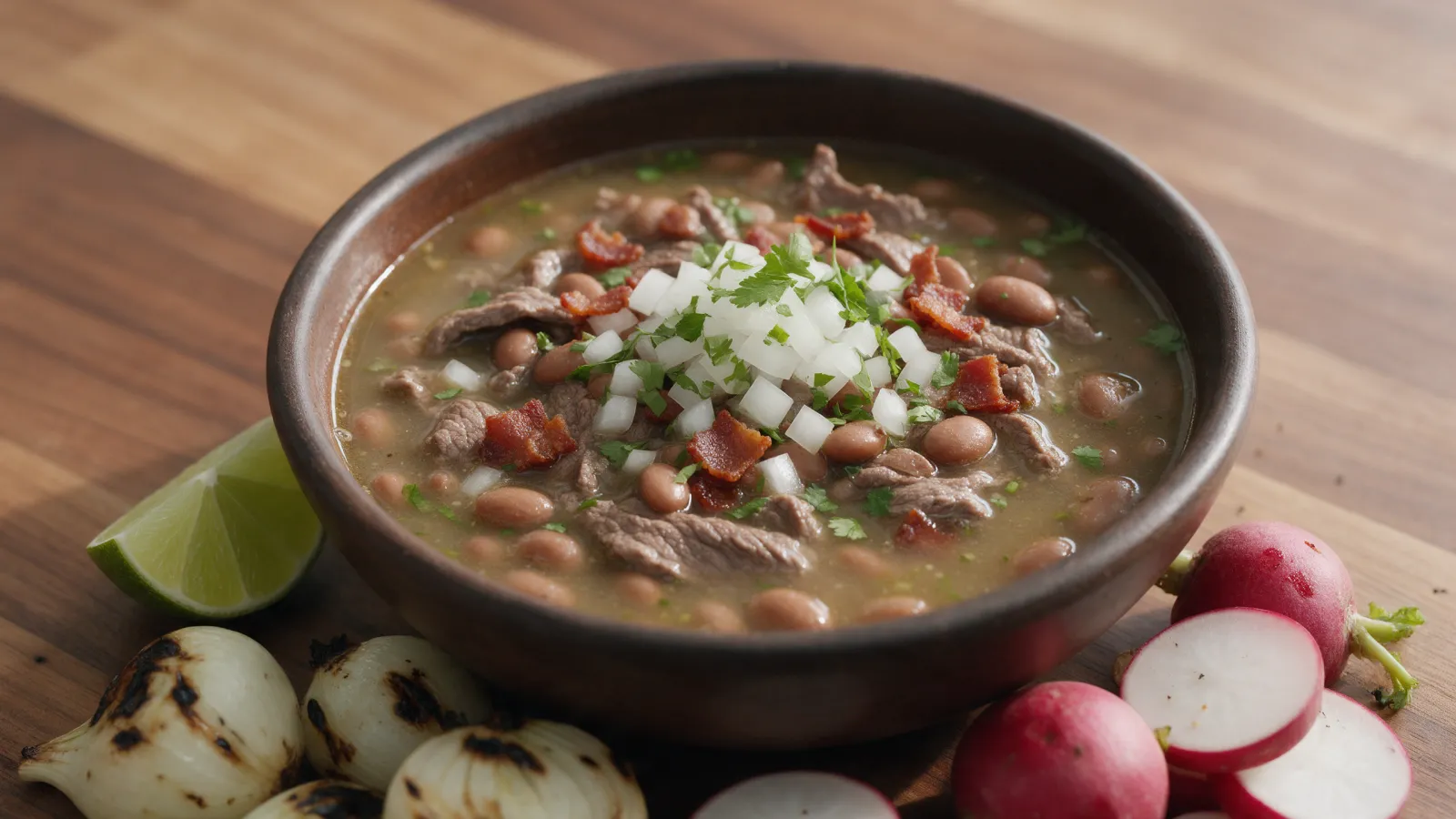

Picture a bowl of Guadalajara beef and bean soup where the beef spends just 8 minutes in the pot. The beef is cut into strips thin enough to bend, cooked for a few minutes in a broth tinted green by blended tomatillos, with whole beans, crisp bacon on top and a heap of raw onion, cilantro and radish that you finish with a squeeze of lime. That’s carne en su jugo (KAR-neh en soo HOO-go), “meat in its juice”, the signature dish of Guadalajara, in the Mexican state of Jalisco. On 31 August 1996 one restaurant there, Karne Garibaldi, set the Guinness record for the fastest restaurant service by getting a bowl from order to table in 13.5 seconds, as Time Out México and BBC Mundo report. The trick behind that speed is the same one that makes it work at home: very thin beef needs very little heat.
Is carne en su jugo worth making at home?
How do you make carne en su jugo? Chill lean beef in the freezer for 30 minutes, slice it ⅛ inch (3 mm) thick across the grain and sear it in the fat from 9 oz (250 g) of crisped bacon. Fry a blended salsa of boiled tomatillos, serrano, onion, garlic and cilantro in the same pot, add beef broth and cooked pinto or bayo beans, and return the beef for 8 minutes below a boil. Top with bacon, onion, cilantro, radish and lime. 60 minutes for 6 servings.
Yes, especially if you have cooked beans ready. It’s a full meal in one bowl, about 50 g of protein per serving, and it scales well for a crowd because the toppings do half the work.
Make it when you want a hearty soup that isn’t heavy with long-braised meat, you’re feeding 6 to 20 people, or you already have a pot of beans in the fridge.
Skip it when you don’t eat pork (the bacon is the cooking fat; there’s a pork-free version below), you’re watching sodium (970 mg a bowl), or you want dinner in 30 minutes starting from dried beans.
Real time. 60 minutes, about 50 of them hands-on, with cooked beans. From dried beans, add an overnight soak and 90 to 120 minutes of simmering the day before.
Honest difficulty, medium. Two things decide it: slicing the beef thin, which the freezer solves, and keeping the broth from boiling hard once the beef goes in.
If you know beef birria, the other famous Jalisco beef dish, this is its opposite: lean meat, short cooking and a bright green broth instead of a deep chile consommé.
What to buy, and what to swap in the US and UK
The recipe card has the exact amounts: 1 kg (2.2 lb) of lean beef, 250 g (9 oz) of bacon, 500 g (1.1 lb) of tomatillos, 600 g (3½ cups) of cooked beans and 1.5 liters (6⅓ cups) of broth for 6 bowls.
The best cut of beef for carne en su jugo
You want a lean steak cut from the hip or leg, with almost no sinew, because it only spends 8 minutes in the broth and connective tissue won’t soften in that time. In Mexico the usual choices are pulpa (round) in thin steaks, bola or aguayón (top sirloin). In a US supermarket that means top sirloin or top or bottom round; in the UK, rump, topside or silverside.
Flank (bavette) gets recommended a lot online. In short strips I find it stringy; it’s better left for carne asada, where it’s sliced across the grain after grilling. Chuck only works if you go for the long, 45-minute version.
How to slice beef paper-thin
Fridge-cold beef squirms under the knife and you end up with thick, ragged strips. Thirty minutes in the freezer firms the outside so a long, sharp knife takes off even ⅛-inch (3 mm) slices. If your beef is frozen solid, give it an hour in the fridge first; rock-hard meat won’t slice either.
Cut across the grain: find the lines running along the meat and slice at right angles to them, so every strip has short fibers and chews tender. Then cut the slices into strips about 1½ inches (3 to 4 cm) long, spoon-sized.
Beans, tomatillos and bacon, with substitutes
| Ingredient | What it does | US swap | UK swap | What changes |
|---|---|---|---|---|
| Bayo beans | creamy, mild, pale broth | pinto beans | canned pinto, or borlotti | pinto is near-identical; borlotti a little firmer |
| Fresh tomatillos | the sour green broth | sold loose in most supermarkets | canned whole tomatillos from Mexican online grocers | canned are pre-cooked: skip boiling, cut salt by ½ tsp |
| Serrano | medium heat | jalapeño | fresh green chilli | jalapeño is milder |
| Smoked bacon | fat for searing, crisp topping | thick-cut smoked bacon | smoked streaky | unsmoked gives a flatter broth |
| Beef broth | body | low-sodium carton broth | good stock cube | cubes add salt; taste before seasoning |
If you have broth left over from a Mexican beef soup made with bone-in shank, strain it and use it instead of the carton: it has more body and less salt.
Tomatillos are not green tomatoes. They’re a different fruit in a papery husk, Physalis philadelphica, sharper and more acidic. A 794 g (28 oz) can of whole tomatillos gives about 550 g drained, enough for this pot. For more on getting them to the right olive-green point, see my Mexican salsa verde.
Equipment
A heavy 4 to 5 quart (4 to 5 liter) pot, a blender, a long sharp knife and a slotted spoon. No long knife? Ask the butcher to run the beef through the slicer at ⅛ inch and cut the slices into strips with kitchen scissors.
Game plan, make-ahead and how to scale it
Sixty minutes on the clock with the beans already cooked. Put the beef in the freezer first and do everything else while it firms up.
Make ahead. The beans with their liquid keep 3 to 4 days in the fridge. The blended salsa keeps in a jar overnight. Crisp the bacon the day before and re-crisp it in a dry pan for 2 minutes. Raw sliced beef keeps covered in the fridge up to a day. With all that done, serving day is about 40 minutes.
How to tell each stage is right.
- Freezer → after 30 minutes the edges are hard and the center gives under your thumb.
- Tomatillos → olive green after 8 to 10 minutes. Pull them all the moment one splits.
- Bacon → it stops bubbling and turns golden at 12 to 15 minutes.
- Sear → the beef releases from the pot on its own after a minute. A puddle of water means the batch was too big.
- Salsa → darker by a shade and no longer smells raw after 4 minutes.
- Final heat → the broth shivers with the odd bubble, about 195°F (90°C).
Quantities for 3, 6, 10 and 20
| People | Beef | Bacon | Tomatillos | Serranos | Beef broth | Cooked beans | Salt |
|---|---|---|---|---|---|---|---|
| 3 | 500 g (1.1 lb) | 125 g (4.5 oz) | 250 g (9 oz) | 1 | 750 ml (3 cups) | 300 g (1¾ cups) | ¾ tsp |
| 6 | 1 kg (2.2 lb) | 250 g (9 oz) | 500 g (1.1 lb) | 2 | 1.5 l (6⅓ cups) | 600 g (3½ cups) | 1½ tsp |
| 10 | 1.7 kg (3.75 lb) | 420 g (15 oz) | 850 g (1.9 lb) | 3 | 2.5 l (10½ cups) | 1 kg (6 cups) | 2½ tsp, to taste |
| 20 | 3.3 kg (7.3 lb) | 800 g (1.75 lb) | 1.7 kg (3.75 lb) | 6 | 5 l (5.3 qt) | 2 kg (12 cups) | 4½ tsp, to taste |
Don’t scale the salt blindly: bacon, stock cubes and canned beans all bring their own. For 20, use two pots and sear in batches of 12 oz (330 g) at most, about 10 batches and 25 minutes. Crowd the pot and the beef stews in its own water instead of browning.
Before you cook, why it turns tough and the food-safety numbers
Why carne en su jugo goes tough
Thick slices, slicing with the grain, or a hard boil. Lean beef has very little collagen to melt, and in a rolling boil the muscle fibers tighten and squeeze their juice into the broth.
In my kitchen there are two good windows and one bad one. At 8 minutes with the broth barely moving, the strips are tender and still juicy. At 45 minutes, covered on low, as in the Guadalajara cookbook recipe El Universal published, they turn very soft and the broth tastes beefier. Anywhere from a quarter of an hour up to about 25 minutes is where I find them toughest. If you’ve drifted into that zone, don’t fish the beef out: cover the pot and carry on to 45.
Food safety. The USDA FSIS safe minimum for whole cuts of beef is 145°F (63°C) with a 3-minute rest. Strips ⅛ inch thick in broth at 195°F (90°C) get there in the first minute.
Common mistakes.
- Tough beef → hard boil, or pulled out between 15 and 25 minutes. Go 8 or go 45.
- Thick, uneven strips → sliced without chilling. Thirty minutes in the freezer.
- Grey, boiled-looking beef → batches too big. 12 oz (330 g) at a time in a 10 to 11 inch (26 to 28 cm) pot.
- Sour broth → tomatillos burst, or the salsa wasn’t fried. Fry it 4 minutes; if it’s still sharp, ½ tsp sugar for the whole pot.
- Too salty → bacon, stock cube and canned beans add up. Salt only at the end.
- Soggy bacon → it went into the broth. It goes on top of each bowl.
Heat level, 2 out of 5 with 2 serranos. One seeded serrano, or 2 jalapeños, brings it to 1.
Kids. Bacon and beans usually win them over. Use one seeded serrano and leave the raw onion off their bowls.
Allergens. No gluten, dairy, egg, nuts or fish in the recipe itself. Check the labels on stock cubes and bacon, which can contain gluten, milk or soy. Contains pork.
Which version should you make?
- Weeknight → canned pinto beans and carton broth, beef sliced the night before. About 35 minutes.
- The Guadalajara cookbook way → a first broth made from bottom round with radish and oregano, then thin-sliced beef covered for 45 minutes and uncovered for 10 on low. Slower, deeper broth.
- For a party → the long version, because the beef holds in the pot without toughening. Keep it above 140°F (60°C) and set the onion, cilantro, radish and lime out in bowls.
- No pork → 3 tbsp (45 ml) neutral oil instead of bacon fat and ½ tsp smoked paprika in the salsa. You lose the crisp topping.
- Lighter → crisp the bacon for the fat but keep it for another meal. That takes about 80 kcal and 290 mg of sodium off each bowl.
- Vegetarian → 600 g (1.3 lb) mushrooms in strips, browned 6 minutes, vegetable broth and double the beans. A different dish, but the green broth works.
Leftover beans go straight into Mexican refried beans, and if you’d rather cook your pot from scratch with a smoky edge, my frijoles charros give you the same soak-and-simmer method.
How much does carne en su jugo cost?
At BLS US city average prices for August 2026 (boneless sirloin steak at $14.357/lb, bacon $6.605/lb, dried beans $1.630/lb) and USDA AMS advertised prices from 9 October 2026 for tomatillos, onion, cilantro and garlic, a pot for 6 comes to $39.04, about $6.51 a bowl. Using boneless round steak at $9.692/lb brings it to $28.76, $4.79 a bowl.
Yield. 6 deep bowls of about 23 oz (650 g) with beef, beans and broth. With tortillas and all the toppings, it feeds 8 light eaters.
What drives the price. The beef, at 81% of the total. Bacon is a distant second. Radishes, limes, broth and tortillas aren’t counted. I couldn’t find a published UK price for canned tomatillos, so there’s no sterling total.
What to expect, how to serve it and how to store it
Flavor and texture. A pale green broth, tangy from the tomatillos and smoky from the bacon, with a little heat at the end. Tender strips of beef and creamy whole beans underneath; crunchy onion, cilantro and radish on top.
How it’s served in Guadalajara. In a wide, shallow bowl with plenty of broth, crisp bacon on top, and the onion, cilantro, radish and lime at the table. Grilled or fried spring onions are a common extra, along with warm corn tortillas.
Fridge. USDA FSIS numbers for soups and stews with meat: no more than 2 hours at room temperature, then 3 to 4 days at 40°F (4°C) or below. Cool it in containers under 3 inches (7.5 cm) deep and keep the bacon separate so it stays crisp.
Freezer. 2 to 3 months for soups and stews with meat, per FSIS; that’s for quality, not safety. Broth, beef and beans freeze well; add the fresh toppings when you serve.
Reheating. Thaw in the fridge, then warm covered over low heat to 165°F (74°C), never at a hard boil, or the tender beef tightens up again. In the microwave, covered, in 1-minute bursts with a stir between each.
Carne en su jugo FAQ
What is carne en su jugo? A Guadalajara beef and bean soup: thin strips of lean beef in a tomatillo and beef broth with whole beans and crisp bacon, topped with onion, cilantro, radish and lime.
What cut of beef is best? Top sirloin, top round or bottom round, sliced ⅛ inch thick across the grain. In the UK, rump, topside or silverside.
How do I slice beef really thin? Freeze it for 30 minutes until the outside is firm, then use a long sharp knife across the grain.
Why is my carne en su jugo tough? The slices were too thick, the broth boiled hard, or the beef came out halfway through a long cook. Eight minutes below a boil, or 45 minutes covered on low.
Can I use canned beans? Yes, two 15 oz (425 g) cans of pinto beans, drained and rinsed. Cut the salt by ½ tsp and taste at the end.
Is carne en su jugo spicy? Mildly. Two serranos put it at 2 on a 5-point scale. Use one seeded serrano or jalapeños for kids.
How long does it keep? 3 to 4 days in the fridge and 2 to 3 months in the freezer, per USDA FSIS. Reheat to 165°F (74°C).
What’s the difference between carne en su jugo and birria? Birria is fatty meat braised for hours in a dried-chile adobo. Carne en su jugo is lean beef cooked for minutes in a tomatillo broth with beans and bacon.
Nutrition per serving
Per bowl (about 650 g / 23 oz, without tortillas), calculated ingredient by ingredient from USDA FoodData Central (SR Legacy) using this recipe’s amounts. I counted raw top sirloin for the beef, unsalted cooked pinto beans for the bayo (USDA has no bayo entry), pan-fried bacon at USDA’s yield (9 oz raw gives about 3.6 oz, or 103 g, cooked), 2 tablespoons of its fat for searing, the juice of 1½ limes, and water in place of broth:
- Calories: 670 kcal
- Protein: 50 g
- Carbohydrates: 38 g
- Fat: 36 g, including 13 g saturated
- Fiber: 12 g
- Sugars: 6 g
- Sodium: 970 mg
Most of the sodium is the pot’s salt (3,490 of 5,830 mg) and the fried bacon (1,730 mg). A stock cube or canned beans will raise it; check the label. Each corn tortilla, about 0.85 oz, adds around 52 kcal.
I didn’t grow up with this soup. The beef soups of my Venezuelan childhood boiled for hours with vegetables, so my instinct was to let this one bubble away too, and the first pots came out chewy. The freezer, the knife and a timer set to 8 minutes fixed it, and now it’s what I make when I have a pot of beans in the fridge and people coming over. Josnaisis.