
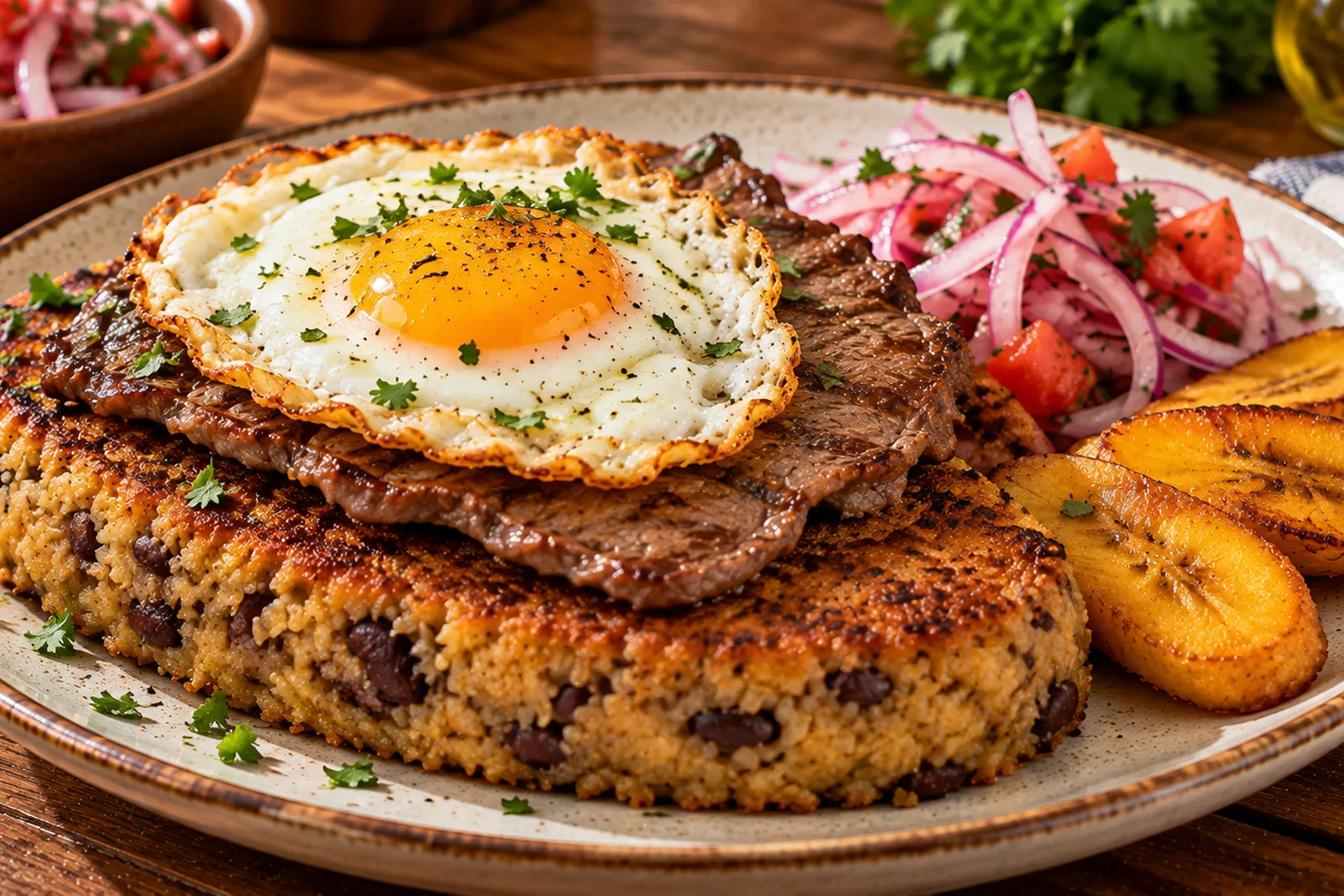

Tacu tacu (TAH-koo TAH-koo) is what Peru does with yesterday’s rice and beans: they’re stirred into a base of red onion, garlic and aji amarillo, Peru’s fruity yellow chile, half-mashed, then pan-fried into a thick oval cake with a crackly golden crust and a soft, creamy middle. It’s a lunch plate, usually served “montado,” with a fried egg on top, or under a steak or a beef stir-fry. This recipe makes 4, and covers the rice-to-bean ratio that holds together, which beans to buy in a US or UK store, how to flip it without breaking it, and how to store cooked rice safely.
What tacu tacu is
How do you make tacu tacu? Gently cook red onion, garlic and 3 tbsp aji amarillo paste, stir in 21 oz (600 g) of cooked canary beans, half blended and half mashed, then 21 oz (600 g) of day-old rice. Stir until it clumps, rest 10 minutes, and pan-fry each portion over medium heat for 3 to 4 minutes per side with a single flip. 75 minutes for 4 servings.
Think of it as a rice-and-bean hash brown, or the Peruvian cousin of bubble and squeak: the same idea of frying leftovers into a crust. The flavor is the base: sweet onion, garlic and a mild, fruity chile heat. If you’d rather keep rice and beans loose, the Colombian calentado breakfast of leftover rice and beans and Costa Rica’s gallo pinto, day-old rice with black beans, are fried and stirred, never pressed; for rice and beans cooked together from scratch, there’s Cuban congrí.
The most widely accepted story places its origins on colonial plantations on Peru’s coast, among enslaved Afro-Peruvian workers who fried the leftover rice and beans.
Time. 75 minutes with one skillet, 30 of them frying the four cakes; about 60 with two skillets. Medium difficulty: nothing hard, but the flip takes a calm hand.
Ingredients and what to buy
The recipe works out to about 5 oz (150 g) each of cooked rice and beans per person, a generous main course.
Beans
Peru uses canary beans (frijol canario): pale yellow, thin-skinned and very creamy once cooked. In the US they’re sold dried and canned as mayocoba or peruano beans in the Hispanic aisle and at Latin grocers. In the UK, look at Latin American shops and online. Failing that, canned cannellini or navy beans (sold as haricot beans in the UK) are on every supermarket shelf and are the easiest swap. If you cook them yourself, the method is in the Peruvian seco de res with canary beans, the stew whose leftovers traditionally end up as tacu tacu.
With canned beans, drain and rinse them, and use water or stock instead of the canning liquid, which is often salty and thick.
Rice-to-bean ratio
I use equal weights, 21 oz (600 g) of each. The blended beans are what glue the rice together: too little and the mixture crumbles, too much and it turns into a soft purée that sticks. If your leftovers aren’t even, it still works. With extra rice, add 2 or 3 more tablespoons of liquid; with extra beans, let the mixture rest longer before shaping.
Aji amarillo paste
The jarred paste is in the Hispanic aisle of many large US supermarkets and at Latin grocers; in the UK, at Latin American grocers and online. Brands vary a lot in heat, so taste ½ tsp first and start with 2 tbsp if yours is fiery or you’re cooking for kids. No paste? A yellow bell pepper blended with half a jalapeño gives color and some heat, but not the fruity flavor.
Rice
Long-grain white rice, cooked the day before. Cold rice is drier and mixes in without turning to mush. Short-grain or risotto rice like arborio releases starch and makes the mixture gummy. If you need a reliable everyday pot, the Colombian-style fluffy white rice is the one I use.
Equipment. A large skillet for the mixture, a 10-inch (24 to 26 cm) nonstick skillet for frying, a wide spatula, a flat plate larger than the pan and a blender or stick blender.
Game plan
Cook the rice and beans one or two days ahead and refrigerate them; then the day itself is just the base, the mix and the frying. Make the salsa criolla, a quick lime-pickled red onion, while the mixture rests. If you’re serving it with lomo saltado, fry the tacu tacu first, hold them in a low oven and cook the stir-fry last, since it takes 10 minutes and won’t wait.
How to make tacu tacu
The aji amarillo base
The onion goes 6 to 7 minutes over medium-low heat, until soft and translucent but not browned. Then garlic for 1 minute and the aji paste with cumin for 2 to 3 minutes. It’s ready when the base looks glossy and the oil turns orange at the edges. High heat scorches the garlic and makes the whole batch bitter.
Half-blended, half-mashed
Blending half the beans with their liquid makes the glue; mashing the other half with a fork keeps texture. Cook the beans in the base for 5 minutes, until thick like a coarse purée, then the rice and salt for 3 to 5 minutes, pressing with the spoon.
The mixture is ready when it’s steaming, pulls away from the pan in one mass and holds together when you squeeze a little between your fingers. Crumbly? Add liquid a tablespoon at a time. Wet and shiny? Keep stirring a couple of minutes more.
A few spoonfuls of juices from a leftover stew are optional but add a lot of savory depth. The 10-minute rest lets the rice absorb moisture so the mixture firms up for shaping.
Shaping it in the pan
Medium heat and ½ tbsp oil, shimmering. Add a quarter of the mixture, about 12 oz (350 g), tilt the pan toward you and push the mixture against the curved side with the spatula. The curve of the pan gives it the classic oval: aim for about 7 in (18 cm) long and ¾ to 1 in (2 to 3 cm) thick.
Shape it, don’t pack it like a brick. A hard-pressed cake flips more easily but is dense and dry inside.
The flip
- First side, 3 to 4 minutes, hands off. Ready when the edge is golden and the cake slides when you shake the pan. If it sticks, give it another minute: there’s no crust yet.
- Flip with a plate. Set a flat plate on top, hold it firmly and turn the pan over in one quick move. Add another ½ tbsp oil and slide the cake back in, raw side down. Once you’re confident, two spatulas, one above and one below, work too.
- If it cracks, push the pieces back against the side of the pan with the spatula; the heat glues them together.
- Second side, 3 to 4 minutes, until both faces are evenly golden.
Hold the finished cakes on a sheet pan in the oven at its lowest setting, about 200°F (90°C), uncovered so they don’t steam.
What to serve with tacu tacu
- Montado. A fried egg with a runny yolk on top, 2 to 3 minutes in a second pan while the last cake fries. The most common way, and the quickest.
- With lomo saltado. The tacu tacu sits underneath and soaks up the juices of lomo saltado, Peru’s beef and onion stir-fry.
- A lo pobre. With a thin griddled steak, a fried egg, fried ripe plantain and sometimes fries. The hearty version.
- Under last night’s stew. Reheated seco de res with its green sauce.
- Salsa criolla. Almost always, on the side: the lime-sharp onion cuts the richness.
- Fried ripe plantains. Slices of black-spotted plantain bring sweetness against the chile.
If all you have left is rice, Peru’s other answer is arroz chaufa, Chinese-Peruvian fried rice.
Troubleshooting
Spice level. Medium with 3 tbsp of a typical paste; it depends on the brand. Allergens. No gluten, dairy or nuts; egg only if you serve it montado. Check the labels on the aji paste and any stock. Skip the egg and use vegetable stock and it’s vegan.
Leftover rice safety
Cooked rice can carry bacterial spores that survive cooking; if the rice sits warm for hours, they produce a toxin that reheating doesn’t destroy. Tacu tacu is a leftover dish, so this matters.
- Cool it fast. Spread cooked rice in a shallow container and refrigerate it within 1 hour if you can, never more than 2 hours at room temperature. Same for the beans.
- Fridge time. Covered, at 40°F (4°C) or below. For tacu tacu, use them within 1 to 2 days; the strictest advice for rice is 24 hours.
- Heat it once. Rice should be reheated only once, and in tacu tacu that’s the skillet: the mixture must be steaming and the center should reach 165°F (74°C). That’s why I only fry what we’ll eat. To save some for later, set rice and beans aside before you mix them.
- Leftover fried cakes: refrigerate within 1 hour and eat them the next day cold, knowing the rice has already been reheated once; the cautious choice is not to reheat them again.
- Freezer. Freeze cooked rice and beans separately, in flat portions, for 3 to 4 months. Thaw in the fridge overnight and make tacu tacu that day.
Scaling and variations
- For 8 or 12. Multiply the recipe, mix in two large skillets and fry in two pans at once, holding finished cakes in a single layer in the low oven.
- One big cake to share. All the mixture in a 12-inch (30 cm) skillet over medium-low heat, a few minutes longer per side, always flipping with a plate.
- Lima beans or lentils. Same method with cooked lima beans (butter beans in the UK) or lentils. Different flavor and color, same skillet work.
- With seafood. A seafood sauce on top in place of the egg.
Tacu tacu FAQ
Can I use freshly cooked rice and beans? Yes. Spread the rice on a tray to steam off and cool, and use less liquid when blending the beans, since fresh beans are wetter. The mixture is softer, so rest it 15 minutes instead of 10.
Is tacu tacu spicy? Mildly to medium, depending on your aji amarillo paste. It’s fruity rather than sharp; for kids, use 2 tbsp of paste and keep the fresh chile out of the salsa criolla.
Can I use black beans? You can, but the cake comes out almost black and tastes earthier. It works as a rice-and-bean cake, just not like the Peruvian original.
Can I make tacu tacu ahead? Cook the rice and beans up to 2 days ahead and keep them apart in the fridge. Mix and fry just before eating, since the skillet is the one time that rice gets reheated.
Tacu tacu nutrition
Per serving (one cake, without egg or salsa criolla), calculated ingredient by ingredient from the recipe, counting all the frying oil:
- Calories: 620 kcal
- Protein: 19 g
- Carbohydrates: 86 g
- Fat: 23 g, of which 2 g saturated
- Fiber: 17 g
- Sugars: 3 g
- Sodium: 450 mg, not counting the salt in the aji paste, which varies a lot by brand
The beans supply nearly all the fiber and much of the protein. A fried egg on top adds about 90 kcal and 6 g of protein.
There’s always rice left over in my kitchen, and tacu tacu taught me to cook beans with the next day already in mind. The hardest part for me was keeping my hands off it in the pan; now I wait until it slides on its own, and the plate-over-the-skillet flip saves me nearly every time. I serve it montado, with a soft egg and the onion relish ice-cold on the side. Josnaisis.