
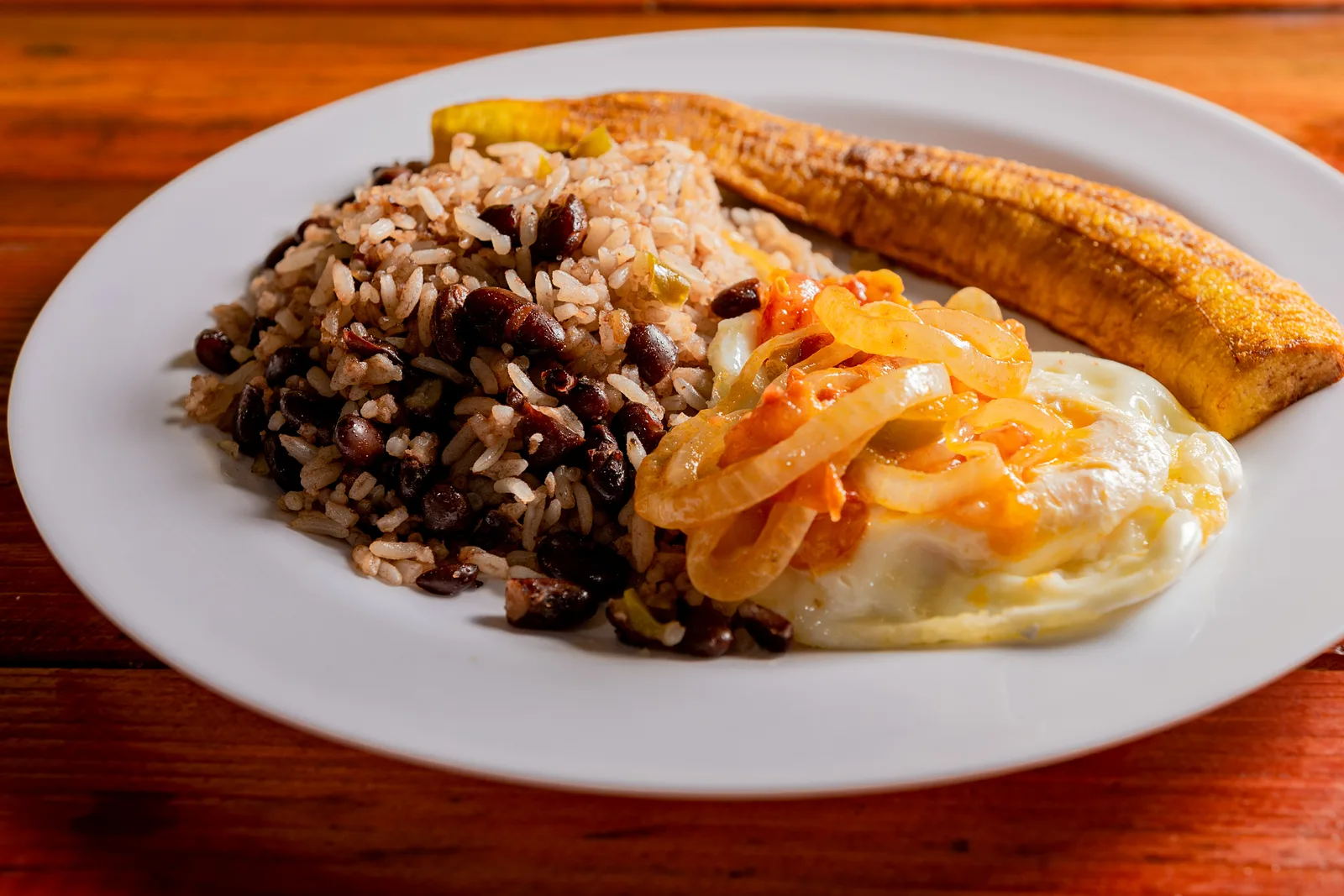

Gallo pinto (GAH-yoh PEEN-toh, “spotted rooster”) is what most Costa Ricans eat for breakfast: yesterday’s rice and a pot of black beans fried together with onion, sweet pepper and cilantro, seasoned with a tangy brown bottled sauce called Salsa Lizano. The rice takes on the color of the bean broth and the beans stay whole, so every forkful is speckled. Nicaragua makes its own version with small red beans, and both countries call it theirs.
How to make gallo pinto
How do you make Costa Rican gallo pinto? Soften onion, red bell pepper and garlic in oil, add 2 cups of cooked black beans with ½ cup (120 ml) of their cooking liquid and 3 tablespoons of Salsa Lizano, and simmer 2-3 minutes. Fold in 3 cups of cold day-old rice until no white grains or liquid remain, then stir in cilantro. Ready in 30 minutes for 4 servings.
It is not a pot of rice cooked with beans, like Cuban congri or Dominican moro. Both components are already cooked, which is why it fits into a weekday morning: 15 minutes of chopping and 15 at the stove, as long as the rice and beans were made ahead.
Effort. Easy. The only judgment call is when to stop: the rice should have soaked up the liquid but not started to stick and mash.
Ingredients and US or UK swaps
This makes 4 breakfast plates, each with an egg on the side. The cup measures matter more than the weights, because they set the ratio: 3 parts rice to 2 parts beans, plus a quarter as much bean liquid as beans.
Why the rice has to be cold
Long-grain white rice, cooked the day before and refrigerated. Cold grains are firm and a little dry on the surface, so they drink up the bean liquid without breaking. Fresh, steamy rice splits when you stir it and the gallo pinto turns pasty.
A scant 1 cup (185 g / 6.5 oz) of raw rice gives a little over the 3 cups you need. For the water ratio and timing, follow the Colombian white rice method.
No leftover rice? Cook it at least 2 hours ahead, spread it on a rimmed baking sheet to release the steam, and once it stops steaming, chill it for 30 minutes. That gets you most of the way there.
Beans and their liquid
Costa Rica’s Central Valley uses black beans. Homemade beans are better here because their thick, dark cooking liquid is what colors and flavors the rice.
- From dried. ¾ cup (145 g / 5 oz) dried black beans gives about 2 cups cooked. Soak them 8 hours, drain, cover with water by about 2 inches (5 cm) and simmer covered for 60-90 minutes, or about 35 minutes in a pressure cooker, until they crush easily between your fingers but still hold their shape. Uncover for the last few minutes so the liquid thickens, and store them in it.
- Canned. About 1½ cans (15 oz in the US, 400 g in the UK) give the 2 cups drained. Canned liquid is saltier and thicker, so use ¼ cup of it mixed with ¼ cup of water in place of the cooking liquid, and hold the salt until the end.
Leftover Venezuelan black beans also work, though they already carry a sofrito and a touch of sweetness, so halve the onion.
What Salsa Lizano is, and what to use instead
Salsa Lizano is a thin, light-brown Costa Rican sauce sold in bottles. It tastes tangy and slightly sweet, with cumin and a vegetable background, and it is barely spicy at all. It gives Costa Rican gallo pinto its toasty color and the flavor people there recognize instantly.
In the US you will find it in Latin markets that stock Central American products and from online retailers; in the UK, mostly online. If you cannot get it, Worcestershire sauce is the usual stand-in, but it is not the same: sharper, more sour, made with anchovies and without Lizano’s sweetness or cumin. My swap is 1½ tbsp Worcestershire + ½ tsp brown sugar + a pinch of ground cumin for the 3 tbsp of Lizano. The color comes out close; anyone who grew up with Lizano will still know.
The aromatics
- Sweet pepper. Costa Rica’s chile dulce is a small sweet pepper. A red bell pepper is the closest supermarket match. No heat.
- Cilantro. Costa Ricans call it culantro, but it is ordinary cilantro (fresh coriander in the UK). The long, saw-edged herb sold as culantro in some US Latin markets is a different, stronger plant: use half as much.
- White onion and garlic, chopped fine so they disappear into the rice.
Equipment. A large 11-inch (28 cm) skillet or a wide pot and a flat spatula. In a small pan the layer is too deep and the rice gets crushed as you stir.
The 30-minute morning, step by step
Soften, don’t brown
Medium heat, oil, onion and bell pepper for 5-6 minutes, until the onion is soft and see-through; garlic for 1 minute at the end. You don’t want color here, because browned aromatics turn bitter and fight the Lizano.
Beans, liquid and Lizano
In go the beans with ½ cup (120 ml) of their liquid and the 3 tablespoons of Lizano. Simmer 2-3 minutes, until the liquid is reduced by about half and looks thick and glossy. Too much loose liquid and the rice gets soggy; let it dry out completely and the rice stays pale.
Fold in the rice
Add the crumbled rice and fold it with the spatula, lifting from the bottom and letting it fall, the way you toss a salad. Pressing it against the pan is what breaks the grains. Medium heat, 5-7 minutes.
How to tell it’s done
- Even color. Every grain stained a dark purplish brown, no white patches.
- Loose but moist. A spoonful separates into grains when pressed; it shines but leaves no liquid on the plate.
- A clean pan. When you drag the spatula across the bottom, there is no liquid and only a thin film is starting to stick. That’s when the heat goes off.
- Hot all the way through. It steams in the middle of the pan, not just at the edges. This is day-old rice and needs to be reheated thoroughly.
Taste before you salt: between the Lizano and the bean liquid, it often doesn’t need any. Stir in the cilantro off the heat so it stays green.
If it goes wrong. Pasty means fresh rice or too much liquid. Dry and pale means too little liquid, so add 2 tablespoons of bean liquid or water and stir for a minute. Too salty means Lizano, salt and canned beans all at once; stir in another cup of cold rice with a splash of water.
Heat and allergens. Nothing in it is spicy, so children usually eat it as is; hot sauce goes on the table. The listed ingredients contain no gluten or dairy, but check the label of whatever bottled sauce you use if you are cooking for someone with celiac disease, and remember that Worcestershire contains fish.
Nicaraguan gallo pinto
In Nicaragua gallo pinto is made with small red beans (the local frijol de seda) and eaten at any time of day, often alongside grilled meat. It is simpler: oil or lard, onion, sometimes a little sweet pepper, salt and no Lizano. The beans are fried before the rice goes in, and the result is drier and toastier.
With the same amounts of rice and beans as above:
- Heat 3 tbsp oil or lard in the large skillet and fry ½ chopped onion over medium heat for 4-5 minutes, until it starts to color.
- Add 2 cups cooked small red beans, drained, with just 2-3 tablespoons of their liquid. Fry for 5-6 minutes, stirring now and then, until they start to split and crackle in the oil.
- Add the 3 cups crumbled cold rice and mix. Let it fry undisturbed for 2-3 minutes, stir, and repeat for 8-10 minutes in all, until the rice is toasted in spots and evenly colored. Salt to taste.
Which beans to buy. In the US, look for bags or cans labeled small red beans. Red kidney beans are bigger and mealier, and they fall apart when fried. In the UK, small red beans are easiest to find in Latin or Caribbean shops and online.
A Nicaraguan breakfast plate puts it next to fried cheese, cream, corn tortillas, fried sweet plantains and chilero, a pickled onion and chili relish.
Other versions. In Guanacaste, in northwest Costa Rica, it is often made with red beans and more lard and comes out toastier, somewhere between the two. For a smoky version, brown 3.5 oz (100 g) chopped bacon and use its fat instead of the oil. For 8 people, double everything and use a wide pot or two skillets: once the layer is more than 2 inches (5 cm) deep, the bottom gets crushed before the top is hot.
What to serve with it
A full Costa Rican breakfast plate adds:
- Eggs, fried or scrambled, 1-2 per person.
- Natilla, a thin Costa Rican sour cream. Use regular sour cream in the US, or soured cream or crème fraîche in the UK.
- Fried ripe plantains, like Venezuelan fried sweet plantains.
- Corn tortillas or bread, fresh or fried cheese, and coffee.
It is one of the cheapest breakfasts you can make, since dried rice and beans cost little and go a long way. The only splurge outside Central America is the bottle of Lizano, and it lasts for many batches.
Storing cooked rice safely
Cooked rice is the part to be careful with. It can carry spores of a bacterium that survive cooking; if the rice sits warm on the counter, they multiply and produce a toxin that reheating does not destroy.
- When you cook rice the night before, get it into the fridge within 2 hours, spread out in a shallow container so it cools quickly. Don’t leave it out overnight to cool.
- Cooked rice and beans keep 3-4 days in the fridge at 40°F (4°C) or below, the beans in their liquid.
- Finished gallo pinto, the same: fridge within 2 hours, 3-4 days. Frozen, about 2 months; the rice comes out a little softer.
- In the UK, the official advice on cooked rice is stricter: chill it within an hour, eat it within 24 hours and reheat it only once. Rice cooked the night before fits that window; eat leftover gallo pinto the next day and don’t reheat it a second time.
Reheating. In a skillet with 1-2 tablespoons of water over medium heat, stirring until it steams all the way through, or covered in the microwave, stirring halfway. It should reach 165°F (74°C) in the center. Reheat only what you’ll eat, and on a long brunch table keep it above 140°F (60°C) or back in the fridge within 2 hours.
Gallo pinto, congri, moro and calentado
These are all rice-and-bean dishes, but they are built differently:
- Cuban congri and Dominican moro de guandules. Raw rice cooks in the bean or pigeon pea broth, covered over low heat for about 20 minutes. In gallo pinto the rice is already cooked and only gets folded through the beans.
- Colombian calentado. Also a breakfast of leftover rice, but with stewed red beans, chorizo or pork cracklings, and a crust from the bottom of the pan. The Central Valley gallo pinto in this recipe is never browned.
- Cuban black beans. Black beans as a thick stew of their own, ladled next to white rice instead of folded into it.
Gallo pinto questions
Is gallo pinto from Costa Rica or Nicaragua? Both countries call it a national dish, and no documented origin settles it. The two have even competed over the record for the biggest pot of gallo pinto, with batches feeding thousands of people.
Is gallo pinto healthy? One serving of this recipe is about 360 calories with 9 g of fiber, protein from the beans and little fat. Most of the extra comes from what goes on the plate with it: fried eggs, sour cream and fried plantains.
Can I use pinto beans or kidney beans? Pinto beans work and taste mild; the color comes out lighter. Kidney beans are large and tend to break up when you fold or fry them, so small red beans or black beans are the better choice.
Nutrition per serving
Per serving, of 4 (calculated with Worcestershire sauce standing in for Lizano, without eggs or sides):
- Calories: 360 kcal
- Protein: 12 g
- Carbohydrates: 61 g
- Fat: 8 g, of which 1 g saturated
- Fiber: 9 g
- Sugars: 4 g
- Sodium: 310 mg
Sodium depends on the sauce and on whether the beans are canned; with home-cooked unsalted beans it stays low.
Black beans are what I grew up with in Venezuela, so this is the version that feels like home to me, and the one rule I never bend is the cold rice. When I plan gallo pinto for the morning, the beans go on the stove the night before with more water than usual, and the rice goes into a shallow container in the fridge the moment it stops steaming. Josnaisis.