
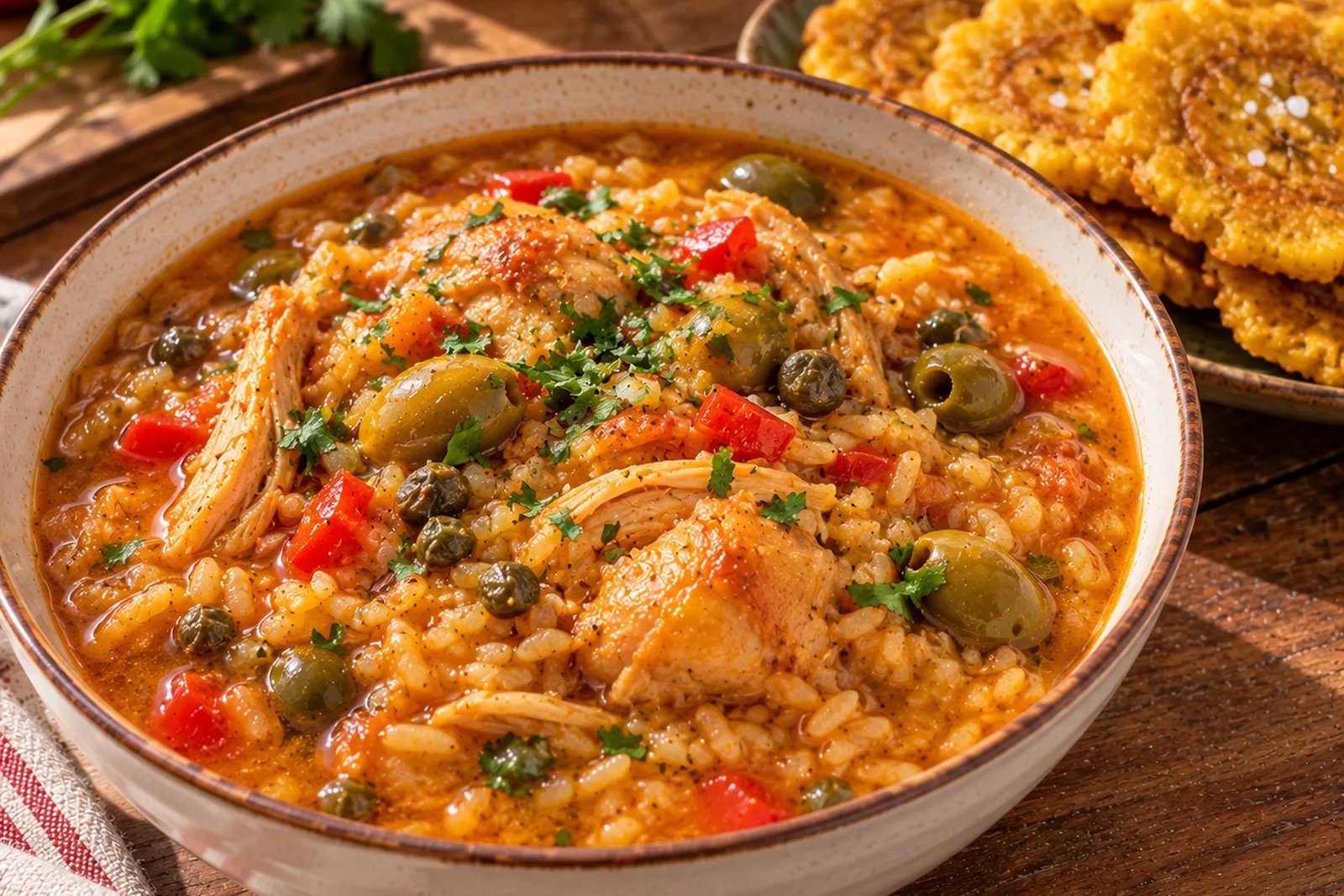

Asopao (ah-soh-PAH-oh) is Puerto Rico’s soupy chicken and rice: chicken simmered in sofrito, sazón and tomato sauce, with 1 cup of medium-grain rice cooked in about 7 cups of liquid, so the grains swell and thicken the broth without drying out. It eats like a thick soup, with a spoon, and it is often called the island’s national soup. The whole trick is timing: the rice goes in once the chicken is almost done, cooks for about 20 minutes, and the pot goes to the table the moment the grains are tender, because they keep absorbing broth. Below: the recipe for 6, what to buy in a US or UK supermarket, and how to rescue a pot that has turned to porridge.
What asopao is, and how it differs from arroz con pollo
How do you make asopao de pollo? Brown 2 lb (900 g) of chicken thigh chunks, cook ½ cup of sofrito with a packet of sazón and an 8 oz can of tomato sauce, then return the chicken with 6 cups of stock and simmer it covered for 10 minutes. Stir in 1 cup of medium-grain rice and the olives and simmer uncovered for 18 to 22 minutes, until the rice is tender and the chicken reaches 165°F (74°C). Thin with hot stock and serve at once. 70 minutes for 6 servings.
If you know Spanish rice dishes, think of it as a cousin of arroz con pollo with roughly three times the liquid. The Colombian arroz con pollo is a dry rice: every drop is absorbed and the grains come out separate. Asopao is served in a deep bowl, with the rice suspended in a glossy, starchy broth that tastes of green herbs, annatto and briny olives.
It’s also not a chicken soup with rice on the side. In the Mexican caldo de pollo the broth stays clear and the rice is added at the table, and the Colombian sancocho is a root-vegetable and plantain soup with rice served separately. In asopao the rice cooks in the pot and changes the broth.
Time: 70 minutes, 15 of cutting and seasoning and 55 at the stove, 30 of them a gentle simmer where you only stir. Easy, as long as you don’t walk away from the rice.
Ingredients, and what to buy outside Puerto Rico
The recipe makes 6 deep bowls, about 5 oz (150 g) of raw chicken per person, with broth to spare.
Chicken
Boneless, skinless thighs are the safest bet: they take 30 minutes in the pot and stay juicy. Breast dries out if it simmers the whole time, so brown it, set it aside and return it when the rice has 10 minutes left, pulling the pot as soon as the chunks hit 165°F (74°C). For more flavor in the broth, use about 3 lb (1.3 kg) of bone-in pieces: same method, but I give them 15 minutes covered before the rice instead of 10, and check the temperature next to the bone.
The Puerto Rican pantry, and swaps
| Ingredient | What it is | If you can’t find it |
|---|---|---|
| Sofrito / recaíto | Green paste of culantro, sweet ají peppers, onion, green pepper and garlic | Blend ½ onion, ½ green bell pepper, 3 garlic cloves and a bunch of cilantro. Less fragrant, still good |
| Sazón with coriander and annatto | Salty seasoning packet that turns the broth orange | Homemade sazón (linked below), or annatto oil for the color |
| Alcaparrado | Manzanilla olives, pimientos and capers in brine | Pimiento-stuffed green olives with 1 tsp capers |
| Adobo | Garlic, oregano, pepper and salt | The salt, garlic powder and oregano in the recipe |
The homemade sofrito (it makes 1½ cups and freezes in ice-cube trays) and the homemade sazón are in my Puerto Rican arroz con gandules. If you buy a jar, get green recaíto; red “sofrito” jars contain tomato and change the flavor. In the US, all four sit in the Hispanic aisle of most supermarkets. In the UK, look in Caribbean or Latin shops or online, or make the blended swap above.
Annatto oil, for deeper color: warm 3 tbsp oil with 1 tbsp annatto (achiote) seeds over low heat for about 5 minutes, without letting it smoke, and strain.
Rice
- Medium-grain, the usual choice for asopao. It releases starch that thickens the broth and turns tender without falling apart. Don’t rinse it: that starch is what gives the broth body.
- Long-grain works, but the broth stays thinner and the grains more separate. Go by the bite test, not the clock.
- Parboiled (converted) rice holds up longer without going mushy, but takes longer to soften and gives a thinner broth.
- Arborio or paella rice, I don’t use here: they soak up far more broth and you end up with risotto.
Stock. Use low-sodium, because the adobo, sazón, ham and olives all add salt. Water plus a bouillon cube works too; taste before salting.
Equipment. A heavy 5 to 6 quart (5 to 6 liter) pot or Dutch oven and a wooden spoon that reaches the corners. In a thin pot the rice sticks, so stir more often.
Making asopao, step by step
The base
Brown the chicken in 2 batches, 4 to 5 minutes each; crowd the pot and it steams and turns gray. The sofrito cooks 3 to 4 minutes in the browned bits until it stops smelling raw. The sazón gets just 30 seconds, since annatto scorches fast and turns bitter, then the tomato sauce 2 minutes.
When the rice goes in
Only after the chicken has had 10 minutes in the broth. Rice that cooks from the start alongside the chicken is split and pasty by the 40-minute mark.
From then on the pot stays uncovered at a gentle simmer, steady bubbles but no rolling boil. Stir from the bottom every 5 minutes, because the starch settles and catches. From minute 18, bite a grain: it’s ready when there’s no chalky center and the grain is still whole, usually between 18 and 22 minutes.
Is the chicken done?
Chicken is safe at 165°F (74°C) in the center of the thickest piece. With 1½ in (4 cm) thigh chunks, 10 minutes covered plus about 20 with the rice usually gets there with room to spare. Without a thermometer, cut the largest piece: it should be opaque all the way through with clear juices. Treat that as a rough guide, since annatto stains the outside.
How soupy it should be
At the right point, a ladle lifts rice suspended in broth, not a mound, and the broth is thick but still flows. Once the heat is off, the rice keeps drinking, and a pot left to sit soon turns into soft rice. So:
- Serve as soon as the rice is tender, with bowls already out.
- Loosen with the hot reserve stock, ½ cup at a time. Cold stock stops the simmer and leaves the bowls lukewarm.
- For a thicker, stand-up-spoon asopao, give it 3 or 4 more minutes over low heat rather than adding more rice.
Mushy, watery or stuck, and how to fix it
The most common complaint is a pot with no broth left by the time it reaches the bowls. It nearly always comes down to one of four causes, and most can be fixed on the spot.
- Too salty. Adobo, sazón, ham, olives and bouillon add up. Salt only at the end; if you overshoot, add unsalted stock or hot water and simmer 2 minutes.
- Dry, stringy chicken. Breast cooked from the start, or a hard boil. Use thighs, or return the breast for the last 10 minutes.
Heat and allergens. Not spicy: the ají dulce in sofrito is a sweet pepper, and kids usually like it. The recipe as written is gluten-free and dairy-free, but some sazón, adobo, jarred sofrito and bouillon products contain additives, so check the labels.
Variations
- Shrimp asopao (asopao de camarones). Swap the chicken for 1½ lb (700 g) peeled shrimp and the chicken stock for seafood stock or a quick stock simmered from the shells. Build the base and cook the rice the same way, without chicken, and stir in the raw shrimp once the rice is tender: 3 to 5 minutes, until pink and opaque. Any earlier and they turn rubbery.
- Asopao de gandules. A different dish: a pigeon pea stew with green plantain dumplings and little or no rice. You can’t get there by swapping the chicken in this recipe.
- With plantain dumplings. Grate 1 very green plantain, mix with a little adobo, roll small balls and drop them in with the rice. Plantains that are starting to yellow won’t hold together.
- For 12. Double everything in an 8 to 10 quart (8 to 10 liter) pot and brown the chicken in 4 batches. It takes a few extra minutes to come to a boil; the rice time doesn’t change. Keep 4 cups of hot reserve stock, because a big pot takes longer to serve and keeps thickening.
Cost. The chicken is the expensive part; boneless thighs usually cost less than breast and hold up better in the broth. To stretch it, add more stock, rice and peas rather than more chicken.
Serving, storing and reheating
To serve. In deep bowls with lime wedges, sliced avocado and twice-fried tostones or crusty bread. No rice on the side: it’s already in there.
Make-ahead. Cook through step 4, with the chicken simmered 10 minutes in the broth. Cool it in a shallow container and refrigerate within 2 hours. The next day bring the base back to a boil, add the rice and carry on from step 5: the rice always cooks on the day you eat it.
Fridge. Finished asopao keeps 3 to 4 days in shallow covered containers. By day two there’s barely any broth left.
Freezer. Soups and stews keep their quality for 2 to 3 months. Frozen rice turns soft and breaks up on thawing, so I freeze the chicken base without rice, flat in bags, and cook fresh rice when I reheat. Thaw overnight in the fridge.
Reheating. In a saucepan over medium heat with ½ cup (120 ml) of stock or hot water per serving, stirring, until it boils or reaches 165°F (74°C). In the microwave, covered, with the liquid added first, in 1 to 2 minute bursts, stirring in between.
Asopao questions
Is asopao a soup or a stew? Somewhere in between: it’s rice cooked in a lot of broth. When you serve it, the rice should sit in liquid. If you can cut it with a spoon, it has become a risotto-like rice.
Can I use leftover cooked rice? Yes. Heat the base with the chicken and stir in 2 cups of cooked rice just 5 minutes before serving. The grains stay more separate and the broth thinner.
How much rice for a thicker asopao? Up to 1½ cups with the same stock. It comes out spoon-standing thick and firms up even faster as it sits, so keep the hot reserve close. If you like rice dropped into broth at the end, the Colombian chicken giblet and rice soup works the same way.
Why does my asopao taste vinegary? The olive brine or a sharp jarred sofrito. Drain the alcaparrado before it goes in.
Asopao nutrition
Per serving (1/6 of the recipe, with ham, peas and low-sodium stock), worked out ingredient by ingredient from the recipe amounts:
- Calories: 460 kcal
- Protein: 42 g
- Carbohydrates: 38 g
- Fat: 16 g, of which 4 g saturated
- Fiber: 3 g
- Sugars: 4 g
- Sodium: 1010 mg
The chicken brings about 180 kcal per serving and the rice about 120. Sodium runs high from the sazón, tomato sauce, ham, olives and stock together: leaving out the ham saves about 130 mg per serving, and homemade unsalted stock saves much more.
I grew up with Venezuelan chicken soup, where the rice or noodles were cooked separately, so asopao made me change my order of work: the rice goes in last and the pot goes straight to the table. When I know there will be leftovers, I set aside a couple of ladles of the base before the rice goes in and cook fresh rice in it the next day, because reheated asopao is never quite as brothy. Josnaisis.