

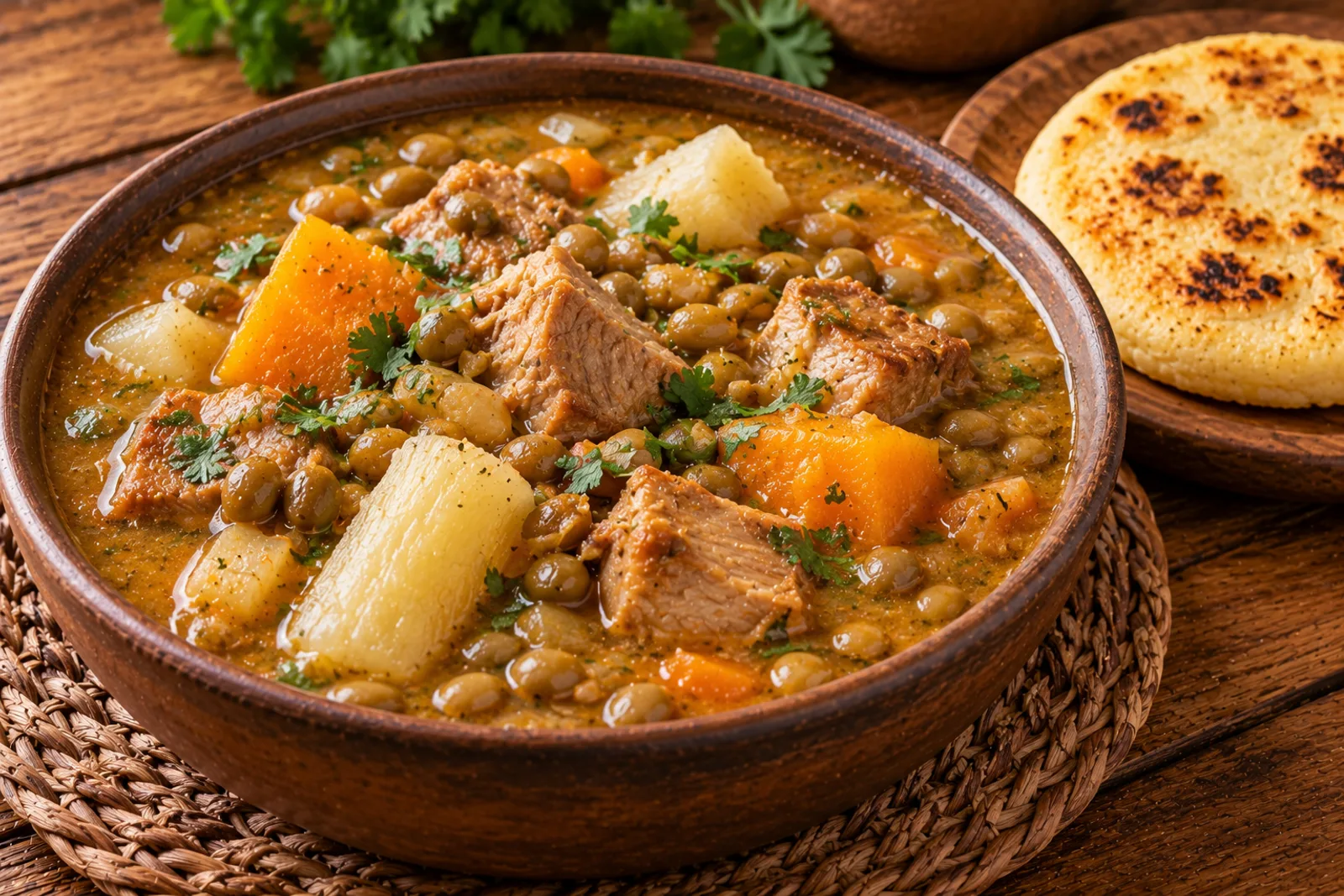

Sopa de quinchoncho is what Venezuelans make with pigeon peas when they want them in a bowl instead of in rice: dried peas soaked overnight, boiled once and drained, then simmered with pork ribs and bacon until soft, with malanga, plantain and squash added in turns. It’s a thick, filling, one-bowl dinner. If you’ve only met pigeon peas in Puerto Rican or Dominican rice, this is a different way to eat them, and below you’ll find what to buy in the US or UK, how long each kind of pea takes, and how to tell the pot is done.
What is sopa de quinchoncho?
How do you make Venezuelan pigeon pea soup? Soak 500 g (1.1 lb) of dried pigeon peas overnight, boil them 15 minutes in fresh water and drain. Simmer them 60 minutes with browned pork ribs and bacon in 3 liters (3.2 qt) of water, add malanga, plantain and an annatto sofrito, and after 15 minutes the squash. Finish with cilantro. 155 minutes, 6 bowls.
Quinchoncho (keen-CHON-cho) is the Venezuelan name for pigeon peas, and this soup belongs to everyday country cooking there rather than to one region: in Falcón it’s eaten with goat cheese and arepas, in the Andes with rice. Every household uses the pork it has, or no meat at all. The finished soup is brick red from the annatto, earthy and slightly nutty, thick enough to coat a spoon.
Time. 155 minutes, of which about 40 are hands-on: picking over the peas, chopping and peeling, mostly while the peas simmer. Difficulty, easy: the only real requirement is remembering the soak.
It isn’t the Dominican moro de guandules or Puerto Rican arroz con gandules, where the same peas cook inside the rice with no broth. Nor is it the Colombian pigeon pea soup made with salted beef. And if you want the Sunday meat-and-roots soup without legumes, that’s Venezuelan beef hervido, or Venezuelan cruzado with beef and hen for two meats.
Pigeon peas, and which kind to buy
One pea, many names
Pigeon peas are small, round legumes, beige or speckled when dried and green when fresh. You’ll find them under different names depending on the shop:
- US supermarkets and Latin grocers: gandules or pigeon peas, in the Hispanic aisle.
- UK: gungo peas, the Jamaican name, in 400 g tins on the world-food shelf, and frozen pigeon peas in some bags.
- Indian grocers: toor or arhar. Watch out: toor dal is hulled and split, and it collapses into mush in a soup. Ask for the whole pea, with its skin.
- Spanish speakers: quinchoncho in Venezuela, guandú in Colombia and Panama, guandul in the Dominican Republic, gandul in Puerto Rico.
Dried, frozen or canned
The recipe is written for dried peas, which give the firmest texture and the fullest broth. Frozen green peas skip the soak and are tender sooner. Canned peas are the easiest to find and still make a good soup, a little softer and with a thinner broth. The timing for each is in the table further down.
The pork
I use pork spare ribs, for meat that comes off the bone and a broth with some richness, plus bacon for smokiness. Pork chops, pork trotters or beef short ribs work too; beef ribs need about 40 minutes on their own before the peas go in. The meat is a supporting act here: the peas are the dish.
Vegetables and US or UK swaps
- Malanga (Venezuelan ocumo, also sold as yautía). It turns creamy in the broth. Latin and Caribbean grocers carry it; white yam (ñame) is firmer but works, and a floury potato will do in a pinch. Don’t use orange “yams”, which are sweet potatoes.
- Plantain. Semi-ripe, yellow with green patches, for a mild sweetness. Green stays firmer and less sweet; fully black ones dissolve.
- Squash. Venezuelan auyama is a dense orange squash; calabaza from a Latin grocer or butternut from any supermarket is the match. It’s what thickens the soup.
- Ají dulce. A small pepper with perfume and no heat. US Latin grocers sell it frozen; otherwise use the extra bell pepper. The scallion is a spring onion in the UK.
- Annatto (achiote). It colors the oil red and adds little flavor. Without it the soup is brown, and just as good.
Equipment. An 8-liter (8-quart) pot, a colander and a ladle for skimming. For the shortcut, a pressure cooker of at least 6 liters (6 quarts).
How to make it, step by step
Soak, then boil and drain
An 8 to 12 hour soak hydrates the peas and cuts the cooking time a lot. Without it, stovetop peas can take over 2 hours and soften unevenly; if you forgot, go straight to the pressure cooker.
Then the step Venezuelans don’t skip: 15 minutes at a hard boil in fresh water, and that water goes down the drain. Dried pigeon peas can have a faint bitterness, and it leaves with that water. It comes out murky and yellowish. I never skip it.
Some cooks add 1 tsp of baking soda to the soak to soften the peas faster. I don’t: with a soak and the first boil it isn’t needed, and too much makes them taste soapy.
Simmering the peas with the pork
The bacon renders in 5 minutes and the ribs brown in that fat in another 5. They only need to lose their pink outside. Then peas and water go in, you skim when it boils, and it simmers 60 minutes with the surface just trembling.
At 60 minutes, taste three peas, not one, because they don’t all soften at once. They’re ready when they squash between two fingers with no resistance and no chalky white center. Some skins split open; that’s fine. The ribs should give to a fork.
When each vegetable goes in
- Peas soft: malanga, plantain, the sofrito and 1 tsp of salt, 15 minutes.
- Then: the squash, another 15 minutes.
- Heat off: cilantro, scallion greens and the last ½ tsp of salt.
Add the squash with the malanga and it dissolves completely, turning the soup into a purée. Added last, part of it melts and thickens the broth and the rest stays in chunks.
How to tell it’s done
- Peas → crush against the roof of your mouth with your tongue.
- Malanga → a knife slides in and the chunk stays whole.
- Squash → the edges have melted and the broth looks orange.
- Broth → coats the spoon without being a purée. Too thin: press a ladle of peas and squash against the side of the pot and simmer 10 minutes uncovered. Too thick: hot water, ½ cup (120 ml) at a time.
- Salt → only at the end, after tasting, because of the bacon.
Pressure cooker, frozen and canned peas
Pressure cooker. Soak and boil the peas as above. Brown the bacon and ribs in the pressure cooker, add the peas and 2 liters (2.1 qt) of water, bring to a boil with the lid off, skim and lock the lid: 20 minutes at high pressure, then let it release naturally for 10 minutes. Unsoaked, 30 minutes. Never fill it past halfway, because the peas foam and can block the valve. Open, test the peas, add the remaining 1 liter (1 qt) of water, hot, and carry on uncovered with the malanga, plantain and sofrito.
Frozen or fresh green peas. No soak. Boil them 10 minutes, drain, and add them once the ribs have simmered alone for 30 minutes. Cook 30 minutes together, then the vegetables.
Canned peas. You need about 1.2 kg (2.6 lb) drained, roughly 7 cups, which is what 500 g of dried peas gives once cooked; check the drained weight on the label to know how many cans or tins. Simmer the ribs alone 60 minutes, add the drained and rinsed peas with the malanga, and follow the recipe from there. Use 2 liters (2.1 qt) of water instead of 3, since canned peas don’t absorb any.
Other versions
- Meatless. Sofrito with 3 tbsp of oil and annatto, peas and vegetables, and a bit more squash for body. It’s vegan and gluten-free.
- Beef short ribs. They simmer alone 40 minutes before the peas.
- Pork trotters. A more gelatinous soup. Simmer the trotters until a fork goes in easily, then add the peas.
- With pasta. Some families stir in a handful of short pasta at the end. I’d rather serve rice on the side, because pasta keeps drinking the broth overnight.
Making it for 12 or 20
Double everything for 12 in a 16-liter (16-quart) pot. For 20, multiply by 3⅓ and split between two pots: one huge pot takes too long to come back to a boil after each addition. Larger batches of peas can take a little longer, so test three peas before adding vegetables, which keep their 15 + 15 minutes.
Make ahead. Put the peas to soak in the fridge and chop the sofrito the night before; the sofrito keeps covered in the fridge too. To get further ahead, cook the peas with the pork until soft, cool quickly and refrigerate. Next day, bring back to a boil and finish with the vegetables, about 35 minutes.
Common mistakes
- Peas won’t soften. Old stock or too short a soak. If they’re hard at 90 minutes, pressure-cook them in their broth for 15 minutes.
- Bitter aftertaste. The first-boil water wasn’t thrown out. Can’t be fixed in that pot; next time, boil 15 minutes separately.
- Watery soup. Not enough squash or taken off the heat too early. Press peas and squash against the pot and simmer 10 minutes uncovered.
- Malanga fell apart. It went in before the peas were soft and sat boiling while they caught up.
- Too salty. Salt went in at the start with the bacon.
Heat: none. Ají dulce isn’t spicy; put hot sauce on the table. Kids usually like it for the sweet squash and plantain. Allergens: no gluten, dairy, egg, nuts or fish. Pigeon peas are a legume, so anyone avoiding legumes should skip it.
Serving and storing
Serving. Deep bowls, each with a rib, peas, a piece of each vegetable and broth. Serve Colombian-style white rice and Venezuelan arepas on the side; crumbled salty white cheese on top is how Falcón eats it, and feta is the closest UK or US swap. Sliced avocado goes well.
Fridge. 3 to 4 days at 40°F (4°C) or below, as long as it’s in the fridge within 2 hours of coming off the heat. It thickens overnight and, to me, tastes better.
Freezer. 2 to 3 months. Peas, pork and broth hold up well; the malanga turns slightly rubbery.
Reheating. Covered, over low heat, with ½ cup (120 ml) of water for every 2 cups of soup, stirring so it doesn’t catch, until it simmers and reaches 165°F (74°C).
FAQ
Are pigeon peas the same as gandules and gungo peas? Yes. Gandules, guandules, guandú, quinchoncho and gungo peas are all the same legume. Toor dal is too, but hulled and split, so it won’t hold its shape in soup.
Why boil the peas and throw the water away? To remove the faint bitterness dried pigeon peas can have. Fifteen minutes at a hard boil, and that water doesn’t go back in.
Can I use black-eyed peas instead? They make a good soup, but a different one: softer, with a milder flavor. Use the same soak and cooking times and test them earlier.
How long do dried pigeon peas take in an Instant Pot or pressure cooker? Soaked, 20 minutes at high pressure plus 10 minutes natural release. Unsoaked, 30 minutes plus 10.
Nutrition per bowl
Per bowl (one sixth of the pot), calculated ingredient by ingredient from the recipe card, counting 350 g (12 oz) of meat and fat in the 500 g (1.1 lb) of bone-in ribs, malanga as yautía, the squash as butternut and the 9 g of salt, without rice or arepas:
- Calories: 778 kcal
- Protein: 34 g
- Carbohydrates: 99 g
- Fat: 29 g, including 9 g saturated
- Fiber: 18 g
- Sodium: 856 mg
Each bowl holds about 83 g (3 oz) of dried peas, which supply more than half the protein and most of the fiber. The fat comes mainly from the bacon and ribs, so the meatless version is much lighter.
I make this almost always in the pressure cooker: the peas soak overnight and the rest happens in the morning. In Colombia I buy them as guandú at the market, and now and then fresh and green, which means no soaking at all. The one thing I never change is the first boil, 15 minutes and that water gone. Josnaisis.