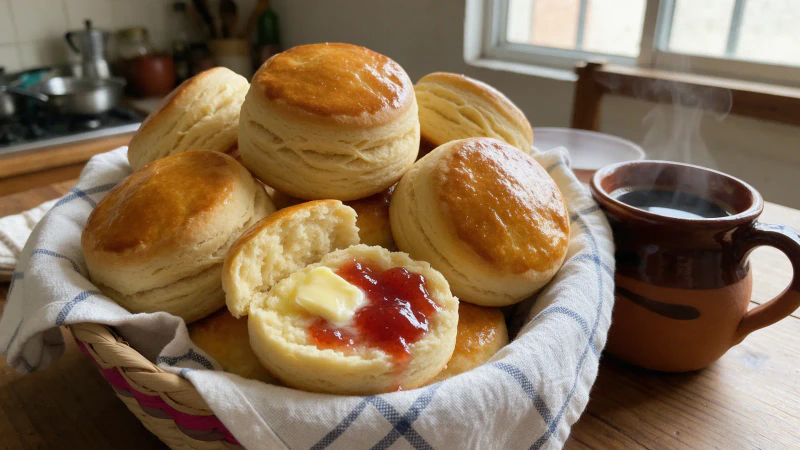
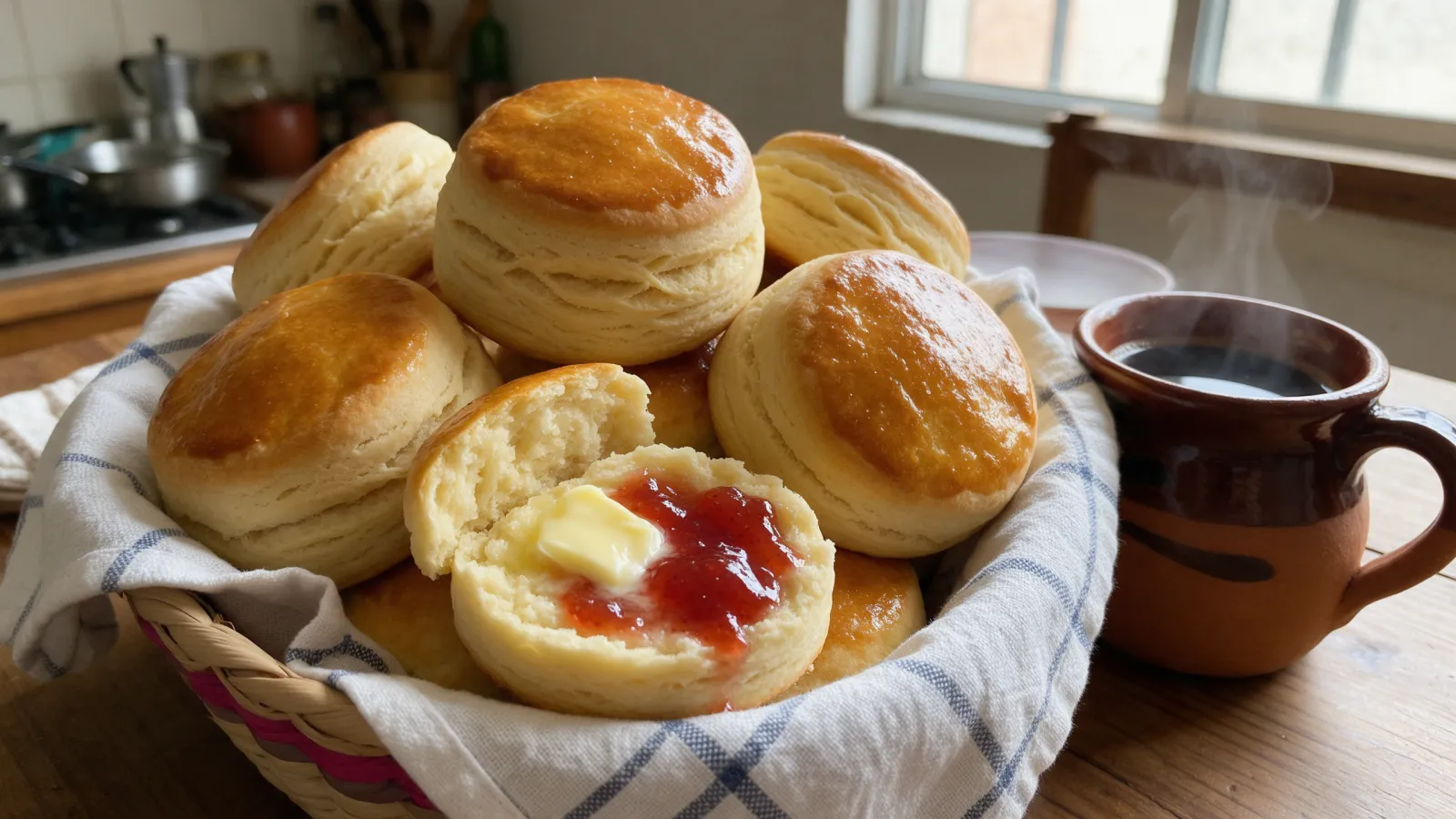

In a Mexican café, a bisquet (bees-KET) arrives warm on a small plate next to a cup of coffee, split in half, with butter and a dish of strawberry jam. It is Mexico’s take on the American biscuit, sold in bakeries and coffee shops: a quick bread made with cold butter and baking powder, but with an egg in the dough, a touch of sugar and an egg wash that bakes into a shiny, deep-gold top. This batch makes a dozen tall, layered bisquets from 4 cups (500 g) of flour without yeast, and the two habits that decide whether they rise straight are cold butter and a cutter that never twists.
What are Mexican bisquets, and how are they different from biscuits and scones?
How do you make Mexican bisquets? Cut 1½ sticks (170 g) of cold butter into 4 cups (500 g) of flour with baking powder, salt and sugar, then stir in one egg and a cup of cold milk without kneading. Fold the dough in thirds twice, chill it 30 minutes, cut ¾-inch (2 cm) rounds, brush with egg and bake at 375°F (190°C) for about 20 minutes. Ready in 85 minutes for 12 servings.
All three are cold-fat, baking-powder breads, which is why they get confused. The differences are small but you can taste them.
Make them if you want a weekend breakfast bread that needs no rising time, or a bag of raw rounds in the freezer for weekday mornings. Skip them if you are after a soft, airy pan dulce: for that, Mexican conchas with a sugar shell are the bakery classic, and they take 205 minutes because the dough has to rise.
Time and effort. 85 minutes start to finish, about 35 hands-on. Difficulty, easy. There is no kneading and no proofing; the only skill is working fast enough that the butter stays cold.
Ingredients and US and UK swaps
Exact amounts are in the recipe card. Measured against the flour, the dough is 34% butter, 10% sugar, 4.4% baking powder and 1.2% salt, bound with one egg and a cup of milk.
Flour. Ordinary all-purpose in the US, plain flour in the UK. Spoon it into the cup and level it, or you will pack in more than 125 g (4.4 oz) per cup and the bisquets come out dry. Do not use self-raising flour with the full amount of baking powder: it already contains raising agent.
Baking powder. Most US supermarket baking powder is double-acting, and the label says so: about a third of the gas is released when the dough gets wet and the rest in the oven, once the dough passes about 120°F (49°C). That second push is why chilled or frozen rounds still rise. In the UK, standard baking powder works; just bake soon after cutting.
Butter. Unsalted, straight from the fridge. Replacing a third of it with vegetable shortening (Crisco in the US, Trex or Cookeen in the UK) gives a slightly more tender bisquet. Lard is used in some Mexican kitchens and adds its own flavor.
Milk. Whole milk is standard. Buttermilk works too and makes the crumb a little tangier; to fake it, stir 1 tbsp lemon juice into the milk and leave it 10 minutes.
Sugar. Granulated in the US, caster in the UK. At ¼ cup (50 g) for 12, it is there for browning more than sweetness.
Equipment. A pastry blender or two forks, a rolling pin, a sheet pan with parchment and a 2¾-inch (7 cm) round cutter. No cutter? Use a thin-rimmed floured glass, pressed straight down, or cut 2½-inch (6 cm) squares with a sharp knife, which leaves no scraps to re-roll.
How to make bisquets, from cold butter to egg wash
Cut in the butter and stop before it looks like dough
Cube the butter and put it back in the fridge while you measure the dry ingredients. You are aiming for coarse sand with pea-sized lumps; those lumps become the layers. Use your fingertips or a pastry blender, never your palms. If the butter starts to look glossy, put the whole bowl in the freezer for 10 minutes.
When the milk and egg go in, stop the moment there is no dry flour. Every extra stir builds gluten, and gluten is what makes a bisquet tough and dense. The dough will look rough and a bit sticky. That is right.
Two letter folds for layers
Pat the dough into a rectangle about ¾ inch (2 cm) thick, fold one third over the middle and the other third on top, like a business letter. Turn it 90 degrees, flatten and fold again. Two folds give nine layers of dough with butter between them. Keep folding and the butter warms up without adding layers you can see; if the dough gets sticky, give it 10 minutes in the fridge between folds.
Cut straight down, never twist
Roll the chilled dough to ¾ inch (2 cm); bisquets nearly double in height in the oven. Flour the cutter each time, press straight down to the counter and lift. A twist squashes and seals the cut edge, so that side rises less and the bisquet leans. Stack the scraps once, without kneading. Those last few will be a bit shorter.
Egg wash and the center mark
Brush the beaten egg and milk over the tops only. Egg that runs down the sides sets on the edge in the oven and holds that side down. The small ring pressed into the center is the Mexican bakery look; it does not change the flavor, but it helps the top rise evenly.
Oven temperature, timing and doneness
Bake at 375°F (190°C) for 18-22 minutes on the center rack. They are done when the tops are deep golden and glossy, the bottoms golden and the sides look dry rather than shiny. With a thermometer, the center reads about 200°F (93°C). A hotter oven browns the sugary, egg-washed top before the middle is cooked. Keep the door shut for the first 10 minutes.
Make ahead, freeze unbaked and bake from frozen
This is the most useful thing to know about bisquets. Cut the rounds, set them on a lined tray without the egg wash and freeze until hard, then move them to a freezer bag. They keep up to 2 months.
On the morning, do not thaw them. Put the frozen rounds on a lined sheet, brush with egg wash and bake at 375°F (190°C), about 5 minutes longer than fresh ones. Bake two or the whole bag.
Overnight in the fridge. You can also make both folds, wrap the dough and leave it in the fridge until the next morning, then roll, cut, brush and bake.
Scaling. Half the recipe makes 6. For 12-20 people, double it for about 24, but mix it as two separate 500 g batches: 340 g (3 sticks) of butter in one bowl starts to soften before you finish cutting it in.
Why bisquets don’t rise, or come out hard
- Old baking powder. If the tin has been open longer than 6 months, stir ½ tsp into ¼ cup hot water. It should fizz hard. If it barely bubbles, replace it.
- Kneading. Mix, fold, cut. Anything more and they turn tough.
- Soft or melted butter. No layers and greasy bottoms. Cold cubes and the 30-minute chill fix it.
- Twisting the cutter or rolling too thin. Short, lopsided bisquets. Straight down, ¾ inch (2 cm) thick.
- Cut rounds left on a warm counter. The butter softens and the powder loses some of its first lift. If you are not baking right away, put them in the fridge.
- A cool oven. Pale tops, doughy centers. Preheat for 20 minutes and check the 375°F (190°C) with an oven thermometer if you can.
Heat level, 0 out of 5. Kid-friendly? Very: soft, barely sweet, and pressing the center mark is a good job for small hands. Allergens. Wheat (gluten), egg and milk.
Variations
- Bakery-style, with yeast. Some Mexican bakeries and home recipes add yeast to the baking powder for a fluffier crumb. Mix 4 g (1¼ tsp) instant yeast into the dry ingredients and let the cut rounds rest, covered, 30 to 45 minutes before the egg wash. Keep the butter very cold, since the dough sits out longer.
- Half shortening. 120 g butter and 50 g shortening, for a more tender bisquet.
- Buttermilk. Swap all the milk for cold buttermilk.
- Filled. Split and fill with cream cheese and strawberry jam.
- Unsweetened. Leave out the sugar for a plainer, savory-leaning bisquet to eat with eggs.
What a batch costs
A dozen bisquets cost about 24 cents apiece in the US, $2.85 for the batch at September 2026 city-average prices, before baking powder and salt. Butter is 52% of the cost.
Yield. 12 bisquets from about 1,050 g (2.3 lb) of dough, roughly 88 g (3 oz) each. One per person with coffee, two for a full breakfast. Swapping part of the butter for shortening is the only real saving.
Serving and storing
Split them warm and spread with butter and jam, or with nata, the thick cream that forms on boiled milk and also goes into Mexican gorditas de nata; clotted cream is the closest thing in a UK shop. Coffee is the classic partner, and a pot of Mexican cafe de olla with piloncillo and cinnamon suits them better than anything. On a cold afternoon, try a thick Mexican champurrado or a Colombian hot chocolate with cheese. For a bigger bread spread, they sit well next to crusty bolillo rolls and a tray of Colombian mantecada, a buttery corn cake.
Room temperature. Fully cooled, in a sealed container or bag, 2-3 days. Best on the first day; reheat them from the second.
Fridge. Not needed, and it dries the crumb faster.
Freezer, baked. Wrapped one by one in a freezer bag, up to 2 months.
Reheating. Wrapped in foil, 8-10 minutes at 325°F (160°C) at room temperature or thawed, 15-20 minutes from frozen. The microwave, 10-30 seconds, softens them but the top loses its crispness.
FAQ
Are Mexican bisquets the same as American biscuits? Close relatives. A bisquet has egg in the dough, a little sugar and an egg-washed top, and is eaten with butter and jam. A Southern biscuit usually has no egg and little or no sugar.
Do bisquets have yeast? Home versions like this one use only baking powder. Some bakery versions add a little yeast and a short rest for a fluffier crumb.
Why didn’t my bisquets rise? Usually old baking powder, a twisted cutter or dough rolled thinner than ¾ inch (2 cm).
What temperature do you bake bisquets at? 375°F (190°C) for 18-22 minutes, until golden top and bottom with dry-looking sides.
Can you freeze bisquet dough? Yes. Freeze the cut rounds without egg wash for up to 2 months and bake from frozen, about 5 minutes longer.
How many bisquets does this make? About 12 with a 2¾-inch (7 cm) cutter and ¾-inch (2 cm) dough, re-rolling the scraps once.
Nutrition per bisquet
Worked out from each ingredient for one bisquet, a twelfth of the batch, with all-purpose flour, unsalted butter, whole milk and half the egg wash:
- Calories: 292 kcal
- Protein: 6 g
- Carbohydrates: 38 g
- Fat: 13 g, including 8 g saturated
- Fiber: 1 g
- Sugars: 5 g
- Sodium: 409 mg
Flour supplies 52% of the calories and butter 35%. Close to half the sodium comes from the baking powder, the rest from the salt.
Where I grew up in Venezuela, nata is a thick, slightly sour cream you spread on an arepa, so the first time I saw “bisquet con nata” I pictured the wrong thing. My first batch leaned like little towers in an earthquake, and the dough was not the problem: I was twisting the glass I used as a cutter. Now I press straight down, chill the dough, and my son Dylan peels the top layers off one by one before he lets anyone near the jam. A cold dough and a straight cut are the whole trick. Josnaisis.