
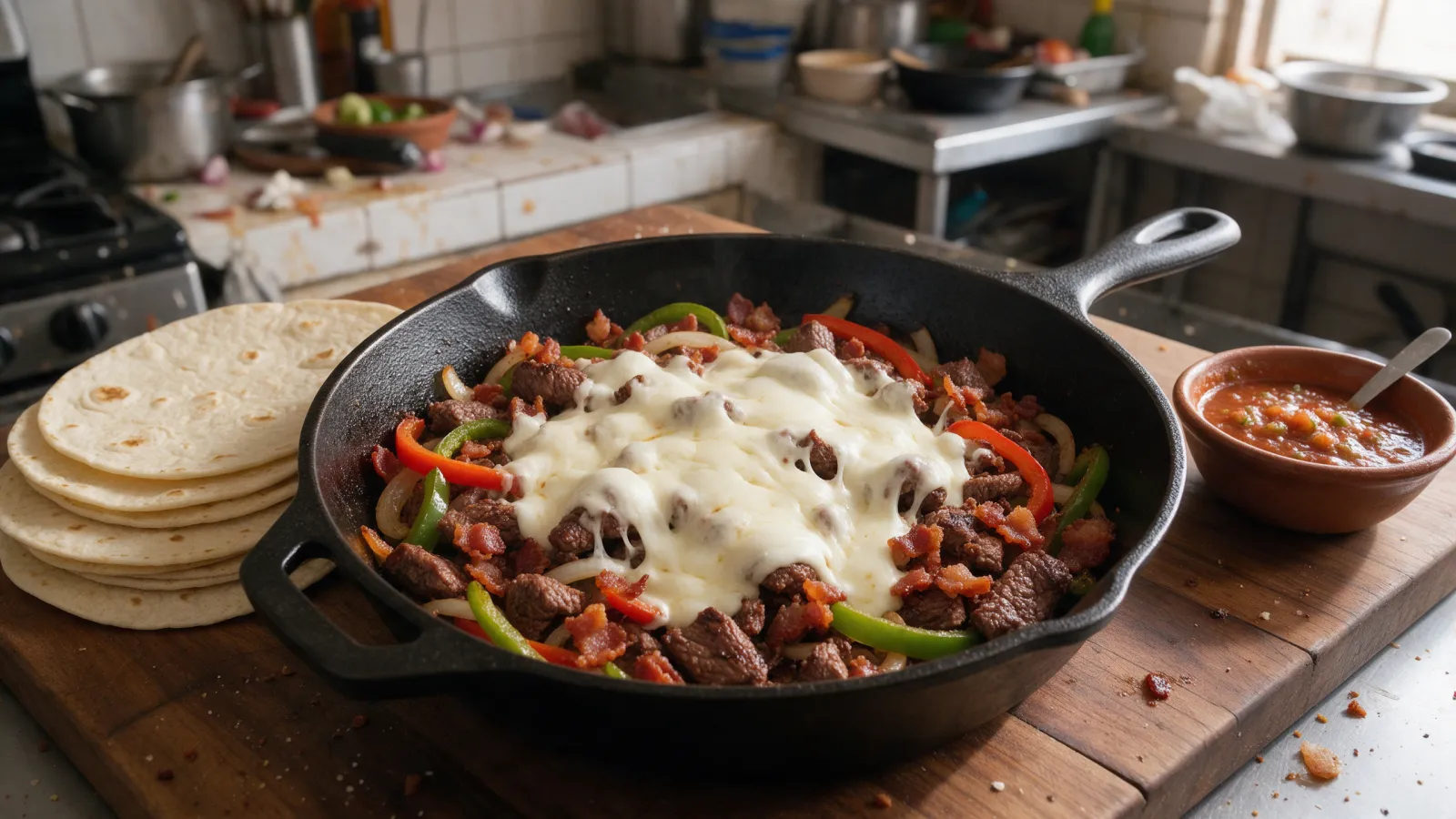

Alambre (ah-LAHM-breh) is a Mexican taquería dish you eat with your hands: small cubes of steak browned with bacon, bell peppers and onion, smothered in melted cheese and spooned into warm tortillas with salsa. It sounds like fajitas, and it isn’t. There is no marinade, the meat is diced rather than sliced, and the whole pan ends under a lid of stretchy Oaxaca cheese. This version walks through which steak to buy in a US or UK supermarket, the cooking order that keeps the pan from going watery, how to melt the cheese without an oven, and how to scale it for a taco night of 12 or 20.
What is Mexican alambre, and who is it for?
How do you make Mexican alambre? Render 4 oz (120 g) of bacon in a cold skillet over medium heat for 6 minutes and lift it out. In the fat, over high heat and one at a time, brown the peppers and onion for 5 minutes, the mushrooms for 5 minutes and 1⅓ lb (600 g) of diced steak in two 3-minute batches. Combine, cover with 7 oz (200 g) of Oaxaca cheese and put the lid on for 2 minutes. Ready in 40 minutes for 4 servings.
The word means “wire” in Spanish, and the usual explanation is that the meat and vegetables were once threaded onto metal skewers to grill. Today it is nearly always chopped and cooked loose on a griddle or in a skillet. Beef is the most common filling, but alambre is also made with chicken, with al pastor pork and with pork chops, and some cooks add ham, chorizo or mushrooms. Who first made it, and where, isn’t documented, so I won’t give you a date.
It is a good fit for a Friday dinner or a game night where the skillet goes in the middle of the table and everyone builds their own tacos. One pan makes 12 tacos, 3 per person for 4.
It may not suit anyone after a light meal: with three corn tortillas a plate comes to about 780 kcal. It isn’t hands-off either, because the 25 minutes at the stove are back to back.
Honest difficulty, easy. No tricky technique, just patience to cook in stages.
Alambre vs fajitas
Chicken fajitas are Tex-Mex: strips of meat marinated in lime, cooked whole and sliced at the end, with peppers and onion in strips, no bacon and no cheese. Alambre is Mexican taquería food with the beef in ¾ in (2 cm) cubes, bacon for the cooking fat and melted cheese over the top. If you want beef in a tomato and serrano sauce instead, that is bistec a la mexicana; if you want a citrus-marinated steak with char from the grill, that is carne asada.
Ingredients, with US and UK swaps
The quantities give each person about 150 g (5 oz) of raw beef, 30 g (1 oz) of bacon and 50 g (1¾ oz) of cheese, with three 6-inch tortillas.
| Ingredient | Metric | US | Notes and UK swaps |
|---|---|---|---|
| Top sirloin or round steak | 600 g | 1⅓ lb | UK: rump steak for sirloin, topside for round |
| Smoked bacon | 120 g | 4 oz, 4-5 slices | UK: smoked streaky bacon; thick-cut holds up better |
| Red and green bell peppers | 150 g each | 1 large each | Any colour; a mix looks best |
| White onion | 150 g | 1 large | Yellow onion works |
| White mushrooms | 150 g | 5 oz | Optional |
| Worcestershire or Maggi | 15 ml | 1 tbsp | Soy sauce for a fish-free version |
| Oaxaca cheese | 200 g | 7 oz, about 1¾ cups shredded | Low-moisture mozzarella or Monterey Jack |
| Corn or flour tortillas, 15 cm | 12 | 12 (6 in) | Warm them just before serving |
Which steak to buy, and how to cut it
Pick a cut that turns tender in 3 minutes in a hot pan. Top sirloin (UK rump) is the most forgiving and the one I use. Round steak (UK topside or silverside) is leaner and cheaper and works if you cut it small and don’t go past the 3 minutes. Chuck is juicy but has some gristle to trim, and skirt has great flavour with a very obvious grain. Stewing beef won’t work here; it needs hours.
Cut across the grain into ¾ in (2 cm) cubes: look for the lines running through the meat and slice through them, not along them. Twenty minutes in the freezer firms the steak so the knife doesn’t squash it. Then pat it dry. Wet beef steams instead of browning.
The cheese
Queso Oaxaca is a mild, stringy Mexican cheese sold in a ball wound like a skein of yarn; you pull it apart by hand and it melts into long strings. Most US supermarkets with a Latin aisle stock it. Mexican recipes also call for “queso manchego”, which in Mexico is a soft cow’s-milk melting cheese, nothing like aged Spanish Manchego, so don’t swap one for the other.
In the UK, the easiest swap is a block of low-moisture mozzarella, the pizza kind, not fresh mozzarella in water, which weeps liquid as it melts.
Equipment
A 12-inch (30 cm) skillet with a lid, ideally cast iron or stainless steel, which can take high heat. No lid? A sheet pan or a large plate upside down over the skillet does the same job. A slotted spoon for the bacon and one big plate to park each ingredient on.
The cooking order that keeps alambre from going watery
Each ingredient goes in, browns and comes out before the next one. Peppers, onion, mushrooms and beef all release water. Cooked together, that water pools, the pan drops below browning heat and everything simmers grey. One at a time over high heat, the water boils off as fast as it appears.
- Bacon, 6 minutes over medium heat, from a cold pan. The fat melts slowly and the bacon browns without burning. The bacon comes out; the fat stays.
- Peppers and onion, 5 minutes over high heat. Browned spots, still bright and firm. Fully soft peppers collapse under the cheese.
- Mushrooms alone, in one layer, over high heat. Leave them untouched for 2 minutes so one side browns, then keep going until their liquid has evaporated, 5 minutes in all.
- Beef, 300 g (about 10 oz) at a time, 3 minutes per batch. One minute without stirring for colour, then toss. All 1⅓ lb at once cools the pan and the beef boils in its own juice.
- Everything back in for 1 minute, then cheese under the lid for 2 minutes with the heat at its lowest.
How to tell each step is done. The bacon has golden edges and the fat in the pan runs clear. The vegetables have browned patches and still bite back. The mushroom pan sizzles again with no liquid in the bottom. A cube of beef cut open shows no pink. The cheese is glossy and stretches when you lift a spoonful.
Melting the cheese without an oven
The lid is the oven. It traps steam and heat, and the cheese melts in 2 minutes without scorching the bottom, as long as the heat is at its lowest and the cheese is shredded and spread in a single layer without stirring. With a cast iron skillet and a broiler, a minute or two under it browns the top in spots. That is a bonus, not a requirement.
Mistakes that ruin alambre
- Watery pan, grey beef. Everything went in together, or all the beef at once. Separate stages, beef in 10 oz batches.
- Tough beef. Cooked past 3 minutes, or a stewing cut. Small cubes, high heat, out.
- Limp, dull peppers. Low heat or an overcrowded pan. High heat for 5 minutes, out while firm.
- Too salty. Bacon, Worcestershire and cheese all bring salt. Taste before adding the ½ tsp.
- Oily or clumpy cheese. An aged cheese or too much heat. Use a melting cheese, shredded fine, lowest heat, lid on.
- Burnt bacon. The pan was already hot. Start cold over medium heat.
Spice level. Alambre itself has no heat at all, 0 out of 5. Heat comes from the table: a red taco salsa with chiles de árbol is properly hot.
Kids. It is steak, bacon and melted cheese in a tortilla, so usually an easy sell. Use flour tortillas and skip the salsa.
Allergens. Milk (cheese). Worcestershire usually contains anchovies, which is fish, and Maggi seasoning usually contains wheat; check the label. Flour tortillas contain gluten, corn tortillas don’t. The bacon is pork.
Which version should you make?
- Short on time → chop the vegetables the night before and skip the mushrooms. About 25 minutes.
- Cheaper → round steak cut small instead of sirloin. It knocks about $5.65 off the pan for 4.
- Chicken alambre → 1⅓ lb (600 g) of boneless thighs or breast in ¾ in cubes, in batches, 5 to 6 minutes per batch, until 165°F (74°C) in the centre. Chicken does need to reach that.
- Al pastor alambre → swap the beef for adobo-marinated pork, often with pineapple. The tacos al pastor recipe covers the overnight marinade; for alambre the pork goes in batches like the beef.
- With ham or chorizo → 3½ oz (100 g) diced ham browned with the bacon, or Mexican chorizo crumbled in place of the bacon.
- No pork → skip the bacon and use 2 tbsp oil for the vegetables. You lose the smokiness; a pinch of smoked paprika on the beef brings some back.
- Vegetarian → no beef or bacon; 10 oz (300 g) mushrooms, 1 zucchini (UK courgette) in squares and the peppers, each browned separately in oil, cheese on top. Use soy sauce, since Worcestershire has anchovies.
- Lighter → half the cheese and no bacon, with 1 tbsp oil for everything. That brings a plate from 780 to about 615 kcal.
Alambre tacos for a crowd
I count 3 tacos and 5 oz (150 g) of raw beef per person. If there are other fillings on the table, 2 tacos each is plenty and the amounts for 12 feed about 18.
| People | Beef | Bacon | Peppers | Onion | Mushrooms | Cheese | Tortillas |
|---|---|---|---|---|---|---|---|
| 4 | 600 g (1⅓ lb) | 120 g (4 oz) | 2 | 150 g (1 large) | 150 g (5 oz) | 200 g (7 oz) | 12 |
| 12 | 1.8 kg (4 lb) | 360 g (13 oz) | 6 | 450 g (3 large) | 450 g (1 lb) | 600 g (1⅓ lb) | 36 |
| 20 | 3 kg (6⅔ lb) | 600 g (1⅓ lb) | 10 | 750 g (5 large) | 750 g (1⅔ lb) | 1 kg (2¼ lb) | 60 |
- Two 12-inch skillets, or a large griddle. The 10 oz batch rule doesn’t change. For 12 that is six batches, done in about 10 minutes across two pans.
- Cook everything but the beef up to an hour ahead and keep it covered in a large pot over the lowest heat.
- Beef when guests arrive, then mixed into the pot.
- Cheese in rounds. Don’t melt it over the whole pot: melt 9 oz (250 g) over a skillet holding about 5 servings, lid on for 2 minutes, out to the table, then the next one.
- Keep it hot at 140°F (60°C) or above, over the lowest heat with a lid, or in a 200°F (95°C) oven.
- Tortillas stay warm wrapped in a towel inside an empty cooler. Homemade flour tortillas can be made the day before; homemade corn tortillas are best the same day.
What alambre costs
Made with round steak, the pan costs about $21.92 at US prices, $5.48 a person; with top sirloin it’s $27.57, or $6.89 each, for 4 people. The beef is two thirds of the bill.
| Ingredient | Amount | Price used | Cost |
|---|---|---|---|
| Top sirloin, boneless | 600 g (1.32 lb) | $14.11/lb, September 2026 average | $18.66 |
| or round steak, boneless | 600 g (1.32 lb) | $9.84/lb, September 2026 average | $13.01 |
| Oaxaca cheese | 200 g (7.05 oz) | $3.79 per 10 oz pack, October 2026 | $2.67 |
| Sliced bacon | 120 g (0.26 lb) | $6.76/lb, September 2026 average | $1.79 |
| Red and green bell peppers | 1 each | $1.19 and $0.86 each, early October sale prices | $2.05 |
| White mushrooms | 150 g (5.3 oz) | $1.76 per 8 oz pack | $1.16 |
| Corn tortillas | 12 | $1.91 per 30 | $0.76 |
| White onion and garlic | 150 g + 6 g | $1.22/lb and $5.99/lb | $0.48 |
| Total with sirloin | $27.57, $6.89 a person |
Worcestershire, salt and pepper aren’t counted. For 20 people it comes to about $138 with sirloin or $110 with round steak. I don’t have reliable UK prices to give you, so there’s no sterling figure.
Storing, freezing and reheating
Fridge. Into a sealed container within 2 hours of cooking, then 3 to 4 days at 40°F (4°C) or below.
Freezer. 2 to 3 months, best without the cheese: freeze the beef, bacon and vegetable filling flat in portions and add fresh cheese when you reheat. The peppers soften.
Reheating. In a skillet over medium heat for 4 to 5 minutes, stirring, until steaming and 165°F (74°C). Then fresh cheese on top and the lid on for 2 minutes. The microwave toughens the beef and turns the cheese rubbery.
Serving. Straight from the skillet with warm tortillas, salsas and lime, so everyone builds their own. An avocado salsa made with tomatillos is the cool, creamy one to put next to the hot red.
Frequently asked questions
What is alambre made of? Diced beef, bacon, bell peppers, onion and melted cheese, sometimes with mushrooms or ham, eaten in corn or flour tortillas with salsa and lime.
What cut of beef is best for alambre? One that is tender after 3 minutes in a hot pan: top sirloin (UK rump), round steak cut small, chuck or skirt. Stewing cuts don’t work.
What is the difference between alambre and fajitas? Fajitas are Tex-Mex: marinated strips of meat cooked whole and sliced, with no bacon or cheese. Alambre is Mexican, with diced beef, bacon and a layer of melted cheese.
What cheese goes on alambre? Oaxaca is the classic. Low-moisture mozzarella, Monterey Jack or Chihuahua all melt well. Avoid aged cheeses, including Spanish Manchego.
How do you melt the cheese without an oven? Lowest heat, shredded cheese spread over the top and a lid on for 2 minutes. A sheet pan or upside-down plate works as a lid.
Why is my alambre watery? Everything went into the pan together, or all the beef at once. Cook each ingredient separately over high heat and the beef in 10 oz (300 g) batches.
How much alambre do I need per person? About 5 oz (150 g) of raw beef and 3 tacos. For 20 people, 6⅔ lb (3 kg) of beef, 1⅓ lb of bacon, 2¼ lb of cheese and 60 tortillas.
Can you make alambre with chicken? Yes. Use thighs or breast in ¾ in cubes, browned in batches for 5 to 6 minutes until they reach 165°F (74°C).
How many calories are in alambre? About 780 kcal a plate with three corn tortillas, about 625 without tortillas, and about 900 with flour tortillas.
Nutrition
Per serving (5 oz / 150 g beef, 1 oz / 30 g bacon, 1¾ oz / 50 g cheese, the vegetables and three 24 g corn tortillas), worked out ingredient by ingredient and counting all the bacon fat, which stays in the pan:
- Calories: 780 kcal
- Protein: 52 g
- Carbohydrates: 43 g
- Fat: 45 g, of which 20 g saturated
- Fiber: 7 g
- Sugars: 6 g
- Sodium: 1,040 mg
The beef brings about 300 kcal, the cheese 160, the tortillas 157 and the bacon 118; the vegetables together about 40. Leaving out the ½ tsp salt takes sodium down to about 750 mg. Swap in three 30 g flour tortillas and a plate rises to about 900 kcal and 1,670 mg sodium.
The first time I made alambre I tipped everything into the pan at once, the way I cook a quick beef and pepper sauté at home, and ended up with stew and cheese floating in the juice. Now I cook it in stages and dirty the same plate four times. Cook each part on its own and the pan takes care of the rest. Josnaisis.