
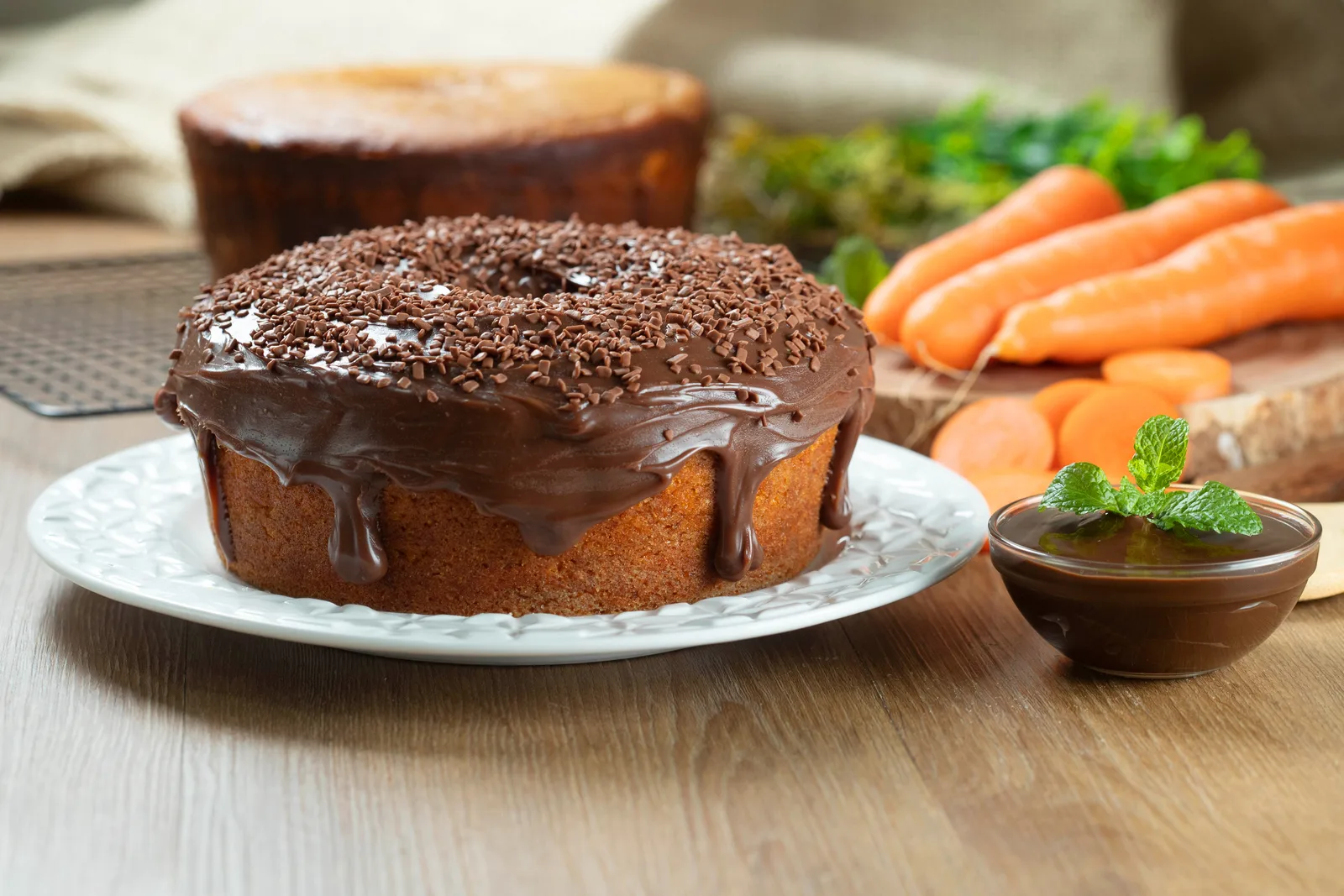

Bolo de cenoura (BOH-loo jee seh-NOH-rah) is the carrot cake Brazilians bake for an afternoon snack, and it has almost nothing in common with the American one. The raw carrots are puréed in a blender with eggs and oil, so the crumb comes out smooth, bright orange and spice-free, and the whole cake gets a soft layer of brigadeiro, the condensed-milk chocolate fudge from Brazilian birthday parties, loosened with cream so it spreads. One sheet pan feeds 12. Below you’ll find gram and cup measures, how long to blend, the three signs that the cake is done, the right consistency for the topping, two other Brazilian toppings and how to store it.
Brazilian carrot cake at a glance
How do you make Brazilian carrot cake? Blend 300 g (10½ oz) raw carrots with 4 eggs and ¾ cup oil until smooth, add 1½ cups sugar, then fold in 2 cups flour and 1 tbsp baking powder by hand. Bake at 350°F (180°C) for 35 to 45 minutes in an 8x12 or 9x13 in pan and cover it while warm with a topping of condensed milk, cocoa, butter and cream cooked to brigadeiro consistency. 90 minutes for 12 servings.
What it tastes like. Mildly sweet, very moist from the oil, with a gentle carrot note you wouldn’t call vegetable-like, under a fudgy layer that tastes like milk chocolate.
Time and effort. About 20 minutes of hands-on work, 35 to 45 minutes in the oven and half an hour to cool and top. Easy: you don’t grate anything and you don’t need a mixer.
Brazilian vs. American carrot cake
| Brazilian bolo de cenoura | American carrot cake | |
|---|---|---|
| Carrots | Raw, puréed in a blender | Grated |
| Spices | None | Cinnamon, often nutmeg and others |
| Add-ins | None | Often walnuts, pecans, raisins or pineapple |
| Topping | Chocolate, usually brigadeiro | Cream cheese frosting |
| Crumb | Smooth and even, sponge-like | Coarser, with visible shreds |
If you love the American version, think of this as a different cake that happens to share an ingredient, closer to a moist sponge with chocolate fudge on top.
What you need, with US and UK swaps
For the cake
- Carrots, 300 g (10½ oz) after peeling. Weigh them if you can. Carrots vary a lot in size, and too much carrot makes the cake heavy and damp in the middle. Use fresh whole carrots, sliced so the blender can break them down; bagged pre-shredded carrots are drier.
- Eggs, 4 large. Some Brazilian recipes use 3; this one is measured for 4.
- Neutral oil, ¾ cup (180 ml). Sunflower, canola, corn or generic vegetable oil. Many Brazilian recipes use a full cup, which makes an even moister, richer cake.
- Granulated sugar, 1½ cups (300 g). In the UK, caster sugar works too.
- All-purpose flour, 2 cups (250 g), spooned and leveled. In the UK use plain flour, not self-raising; if self-raising is all you have, leave out the baking powder. Bread flour makes a tougher crumb.
- Baking powder, 1 tbsp. Regular double-acting baking powder. No baking soda.
For the brigadeiro topping
- Sweetened condensed milk. One 14 oz can in the US (Eagle Brand or store brand), a 397 g tin in the UK. Not evaporated milk, which has no sugar and won’t thicken.
- Unsweetened cocoa powder, 4 level tbsp. Natural or Dutch-process. If you only have hot cocoa mix (US) or drinking chocolate (UK), use 7 tbsp; the topping comes out sweeter and lighter in color.
- Heavy cream, 7 tbsp (100 g). UK double or whipping cream. It’s what turns stiff brigadeiro into a spreadable topping. No cream? Take the pan off the heat a couple of minutes before the full brigadeiro point.
Equipment. A countertop blender, a large bowl, a whisk or spatula, a heavy-bottomed saucepan, and an 8x12 in (20 x 30 cm) pan. A standard 9x13 in (23 x 33 cm) pan works too; the cake is a little thinner and bakes faster.
Step by step, and what to look for
1. Blend until the carrot disappears
Blend the carrots, eggs and oil for a full 3 to 5 minutes. You want a thick, completely smooth orange cream. Look at the surface: if you see flecks or threads, keep blending. That smoothness is what gives the cake its even crumb. Then add the sugar and blend 1 minute more.
2. Fold in the flour by hand
Pour the carrot cream into a bowl, sift the flour and salt over it and whisk only until no dry flour remains. I never add the flour to the blender: the motor overworks it, and the cake turns tough and tunneled. Sprinkle the baking powder over last and fold it in. The batter is loose, like thick pancake batter.
3. Bake and check for doneness
Bake at 350°F (180°C) on the middle rack, or 325°F (160°C) in a fan oven. An 8x12 in pan takes 35 to 45 minutes; a 9x13 is usually at the shorter end, so start checking at 35. Keep the door shut for the first 30 minutes, or the center can sink. It’s ready when:
- The top is golden and springs back when you press it lightly.
- The edges have pulled slightly away from the sides of the pan.
- A toothpick in the center comes out clean or with a few dry crumbs, no wet batter.
4. Cook the topping to the right point
Stir the condensed milk, sifted cocoa and butter together cold, so the cocoa doesn’t clump. Over medium-low heat, stirring nonstop, it starts bubbling and thickening after 5 or 6 minutes; somewhere between 10 and 15 minutes, dragging the spatula across the bottom leaves the pan visible for a moment. That’s the same point used for rolling Brazilian brigadeiros, but here you don’t chill it: off the heat, stir in the 7 tbsp (100 g) cream, and it turns smooth, glossy and spreadable.
Pour it while it’s still warm over the cake, which should be warm too. Brazilians often poke the cake with a fork first so some topping seeps into the crumb. If the topping has stiffened in the pan, warm it for a minute, stirring.
Troubleshooting a dense cake or a runny topping
- Dense and gummy. Usually under-blended carrots or overmixed flour. Blend until fully smooth, and fold in the flour by hand.
- Sunken center. The oven was opened too early, or the cake was underbaked. If the toothpick shows wet batter, give it 5 more minutes.
- Stuck to the pan. The corners weren’t greased and floured. If you plan to turn it out, line the bottom with parchment.
- Dry. Overbaked. From 35 minutes on, check every 5.
- Topping runs off. It wasn’t cooked long enough. Put it back over the heat for a few minutes.
- Topping hard or cracking. It was cooked too long. Warm it with another tablespoon of cream.
Allergens. Contains wheat (gluten), eggs and milk (condensed milk, butter and cream). No nuts. Kids tend to love it, because nobody can tell there are carrots in it.
Other ways Brazilians make it
- Cobertura durinha (crackly chocolate glaze). A topping that sets firm and snaps, a bit like the top of a brownie: 210 g (1 cup) sugar, 90 g (about 1 cup) sweetened cocoa drink mix, 1 tbsp butter and 50 ml (3½ tbsp) milk. Heat over low, stirring, and when it starts to boil, cook 1 minute and turn it off. Pour it hot over the warm, fork-poked cake; it’s firm in about 40 minutes. Don’t cook it longer, or it won’t set properly.
- Condensed-milk ganache. Darker and less sweet: melt 200 g (7 oz) semisweet chocolate, stir in 140 g (½ cup) condensed milk and 110 g (½ cup) cream, chill 20 minutes to thicken and spread over the cake once it’s fully cool.
- Tube or Bundt pan. In an 8½ to 9½ in (22 to 24 cm) tube pan it takes 45 to 50 minutes. Turn it out while warm, let it cool completely and pour the topping over the top so it drips down the sides.
- No blender. Grate the carrots very finely and whisk them by hand with the eggs, oil and sugar. The crumb has orange flecks and is less smooth, but the flavor is the same.
- For a party of 24. Blend in two batches (most blender jars can’t hold a double batch) and bake two pans, side by side if they fit on one rack.
Make-ahead, serving and storage
Serving. Cut it into squares and serve it at room temperature with coffee or a glass of milk, the way it’s eaten in Brazil. With the brigadeiro topping it’s best on day one or two, while the topping is still soft. For a Brazilian spread, add a batch of Brazilian cheese bread. If you’re baking for a crowd and want a second cake, tres leches cake is served cold and can be made a day ahead, and the orange cake and Colombian banana cake follow the same fold-the-flour-by-hand rule.
Make ahead. Bake the cake the day before, keep it tightly covered and make the topping the day you serve it.
Room temperature. Covered or in an airtight container, 2 days in a cool kitchen. In hot weather, refrigerate from day one.
Fridge. Well covered, up to 5 days. The crumb firms up when cold, so take it out 20 to 30 minutes before serving.
Freezer. Freeze it without the topping, wrapped in plastic wrap and then foil, up to 2 months. Thaw overnight in the fridge and top it with freshly made brigadeiro.
Cost. The can of condensed milk is the priciest item; the carrots cost next to nothing.
Brazilian carrot cake FAQ
Does it taste like carrots? Barely. It tastes like a mild, sweet sponge with a faint earthy note. The 300 g (10½ oz) of carrots bring color, moisture and a little sweetness.
Can I add cinnamon or walnuts? You can, but then you’re drifting toward an American carrot cake. The Brazilian original keeps it plain so the chocolate is the only other flavor.
Can I use cream cheese frosting instead? It works, but it’s a different cake. If you do, refrigerate it, since cream cheese frosting shouldn’t sit out.
Can I put the flour in the blender to save a bowl? You can, but the motor overmixes the flour and the cake turns out tougher. I’d rather wash one more bowl.
I bake it in a rectangular pan and never turn it out: I cut it into squares right in the pan while the topping is still soft, and it looks just as good on the second day. The step I watch most is the blender. If the carrot cream is smooth, the cake will be fine. Josnaisis.