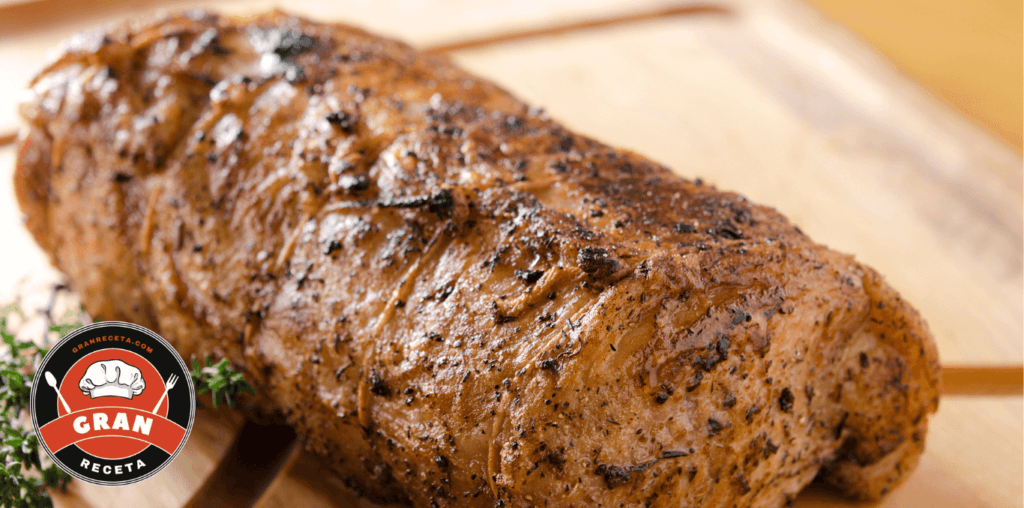
There is no thermometer in this recipe, no grate and no way to look at the 2.2 lb of beef while it cooks. A whole beef tenderloin goes into a cotton cloth packed with 2.2 lb of coarse salt, gets tied like a parcel and is laid straight on glowing coals, and the only instrument is a timer: 7 minutes a side for a center around 131 °F. Lomo al trapo is the most theatrical thing Colombians do at a cookout and the least forgiving, which is the trade you accept. Four servings, 45 minutes.
How do you cook lomo al trapo? Spread a ⅜-inch layer of coarse salt on a cotton cloth, roll the tenderloin up tightly and tie it. Put the roll straight on ash-covered coals for 7 minutes a side, crack the salt shell open, rest 5 minutes and slice into medallions. 45 minutes for 4 servings.
Why it does not come out salty
This is the first thing everyone asks when they see the pile of salt. The answer is what heat does to it: the innermost layers fuse against the meat into a solid shell, and from that point the salt behaves like a ceramic case rather than a cure.
The other half of the answer is time. Contact lasts 14 minutes, and salt needs far longer than that to migrate into a piece 3 inches thick. A salt-cured beef would sit for days; this one comes out of the cloth seasoned at the surface and barely salted at the center.
Doneness, read with a clock
Seven minutes a side over hot coals brings the center to about 131 °F, the red and juicy point this recipe aims at. Each extra minute adds roughly 5 °F, so 9 minutes a side gives medium and 11 gives well done.
The safety note matters here more than in most recipes, because there is no probing. According to the USDA FSIS, whole cuts of beef are safe at 145 °F with a 3-minute rest. A lomo al trapo served at 131 °F sits below that, like any steak served rare, and anyone who wants to meet the guideline simply adds 2 minutes a side.
What you need, and what ruins it
Two mistakes spoil the dish outright. Table salt pastes against the meat instead of fusing, and it does season it, thoroughly and unpleasantly; and synthetic cloth melts rather than charring, which puts plastic where your dinner is. Coarse sea salt and a plain cotton dish towel, washed without fabric softener, are the whole equipment list.
The fire matters just as much. This needs a bed of radiant coals under white ash, which means lump charcoal or hardwood, not a gas grill: there is nothing for the parcel to sit on and no radiant bed to cook it. Plan 25 minutes from lighting.
How the 45 minutes break down
Fourteen minutes of cooking, 25 of waiting for the fire, and about 5 of rolling. The rolling can happen while the coals burn down, so the hands-on work is minimal and the whole recipe is mostly patience before anything starts.
That is what makes it a party dish. The parcel can be rolled up to 2 hours ahead and kept in the fridge, so when people are standing around the fire all that is left is to lay it down, turn it once and crack the shell open in front of everyone, which is the part nobody wants to miss.
Choosing the cut
Ask for a center-cut tenderloin, about 2.2 lb, the even cylinder rather than the tapered tail. Even thickness is what makes a blind cooking method work: a piece that goes from 3 inches to 1 inch will be rare in the middle and grey at the end.
If your piece does taper, fold the thin end underneath and tie it in place so the parcel has one thickness. And bring the meat to room temperature for 30 minutes before it goes on, since a fridge-cold center will still be blue after 14 minutes.
Cloth, grate or oven
If you have grilled a tenderloin, the difference will be obvious in the slice. A grilled one has a browned, seasoned crust and a gradient from edge to center; this one has no browning at all and an almost even color from edge to edge, because it steams inside its own shell rather than drying on a grate.
An oven salt crust gets to a similar place with a thermometer and no risk, but also without the fire flavor and without the part where you smash a shell open with a mallet. Choose accordingly.
Who this recipe is for
- If you have no charcoal fire → this one cannot be done in a pan or a gas grill; an oven salt crust is a different recipe at 400 °F for 35 minutes
- If your piece is uneven → fold the thin end under and tie it, so the thickness is the same throughout
- If you want medium → 9 minutes a side; well done, 11
- If you are cooking for 8 → two 2.2 lb rolls rather than one of 4.4 lb, since a thicker piece cannot cook evenly in this time
- If you cannot find coarse sea salt → grill salt or coarse kosher salt work; table salt does not
What goes wrong
Laying it over flame. The cloth burns away in seconds and the beef chars without cooking.
Using fine salt. It forms a paste against the meat and genuinely salts it.
Rolling it loose. The salt shifts, parts of the surface have no shell, and juice escapes there.
Slicing immediately. Five minutes of rest is enough, but without them the juice ends up on the board.
A synthetic cloth. It melts instead of charring and leaves a plastic smell through all 14 minutes on the coals.
Variations
With herbs. Rosemary and thyme over the salt before rolling, aromatic without dominating.
With coarse pepper. Two tablespoons over the salt layer, which does show up on the surface of every medallion.
With mustard. A thin coat on the meat before the salt, a pitmaster habit that helps the shell grip.
With pork loin. The same method with pork, which needs 10 minutes a side for its thickness and for the 145 °F safe point.
What to serve with it
Sliced into medallions with chimichurri or a fresh hot sauce, about 6.7 oz a person. Alongside, Colombian patacones or salted potatoes, and a plain tomato and onion salad to cut the richness.
If the fire is going to burn all afternoon anyway, llanero beef is the 4-hour roast built for it and beef skewers are what you eat while it cooks. If the gathering runs long, Colombian cheese arepas cooked on the same coals make a good thing to eat while waiting, and something cold like Colombian rice pudding closes it. To drink, cold beer or Colombian aguapanela with lime, which is what gets drunk at a farm cookout.
Frequently asked questions
Doesn’t the beef come out salty? No. The salt fuses into a shell that seals the surface, and 14 minutes of contact is far too short for it to penetrate.
What kind of cloth? 100% cotton, clean, washed without fabric softener. Synthetic fabric melts and leaves a plastic smell.
Can I do it without live coals? No. It needs the radiant heat of a coal bed; in an oven you make a salt crust, which is a different recipe.
How long per side? Seven minutes for rare, 9 for medium and 11 for well done, with a 2.2 lb piece.
Can I prepare it ahead? The parcel, yes, up to 2 hours in the fridge. The cooking always happens at the last moment.
Nutrition
Per serving of about 6.7 oz of cooked beef, a quarter of the piece, calculated with the USDA database for beef tenderloin:
- Calories: 350 kcal
- Protein: 55 g
- Carbohydrates: 1 g
- Fat: 14 g, of which 5 g saturated
- Fiber: 0 g
- Sodium: 420 mg, estimated
This is the highest-protein serving on the site and one of the cleanest: according to the USDA, lean tenderloin carries 21.94 g of protein and 5.74 g of fat per 100 g raw, with no carbohydrate at all. The sodium figure is an estimate, since how much salt the meat takes depends on the thickness of the shell and the minutes of contact, and no published figure exists for this method.
The first time I saw a lomo al trapo I assumed it was a showman’s trick and that the meat would be inedible. Someone handed me the mallet and made me crack the shell myself in front of everyone, which is how I learned that the theater is part of the recipe. Now I make it when there are guests, and I always let somebody else swing. Josnaisis.