

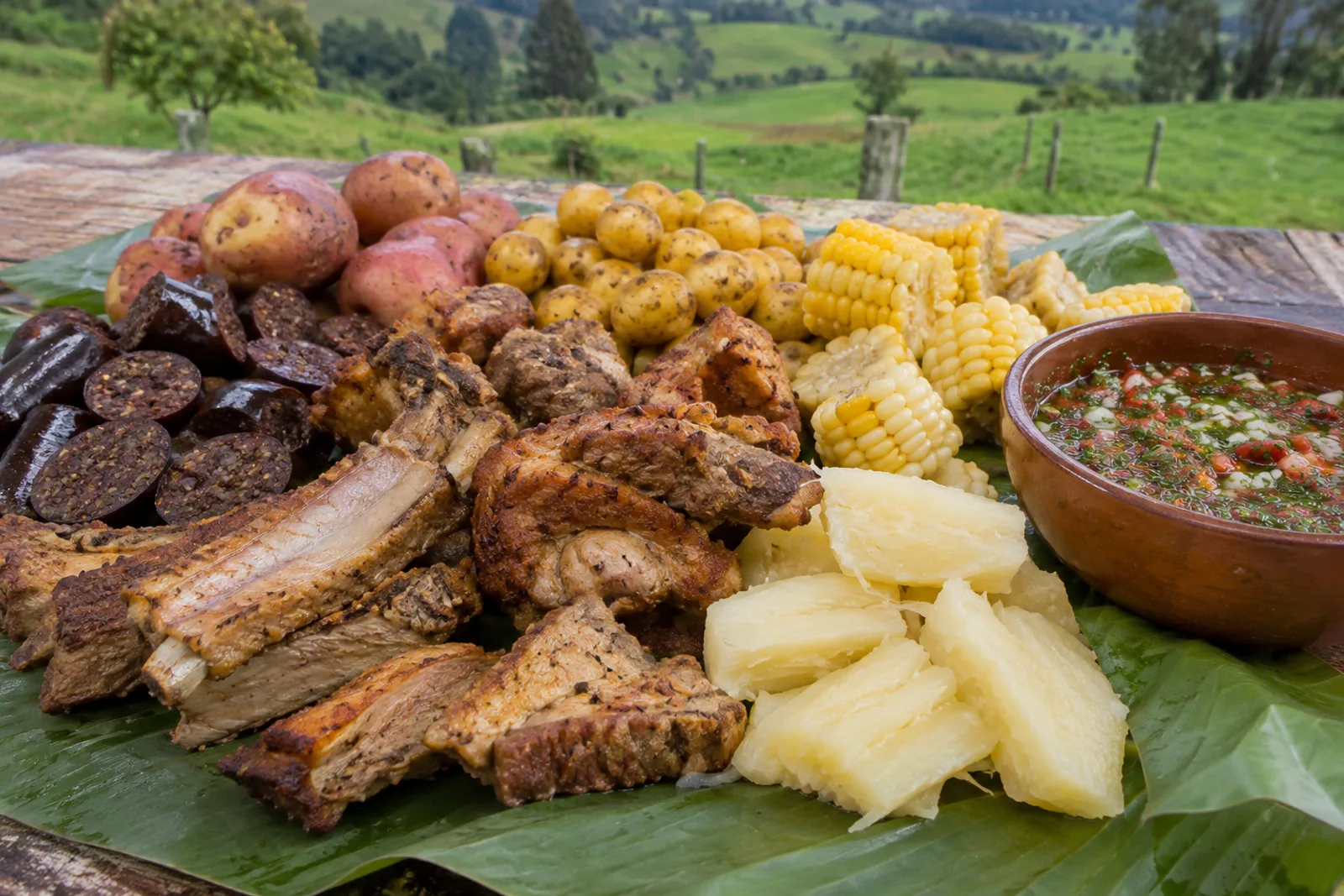

Piquete (pee-KEH-teh) is what families in Colombia’s Andean highlands, around Boyacá and the countryside north of Bogotá, cook for a day out by the river or a Sunday with the whole family: a hen and pork ribs simmered in a pot with scallions and garlic, then browned over coals, laid on banana leaves with sausages, salt-crusted potatoes, cassava, corn and roasted plantain, and eaten from the middle of the table, mostly by hand. Nothing in it is hard. The challenge is timing four cooking stations so the whole spread is hot at once, which is what this recipe is built around.
What is a Colombian piquete?
How do you make a Colombian piquete? Simmer a 3.3 lb (1.5 kg) stewing hen for about 90 minutes in 3.7 quarts (3.5 liters) of water with scallions and garlic, adding pork ribs for the last 60 minutes and cassava and corn for the last 30. Meanwhile boil small potatoes in heavily salted water until they wrinkle and roast ripe plantains at 400°F (200°C). Finish by browning the hen and ribs on the grill, cooking the fresh sausage to 160°F (71°C), heating the blood sausage and grilling a beef steak, then pile everything on banana leaves with ají. 140 minutes for 6 servings.
There’s no single fixed list. Around Villa de Leyva it’s hen boiled then browned over coals with beef, pork, potatoes, cassava, grilled corn, ají and guacamole; in some towns rabbit and sausages join in; in western Boyacá it can be air-dried beef with roasted cassava and plantain and salted potatoes. This version is the boiled-then-browned hen with sausages, salt-crusted potatoes, cassava, corn and plantain. It belongs to the food of Bogotá and Boyacá, and like the rest of that cooking it isn’t spicy: the heat is all in the salsa on the side.
How long and how hard. 140 minutes for 6, about 75 of them hands-on. Medium: no single step is tricky, but you’ll be running a big stockpot, a potato pot, the oven and the grill together.
Piquete, fritanga and picada aren’t the same plate
The names overlap from town to town and restaurant to restaurant, but broadly:
| Piquete | Fritanga | Picada | |
|---|---|---|---|
| Main meats | Hen, pork ribs, beef, fresh sausage, blood sausage | Pork ribs, beef, chorizo, blood sausage | Pork belly chicharrón, chorizo, blood sausage |
| How it’s cooked | Simmered, then grilled or roasted | Deep-fried in batches at 340°F (170°C) | Fried and cut into bite-size pieces |
| Starches | Salt-crusted potatoes, cassava, corn, plantain | Fried papa criolla and cassava | Fried potatoes, cassava, plantain, mini arepas |
| How you eat it | Big pieces on banana leaves, by hand | From a platter | With toothpicks |
In Bogotá, “piquete” is also what the city’s piqueteaderos call their fried platters, which are closer to a fritanga. And if you know the highland boiled dinner, the Colombian Andean tuber stew uses similar meats but is served in a bowl with its broth.
Ingredients and what to buy in the US and UK
Each person gets roughly 9½ oz (275 g) of cooked meat across the five kinds, plus potatoes, cassava, half an ear of corn and half a plantain.
| Ingredient | For 6 | US | UK | What changes |
|---|---|---|---|---|
| Stewing hen | 1.5 kg (3.3 lb) | “Stewing hen” or “fowl” at Asian and Latin markets | ”Boiling fowl” from a butcher | A regular chicken works but cooks in 30 to 35 minutes and falls apart if you give it the hen’s 90 |
| Fresh sausage | 300 g (10.5 oz) | Colombian longaniza at Latin markets, or plain fresh pork links | Cumberland sausage | Supermarket sausages are more peppery or herby; they grill the same way |
| Blood sausage | 300 g (10.5 oz) | Colombian or Puerto Rican morcilla, both made with rice | Spanish morcilla de Burgos, or black pudding | Black pudding is oat-based, firmer and more peppery |
| Papa criolla | 400 g (14 oz) | Frozen, in the Latin freezer aisle | Baby yellow potatoes | Fresh baby potatoes are less creamy |
| Small potatoes | 700 g (1½ lb) | Creamer or baby potatoes | Charlotte or new potatoes | None |
| Cassava | 500 g (1.1 lb) | Fresh or frozen peeled yuca | World food aisle or Afro-Caribbean grocers | Frozen goes straight into the pot |
| Corn | 3 ears | Sweet corn | Corn on the cob | Much sweeter and more tender: add it for the last 10 minutes only |
| Banana leaves | 2 or 3 | Frozen, Asian and Latin markets | Asian grocers | A big board lined with parchment works |
About the sausages. Colombian longaniza is a long coil of fresh pork sausage sold raw; the Boyacá town of Sutamarchán is known for it. The blood sausage, which highland Colombians call rellena, is pork blood with rice, peas and mint-like herbs, and it’s sold already cooked. There’s a recipe for making Colombian blood sausage at home if you’re curious, but nobody makes it just for a piquete.
Equipment. An 8-quart stockpot, a 5-quart pot, a charcoal grill or your oven with two sheet pans, long tongs and an instant-read thermometer, which is the only reliable way to know the sausage is done.
The game plan
The hen is the one thing you can’t hurry, so everything else starts when it has about 30 minutes to go.
Making it ahead
- Cook the hen and ribs the day before. Don’t chill the whole stockpot: divide the meat and broth into small, shallow containers so they cool fast, and refrigerate within 2 hours. On the day, reheat them in the broth at a gentle simmer, about 15 minutes, until the center reaches 165°F (74°C), and go straight to browning. That cuts the day-of work for 6 to about 75 minutes.
- The ají keeps up to 5 days in the fridge if it’s made with vinegar, about 2 if it’s lime only.
- The cassava can be boiled ahead and chilled; it browns well on the grill.
Make the potatoes and plantains on the day. Reheated, the potatoes lose their wrinkled skins.
Cooking it
One pot for the hen, ribs, cassava and corn
Start with cold water. When it boils, gray foam rises: skim it for 5 minutes, then turn the heat down until the surface barely shivers. A hard boil tightens the meat and clouds the broth.
The ribs go in 30 minutes after the hen. The hen is ready when the thigh gives easily and the meat comes off the bone without collapsing; an old bird can need another 15 minutes. Cassava and corn cook in the same broth for the last 30 minutes, until the cassava splits at the edges.
Salt-crusted potatoes
Little water and a lot of salt, 5 cups (1.2 liters) with 2 oz (60 g), just below the top of the potatoes. The papa criolla goes in 8 minutes after the boil because it cooks in 15 to 18 minutes and bursts if overdone. After 25 minutes, pour off what’s left and shake the pot over low heat for 2 to 3 minutes. The steam lifts off, the skins wrinkle and dry to a white film of salt, and the inside stays soft and barely salted. Anyone who’s had Canarian papas arrugadas will recognize the idea.
Browning on the grill, or in the oven
Meat straight out of the pot is wet, and wet meat steams instead of browning. Pat everything dry and brush it with oil.
- Fresh sausage first, because it’s raw: 20 to 25 minutes over medium heat, turning every 5. On high heat it splits and blackens before the center is cooked.
- Hen and ribs, 12 to 15 minutes, turning once. They’re already cooked; you only want golden skin and crisp edges.
- Blood sausage, the last 10 minutes, over medium heat. Turn it with tongs, never a fork, or it bursts.
- Beef, high heat, 4 to 5 minutes per side, then 3 minutes’ rest before slicing against the grain.
No grill? Use the oven at 400°F (200°C): plantains on the lower rack, the sausage on a second pan with 25 minutes to go, and the hen and ribs for the last 15. Do the blood sausage and beef in a cast-iron skillet or griddle.
The ají
Colombian ají is a loose, vinegary salsa of scallions, tomato, cilantro and hot chile, spooned over everything. Make a batch of Colombian ají picante, about 2 cups (500 ml) for 6. It’s the only heat on the table.
Safe temperatures for each meat
Five meats with five different targets, and color won’t tell you much. Push the thermometer into the thickest part:
- Hen or chicken, 165°F (74°C). If it came out of the pot tender, it’s well past that.
- Pork ribs and beef, 145°F (63°C) with a 3-minute rest. Ribs simmered an hour are far beyond it.
- Raw fresh sausage, 160°F (71°C). The one people get wrong. The color inside proves nothing; trust the thermometer.
- Blood sausage, 165°F (74°C) in the center. It’s already cooked, so you’re only reheating it.
On the table, anything out for more than 2 hours goes in the trash, or 1 hour if it’s above 90°F (32°C) outdoors. Keep what’s waiting in a low oven, above 140°F (60°C).
Feeding 12 or 20
The amounts scale straight up. Your kitchen doesn’t, so the plan changes: more pots, more grill batches, and from 12 people the hens get cooked the day before.
- For 12, two hens in two 8-quart pots or one 16-quart. With the hens cooked ahead, start 1 hour 30 minutes before eating.
- For 20, three 3¾ lb (1.7 kg) hens in two 15-quart pots, and the potatoes in two pots, because one crowded pot won’t dry them. Grill in three batches: all the sausage, then the hens and ribs, then the blood sausage and beef. One person at the grill, another cutting and plating.
- Holding. Whatever finishes first waits in the oven at 200°F (90°C), loosely covered with foil.
What goes wrong, and the fix
- Wet meat on the grill. It steams and stays pale. Pat dry, brush with oil.
- Sausage on high heat. Charred outside, raw inside. Medium heat, 20 to 25 minutes, thermometer.
- Forking the blood sausage. It splits and crumbles. Tongs only.
- Boiling the hen hard. The meat seizes up and toughens. Bare simmer only.
- A supermarket chicken on the hen’s timing. It falls apart when you brown it. Give it 30 to 35 minutes.
- Too much water with the potatoes. The salt is diluted and the skins never wrinkle.
- Starting everything at once. The potatoes and cassava sit and cool while the hen finishes.
Heat, kids and allergens. Nothing on the platter is spicy unless you add ají, and kids usually go straight for the potatoes and plantain. There’s no dairy or gluten in the dish itself, but some commercial sausages and blood sausages contain flour or bread, so check the labels if anyone is avoiding gluten.
Variations
- Pressure cooker. Hen and ribs together, 30 minutes at full pressure. It saves an hour, but the hen is softer and needs gentler handling on the grill.
- Free-range chicken instead of hen. The easiest swap. The ribs go in first, since they still need their full hour, and the chicken 15 to 20 minutes later for its 40 to 45, so both come out together. Take the chicken to 165°F (74°C) in the thigh.
- Hen only. Boiled and browned hen with potatoes, cassava and plantain, no sausages. Some towns near Bogotá serve exactly that.
- With arepas. In some towns a corn arepa is part of the piquete. Boyacá-style arepas stuffed with fresh cheese can go on the same grill.
- With a cheese sauce. If your crowd wants something on the potatoes, make papas chorreadas with tomato and cheese sauce with the papa criolla instead of salting it.
Keeping the cost down. The hen and the sheer amount of meat are what make it expensive. A chicken instead of a hen, plus an extra potato and half an ear of corn per person, keeps the table full for a lot less.
Serving and leftovers
Put it in the middle and let everyone dig in. Cold beer, lemonade, or refajo, beer mixed with a sweet soda, is what usually goes with it. Keep the broth: 3.7 quarts of hen stock is tomorrow’s soup.
- Fridge. Meats, potatoes and cassava in sealed containers within 2 hours, for 3 to 4 days. Cooked blood sausage, 4 days.
- Freezer. Cooked meats and the broth, 2 to 3 months. Not the potatoes, cassava or plantain, which turn watery when thawed.
- Reheating. Meats covered with foil and a splash of broth in a 350°F (180°C) oven, about 15 minutes, to 165°F (74°C). Potatoes and blood sausage in a skillet over medium heat, 3 to 5 minutes per side. The microwave softens the hen’s skin and dries out the blood sausage.
Piquete FAQ
Is piquete the same as bandeja paisa? No. Bandeja paisa is one person’s plate from the Medellín region, with beans, rice, ground beef and a fried egg. Piquete is a shared spread with no rice or beans.
Can I make it without banana leaves? Yes. The leaves are mostly about presentation and easy cleanup; a large board or sheet pan lined with parchment does the job.
What can I use instead of a stewing hen? A free-range or heritage chicken is closest. A regular supermarket chicken works too if you cut the simmer to 30 to 35 minutes.
How many potatoes per person? About 6.5 oz (185 g), three or four small ones. They disappear first, so make extra.
Nutrition per serving
Per serving, without ají, avocado or drinks, worked out ingredient by ingredient from the amounts above:
- Calories: 1340 kcal
- Protein: 73 g
- Carbohydrates: 114 g
- Fat: 67 g, including 23 g saturated
- Fiber: 8 g
- Sugars: 27 g
The meats and sausages account for about 870 kcal and the potatoes, cassava, corn and plantain for about 470. Sodium depends mainly on how much salt clings to the potatoes and on the sausages you buy, so I don’t give a figure. It’s a feast for sharing, not a weeknight dinner.
When I cook a piquete for a big group, the thing that helps most is cooking the hen the day before. The next day the stock is already made and all that’s left is browning, cutting and laying out the leaves, which means I get to sit down and eat with everyone instead of standing by the grill the whole afternoon. Josnaisis.