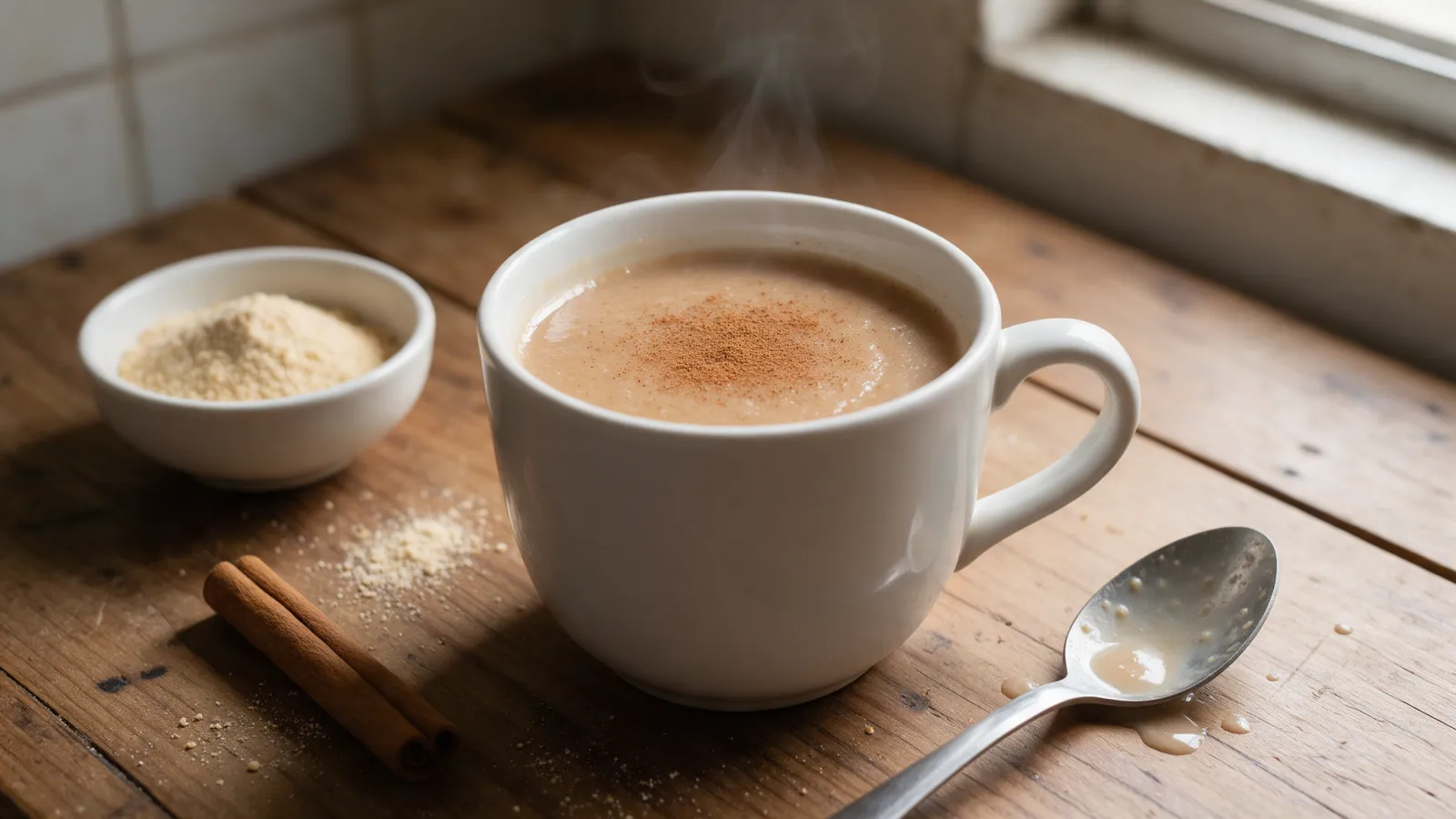

Fororo (foh-ROH-roh) is two things in Venezuela: a flour made from dried corn kernels toasted in a dry pan and ground, and the hot, thick breakfast drink made by cooking that flour in milk with cane sugar and cinnamon. If you know Mexican atole, the difference is the toast. Atole uses limed masa that is never toasted, so it tastes of tortilla; fororo tastes of popcorn and toasted bread. That same toasting means it thickens less per gram, so it takes more flour than atole does.
How do you make Venezuelan fororo?
How do you make fororo? Whisk 80 g (⅔ cup) of fororo into 250 ml (1 cup) of cold milk until smooth, add 750 ml (3 cups) more milk, grated papelón, a cinnamon stick and a pinch of salt, and whisk over medium heat until it boils. Simmer gently for 8 to 10 minutes, scraping the bottom, until it coats a spoon. Ready in 20 minutes for 4 servings.
That’s the whole method once you have the flour. The rest of this page covers where to get the flour outside Venezuela (or how to make it from dried corn), how much to use, what each milk and sweetener changes, and why it sometimes goes lumpy.
Is fororo worth making, and who is it for?
Yes, if you like oatmeal or atole and want something that tastes of corn rather than grain. Four cups take 20 minutes, and the only part that needs your full attention is the whisking at the start. A cup comes to about 286 kcal, so it works as breakfast, not as a side drink.
It suits a cold morning, a kids’ snack after school, or a light supper. It’s not for anyone after a thin or chilled drink: fororo is served hot and has body. And making the flour from scratch is a project, 75 minutes from kernel to flour, 30 of them stirring a skillet. My advice is to make a jar on a weekend and use it for weeks.
Difficulty: easy. There is one rule (cold milk first) and if you follow it, the first batch works.
What fororo is made of, and what to buy in the US and UK
Fororo flour is just dried whole corn, toasted until golden and ground. Nothing is added. In Venezuela it comes in bags; the La Lucha brand sells for $7.99 per 900 g (2 lb) at Venefood USA, an online Venezuelan grocery in the US.
The closest substitute, pinole
Pinole is Mexico’s and Central America’s toasted ground corn, the same idea under a different name, and the easiest swap in the US. Look for plain pinole at Mexican grocers or online; if it comes pre-mixed with sugar and cinnamon, cut the papelón in this recipe by half and taste.
In Spain and the Canary Islands, gofio de millo (toasted ground corn) does the same job. In the UK, look for either one online from Latin American or Spanish food sellers.
What does not work: masa harina or cornstarch will thicken the milk, but the result is atole, not fororo. Precooked arepa flour (Harina P.A.N.) is already cooked and doesn’t taste toasted either.
Making the flour from dried corn
You need dried whole field corn (dent corn, sold as maíz seco or maíz entero in Latin stores), not popcorn: popcorn kernels pop in the skillet. If popcorn is all you have, pop it, cool it and grind it, which is how some pinole recipes do it; the flavor is lighter.
- Toast, 25 to 35 minutes. 250 g (9 oz) of kernels in a heavy skillet or cast-iron pan, no oil, over medium heat, stirring constantly with a wooden spatula. The corn turns from yellow to an even toasted gold, smells like popcorn, and some kernels crackle and split without opening. Pick out any that go black; they make the whole batch bitter.
- Cool, 30 minutes. Spread on a tray. Hot corn gums up the grinder and can burn your hands.
- Grind twice and sift, 15 minutes. A first pass to crack the kernels, a second to make flour, in a hand mill, a spice or coffee grinder, or a high-powered blender in small batches. Sift and regrind the coarse bits. A standard blender leaves a sandy flour that never fully dissolves.
My 250 g (9 oz) of kernels gives me about three batches of the drink; some weight goes in the moisture the corn loses and in the coarse bits I sift out.
Papelón, piloncillo or sugar
Papelón is Venezuelan unrefined cane sugar, the same product as Colombian panela and Mexican piloncillo; you’ll find piloncillo cones at Mexican grocers and panela in Latin aisles. Grate it finely so it melts in the time the drink cooks. Swap in ¼ cup (50 g) of white sugar and the drink tastes more of corn and less of molasses. Light brown sugar is closer in flavor: use the same 60 g (2 oz).
The ratio, 80 g of flour per liter of milk
Published recipes range from roughly 30 to 122 g of fororo per liter (1 to 4.1 oz per quart), which is why some come out thin and others nearly spoonable. One cup of flour per liter sets almost like pudding once it cools. I settle on 80 g per liter (2.7 oz per quart): it coats a spoon while hot and is still drinkable when it cools a bit.
No scale? Measure ⅔ cup, or about 10½ level tablespoons; a cup of cornmeal weighs 122 g, so each spoonful is roughly 7.6 g.
Cooking for 4, 12 or 20
- 4 cups → 1 liter (4¼ cups) milk, 80 g (⅔ cup) fororo, 60 g (2 oz) papelón, 1 cinnamon stick.
- 12 cups → 3 liters (12⅔ cups) milk, 240 g (2 cups) fororo, 180 g (6⅓ oz) papelón, 2 sticks.
- 20 cups → 5 liters (5¼ quarts) milk, 400 g (3¼ cups) fororo, 300 g (10½ oz) papelón, 3 sticks.
For a crowd, use a 6 to 8 liter (6 to 8 quart) pot and dissolve the flour in a quarter of the cold milk. A big pot is slow to boil. With 5 liters I wait 15 to 20 minutes, and the simmer afterward takes about the same 10 minutes as a small batch.
What goes wrong, and how to fix it
- Lumps → the flour met hot milk, or wasn’t whisked long enough cold. Strain it, or give it 30 seconds with an immersion blender.
- Scorched bottom → heat too high or not enough scraping. Low heat for the simmer and a wooden spoon across the bottom every minute. If it catches, pour it into a clean pan without scraping.
- Gritty → coarse homemade flour. Sift it, or simmer 3 to 4 minutes longer so the corn hydrates.
- Too thin → whisk 1 to 2 tablespoons more fororo into a little cold milk and stir it into the boiling pot.
- Pudding in the cup → it was taken off too thick. Pull it a little early.
- Bitter → burnt kernels in homemade flour. If the flour smells burnt, start over.
Dairy-free, lighter and kid-friendly versions
- Lactose-free milk → same amounts. It tastes a little sweeter because the lactose is already split into sweeter sugars, so drop the papelón by 10 g (⅓ oz).
- Unsweetened soy milk → in my kitchen it thickens about the same as dairy, and it makes the drink vegan.
- Oat milk → thickens more for me; add about 100 ml (⅓ cup plus 1 tbsp) of extra liquid.
- Half milk, half water → about 208 kcal a cup instead of 286, and less creamy.
- Less sweet → with 30 g (1 oz) of papelón, the sugar per cup drops from 28 g to about 20 g.
For kids, serve it warm rather than straight off the stove; a thick drink holds heat longer than milk does. I halve the papelón for small children.
For babies, two clear rules put this recipe off the table: no cow’s milk as a drink before 12 months, and no added sugars before age 2. Fororo cooked in water without sweetener is essentially a corn cereal; ask your pediatrician before offering it.
Allergens: milk. Corn is gluten-free, but some home recipes use the word fororo for toasted wheat, and commercial flours can carry traces, so for anyone with celiac disease buy corn fororo and read the label. Heat level 0 of 5.
How it compares with other drinks on this site
Fororo sits in the same family as Latin American cereal drinks, and the differences are bigger than they look:
- Champurrado is atole with Mexican chocolate, at 49 g of masa harina per liter; chocolate comes first.
- Venezuelan chicha is cooked rice blended with milk and condensed milk, served over ice.
- Colombian mazamorra is whole hulled corn soaked overnight and cooked for 2 hours, eaten cold with milk and panela on the side.
- The Colombian cold oat drink is blended oats, served very cold, 10 minutes for 4 glasses.
What it costs
At US prices, 4 cups come to about $2.17, or $0.54 a cup: 1 liter of whole milk at $1.12 (US average for August 2026, $4.229 a gallon), 80 g of La Lucha fororo at $0.71, and 60 g of piloncillo at $0.34 ($1.28 for 8 oz at H-E-B). With white sugar instead, $1.94 a pot.
Milk is more than half the cost. The flour is only expensive when it’s imported; toasted at home it costs what the dried corn does.
Serving, make-ahead and storage
Serve hot in mugs, with a dusting of ground cinnamon if you like, alongside bread, cookies or toast. For a Venezuelan weekend breakfast, it goes well next to cachapas or cheese arepas; for a cold drink with the same papelón, there’s papelón con limón.
Make ahead. The flour, weeks ahead. The drink, the night before: it sets almost like custard in the fridge and loosens with milk as it reheats.
Fridge. The usual rules for leftovers apply: no more than 2 hours at room temperature, then 3 to 4 days at 40°F (4°C) or below, covered.
Freezer. I don’t freeze it; the starch weeps water when it thaws and the texture breaks.
Reheating. Add 2 to 3 tablespoons of milk per cup and warm over low heat, whisking, to 165°F (74°C), or microwave in 30-second bursts, stirring in between.
The flour. Store-bought cornmeal keeps about 12 months in a tightly covered container in the cupboard, and much longer frozen. I keep homemade fororo in an airtight jar and use it within a month or two, since whole corn keeps its germ and loses aroma over time.
Frequently asked questions
What is fororo? Toasted, ground dried corn, and the hot drink Venezuelans make by cooking it in milk with cane sugar and cinnamon.
What does fororo taste like? Toasted corn, close to popcorn, softened by milk and cinnamon, with a molasses note from the papelón. The texture is thick and silky.
Is fororo the same as atole? No. Atole is made from nixtamalized masa that isn’t toasted and tastes of tortilla. Fororo is toasted, unnixtamalized corn.
Can I use pinole instead of fororo? Yes. Pinole is toasted ground corn too; if it’s pre-sweetened, halve the sugar.
How much fororo per cup of milk? About 20 g (2½ level tablespoons) per 250 ml (1 cup), which is 80 g per liter.
Why is my fororo lumpy? The flour hit hot milk. Always whisk it into cold milk first; strain or blend a lumpy batch.
Can I make it with water? Yes, though it’s thin and loses its creaminess. Half water and half milk is a good middle ground at about 208 kcal a cup.
How long does fororo keep? 3 to 4 days in the fridge at 40°F (4°C) or below. Reheat with a splash of milk to 165°F (74°C).
Nutrition
Per cup (about 250 ml, one of 4), calculated from this recipe’s amounts, using whole-grain yellow cornmeal for the fororo and brown sugar for the papelón:
- Calories: 286 kcal
- Protein: 10 g
- Carbohydrates: 42 g
- Sugars: 28 g (15 g from papelón, 13 g from the milk’s lactose)
- Fat: 9 g, of which 5 g saturated
- Fiber: 1 g
- Sodium: 170 mg
Fororo came to my house in Venezuela in a bag, and I never wondered how it was made until I lived in Colombia without one. My first homemade batch went through a regular blender and came out sandy; now I toast the corn in a heavy pot on a Saturday and grind it in my arepa corn mill. A jar of it lasts the month. Josnaisis.