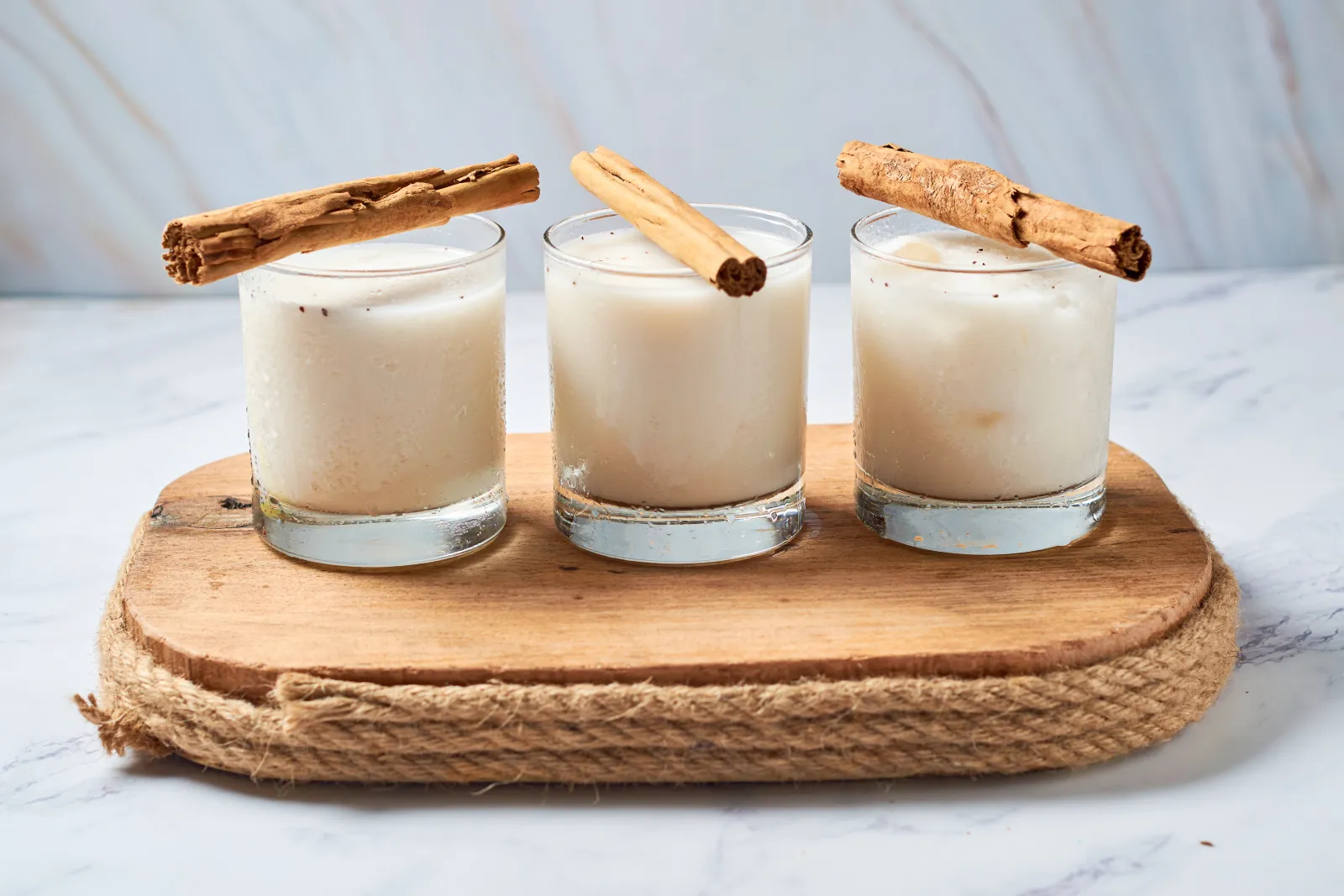

Horchata (or-CHAH-tah) is the milky, cinnamon-scented drink that comes in a big glass barrel at taquerías and Mexican juice stands, and the surprise for most people is that the version in the US and Mexico usually has no milk in it at all. It’s raw rice soaked overnight, blended with water and a stick of cinnamon, strained and sweetened. The texture you love is rice starch suspended in water. Get the ratio right, 100 g (½ cup) of rice per liter of finished drink, and the rest is patience and a good strainer.
What is Mexican horchata, and how is it different from Spanish horchata?
How do you make Mexican horchata? Soak 200 g (1 cup) of long-grain rice with a cinnamon stick in 1 liter (about 4¼ cups) of cold water in the fridge for 8 to 12 hours. Blend in two batches, strain twice, the second time through cloth, then add another liter of water or water and milk, 150 g (¾ cup) of sugar and vanilla. 20 minutes of work, 500 minutes in total for 8 servings of 8 oz (250 ml).
Mexican horchata belongs to the aguas frescas, the sweet cold drinks made from fruit, flowers, seeds or grains that sit next to each other in big jars. Rice horchata is the creamy one of the set.
If you’ve had horchata in Spain, that’s a different drink. Spanish horchata is made from tiger nuts, the small tubers of Cyperus esculentus, and Spanish law (Royal Decree 1338/1988) defines it and lets it be sold simply as “horchata”. It must reach at least 12% soluble solids and is kept at 36°F (2°C) or below at the factory. The Mexican drink shares the name and the milky look, nothing else.
Is it worth making? Yes. A batch costs under a dollar, there’s no cooking, and homemade tastes of real cinnamon instead of syrup. The catch is time: it needs an overnight soak, so it’s a plan-ahead drink, not a five-minute one. Difficulty is easy; the only skill is blending and straining well.
The ratio, the rice and the cinnamon
For 8 glasses you need 200 g (1 cup) of rice, one 5 g cinnamon stick, 2 liters (about 2 quarts) of water used in two stages and 150 g (¾ cup) of sugar. The first liter soaks and blends the rice, and what comes through the cloth is a base at double strength; the second liter brings it to drinking strength. Use more water per gram of rice and it turns thin and see-through; use less and it drinks like a porridge.
Substitutions for a US or UK kitchen
| Ingredient | Best choice | Swap | What changes |
|---|---|---|---|
| Rice | US long-grain white, or UK basmati or long-grain | Brown rice | Nuttier, beige, needs a 12-hour soak |
| Cinnamon | Ceylon stick (“canela”, “true cinnamon”) | Cassia stick, the hard single-layer kind | Spicier and harsher, use half a stick |
| Sugar | Granulated sugar | Piloncillo, dark brown sugar or maple syrup | Darker color, caramel notes |
| Milk (optional) | Whole milk | Oat milk, almond milk, coconut milk | Oat stays neutral, coconut adds fat and flavor |
| Cheesecloth | Nut-milk bag | Clean thin cotton tea towel | Works the same if you squeeze it hard |
Mexico buys its stick cinnamon almost entirely from Sri Lanka: Data México, from the Mexican Ministry of Economy, puts 2024 imports of whole cinnamon from Sri Lanka at $71.5 million, against $204,000 from Vietnam. That’s the soft, papery, many-layered stick. In the US look for “canela” in the Hispanic aisle or “Ceylon” on the spice-jar label; in the UK, Ceylon sticks are sold in supermarkets and Asian grocers.
Short-grain or sushi rice makes my horchata slightly slimy, so I stick to long-grain.
How to plan it, from overnight soak to pitcher
Twenty minutes of work, eight hours of fridge. I rinse the rice after dinner, put it to soak, and blend in the morning.
How long to soak the rice. At least 8 hours, up to 12, in the fridge. Under 6 hours the grain is still hard in the middle and the blender chips it instead of grinding it. With a high-speed blender, 4 hours in the fridge gives a decent result.
How to tell each stage is right. After soaking, a grain snaps under your thumbnail and is chalky white all through. After blending, a drop rubbed between finger and thumb feels smooth. The strained base looks like skim milk and leaves a thin film on a spoon.
Without a blender. An immersion blender in a tall jug works in small batches, 4 minutes each, with three passes through the sieve. Expect a little sediment at the bottom of the glass.
Why horchata turns gritty, and the fix
The sandy feel is pieces of rice the blade never ground. In order of importance: a full soak, blending with only half the water at a time so the rice rubs against the blade instead of spinning loose, and a second strain through cloth, squeezed until the pulp inside is almost dry.
Is horchata safe to keep? Storage, fridge life and soaked rice
Keep it cold and drink it within 48 hours. That’s my rule, not an official number: no US agency publishes a shelf life for homemade rice horchata, and published recipes range from 24 hours to a week. Here’s why I stay at the short end. The CDC describes Bacillus cereus as “frequently present in uncooked rice”, with spores that survive cooking. The University of Florida’s IFAS extension, citing the FDA, says its vomiting toxin forms at 77-86°F (25-30°C) and stays stable up to 250°F (121°C), so boiling would not undo it. Horchata is never cooked at all.
- Soak in the fridge, never on the counter overnight, especially in a warm kitchen.
- Two hours out of the fridge at most, one hour above 90°F (32°C), according to USDA FSIS, whose danger zone runs from 40 to 140°F (4-60°C). At a party, refill a small pitcher from a big one kept cold.
- If it smells sour or fizzes, throw it out. That’s fermentation.
- Settling is normal. The starch sinks; stir before pouring.
- Freezing. Freeze the sweetened concentrate in ice-cube trays and use the cubes instead of ice. Mine separates when thawed, so I give it 10 seconds in the blender.
Which horchata to make, dairy-free, creamy, almond or coconut
- Dairy-free and vegan → the base recipe as written: rice, water, cinnamon, sugar.
- Creamy → swap 500 ml (2 cups) of the diluting water for whole milk or oat milk.
- Taquería-sweet → swap the sugar and the second liter of water for 1 can of sweetened condensed milk (14 oz, 397 g) and 1 can of evaporated milk (12-13 oz) plus 300 ml (1¼ cups) water. It comes out very sweet: about 315 kcal a glass instead of 167.
- With almonds → add 50 g (⅓ cup) of blanched almonds to the soak and blend them with the rice. More body, a marzipan edge.
- With coconut → 200 ml (¾ cup + 1 tbsp) of canned coconut milk instead of the same amount of diluting water.
- Less sweet → 100 g (½ cup) of sugar, about 143 kcal a glass.
- Dirty horchata → a shot of cold brew or espresso poured over a glass.
Horchata concentrate
The strained base is already double strength. Sweeten it, bottle it, refrigerate it, and mix 1 part base to 1 part cold water when you pour. It takes half the fridge space and gives you a glass in a minute.
How much horchata for a party
I count 2 cups (500 ml) per guest for an afternoon with another drink on the table, and 3 cups (750 ml) if horchata is the only one.
| Guests | Finished horchata | Rice | Cinnamon | Sugar | Soaking + diluting water |
|---|---|---|---|---|---|
| 4-6 | 2-3 liters (2-3 quarts) | 200-300 g (1-1½ cups) | 5-8 g | 150-225 g (¾-1⅛ cups) | 1 + 1 L to 1.5 + 1.5 L |
| 12 | 6 liters (1½ gallons) | 600 g (3 cups) | 15 g | 450 g (2¼ cups) | 3 + 3 L |
| 20 | 10 liters (2½ gallons) | 1 kg (5 cups) | 25 g | 750 g (3¾ cups) | 5 + 5 L |
Scaling changes nothing except the blending, which you do in 500 ml (2-cup) batches. Make the concentrate the day before and dilute into the pitcher as it empties.
What it costs to make horchata
At US city average prices from the Bureau of Labor Statistics for August 2026, a water-only batch costs about 83 cents, roughly 10 cents a glass.
What makes it pricier is what the BLS doesn’t track: the cinnamon stick, almonds if you use them, and the condensed-plus-evaporated-milk version, which costs several times the base.
What to serve with horchata
It’s the drink for chili heat, poured into a tall 12 oz (350 ml) glass packed with ice: cold, sweet and starchy against tacos al pastor or a bowl of pozole rojo. On a drinks table it pairs with agua de jamaica, the tart hibiscus agua fresca, which balances its sweetness.
If you like the cinnamon here, café de olla uses the same stick with piloncillo, and champurrado is the hot, thick chocolate cousin made with masa. From Colombia, the cold oat drink is the closest relative, and Colombian rice pudding takes the same rice, cinnamon and sugar and cooks them.
Horchata questions
Is horchata dairy-free? The base is: rice, water, cinnamon and sugar. Milk and condensed milk are add-ins, so check before you order at a stand.
Why is my horchata gritty? Short soak or too much water in the blender. Soak 8 hours, blend in two batches with half the water each, and strain through cloth.
How long does horchata last in the fridge? I drink mine within 48 hours, kept below 40°F (4°C), and never leave the pitcher out more than 2 hours.
Can I use rice flour instead of soaking rice? It’s quicker, but every time I’ve tried it the drink came out chalky and flat on cinnamon. I don’t recommend it.
Can I make horchata with brown rice? Yes, with a 12-hour soak. It tastes nuttier and the color is beige.
Does horchata have caffeine? No, unless you make it “dirty” with coffee.
How is Mexican horchata different from Spanish horchata? Mexican is rice and cinnamon; Spanish is tiger nuts, and under Spanish law it’s the drink called simply “horchata”.
Nutrition per glass
Per 8 oz (250 ml) glass of the base recipe, from USDA FoodData Central (SR Legacy) using this recipe’s amounts and counting all the rice as if it ended up in the glass; the pulp left in the cloth lowers the carbs a little:
- Calories: 167 kcal
- Protein: 2 g
- Carbohydrates: 39 g
- Sugars: 19 g (almost all added)
- Fat: 0 g (0.2 g)
- Sodium: 2 mg
For comparison, USDA lists restaurant horchata at 54 kcal per 100 g, about 138 kcal a glass, with more sugar and less starch than this one. The sugar is 73 of the 167 kcal.
Growing up in Venezuela, my rice drink was Venezuelan chicha, made with cooked rice and milk and thick as a custard. Horchata surprised me because it does the opposite, raw rice and water, and still drinks silky. Now the rice goes into the fridge on Friday night, and on Saturday the pitcher lasts until the afternoon. Josnaisis.