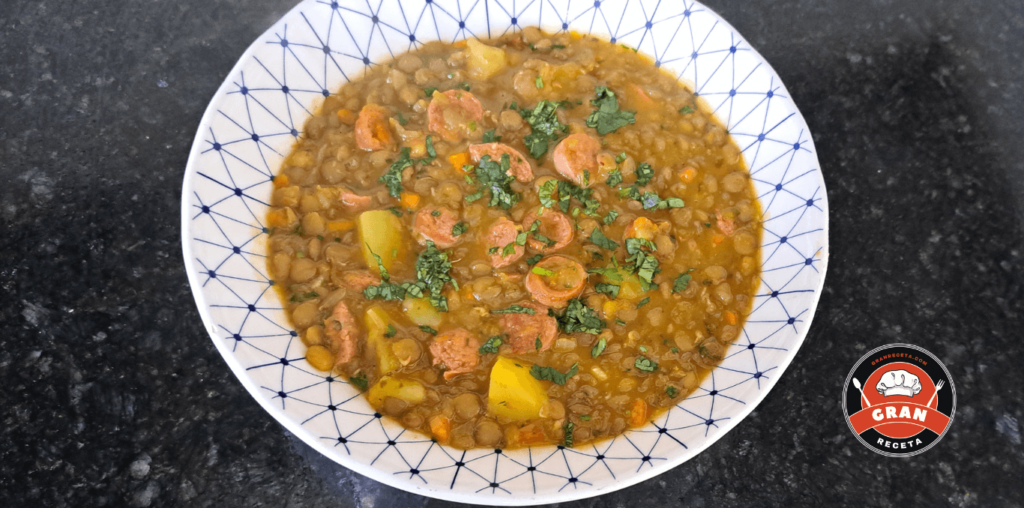

Hold the tomato back until minute 55 and the lentils cook in half the time: what toughens them is acid, not salt. Acid reinforces the pectin holding the cell walls together, and a pot of lentils cooked with tomato from the start can take nearly twice as long and still end up with tough skins. Held back until the lentils are tender, the same tomato does no harm at all. Six bowls at 445 calories, ready in a little over an hour.
How do you make lentils with chorizo? Cook onion, garlic and pepper for 10 minutes, add 2 cups of unsoaked lentils and 6 cups of water and simmer 30 minutes. Add potato and carrot at the forty-minute mark, then the tomato, the separately browned chorizo and the salt a quarter of an hour later. Finish uncovered until it thickens. 6 servings, 70 minutes.
Salt is not the culprit
The rule that salt toughens pulses is the most repeated piece of kitchen advice there is, and it does not hold up. Sodium displaces the calcium and magnesium that stiffen the cell wall, so lentils salted from the start soften just as fast or slightly faster, and they taste seasoned all the way through rather than only on the outside.
Acid is the real problem. Tomato, vinegar and lemon all reinforce the pectin that glues the cells together, and with tomato in from the beginning the lentils can want 55 minutes or more and still come out with separated skins and a mealy middle.
Hence the single change of order here: sofrito without tomato at the start, tomato at minute 55. You notice it in the skins, which stay whole and give under the tooth instead of staying between them.
Which lentil, and why no soaking
Brown lentils — pardina in Spain, the standard brown lentil in a US or UK supermarket — hold up best here, whole and firm after 70 minutes. Green or French lentils work too, with a thicker skin. Beluga lentils stay very intact. Red lentils do not: they have no skin, collapse in 15 minutes and make soup, which is a different dish.
No recent-harvest lentil needs soaking. They are far smaller than a bean or a chickpea and hydrate during cooking itself, in about 30 minutes from dry.
If they are still hard after 45 minutes, it is neither the heat nor the water: the lentils are old. Skins dehydrate over months on a shelf and turn effectively waterproof, and no amount of soaking brings them back.
Protein per 100 g, and why this is a weeknight staple
Dry lentils carry 24.6 g of protein per 100 g according to the USDA, more than raw chicken thigh, and they cost a fraction of it. They do take up around three times their weight in water, so the cooked bowl lands at 23 g of protein with 10 g of fibre.
That is the whole reason this dish exists in so many Colombian kitchens on a Tuesday: it is the cheapest full plate of protein on the stove, and it improves the next day.
Why the chorizo is browned separately
Colombian chorizo is fresh, not cured — ground pork with garlic, cumin and annatto, sold raw, and the USDA puts it at 25 g of fat per 100 g. Dropped into the pot at the start it gives up all its fat to the broth, swells and turns pale and soft.
Browned separately in a dry pan for eight minutes, it colours outside, sheds the excess fat where you can pour it away, and joins the stew at the end with its texture intact. The stew tastes the same and carries noticeably less fat.
If you can only find cured Spanish chorizo, it will work, but it is a different dish: it stains the stew red and brings smoked paprika with it. Mexican fresh chorizo is the closer substitute.
Where the 70 minutes go
Ten minutes of sofrito, half an hour of lentils on their own, then two stretches of a quarter of an hour: potato and carrot first, tomato and chorizo after. Browning the chorizo fits inside the second stretch, so it costs no extra time.
Make it ahead
Lentils are better on day two: the starch they release keeps thickening as they cool and the flavours settle. They keep four days refrigerated and freeze for a full season, though the potato goes a little softer on thawing. Reheat with a splash of water, since the stew tightens considerably in the fridge.
What goes wrong
Tomato at the start. The acid toughens the skins and nearly doubles the cooking time.
Soaking them just in case. Unnecessary, and they break up more in the pot.
Adding the chorizo raw. It gives up its fat to the broth and comes out pale.
Covering the last 15 minutes. The stew will not thicken; that stretch goes uncovered.
Old lentils. Past a year on the shelf, nothing softens them.
Variations
With pork ribs. Seven ounces in from the start, for a denser broth.
Over rice. Ladled over Colombian white rice, the weekday version.
Vegetarian. No chorizo, 1 tsp of smoked paprika instead, and 100 calories less.
With ripe plantain. Two ounces in cubes in the last 10 minutes, for a sweet edge.
What to serve with it
A deep bowl with Colombian white rice alongside and sliced avocado is the Colombian weekday lunch. A serving is about 10 oz, and with the rice it needs nothing else.
For the other great legume of this kitchen, the beans in a bandeja paisa are cooked with ripe plantain, and Venezuelan black beans play the same sweet-savoury game. For something heavier the same day, Colombian arroz atollado puts meat and rice in one pot.
Frequently asked questions
Do lentils need soaking? No. They cook in 30 minutes from dry; soaking only matters for old lentils, and it does not save those either.
Does salt make lentils tough? No. Sodium softens the cell wall; what toughens them is acid, from tomato or vinegar.
Why did mine stay hard? Either tomato went in early or the lentils are old. Neither is fixed by more time.
Can I freeze it? Yes, 3 months. The potato is a little softer after thawing.
Which chorizo should I buy? Fresh Colombian or Mexican, browned separately. Cured Spanish chorizo works but changes the dish.
Nutrition
Per bowl, one sixth of the pot, calculated from each ingredient according to the USDA SR Legacy database:
- Calories: 445 kcal
- Protein: 23 g
- Carbohydrates: 58 g
- Fat: 14 g, 4 g of it saturated
- Fibre: 10 g
- Sodium: 690 mg
This is the best protein-per-dollar plate on the site: 23 g a bowl, 16 of which come from the lentils. Leave out the chorizo and each bowl lands near 345 calories with a third of the fat, and the protein only falls to 18 g.
The lentils at my mother’s house in Venezuela always took forever, and she blamed the salt and added it at the end. Years later, cooking a pot that kept the tomato out until the end, I realised the culprit had been sitting in the sofrito the whole time. Josnaisis.